
American Mistletoe (Phoradendron leucarpum)
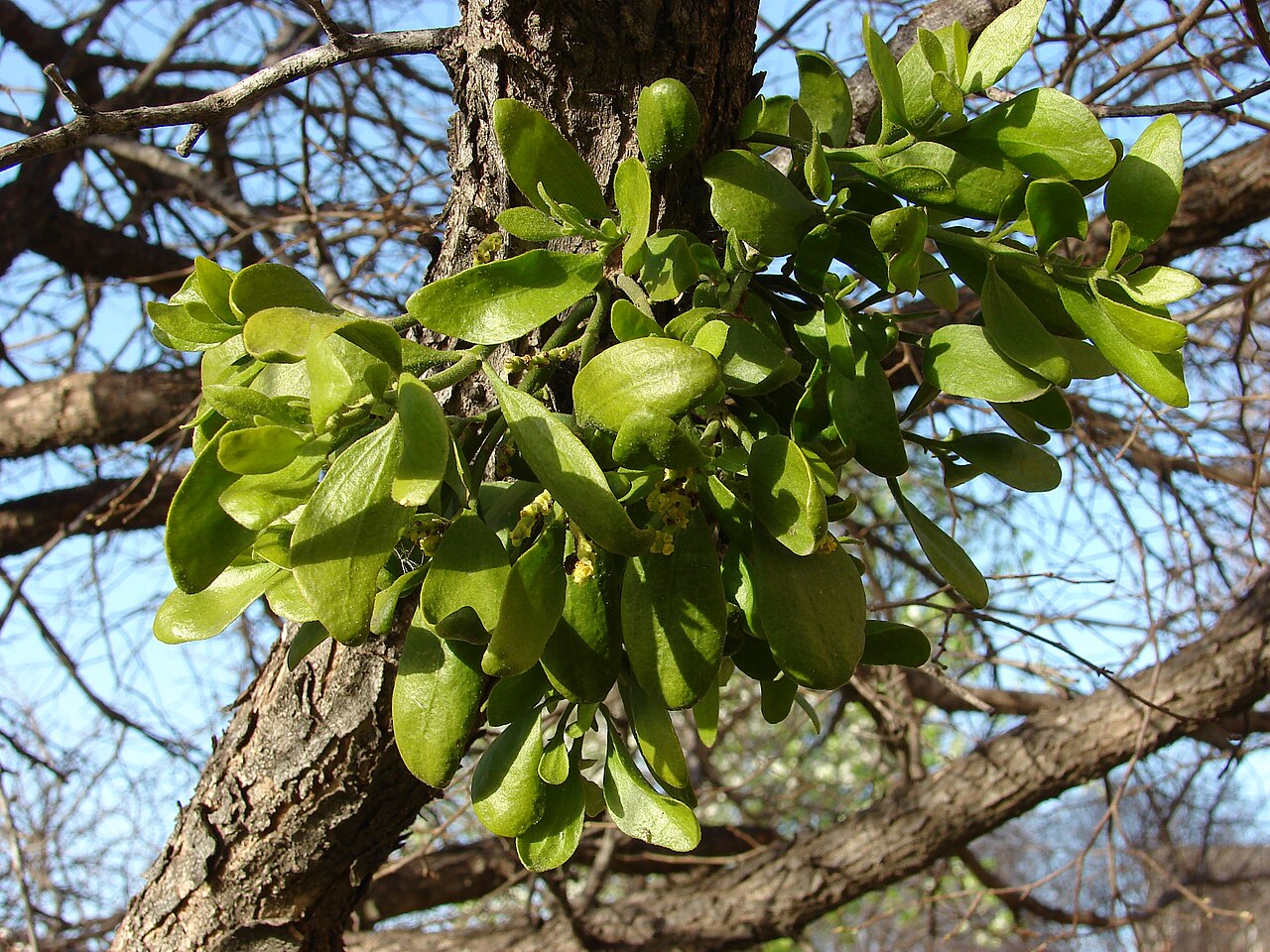
Phoradendron leucarpum, known as American Mistletoe (USDA: oak mistletoe), is an evergreen, hemiparasitic shrub that grows on the branches of hardwood trees across the eastern and southern United States. It belongs to the sandalwood family (Santalaceae), which now includes the mistletoes formerly placed in their own family, Viscaceae. Older books and many websites call it Phoradendron serotinum or P. flavescens. It forms rounded, bushy clumps of green, jointed stems and thick, leathery leaves, usually 1 to 3 feet across, high in the crowns of oaks, maples, hickories, black gum, elms and many other trees.
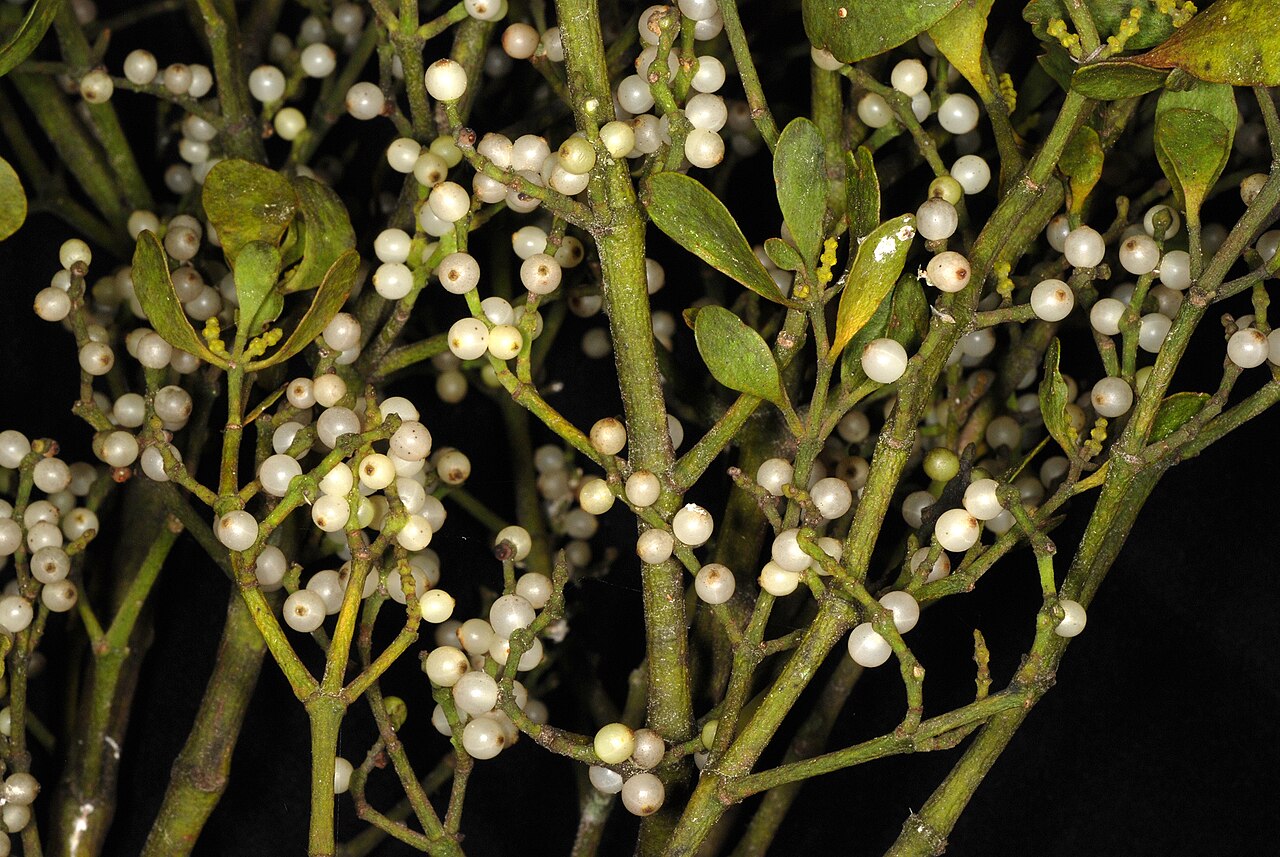
American mistletoe is only partly parasitic. Its green leaves make their own sugars by photosynthesis, but it has no roots in the soil. Instead it sends a specialized root-like organ, the haustorium, into the wood of its host and draws water and minerals from it. Female plants bear small, sticky white berries in late fall and winter, which are eaten by birds that spread the seeds from tree to tree. This is the mistletoe most often sold for holiday decoration in the United States, and it is the state floral emblem of Oklahoma.
Safety first: the leaves, stems and berries of American mistletoe are poisonous to people, dogs, cats and horses. Keep holiday sprigs out of reach of children and pets, and use artificial berries indoors where possible. This page is an identification and appreciation guide. American mistletoe is not sold as nursery stock and cannot be planted like a shrub; it can only grow attached to a living host tree, which it slowly weakens.
Identification
American mistletoe is easiest to spot in winter, when its evergreen clumps stand out in the bare crowns of deciduous trees. From the ground the clumps look like round green balls or nests among the branches.
Growth Habit
Each plant is a dense, rounded, much-branched clump, usually 1 to 3 feet across, attached to a single point on a host branch. Large trees can carry dozens of clumps, mostly on sunny upper and outer branches. Where a clump joins the branch, the host wood is often swollen. Old clumps can live for many years, and dead or broken clumps leave a knobby scar.
Stems
The stems are green, smooth to finely hairy, brittle and jointed, breaking easily at the swollen nodes. Older stems near the base become woody and brownish. The plant has no true roots; its haustorium grows into the host branch beneath the bark.
Leaves
The leaves are opposite, evergreen, thick and leathery, about 1 to 2½ inches long, obovate to elliptic (broadest toward the rounded tip) and narrowed to a short stalk. They are yellow-green to olive-green, without obvious veins, and are smooth or slightly hairy. They remain green all winter.
Flowers
Male and female flowers grow on separate plants. The flowers are tiny, yellowish-green and petal-less, set in short, jointed spikes in the leaf axils. They appear from late summer into fall, mostly September to October, and are easy to overlook. They are slightly fragrant and visited by small flies and bees.
Berries & Seeds
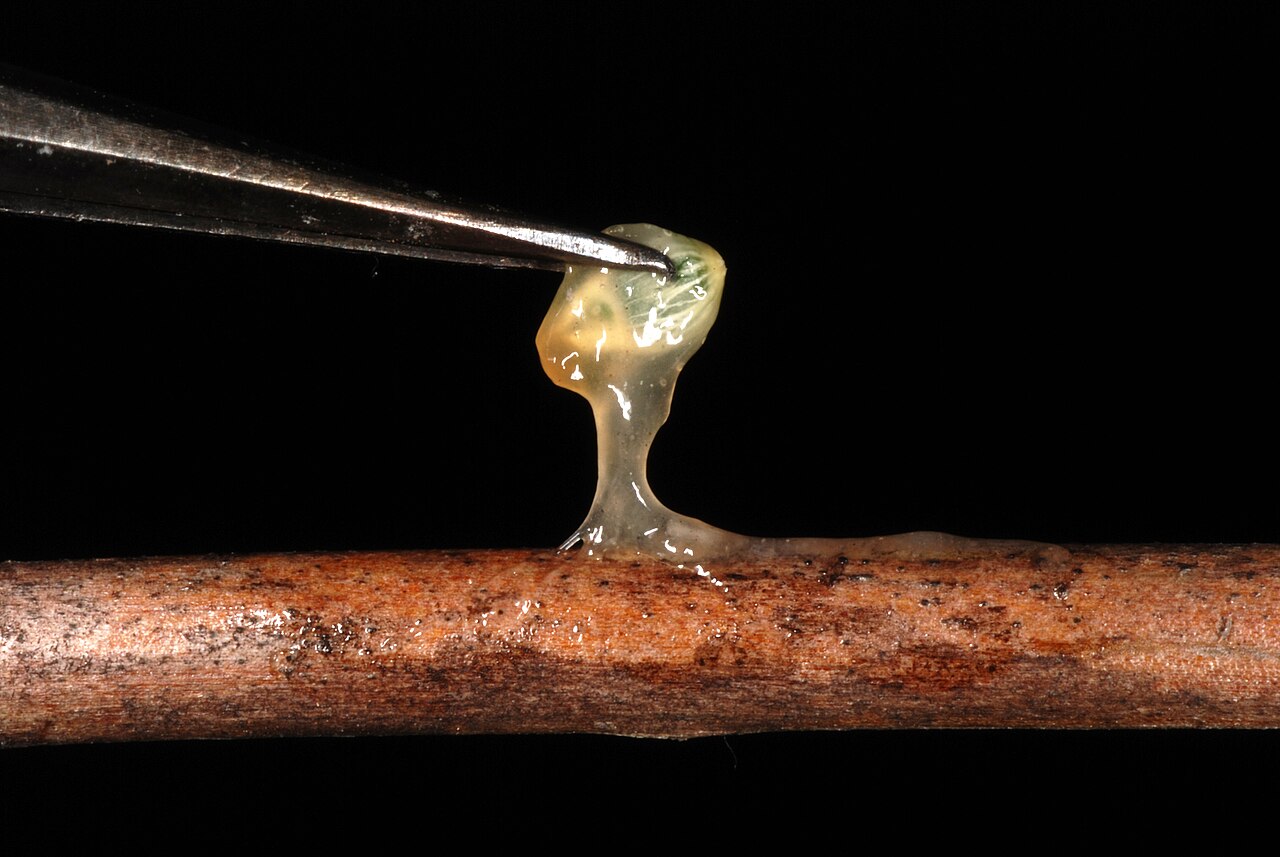
Female plants bear round, white to translucent berries about 1/8 to 1/4 inch across, in clusters along the spikes. They ripen in late fall and stay on the plant through winter, the season when mistletoe is gathered for decoration. Each berry holds one seed surrounded by sticky, stringy pulp called viscin, which glues the seed to bark. The species name leucarpum means “white fruit.”
Look-alikes
European mistletoe (Viscum album), the mistletoe of European Christmas tradition, has narrower, paired leaves and is not established in the wild in the eastern United States. Dwarf mistletoes (Arceuthobium) grow on conifers and are tiny, leafless, yellowish or brownish shoots. In the West and Southwest, other Phoradendron species grow on oaks, mesquite, juniper and other hosts; the western oak-mistletoe was once included in P. leucarpum but is treated by USDA PLANTS as a separate species, P. villosum. Evergreen leaves of host trees such as live oaks are attached directly to twigs and do not form separate clumps.
Safety: Toxic Plant
All parts of American mistletoe, especially the leaves and berries, contain toxic proteins (phoratoxins) and other compounds. Eating it can cause vomiting, stomach pain and diarrhea; larger amounts can cause more serious symptoms. The ASPCA lists American mistletoe as toxic to dogs, cats and horses. If a child or pet eats any part of the plant, call Poison Control (1-800-222-1222 in the U.S.) or your veterinarian right away. Do not use mistletoe as a home remedy or tea.
Quick Facts
| Scientific Name | Phoradendron leucarpum (syn. P. serotinum, P. flavescens) |
| Family | Santalaceae (sandalwood family; formerly Viscaceae) |
| Plant Type | Evergreen hemiparasitic shrub growing on tree branches |
| Mature Height | Clumps about 1–3 ft tall |
| Mature Spread | Clumps about 1–3 ft across |
| Growth Rate | Slow; clumps take several years to become noticeable |
| Sun Exposure | Full sun on upper and outer branches of host trees |
| Water Needs | Taken from the host tree; no soil roots |
| Soil Type | None; grows on living hardwood branches |
| Soil pH | Not applicable |
| Bloom Time | Late summer to fall (mostly September–October) |
| Flower Color | Tiny, yellowish-green |
| Fall Color | None; evergreen |
| Fruit | White, sticky berries on female plants, late fall–winter (poisonous) |
| Deer Resistant | No; deer eat clumps that fall within reach |
| USDA Hardiness Zones | About 6–9, wherever suitable hosts grow |
Native Range
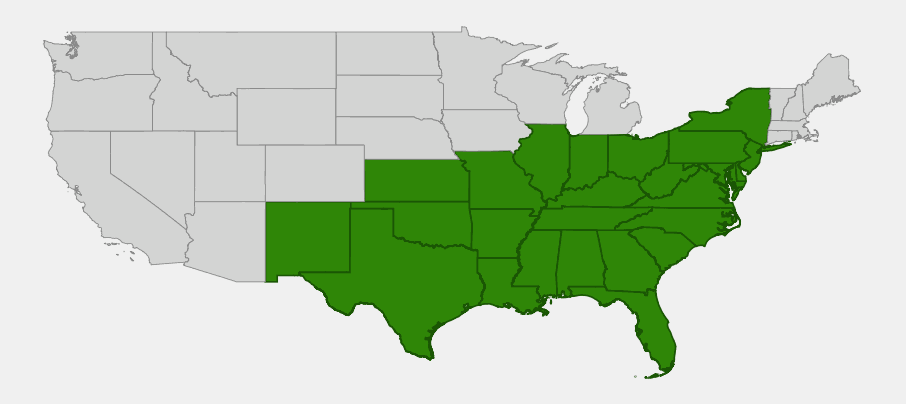
American mistletoe is native to the eastern and south-central United States. USDA PLANTS lists it as native in the lower 48 states and records it from 25 states and the District of Columbia: from New Jersey, Pennsylvania, southern Ohio, Indiana and Illinois south to Florida, and west through Missouri, southeastern Kansas, Oklahoma and Texas. The Lady Bird Johnson Wildflower Center describes its range as New Jersey and Pennsylvania south to Florida and west to West Virginia, Ohio, Indiana, Illinois, Missouri, Kansas and eastern Texas.
It is most abundant in the Southeast and the southern Mississippi Valley, where clumps are common in oaks, black gum, hackberry and other trees along streets, fencerows and bottomlands. It becomes scarce toward its northern limit, which is set largely by winter cold. The New York records and the New Mexico records are outlying ones at the northern and western edges of its range. In Texas it grows mostly in the east; the mistletoes of the Edwards Plateau and West Texas are mainly other Phoradendron species.
It grows wherever suitable host trees receive plenty of sun: open woods, forest edges, river and creek bottoms, old fields with scattered trees, pastures, yards, parks and city streets. Infected trees are often isolated or edge trees, where birds perch and leave seeds. It is generally absent from deep, closed-canopy forest interiors.
📋 Regional plant lists featuring American Mistletoe: New York, Pennsylvania & Northern New Jersey · Ohio & Indiana · Kentucky & Tennessee · Nebraska, Kansas & Eastern Colorado · Maryland, Virginia & West Virginia · Delaware, Southern New Jersey & Long Island · Illinois, Iowa & Missouri · Alabama, Georgia & Mississippi · North & South Florida · North & South Carolina · Arkansas, Louisiana, Eastern Oklahoma & Eastern Texas
Can You Grow It?
Not really, and you should not try. American mistletoe is not sold as nursery stock and cannot be planted in the ground like a shrub. It can only live attached to the branch of a living host tree, from which it takes water and minerals for the rest of its life. Gardeners usually ask the opposite question: how to keep it from spreading in their trees.
Light
In the wild it grows mainly on the sunny upper and outer branches of host trees. Seedlings rarely survive on heavily shaded inner branches.
Soil & Water
It has no roots in the soil, so soil and watering do not apply. Its haustorium draws water and dissolved minerals from the host branch. In droughts, heavily infested trees can be stressed further because the mistletoe keeps drawing water.
Planting Tips
Mistletoe can be started only by pressing fresh, ripe seeds onto the bark of a young branch of a suitable host, which is how birds spread it. Because it is a parasite that weakens its host, we do not recommend deliberately infecting a tree. Never cut clumps from trees in parks, preserves or other people’s property, and never plant mistletoe berries where children or pets could find them.
Pruning & Maintenance
If mistletoe is overloading a valued tree, the most effective control is to prune out infected branches at least a foot below the clump. Simply snapping off the clump leaves the haustorium in the wood, and the plant usually resprouts. Light infestations on healthy, large trees are usually tolerable and benefit wildlife. Work high in trees should be done by a certified arborist.
Propagation
In nature, seeds are spread by birds. The sticky seeds are wiped off beaks onto branches or pass through the gut and land in droppings. A seed glued to thin bark germinates and grows a holdfast and haustorium into the branch. Several years pass before a new plant forms a visible clump and begins to flower.
Where to See It
- Winter woods and bottomlands: scan the bare crowns of oaks, black gum, hackberry and elms for round green clumps
- City streets and parks: older shade trees in southern towns often carry many clumps
- Pastures and fencerows: isolated trees where birds perch are frequently infected
- Birding walks: watch for bluebirds, waxwings and robins feeding in fruiting clumps in winter
- Holiday traditions: buy cut sprigs rather than cutting wild plants, and keep them away from children and pets
Wildlife & Ecological Value
Despite its reputation as a pest, American mistletoe is an important wildlife plant. Ecologists regard mistletoes as keystone resources in many forests because of the food and shelter they provide in winter.
For Pollinators
The tiny fall flowers are visited by small flies, bees and other insects. American mistletoe is the larval host of the great purple hairstreak (Atlides halesus), a striking iridescent blue butterfly of the southern states whose caterpillars feed only on mistletoes.
For Birds
The berries are eaten in winter by eastern bluebirds, cedar waxwings, American robins, northern mockingbirds and other birds, which spread the seeds. Dense clumps provide shelter and nest sites, and some birds build nests in or beside them.
For Mammals
Deer, squirrels and other mammals eat clumps that break off and fall to the ground, and the evergreen leaves are browsed where they can be reached. Squirrels and other small mammals also shelter in large clumps.
Ecosystem Role
As a hemiparasite, American mistletoe takes water and minerals from its host, and heavy infestations can weaken trees already stressed by drought, age or injury. Light infestations rarely kill healthy trees. Its fallen leaves add nutrients to the soil beneath infected trees. It links birds, butterflies and trees in a web of relationships that make it a valuable part of southern hardwood forests.
Cultural & Historical Uses
The custom of kissing under the mistletoe comes from Europe, where it was tied to European mistletoe (Viscum album). In North America, settlers transferred the tradition to the similar-looking native mistletoe, and American mistletoe became the plant hung over doorways at Christmas. Much of the mistletoe sold in the United States is harvested from the wild in the southern states.
Oklahoma adopted mistletoe as its floral emblem in 1893, before statehood, because it was one of the few green plants that brightened the prairie landscape in winter. It remained the state flower until 2004, when the Oklahoma rose was named the official state flower and mistletoe was kept as the state floral emblem.
The genus name Phoradendron comes from the Greek for “tree thief,” a reference to its parasitic habit. Some Native American peoples and early settlers used mistletoe in traditional medicine, but the plant is toxic and should never be used as a home remedy.
Frequently Asked Questions
Is American mistletoe poisonous?
Yes. Its leaves, stems and berries are poisonous to people, dogs, cats and horses. Eating it can cause vomiting and diarrhea, and larger amounts can cause more serious symptoms. If a child or pet eats any part, call Poison Control (1-800-222-1222) or a veterinarian right away.
Can I buy American mistletoe to plant in my yard?
No. It is not sold as nursery stock and cannot be planted in the ground. It only grows attached to the branches of a living host tree. Cut sprigs are sold for holiday decoration, but they will not grow.
Will mistletoe kill my tree?
Usually not. Light infestations on healthy trees are rarely fatal. Heavy infestations can weaken old or drought-stressed trees. Pruning infected branches well below the clump is the most effective control.
How does mistletoe get into trees?
Birds eat the berries and spread the sticky seeds, which stick to branches when birds wipe their beaks or leave droppings. The seed germinates and grows a root-like haustorium into the branch.
Is American mistletoe the same as European mistletoe?
No. They look similar and share the holiday tradition, but European mistletoe (Viscum album) is a different genus native to Europe and Asia. American mistletoe (Phoradendron leucarpum) is native to the eastern and southern United States.

Looking for a nursery that carries American Mistletoe?
Browse our native plant nursery directory: Alabama & Arkansas · Delaware, Florida & Georgia · Illinois, Indiana & Kansas · Kentucky, Louisiana, Maryland, Mississippi & Missouri · New Jersey, New Mexico, New York, North Carolina, Ohio & Oklahoma · Pennsylvania, South Carolina, Tennessee, Texas & Virginia · West Virginia