
Yellow Crownbeard (Verbesina occidentalis)
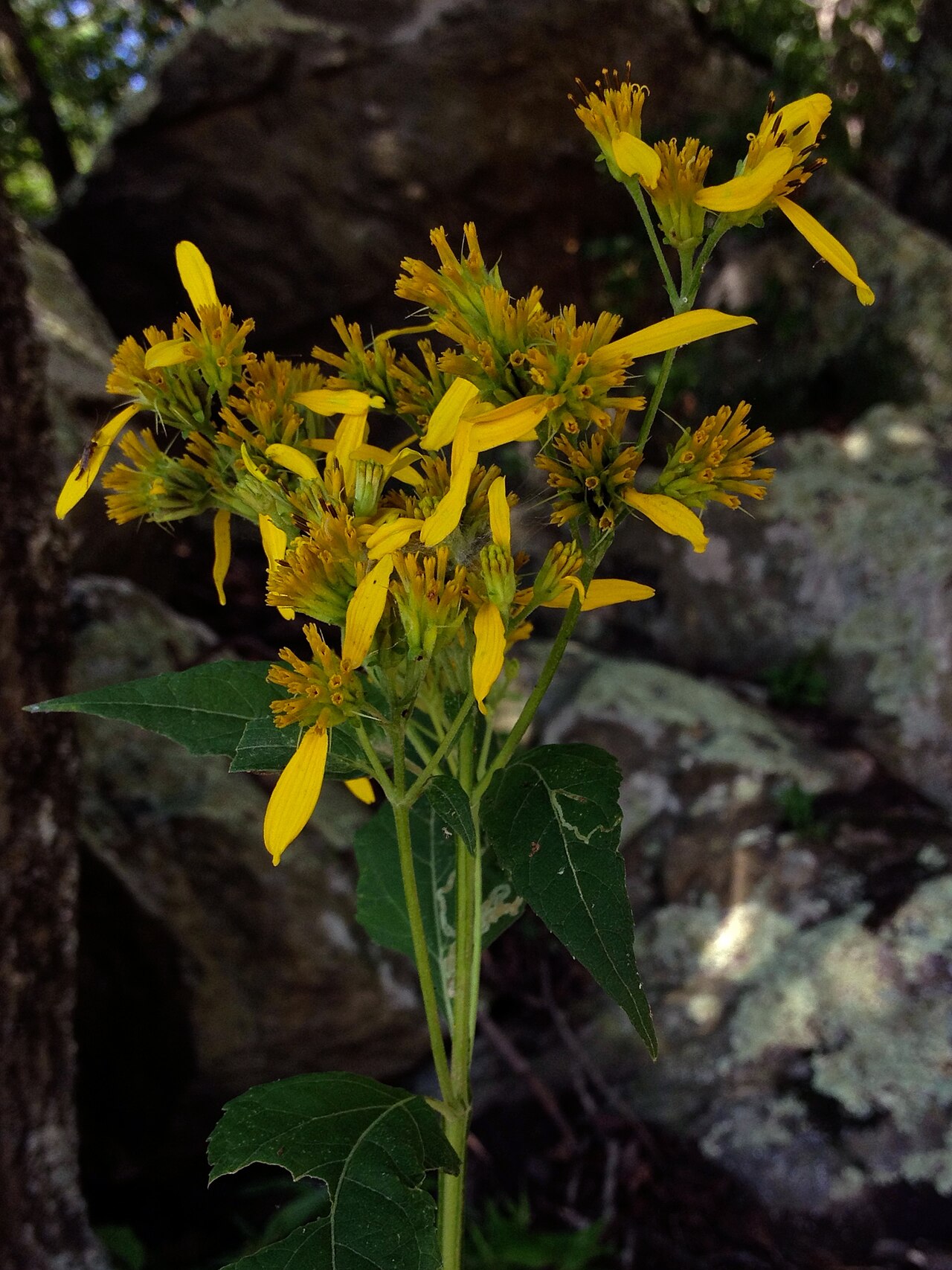
Verbesina occidentalis, known as Yellow Crownbeard or small yellow crownbeard, is a tall native perennial in the aster family (Asteraceae). Its stout stems, usually 3 to 6 feet tall, are lined with narrow green wings and carry large, opposite leaves. From late summer into fall the tops branch into broad, flat-topped clusters of small yellow flower heads, each with just a few uneven, often drooping rays.
It is a plant of the Southeast and the southern Appalachians, growing along woodland edges, in open woods, thickets, clearings, fencerows and roadsides from Pennsylvania and Illinois south to Florida and eastern Texas. It is especially common in the Piedmont and mountains of Virginia, the Carolinas, Tennessee and Georgia, where its yellow clusters line country roads in August and September.
Yellow crownbeard is a close cousin of the better-known wingstem (Verbesina alternifolia), and the two are easily confused. The simplest difference is in the leaves: opposite on yellow crownbeard, alternate on wingstem. Both are tough, late-blooming plants that feed many bees, butterflies and beneficial insects. This guide covers how to identify yellow crownbeard, where it grows and how to use it in a naturalized garden.
Identification
Yellow crownbeard is a big, coarse plant that is easiest to identify in late summer, when its yellow flower clusters open. Look for the combination of winged stems, opposite leaves and small heads with only a few rays.
Stems
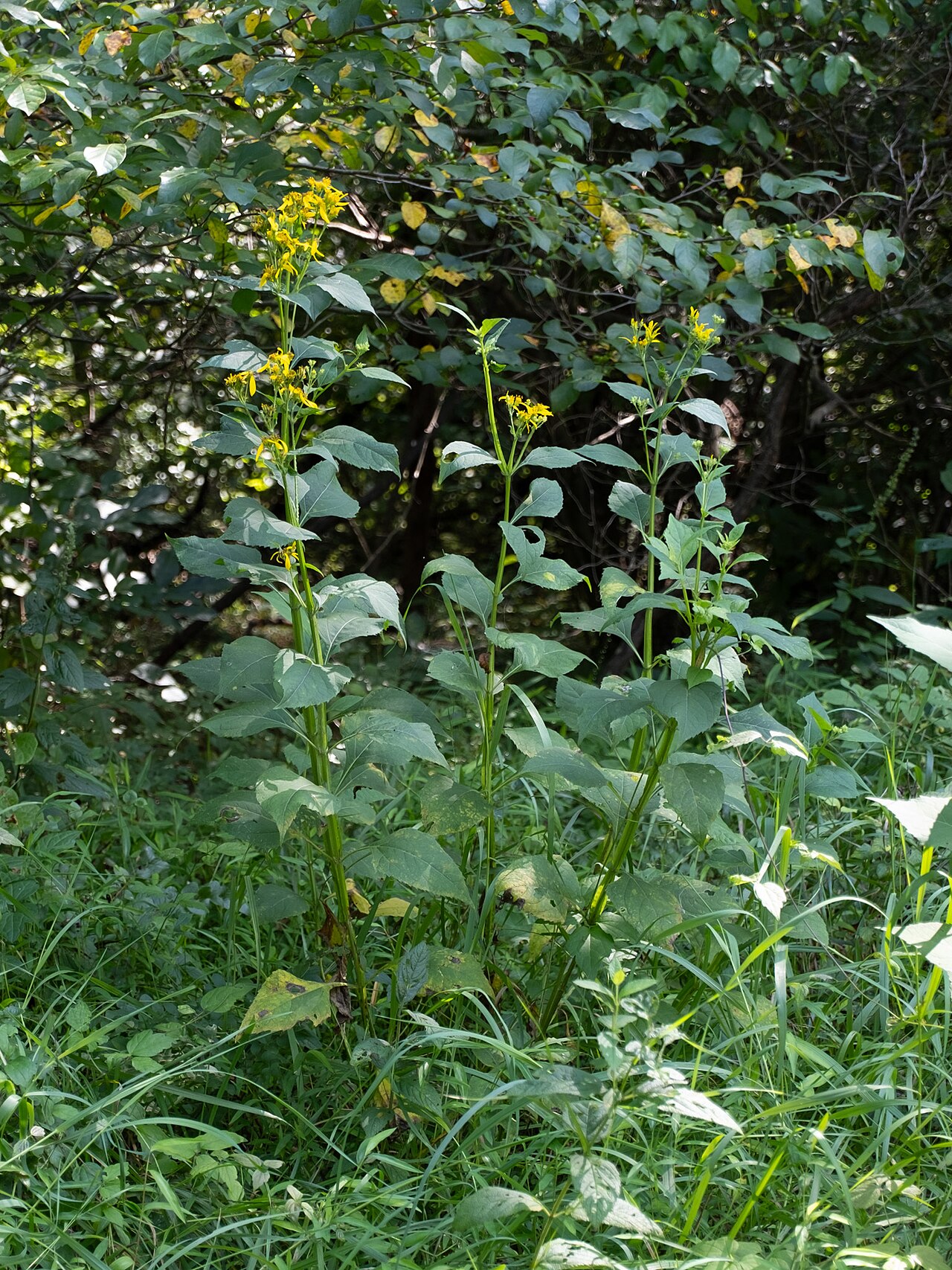
The stems are erect, green, mostly unbranched below the flower clusters and usually 3 to 6 feet tall, occasionally taller. Narrow, leafy wings run down the stem from the base of each leaf. Several stems often rise together from a perennial crown, forming loose colonies.
Leaves
The leaves are opposite, ovate to lance-shaped, 4 to 10 inches long and 2 to 5 inches wide, with toothed margins and pointed tips. They are rough to the touch on the upper surface and paler beneath. The leaf blades taper into winged stalks that continue down the stem as the stem wings. The opposite arrangement separates it from wingstem, which has alternate leaves.
Flowers
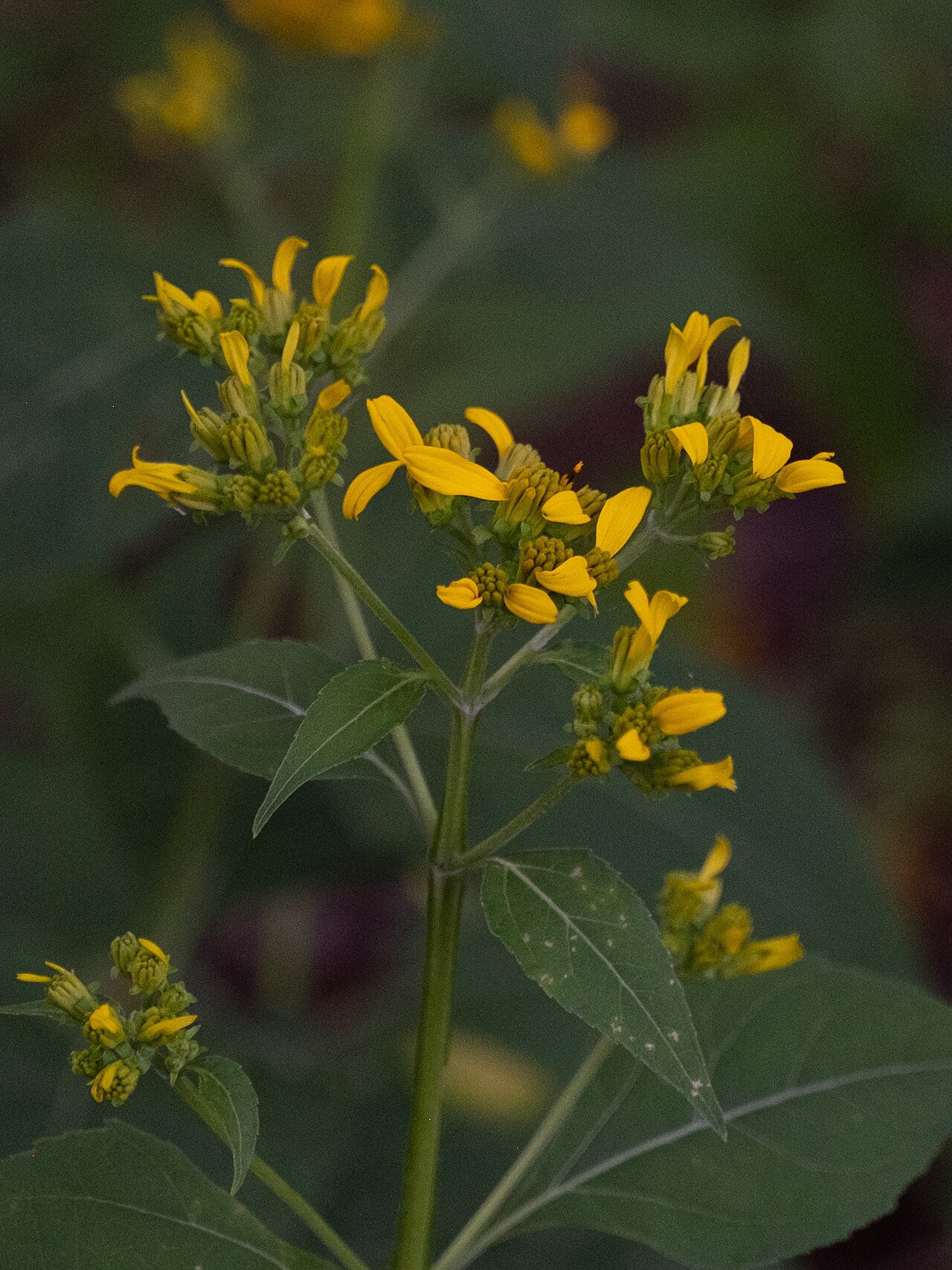
The flower heads are small, about an inch across, and grouped in broad, flat to rounded clusters at the top of the plant. Each head has a small disk of yellow tubular flowers and only 1 to 5 (usually 2 or 3) yellow ray flowers, which are often uneven in length and droop or twist. Bloom runs from about August into October. The few, irregular rays give the cluster a ragged, windblown look that is distinctive once you know it.
Fruit & Seeds
The seeds are small, flattened achenes, often with narrow wings and two short bristles at the tip. Unlike wingstem, whose seed heads become spiky balls, yellow crownbeard heads stay small and open as they mature. The dry stems stand into winter.
Quick Facts
| Scientific Name | Verbesina occidentalis (syn. Phaethusa occidentalis) |
| Family | Asteraceae (aster family) |
| Plant Type | Herbaceous perennial |
| Mature Height | 3–6 ft (occasionally taller) |
| Mature Spread | 2–3 ft; slowly forms colonies |
| Growth Rate | Fast |
| Sun Exposure | Full sun to part shade |
| Water Needs | Medium; prefers moist but well-drained soil |
| Soil Type | Loam, clay loam and rocky soils; tolerates poor, disturbed ground |
| Soil pH | About 5.5–7.5 |
| Bloom Time | August–October |
| Flower Color | Yellow |
| Fall Color | None of note; stems turn brown and stand into winter |
| Fruit | Small, flattened, often winged achenes |
| Deer Resistant | Moderately; the coarse, rough leaves are not a favorite of deer |
| USDA Hardiness Zones | 6–9 |
Native Range
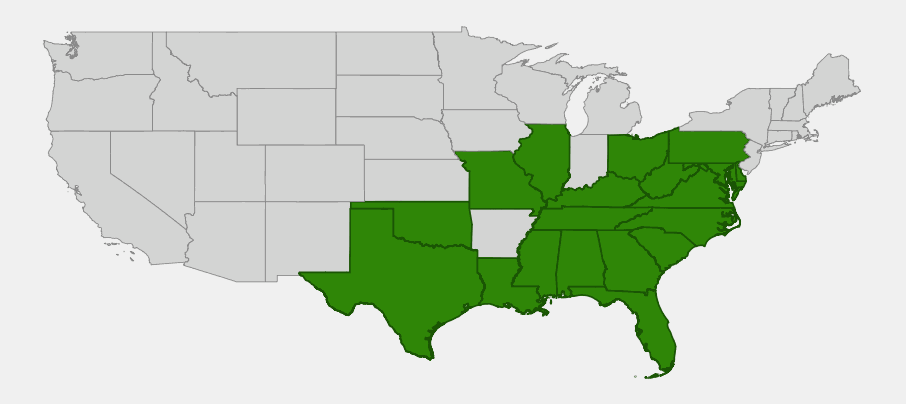
USDA PLANTS records yellow crownbeard as native in 19 states and the District of Columbia, from Pennsylvania, Ohio and Illinois south to Florida and west to Missouri, Oklahoma and eastern Texas. It has no Canadian range. Its heartland is the southern Appalachians and Piedmont, from Virginia and West Virginia through the Carolinas, Tennessee, Georgia and Alabama.
Toward the edges of its range it becomes scattered. Records from Pennsylvania, Ohio, Illinois, Missouri, Oklahoma, Louisiana and eastern Texas are fewer and more local, and in Florida it is limited mostly to the northern counties. It is uncommon on the outer Coastal Plain.
Across this range it favors partly shaded, moist ground: the edges of upland forests, clearings, stream terraces, hedgerows and roadsides. Like many tall late-summer composites, it does well where woods meet open land.
📋 Regional plant lists featuring Yellow Crownbeard: Alabama, Georgia & Mississippi · North & South Florida · North & South Carolina · Maryland, Virginia & West Virginia · Kentucky & Tennessee · Illinois, Iowa & Missouri · Ohio & Indiana · New York, Pennsylvania & Northern New Jersey · Delaware, Southern New Jersey & Long Island · Arkansas, Louisiana, Eastern Oklahoma & Eastern Texas
Growing & Care Guide
Yellow crownbeard is a vigorous, low-maintenance perennial for the back of a border, a woodland edge or a meadow. It is easy to grow but large and rather coarse, so it suits naturalized plantings better than formal beds. Seed and plants are offered mainly by native plant nurseries in the Southeast.
Light
Grow it in full sun to part shade. It blooms best with at least a half day of sun, but it tolerates the dappled light of a woodland edge, where it grows naturally.
Soil & Water
It prefers moist, reasonably fertile soil but adapts to clay, rocky ground and average garden soil. Established plants tolerate short dry spells, though leaves may wilt in drought. Avoid rich, heavily fertilized soil, which makes the stems tall and floppy.
Planting Tips
Set plants 2 to 3 feet apart in spring or fall. Place them behind shorter perennials, since the lower leaves can look tattered by late summer. They pair well with goldenrods, asters and other late bloomers.
Pruning & Maintenance
Cutting stems back by about a third in early June keeps plants shorter and bushier and reduces flopping. Leave the dry stems over winter for overwintering insects and birds, and cut them down in late winter or early spring. Plants reseed modestly; remove seedlings where they are not wanted.
Propagation
Divide clumps in early spring or fall. Seed can be sown outdoors in fall; for spring sowing, a few weeks of cold, moist stratification improves germination.
Landscape Uses
- Woodland edge gardens: a tall, late-season bloomer where sun meets shade
- Pollinator gardens: a late-summer source of nectar and pollen for bees, wasps and butterflies
- Meadows and naturalized areas: mixes with goldenrods, asters and native grasses
- Back-of-border plantings: height and late yellow color in informal beds
- Roadside and right-of-way plantings: a tough native for disturbed, partly shaded ground
Wildlife & Ecological Value
Yellow crownbeard blooms when many summer flowers have finished, and its broad clusters are busy with insects on warm late-summer days.
For Pollinators
The Xerces Society, through the Lady Bird Johnson Wildflower Center, rates yellow crownbeard as having special value to native bees, bumble bees and honey bees. Butterflies, skippers, wasps, flies and beetles also visit the open flower heads. Its late bloom helps bees build up food stores before winter.
For Birds
Small seed-eating birds such as goldfinches pick seeds from the dry heads in fall and winter, and the tall stems give cover at field and woodland edges.
For Mammals
The coarse, rough leaves are not a favored food, and deer usually leave the plant alone unless other food is scarce.
Ecosystem Role
Like other tall composites at woodland edges, yellow crownbeard supports a large community of insects, including leaf-feeding beetles and caterpillars, which in turn feed birds. Its hollow and pithy stems can shelter overwintering insects if they are left standing.
Cultural & Historical Uses
Linnaeus described the plant in 1753 as Siegesbeckia occidentalis, and Thomas Walter moved it to Verbesina in his Flora Caroliniana of 1788. Some later botanists placed it in a separate genus as Phaethusa occidentalis, and that name appears in older works. The species name occidentalis, “western,” is odd for a plant of the eastern states, but it reflects the eighteenth-century view of North America as the western world.
The common name “crownbeard” is used for the whole genus Verbesina, which includes about 300 species, mostly in Mexico and Central and South America. The United States has a few well-known natives, among them wingstem, frostweed and cowpen daisy.
Yellow crownbeard has no well-documented history of human use. Its value today is ecological: it is a dependable late-season nectar plant and a good choice for gardeners in the Southeast who want a tall, tough native for informal areas.
Frequently Asked Questions
How do I tell yellow crownbeard from wingstem?
Look at the leaves. Yellow crownbeard has opposite leaves, while wingstem (Verbesina alternifolia) has alternate leaves. Wingstem flower heads also have more rays and develop a round, spiky seed head; yellow crownbeard heads have only 1 to 5 rays.
Is yellow crownbeard invasive?
No. It is native across the Southeast. It can spread by seed and slowly form clumps in good conditions, but it is easy to control by pulling seedlings and dividing clumps.
When does yellow crownbeard bloom?
Mostly from August into October, with peak bloom in late August and September in the southern Appalachians and Piedmont.
Does it need full sun?
No. It grows naturally along woodland edges and tolerates part shade, though it flowers most in at least half a day of sun.
Is yellow crownbeard good for pollinators?
Yes. It is rated as having special value to native bees, bumble bees and honey bees, and butterflies and many other insects visit its flowers in late summer.

Looking for a nursery that carries Yellow Crownbeard?
Browse our native plant nursery directory: Alabama · Delaware, Florida & Georgia · Illinois · Kentucky, Louisiana, Maryland, Mississippi & Missouri · North Carolina, Ohio & Oklahoma · Pennsylvania, South Carolina, Tennessee, Texas & Virginia · West Virginia