
Cobaea Beardtongue (Penstemon cobaea)
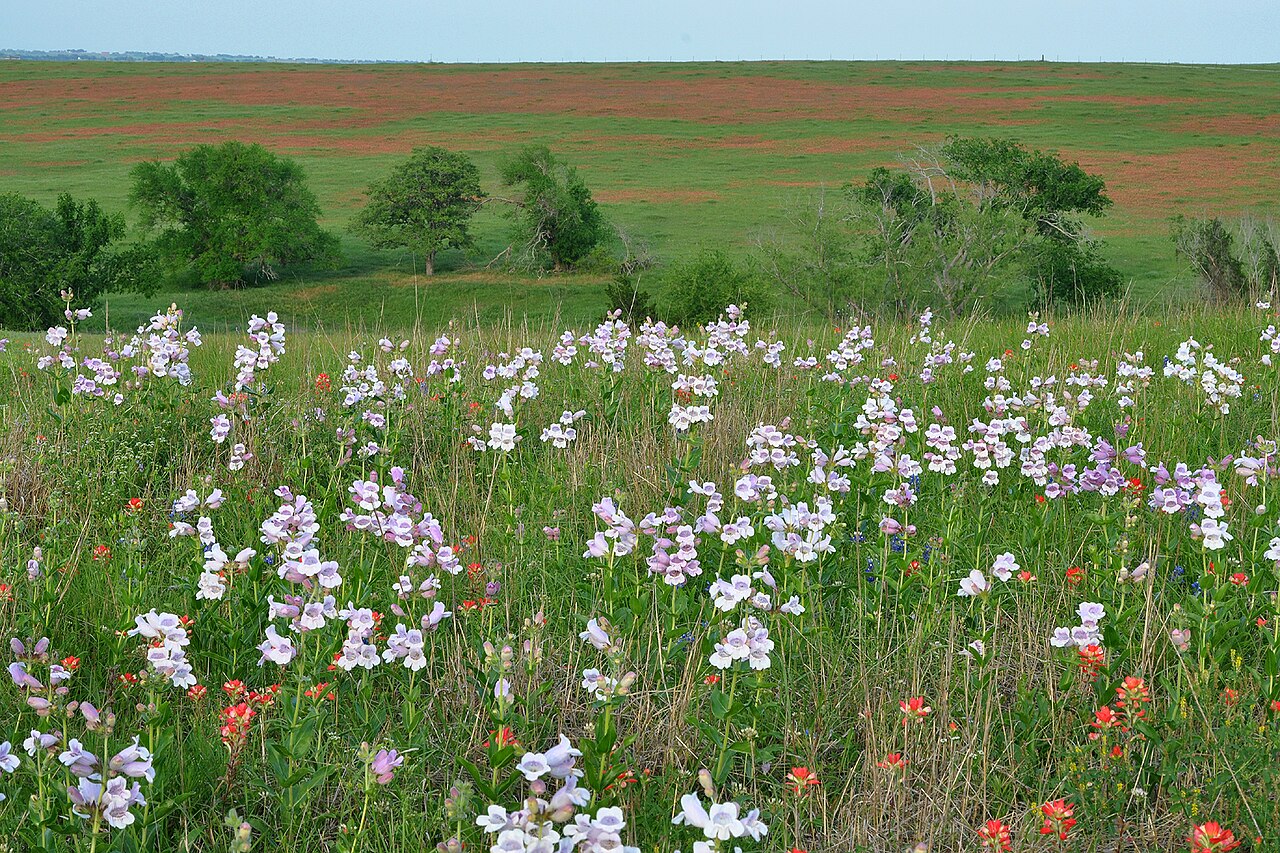
Penstemon cobaea, known as Cobaea Beardtongue (also foxglove beardtongue, prairie penstemon or wild foxglove), is a showy native perennial of prairies and rocky hillsides in the southern Great Plains and Ozarks. It belongs to the plantain family (Plantaginaceae), which now includes most penstemons. Plants send up one to several stout stems 1 to 2 feet tall in spring, lined with large, inflated, bell-shaped flowers that are white to pale lavender, pink or deep purple, with purple lines inside the throat.
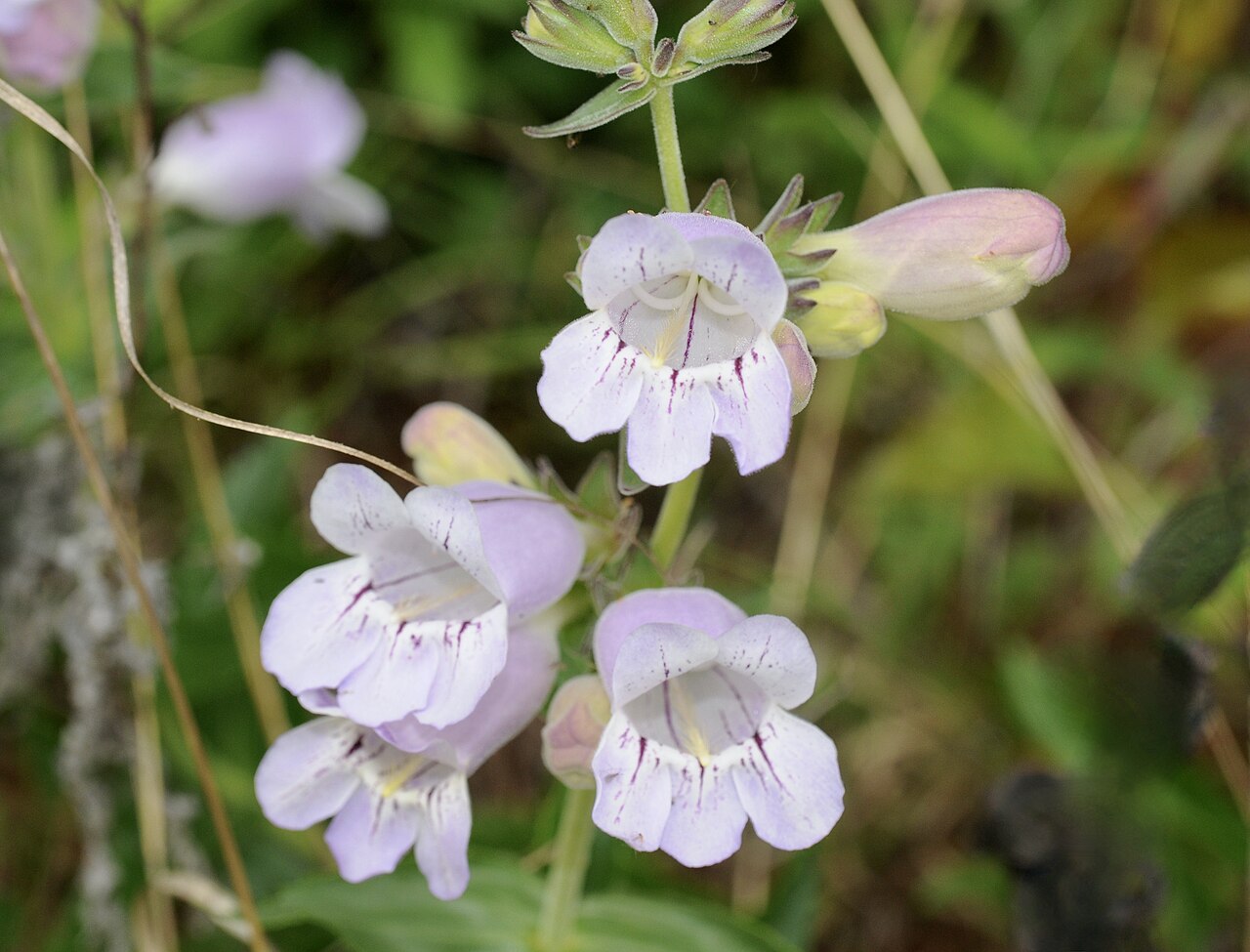
Its flowers are the largest of any penstemon in the region, about 1½ to 2 inches long, and look much like those of garden foxglove, which explains several of its common names. Bumblebees and other large bees crawl right inside the wide flower tubes to reach the nectar, following the purple lines as guides. The plant forms a rosette of thick, glossy, toothed leaves and has a deep taproot that makes it very drought tolerant once established.
Cobaea beardtongue is one of the best penstemons for gardens in the central and southern Plains. It needs full sun and very well-drained soil, and it thrives on rocky, limestone or sandy sites where many garden perennials struggle. It is short-lived but reseeds where it is happy, and it is widely available from native plant nurseries and seed companies in the region.
Identification
In April and May, cobaea beardtongue is unmistakable: a sturdy stem lined with large, swollen, bell-shaped flowers above broad, glossy leaves.
Growth Habit
Plants grow from a woody crown and deep taproot, producing one to three (sometimes more) upright stems usually 1 to 2 feet tall, occasionally to about 3 feet. The stems are finely hairy below and sticky-glandular in the flowering part.
Leaves
Basal and lower stem leaves are oblong to spoon-shaped or elliptic, about 1½ to 6 inches long, thick, dark green and often glossy, with toothed or nearly smooth edges. The stem leaves are opposite, in four to eight pairs, becoming smaller and clasping the stem toward the top. The lower leaves often wither by flowering time. Basal rosettes often stay green through winter.
Flowers
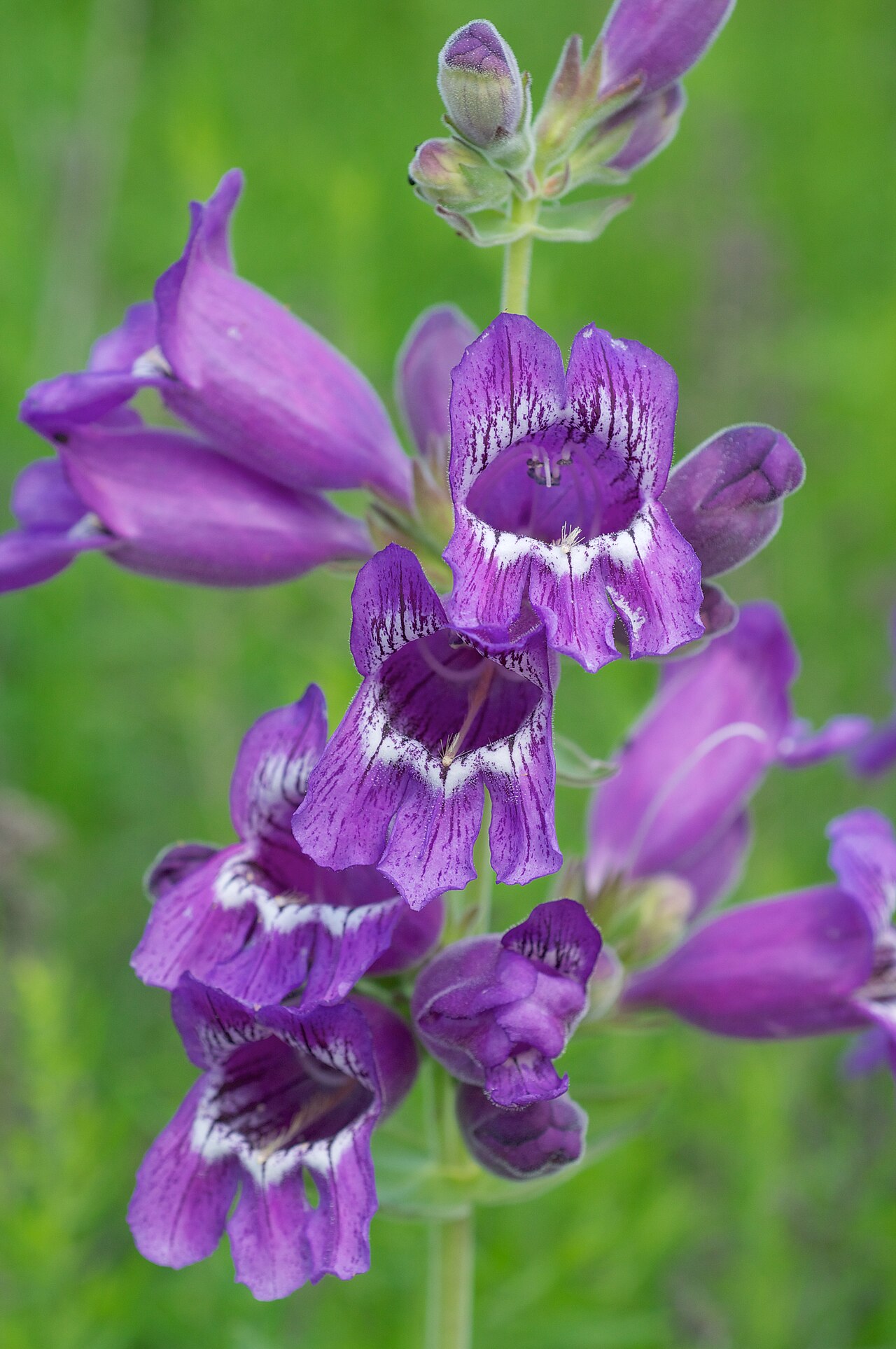
The flowers are borne in several tiers of paired clusters along the upper half of the stem. Each flower is 1½ to 2 inches long, abruptly inflated from a narrow base into a wide bell with two upper lobes and three lower lobes. Color ranges from white to pale lavender or pink with purple nectar lines inside; in the Ozarks, variety purpureus has deep purple to violet flowers. Like other penstemons, it has a sterile fifth stamen (the “beard”) with a tuft of yellow hairs, which gives the group the name beardtongue. Flowering is from April to May in the south and May to June in the north.
Fruit & Seeds
The fruit is a woody, pointed capsule about 1/2 inch long that ripens in summer, turning brown, and splits to release many small, angular seeds. The dry seed stalks often stand into winter.
Look-alikes
Large-flowered penstemon (Penstemon grandiflorus) of the northern Plains also has large flowers, but its leaves are smooth, gray-blue and waxy, and its flowers are less inflated. Foxglove beardtongue (P. digitalis) has smaller white flowers in open, branched clusters and grows in moister sites farther east. Garden foxglove (Digitalis purpurea) is a European plant with flowers on one side of a much taller spike.
Quick Facts
| Scientific Name | Penstemon cobaea |
| Family | Plantaginaceae (plantain family) |
| Plant Type | Herbaceous perennial with a semi-evergreen basal rosette |
| Mature Height | 1–2 ft (occasionally to 3 ft) |
| Mature Spread | 1–1.5 ft |
| Growth Rate | Moderate; often short-lived |
| Sun Exposure | Full sun to light part shade |
| Water Needs | Low; dry to medium, well-drained soil |
| Soil Type | Rocky, sandy or loamy soils, limestone-based or calcareous soils |
| Soil pH | About 6.0–8.0 (slightly acidic to alkaline) |
| Bloom Time | April–June |
| Flower Color | White to pale lavender or pink; deep purple in the Ozark form |
| Fall Color | Basal leaves often turn reddish or purplish |
| Fruit | Brown, pointed capsule with many small seeds |
| Deer Resistant | Moderately; occasionally browsed |
| USDA Hardiness Zones | 4–8 |
Native Range
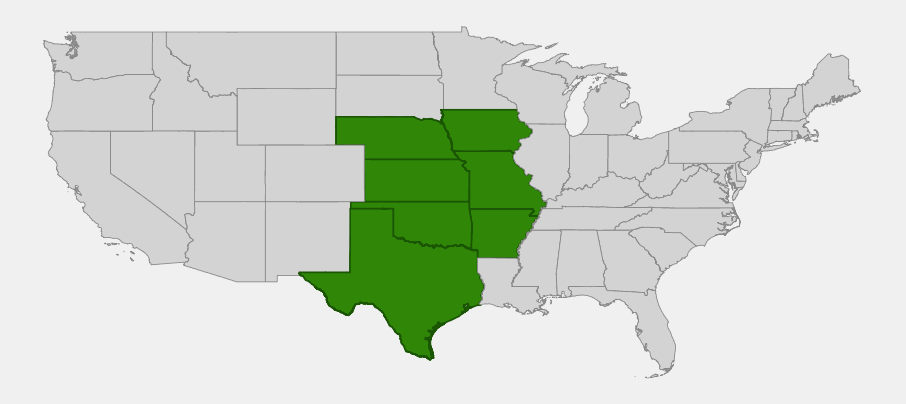
Cobaea beardtongue is native to the south-central United States. Its main range runs from southeastern Nebraska and the eastern two-thirds of Kansas south through Oklahoma to central and south-central Texas, with a second center in the Ozark region of southern Missouri and western Arkansas. Iowa has a few populations at the northeastern edge of the range, where the species is rare. The Lady Bird Johnson Wildflower Center gives its native distribution as southern Nebraska south to south-central Missouri, western Arkansas, Oklahoma and eastern and central Texas.
USDA PLANTS also lists Arizona, Colorado, Illinois, New Mexico and Ohio, but Kew’s Plants of the World Online treats the plants in those states as introduced, and they fall outside the range given by the Lady Bird Johnson Wildflower Center. Because cobaea beardtongue is a popular garden plant, these records are best regarded as escapes from cultivation or plantings, so this page and the map show its native range only.
It grows on open, sunny, well-drained sites: rocky and gravelly prairie hillsides, limestone outcrops and glades, sandy prairies, eroded pastures, roadsides and open woodland edges. In Texas it is characteristic of the Blackland Prairies, Cross Timbers and Rolling Plains and extends south toward the Gulf coast near Victoria. In the Ozarks it grows in dolomite and limestone glades.
📋 Regional plant lists featuring Cobaea Beardtongue: Nebraska, Kansas & Eastern Colorado · Illinois, Iowa & Missouri · Arkansas, Louisiana, Eastern Oklahoma & Eastern Texas · South & West Texas
Growing & Care Guide
Cobaea beardtongue is easy to grow in sunny, well-drained sites and is a standout in spring. Its main enemies are wet soil, rich soil and shade. Buy nursery-grown plants or seed from a regional native plant source.
Light
Full sun is best for strong stems and heavy bloom. It tolerates light afternoon shade in hot climates, but in shade the stems flop and flowering declines.
Soil & Water
It needs excellent drainage. Rocky, gravelly, sandy or limestone-based soils are ideal, and it tolerates clay if planted on a slope or raised bed. Water new plants until established; afterwards it needs little or no supplemental water. Overwatering, heavy mulch and rich, wet soil cause crown rot. Do not fertilize.
Planting Tips
Plant in spring or fall about 12 to 18 inches apart. Set the crown at or slightly above soil level and use gravel rather than wood mulch around it. It suits rock gardens, prairie plantings, dry slopes and the front of sunny borders. Combine it with little bluestem, sideoats grama, coneflowers and other dryland natives.
Pruning & Maintenance
After flowering, either cut the stalks back to the rosette for neatness or leave some to ripen seed. Plants are often short-lived, lasting a few years, so let some seeds fall to keep a population going. Remove crowding grasses and weeds from around the rosettes.
Propagation
Grow from seed. Sow outdoors in fall, or give seeds about 60 days of cold, moist stratification before spring sowing. Seedlings usually flower in their second year. Plants can also be divided carefully in early spring, though the taproot makes this less reliable.
Landscape Uses
- Rock gardens: showy spring flowers on dry, gravelly sites
- Prairie plantings: an early-season highlight among grasses
- Pollinator gardens: a magnet for bumblebees and other large native bees
- Xeriscapes: drought tolerant once established
- Roadside and slope plantings: thrives on lean, well-drained soils
Wildlife & Ecological Value
Cobaea beardtongue is a valuable spring nectar plant in prairies and glades.
For Pollinators
The large, wide flowers are pollinated mainly by bumblebees and other large bees, which crawl inside the floral tube; the purple lines guide them to the nectar. Smaller bees, including mason bees, also visit for pollen and nectar.
For Birds
Small seed-eating birds may take some seeds from the capsules in late summer and fall, and the plants add structure to prairie habitat used by ground-nesting birds.
For Mammals
Rabbits and deer occasionally browse the leaves, especially young growth, but the plant is not a favorite. The glandular, sticky upper stems discourage some grazing.
Ecosystem Role
As an early-blooming prairie perennial, it provides nectar and pollen when many prairie plants are not yet flowering. Its deep taproot helps it survive drought and fire, and it is part of the diverse wildflower community of native prairies and glades.
Cultural & Historical Uses
Thomas Nuttall described Penstemon cobaea in 1835, based on plants from the Territory of Arkansas. The species name refers to its resemblance to the large, bell-shaped flowers of Cobaea, the cup-and-saucer vine of tropical America.
Settlers on the Plains called it wild foxglove for its foxglove-like flowers. Today it is a favorite of native plant gardeners in Texas, Oklahoma and Kansas, and plant breeders have crossed it with other species to create hybrid garden penstemons.
Its big, bold flowers make it a good ambassador for prairie plants. Roadside plantings and wildflower seed mixes in Texas and Oklahoma often include it, and drifts of cobaea beardtongue are a spring highlight on prairie remnants from Kansas to central Texas.
Frequently Asked Questions
Is cobaea beardtongue the same as foxglove?
No. It is a native penstemon in the plantain family. Its common names wild foxglove and foxglove beardtongue come from its large, bell-shaped flowers, which resemble those of the European garden foxglove.
Why did my cobaea beardtongue die?
The most common causes are wet or rich soil and heavy mulch, which rot the crown. Plants are also naturally short-lived. Grow it in lean, well-drained soil and let it reseed.
When does cobaea beardtongue bloom?
From April to May in Texas and Oklahoma and from May to June farther north.
Is it native to Ohio or Illinois?
No. It has been recorded there, but those plants are treated as introduced. Its native range is the southern Great Plains and Ozarks, from Nebraska and Iowa to Texas and Arkansas.
What pollinates cobaea beardtongue?
Mainly bumblebees and other large bees, which crawl inside the wide flowers to reach the nectar.

Looking for a nursery that carries Cobaea Beardtongue?
Browse our native plant nursery directory: Arkansas · Iowa & Kansas · Missouri · Nebraska & Oklahoma · Texas