
Twinleaf (Jeffersonia diphylla)
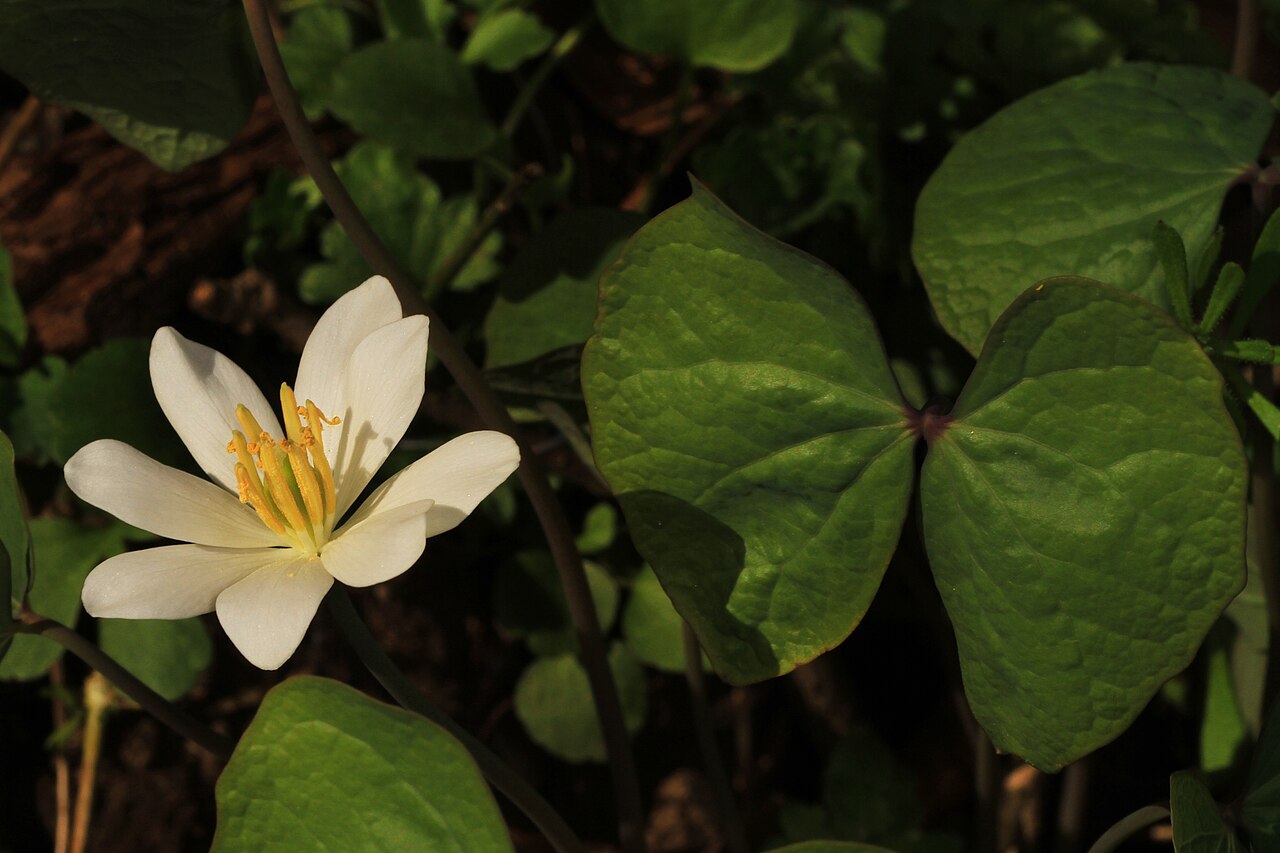
Jeffersonia diphylla, known as Twinleaf or rheumatism root, is a spring wildflower of rich, moist woodlands in eastern North America. Each leaf is divided almost completely into two matching, kidney-shaped halves, so that it looks like a pair of butterfly wings held on a single stalk. In early spring, often before the leaves have fully opened, single white flowers about an inch across rise on leafless stalks. They look a little like bloodroot, but they are among the most short-lived flowers in the woods, often dropping their petals within a day or two.
Twinleaf belongs to the barberry family (Berberidaceae), alongside mayapple and blue cohosh. Its genus is one of very few named for a U.S. president: the botanist Benjamin Smith Barton named it for Thomas Jefferson in 1792. Its only close relative grows in northeastern Asia, a classic example of the plant links between the forests of eastern North America and eastern Asia.
In the garden, twinleaf is a long-lived, slow-growing perennial for shade. The flowers are fleeting, but the unusual leaves stay attractive well into summer, and the curious lidded seed pods are a conversation piece. All parts, especially the rhizome, contain bitter alkaloids and should not be eaten. Buy only nursery-propagated plants, never dig plants from the wild.
Identification
Twinleaf is one of the easiest woodland plants to recognize once its leaves are up. No other native wildflower in its range has leaves split into two nearly identical lobes. In flower, it can be confused with bloodroot, but the leaves and the number of petals tell them apart.
Growth Habit
Twinleaf grows from a short, thick rhizome with many fibrous roots, forming a compact clump that slowly widens over the years. There is no leafy stem: all the leaves and flower stalks come straight from the ground. At flowering time the plant is often only 4 to 8 inches tall, but the leaf stalks keep growing afterward, and by summer the clump stands 12 to 18 inches tall.
Leaves
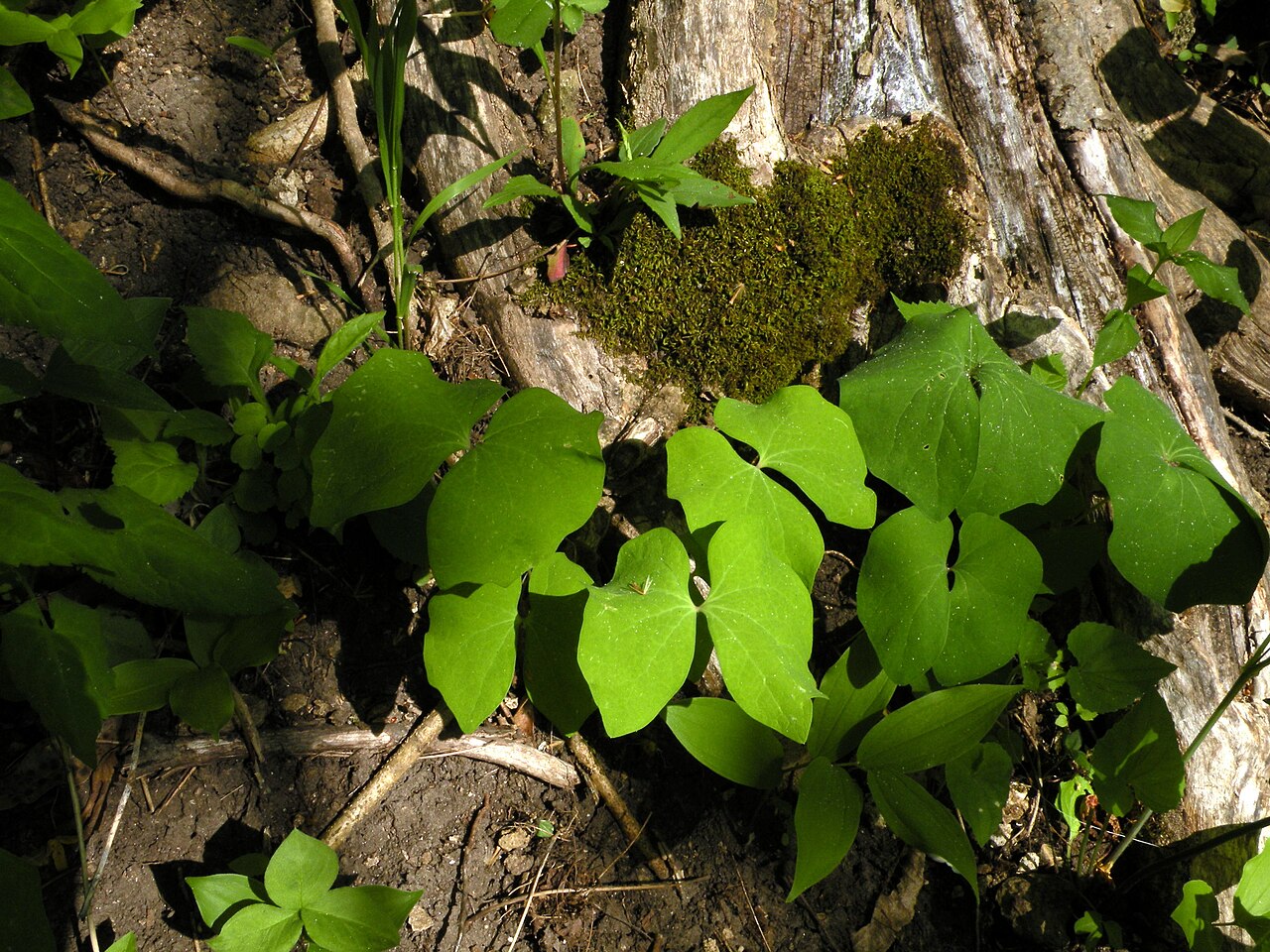
Each leaf has a long stalk and a blade that is divided almost to the base into two half-leaves, each about 2 to 6 inches long. The halves are kidney- to ear-shaped, with smooth or slightly wavy edges, and often a few shallow lobes. They are bluish-green on top and paler and somewhat whitish (glaucous) underneath. When the leaves emerge they are often purplish and folded together like praying hands, then open flat.
Flowers
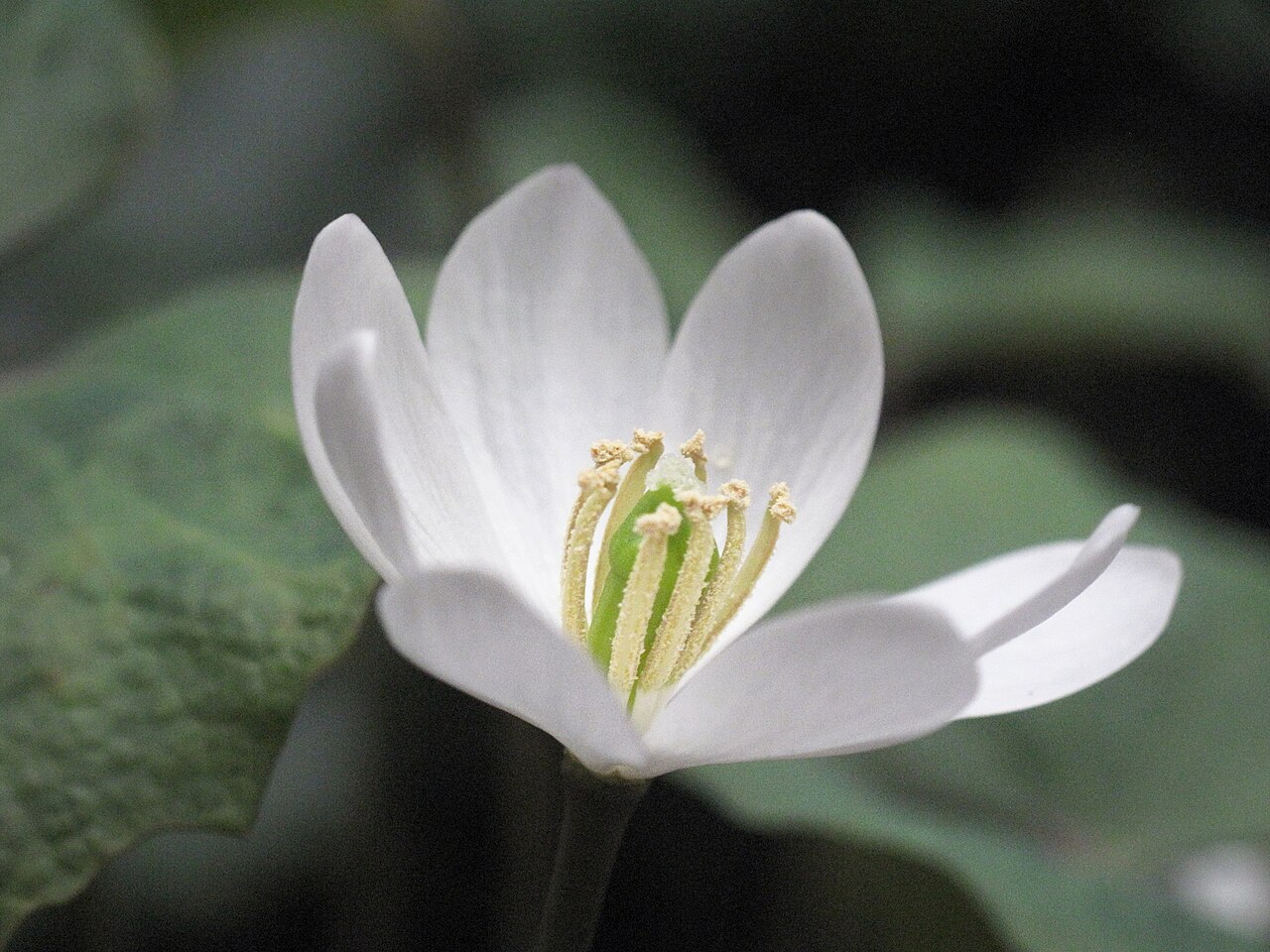
The flowers appear in early to mid-spring, from late March to early May, often while the leaves are still small. Each one sits alone at the top of a leafless stalk and is about 1 to 1½ inches across, with usually eight white, oblong petals that open into a flat star. The four sepals fall as the flower opens. In the center are eight stamens with yellow anthers and a green pistil. The flowers last only a short time, and rain or wind can strip their petals in a single day.
Bloodroot (Sanguinaria canadensis) blooms at the same time and has similar white flowers, but it usually has 8 to 16 petals, its leaf is a single broad, scalloped blade wrapped around the flower stalk, and broken parts ooze orange-red sap. Twinleaf has clear sap and the distinctive two-part leaf.
Fruit & Seeds
The fruit is the most unusual part of the plant. The pistil swells into a green, pear-shaped capsule about an inch long. When the seeds are ripe, in late spring or early summer, the top of the capsule splits most of the way around and opens like a hinged lid, so the pod looks like a small pipe or a jar with its lid ajar. Inside are a few dozen shiny brown seeds, each with a fleshy, oily appendage (an elaiosome) that attracts ants.
Quick Facts
| Scientific Name | Jeffersonia diphylla (L.) Pers. |
| Family | Berberidaceae (barberry family) |
| Plant Type | Herbaceous perennial; spring-flowering woodland wildflower |
| Mature Height | 4–8 in in flower; 12–18 in by summer |
| Mature Spread | 8–12 in; clumps widen slowly |
| Growth Rate | Slow |
| Sun Exposure | Partial to full shade |
| Water Needs | Moderate; evenly moist soil |
| Soil Type | Rich, humusy, well-drained loam; often over limestone |
| Soil pH | Near neutral (about 6.0–7.5) |
| Bloom Time | Late March–early May |
| Flower Color | White |
| Fall Color | Leaves yellow and fade by late summer or fall |
| Fruit | Pear-shaped capsule that opens by a hinged lid; ant-dispersed seeds |
| Deer Resistant | Usually; the bitter foliage is seldom browsed |
| USDA Hardiness Zones | 4–8 |
Native Range
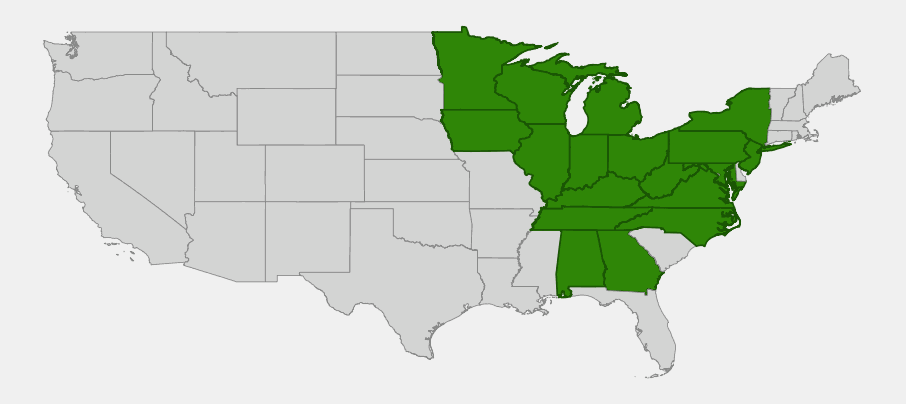
Twinleaf is a plant of the eastern deciduous forest. USDA PLANTS lists it as native in 18 states, from New York, Pennsylvania and New Jersey west through Ohio, Indiana, Michigan, Illinois and Wisconsin to Iowa and Minnesota, and south through Maryland, Virginia, West Virginia, Kentucky and Tennessee to North Carolina, Georgia and Alabama. In Canada it grows only in southern Ontario.
It is most often found in the Ohio Valley, the Great Lakes region and the interior Appalachians. At the edges of its range, including New Jersey, Minnesota, Iowa, North Carolina, Georgia and Alabama, it is scattered and uncommon, and several states track it as a rare plant. In the South it is mostly a plant of the mountains and the limestone valleys of the Ridge and Valley.
Typical habitats are rich, moist deciduous woods, wooded slopes and ravines, and floodplain terraces, especially where the soil lies over limestone or other base-rich rock. It grows under sugar maple, beech, basswood, buckeye and oaks, often in the company of other spring ephemerals such as bloodroot, Virginia bluebells, blue cohosh and Dutchman’s breeches.
📋 Regional plant lists featuring Twinleaf: New York, Pennsylvania & Northern New Jersey · Ohio & Indiana · Michigan, Wisconsin & Eastern Minnesota · Kentucky & Tennessee · Maryland, Virginia & West Virginia · Delaware, Southern New Jersey & Long Island · Illinois, Iowa & Missouri · Alabama, Georgia & Mississippi · North & South Carolina
Growing & Care Guide
Twinleaf is a patient gardener’s plant. It takes a few years to settle in, but once established in a shady spot with rich, moist soil, it can live for decades with almost no attention. Grow it where you will see it in early spring, and give it room so its summer foliage is not smothered by larger neighbors.
Light
Partial to full shade under deciduous trees is ideal. Twinleaf makes much of its growth in spring, while the canopy is still open, and it appreciates shade in summer. Some morning sun is fine in the North, but hot afternoon sun scorches the leaves.
Soil & Water
Give it rich, loose, well-drained soil with plenty of leaf mold. In the wild it favors near-neutral soils over limestone, and in gardens it does well in neutral to slightly acidic or slightly alkaline loam. Keep the soil evenly moist in spring and early summer; established plants tolerate some summer dryness, but long droughts make the leaves die back early. It does not like heavy, waterlogged clay.
Planting Tips
Plant nursery-grown, potted plants in spring or early fall with the crown just at the soil surface, and space them about a foot apart. Mulch with shredded leaves. Twinleaf is slow and dislikes competition, so keep vigorous groundcovers and weeds away from young plants. It pairs well with ferns, wild ginger, hepatica and other spring wildflowers. Never dig twinleaf from the wild: it is uncommon to rare in many places, and buying only nursery-propagated plants protects wild populations.
Pruning & Maintenance
Very little is needed. Leave the fallen leaves of trees in place as a natural mulch, and let the foliage die back on its own in late summer. Avoid moving established clumps; they resent root disturbance.
Propagation
Twinleaf is grown from seed, which must be sown fresh, as soon as the capsules open in early summer. Seeds that are allowed to dry out lose viability quickly. Sow them outdoors in a shaded seedbed or pot and expect germination the following spring. Seedlings take about four to five years to reach flowering size. Large, established clumps can be carefully divided at the end of the growing season. Once a planting is established, it may self-sow nearby, helped along by ants.
Landscape Uses
- Shade and woodland gardens: unusual paired leaves add texture from spring to late summer
- Spring ephemeral plantings: combine with bloodroot, hepatica and Virginia bluebells for an early show
- Native plant collections: a botanical curiosity with Thomas Jefferson’s name and a lidded seed pod
- Under deciduous trees: thrives in leaf litter where lawn grass struggles
- Rock and limestone gardens: suits shady, base-rich sites with good drainage
Wildlife & Ecological Value
Although its flowers last only a short time, twinleaf is part of the busy early-spring life of the forest floor, and its seeds are part of one of the most interesting partnerships in the woods.
For Pollinators
The flowers produce pollen but little or no nectar. They are visited by early bees, including small sweat bees and mining bees, and by flies that are active on warm days in early spring. Because the flowers last so briefly, many go unvisited in cold or rainy springs, and the plant can also set seed by self-pollination.
For Birds
Twinleaf is of little direct value to birds. The rich deciduous woods where it grows, however, support wood thrushes, ovenbirds, warblers and other forest birds that forage among the spring wildflowers.
For Mammals
The leaves and rhizome are bitter and are rarely eaten by deer or rabbits. Small mammals may take some seeds.
Ecosystem Role
Each seed carries an elaiosome, a fatty appendage that ants carry back to their nests. The ants eat the elaiosome and discard the seed, often in a nutrient-rich spot where it can sprout. This process, called myrmecochory, is shared by many spring wildflowers including bloodroot, trillium and Dutchman’s breeches. It helps explain why twinleaf spreads so slowly and why colonies tend to stay in clusters. Healthy twinleaf populations are a sign of intact, rich forest floor that has not been heavily disturbed or invaded by garlic mustard and other weeds.
Cultural & Historical Uses
Twinleaf was named by Benjamin Smith Barton, a Philadelphia physician and botanist, who presented it to the American Philosophical Society in 1792. He chose the name to honor Thomas Jefferson, then Secretary of State, for his knowledge of natural history. Barton praised Jefferson’s learning in natural history, and twinleaf remains one of the best-known plants named for an American president.
The common name rheumatism root refers to past medicinal use. Native American peoples and 19th-century physicians used preparations of the rhizome for a range of ailments, and it was sold as a medicinal root. The rhizome contains berberine and related alkaloids, which are toxic in quantity and can cause stomach upset and other effects. These uses are of historical interest only. Do not eat or use any part of twinleaf as medicine, and keep plants away from pets and young children who might chew on them.
The genus Jeffersonia has only one other species, Jeffersonia dubia of northeastern China, Korea and the Russian Far East, which has lavender-blue flowers. The two species are an example of the striking links between the flora of eastern North America and eastern Asia, which also include mayapple, blue cohosh and many other woodland plants.
Frequently Asked Questions
Why is it called twinleaf?
Each leaf is divided almost to the base into two matching halves, so it looks like a pair of leaves or butterfly wings on a single stalk.
Is twinleaf poisonous?
Yes, it should be treated as toxic. The rhizome and other parts contain bitter alkaloids, including berberine, that can cause stomach upset and other symptoms if eaten. Do not use it as an herbal remedy, and keep children and pets from chewing on it.
Why do the flowers disappear so quickly?
Twinleaf flowers are among the most fleeting of all spring wildflowers. The petals are attached loosely, and a day of wind or rain can strip them off. Visit wild colonies often in early spring if you want to see them in bloom.
How do I tell twinleaf from bloodroot?
Look at the leaves. Twinleaf leaves are split into two equal halves; bloodroot has a single, broad, lobed leaf that wraps around the flower stalk. Bloodroot also bleeds orange-red sap when broken.
Can I grow twinleaf from seed?
Yes, but it takes patience. Sow seeds fresh in early summer, as soon as the pods open, because dry seeds lose viability. Seedlings usually need four to five years to bloom. Buy nursery-propagated plants for faster results, and never dig plants from the wild.

Looking for a nursery that carries Twinleaf?
Browse our native plant nursery directory: Alabama · Georgia · Illinois, Indiana & Iowa · Kentucky, Maryland, Michigan & Minnesota · New Jersey, New York, North Carolina & Ohio · Pennsylvania, Tennessee & Virginia · West Virginia & Wisconsin