
Andrews’ Clintonia (Clintonia andrewsiana)
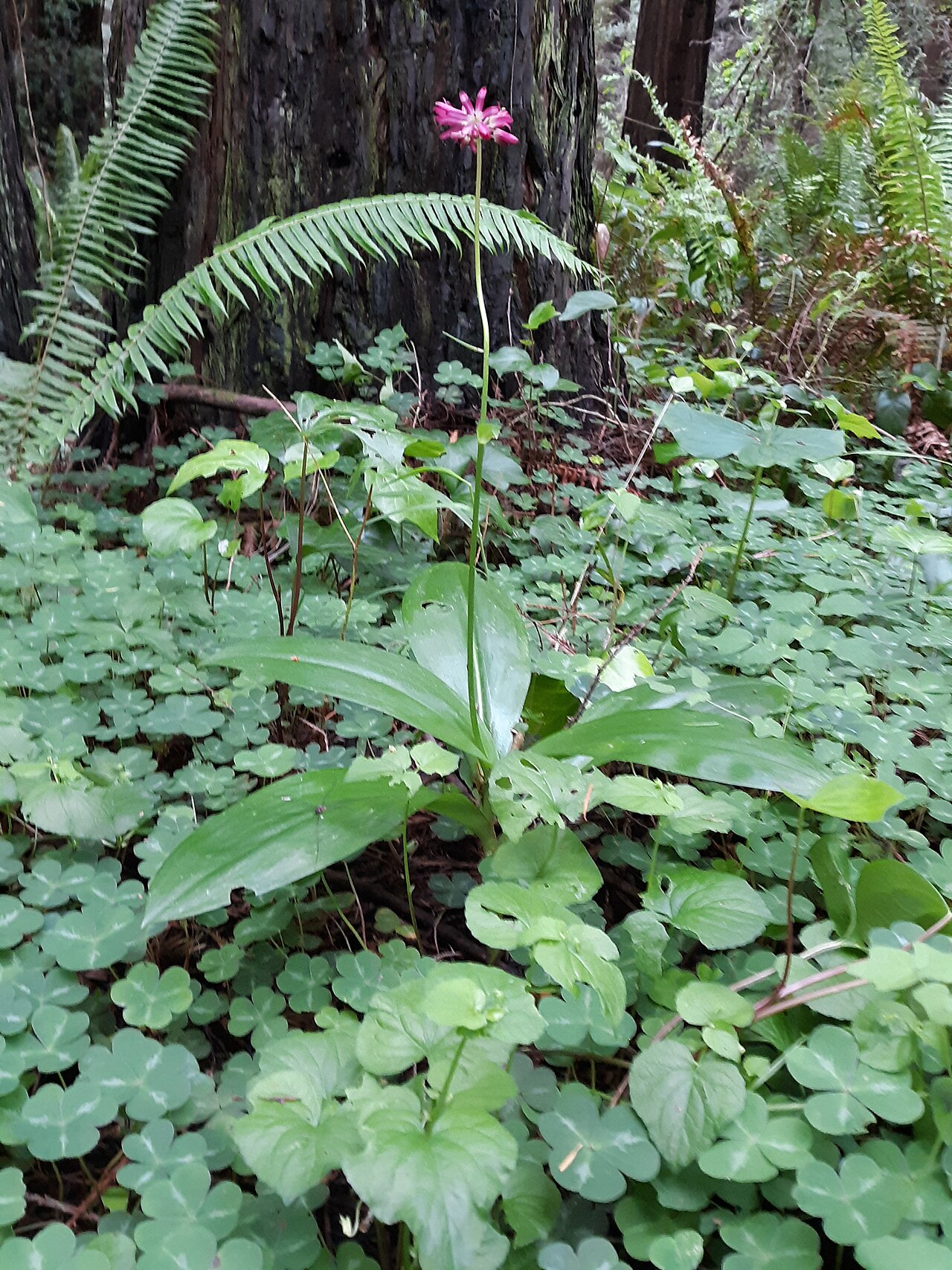
Clintonia andrewsiana, known as Andrews’ Clintonia (USDA: Andrew’s clintonia; also red clintonia, western bluebead lily or bluebead lily), is a striking woodland lily of the coast redwood forests of California and southwestern Oregon. It belongs to the lily family (Liliaceae). From a rosette of large, glossy, dark green leaves it sends up a tall, nearly leafless stalk topped by a ball of deep rose to claret-red bell-shaped flowers in late spring, followed by clusters of brilliant blue berries.
It is the largest species in its genus, reaching 1 to 2 1/2 feet tall in bloom. It spreads slowly by underground rhizomes into loose colonies, often growing with sword fern, redwood sorrel and western trillium in deep, cool shade. In the redwood belt it is one of the showiest spring wildflowers, and hummingbirds visit its red flowers.
Please never dig it from the wild. Plants are long-lived and slow to establish, and wild colonies in redwood parks are protected. Nursery-propagated plants are occasionally available from California native plant nurseries. The berries are not edible; the Pomo people of northern California regarded the plant as poisonous.
Identification
Look for a clump of 5 or 6 broad, shiny, strap- to oval-shaped leaves at ground level in redwood forest shade, with a single stout stalk carrying a rounded cluster of deep pink to red flowers in May to July, or blue berries later in summer.
Leaves
The leaves all arise from the base: usually 5 or 6 per plant, elliptic to oblong, 8 to 14 inches (20 to 35 cm) long and 2 to 6 inches (5 to 15 cm) wide. They are thick, glossy, dark green and slightly fleshy, with smooth edges and fine parallel veins, and they stay green from spring into fall.
Flower Stalk
A single erect, leafless or nearly leafless stalk rises 12 to 31 inches (30 to 80 cm) from the center of the rosette. It is often slightly hairy near the top. Young plants and plants in deep shade may produce leaves only for several years before flowering.
Flowers
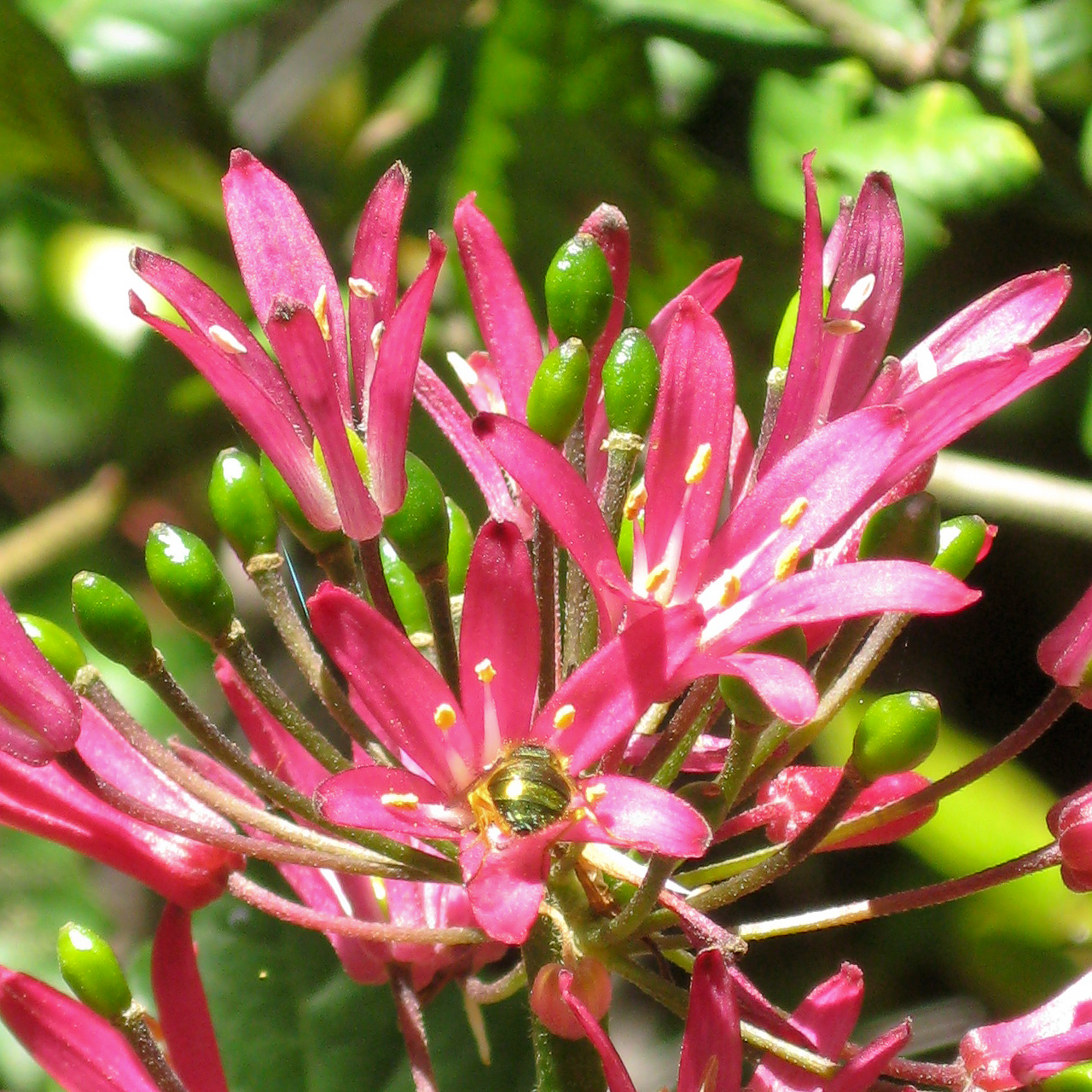
The flowers are held in a terminal umbel of about 10 to 20, often with one to three smaller umbels of 2 to 4 flowers lower on the stalk. Each flower is narrowly bell-shaped, about 1/2 to 3/4 inch (1 to 2 cm) long, with six deep rose, pink-red or claret-colored tepals and six stamens about half as long as the tepals. Bloom time is mainly May to July.
Fruit
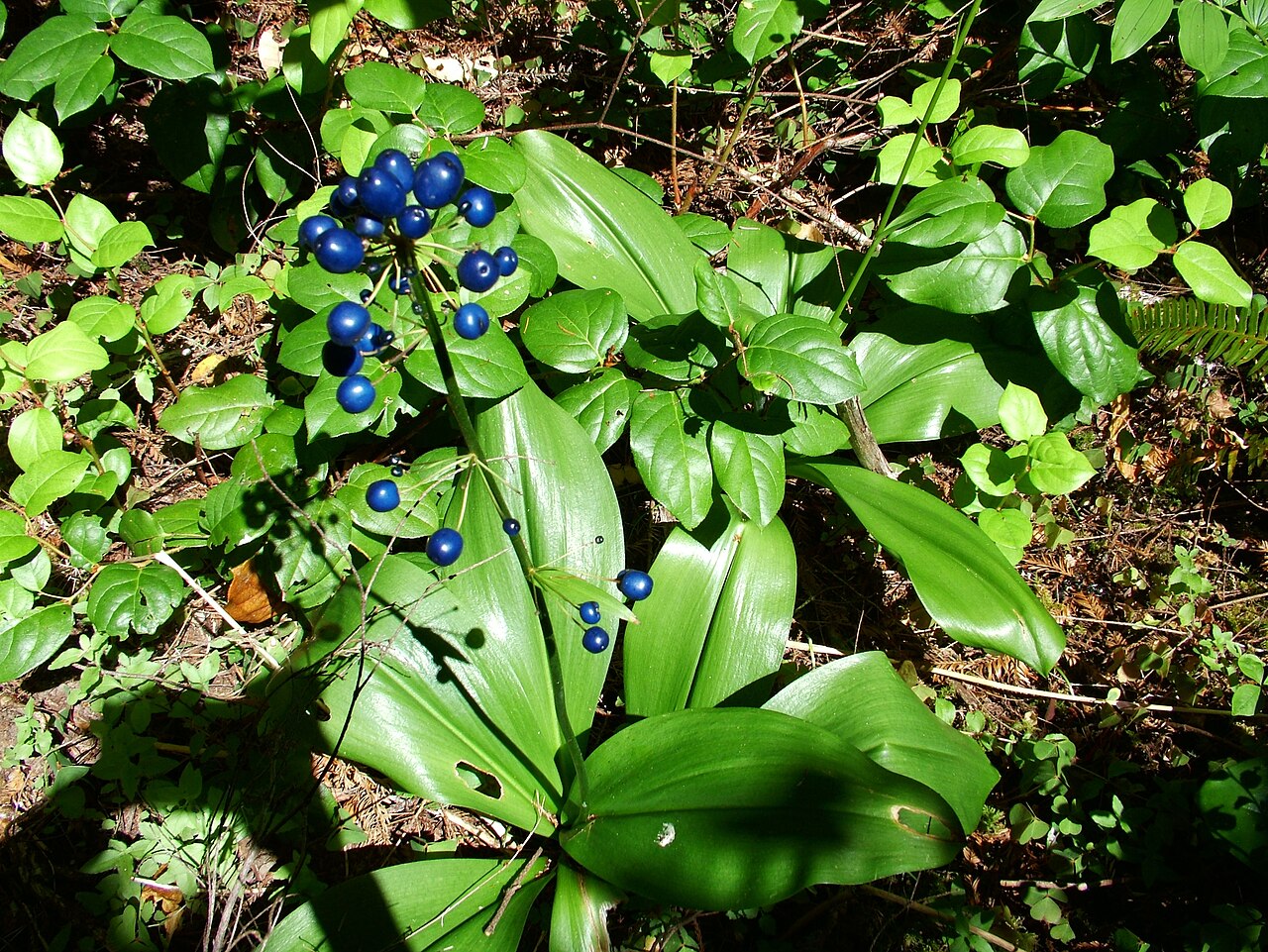
The fruits are round, glossy berries about 3/8 inch (1 cm) across, ripening from green to a deep, bright blue or blue-black in late summer. They are showy against the dark foliage and are the source of the name bluebead lily.
Look-alikes
Bride’s bonnet (Clintonia uniflora), which overlaps with it in Humboldt and Del Norte counties and Curry County, Oregon, is much smaller and has one (rarely two) white flowers per stalk. The eastern Bluebead Lily (C. borealis) has yellow flowers and does not grow in the West, and White Clintonia (C. umbellulata) of the Appalachians has white, speckled flowers. Before flowering, the broad basal leaves might be mistaken for those of Giant Trillium or false Solomon’s seal, but trilliums have three leaves in a whorl on a stem.
Safety & Conservation
Do not eat the berries. The Pomo people considered the plant poisonous, and the berries of related clintonias are generally regarded as inedible. The species is listed as apparently secure (G4) by NatureServe, but it depends on intact, shady redwood forest, and digging plants from parks or private forests is both illegal in many places and harmful to slow-growing colonies.
Quick Facts
| Scientific Name | Clintonia andrewsiana |
| Family | Liliaceae (lily family) |
| Plant Type | Rhizomatous herbaceous perennial |
| Mature Height | 12–31 in (in flower) |
| Mature Spread | 12–24 in; slowly forms colonies |
| Growth Rate | Slow |
| Sun Exposure | Part shade to full shade |
| Water Needs | Moderate; evenly moist soil, summer fog or irrigation |
| Soil Type | Rich, humusy, well-drained forest soils with leaf litter |
| Soil pH | Acidic, about 5.0–6.5 |
| Bloom Time | May–July |
| Flower Color | Deep rose, pink-red to claret |
| Fall Color | None notable; foliage dies back in winter |
| Fruit | Glossy deep blue berries, about 3/8 in |
| Deer Resistant | Moderate; slugs are the bigger problem |
| USDA Hardiness Zones | 8–10 |
Native Range
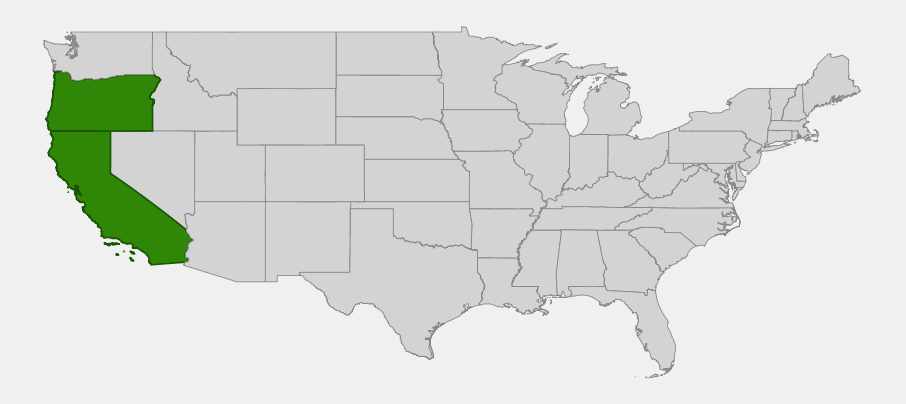
Andrews’ clintonia has a small, mostly coastal range. USDA PLANTS lists it as native in California and Oregon. It grows from the Santa Cruz Mountains and northern Monterey County in central California north through the coast ranges of San Mateo, Marin, Sonoma, Mendocino, Humboldt and Del Norte counties, just reaching Curry County in far southwestern Oregon.
It is closely tied to the fog belt of the coast redwood (Sequoia sempervirens), and it is a familiar sight in parks such as Redwood National and State Parks, Humboldt Redwoods, Armstrong Redwoods, Muir Woods and the Forest of Nisene Marks. It also grows in moist Douglas-fir and mixed evergreen forests near the redwood belt.
Its habitat is deep, cool shade on moist, humus-rich slopes, flats and stream banks, usually at low elevations within the reach of summer fog. Because it grows only west of the Cascades and the Sierra Nevada, it does not occur in the dry interior of Oregon.
📋 Regional plant lists featuring Andrews’ Clintonia: Western Oregon & Western Washington · California & Nevada
Growing & Care Guide
Andrews’ clintonia is a choice plant for a shady woodland garden within its native coastal climate. It is slow to settle in but long-lived once happy. Buy nursery-propagated plants only, and never dig from the wild.
Light
Part to full shade. Morning sun is tolerated near the coast, but hot afternoon sun scorches the broad leaves. Bright shade under tall trees is ideal.
Soil & Water
Plant in rich, loose, acidic soil with plenty of leaf mold or compost. Keep the soil evenly moist through the growing season; in gardens away from summer fog, give regular summer water, but avoid soggy, poorly drained ground, which rots the rhizomes.
Planting Tips
Set rhizomes shallowly, just under the surface, in fall or early spring, and mulch with leaf litter or fine bark. Group several plants together with ferns, redwood sorrel and wild ginger to mimic a redwood forest floor. It does best in coastal California and southwestern Oregon gardens; inland heat and dry air are hard on it.
Pruning & Maintenance
Little is needed. Leave the flower stalks to ripen berries, and let fallen leaves stay as mulch. Slugs and snails love the young leaves and flower buds, so protect plants in spring.
Propagation
Divide established clumps carefully in fall or early spring, keeping a growing point and roots on each piece. Plants can be grown from cleaned fresh seed sown outdoors in fall, but seedlings are slow and may take several years to flower.
Landscape Uses
- Redwood and shade gardens: a showy, long-lived woodland perennial
- Fern and woodland borders: bold leaves contrast with fern fronds
- Hummingbird gardens: red-pink flowers in late spring
- Habitat restoration: native understory plant in coastal forests
- Wildflower viewing: a highlight of spring walks in redwood parks
Wildlife & Ecological Value
Andrews’ clintonia adds color and food to the dim redwood understory, where few plants flower showily.
For Pollinators
Hummingbirds visit the tubular red flowers, and bumblebees and other native bees collect pollen and nectar from them.
For Birds
Birds eat some of the blue berries and help spread the seeds, along with small mammals.
For Mammals
Deer browse the plants lightly. Small mammals may take fallen berries. Banana slugs and other slugs graze the leaves.
Ecosystem Role
As a long-lived rhizomatous perennial of the redwood forest floor, it helps hold humus-rich soil on shady slopes and is part of the distinctive herb layer of old-growth and mature redwood forest.
Cultural & Historical Uses
The genus Clintonia is named for DeWitt Clinton, the New York governor and naturalist who championed the Erie Canal. The species name honors Timothy Langdon Andrews (1819–1908), an early collector who studied the botany of California. The plant was collected by John Milton Bigelow in 1854 and described by John Torrey in 1856.
The Pomo people of northern California regarded the plant as poisonous. Its glossy blue berries gave it the name bluebead lily, which it shares with the eastern Bluebead Lily.
For many visitors to the redwoods, the sight of its pink-red flower heads above a carpet of redwood sorrel is a classic late-spring scene. Other plants of the same forest on this site include Western Wild Ginger, Vanilla Leaf and California Fetid Adderstongue.
Frequently Asked Questions
Where does Andrews’ clintonia grow?
It grows in coast redwood and nearby moist forests from the Santa Cruz Mountains and Monterey County, California, north to Curry County in southwestern Oregon.
Are the blue berries edible?
No. The berries are not considered edible, and the Pomo people regarded the plant as poisonous. Enjoy them by sight only.
Can I grow Andrews’ clintonia in my garden?
Yes, in shady, moist, humus-rich soil, especially in coastal California and Oregon. Buy nursery-propagated plants, protect them from slugs and be patient; it is slow to establish.
How is it different from bride’s bonnet?
Bride’s bonnet (Clintonia uniflora) is a small plant with one white flower per stalk. Andrews’ clintonia is much taller, with clusters of many pink-red flowers.
Can I dig plants from the forest?
No. Wild plants in parks are protected, and dug plants rarely survive. Use nursery stock or seed instead.

Looking for a nursery that carries Andrews’ Clintonia?
Browse our native plant nursery directory: California · Oregon