
Purple Cress (Cardamine douglassii)
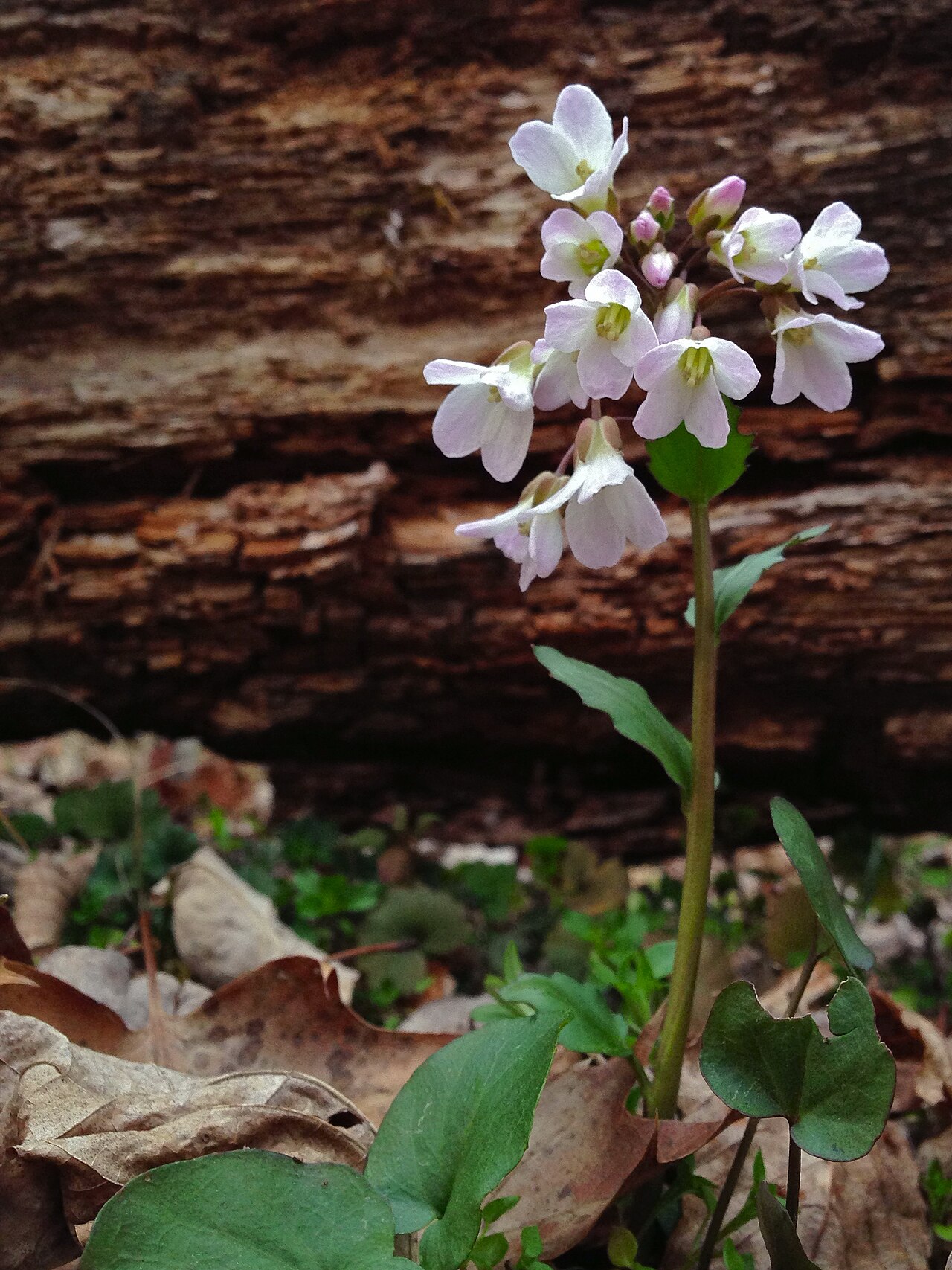
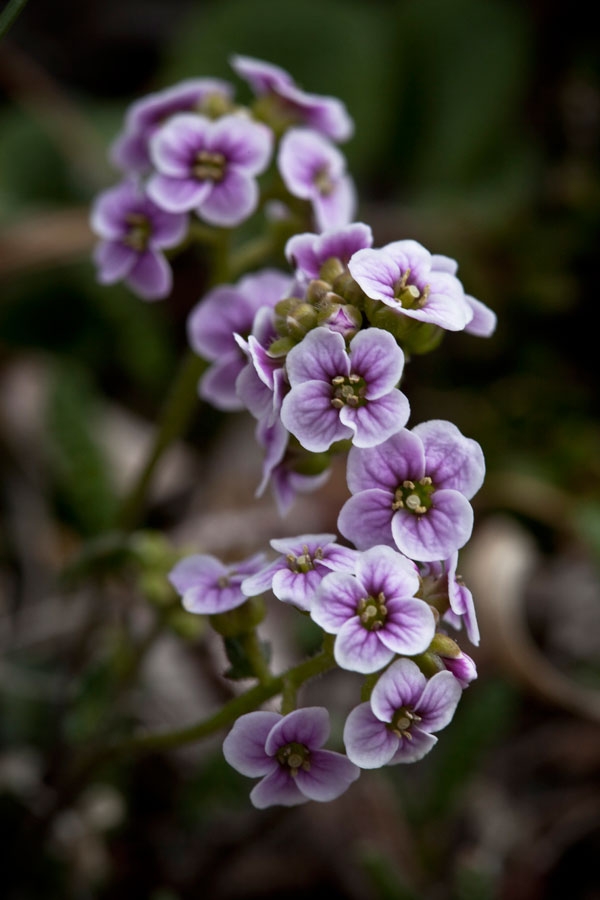
Cardamine douglassii, known as Purple Cress (USDA: limestone bittercress), is one of the first native wildflowers to bloom in the rich woods of the eastern and midwestern United States. A small member of the mustard family (Brassicaceae), it sends up short, hairy stems in March and April topped with loose clusters of four-petaled flowers in shades of pale pink, lavender or nearly white. Older books list it as Dentaria douglassii, from the time when toothworts and their relatives were kept in a separate genus.
Purple cress is a true spring ephemeral. It grows from a small, tuber-bearing rhizome, appears as the snow melts, flowers before the trees leaf out, sets its slender seed pods, and then withers back underground by early summer. For a few weeks it can carpet moist slopes and floodplain terraces, often alongside spring beauty, toothworts and Dutchman’s breeches. Its USDA name, limestone bittercress, reflects its fondness for rich soils over limestone and other lime-rich bedrock.
For gardeners it is a charming, low-maintenance plant for a woodland garden or a shady spot under deciduous trees, where it gives early color and early nectar for native bees, then disappears and leaves room for ferns and later perennials. It is seldom sold, so look for nursery-grown plants or seed from native plant specialists, and never dig plants from the wild.
Identification
Purple cress is small, usually 4 to 12 inches tall, and easy to overlook once the flowers fade. In bloom, look for the combination of pink to lavender four-petaled flowers, a hairy stem, and two or three stalkless, toothed leaves on the stem.
Roots & Growth Habit
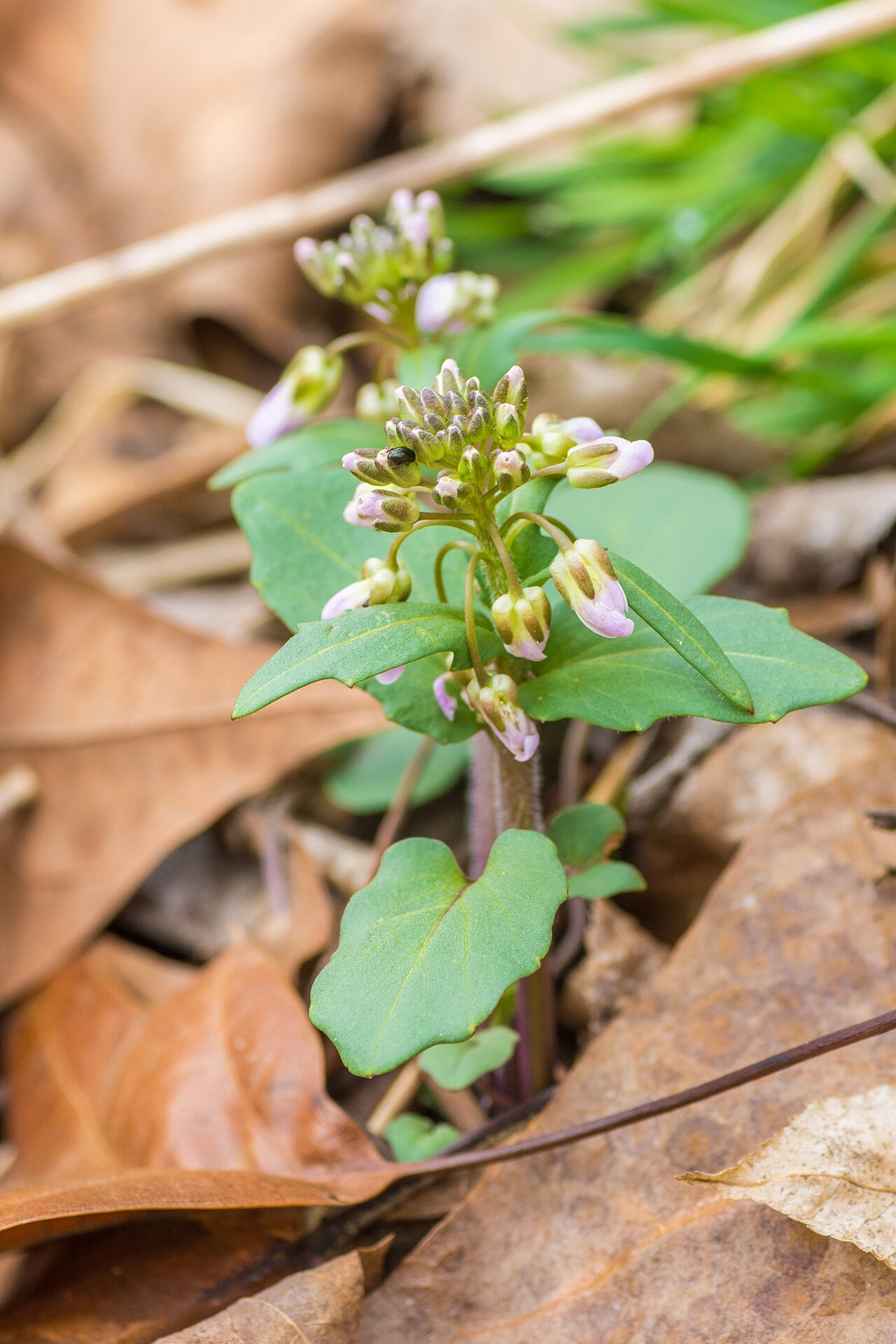
The plant grows from a short, slender rhizome bearing small, rounded tubers. Each tuber can produce a new stem, so plants slowly form loose colonies. Stems are unbranched and usually covered with short hairs, especially in the upper part. All above-ground growth dies back within a few weeks of flowering, typically by late May or June.
Leaves
The basal leaves grow directly from the rhizome on long stalks. They are rounded to kidney-shaped or heart-shaped, about 1 to 2 inches wide, with wavy or shallowly toothed edges. Stem leaves, usually two or three, are quite different: they are stalkless, narrowly oval to lance-shaped, and have a few coarse teeth along the margins. Basal leaves may wither by the time the plant is in full bloom.
Flowers
From March into May, each stem ends in a loose raceme of about 5 to 15 flowers, each roughly 1/2 to 3/4 inch across. As in all mustards, there are four petals arranged in a cross, four sepals and six stamens (four long, two short). The petals are pale pink to rose-purple, sometimes nearly white, often with darker veins. Flowers open in succession from the bottom of the cluster upward.
Fruit & Seeds
After flowering, the flowers develop into narrow, upright seed pods (siliques) about 1 to 1 1/2 inches long, tipped with the remains of the style. When ripe, the pod walls coil back suddenly from the base and fling out the small seeds, a typical trick of the bittercresses. Seeds ripen in late spring, just before the plant goes dormant.
Look-alikes
Spring cress (Cardamine bulbosa) grows in wetter places, blooms a little later, has white flowers and smooth (hairless) stems. Cut-leaved toothwort has a whorl of three deeply divided leaves on the stem, and two-leaved toothwort has two leaves, each split into three broad, toothed leaflets; both have mostly white flowers. Introduced cuckooflower (C. pratensis) has divided leaves with many small leaflets. Purple cress is usually the earliest of these to flower, and its pinkish color, hairy stem and undivided stem leaves set it apart.
Safety
Purple cress is not considered poisonous. Like many cresses, its leaves have a peppery, mustard-like taste and have been nibbled as a wild green. It is a small, slow-spreading plant that is easily damaged by picking, though, so it is best enjoyed by looking rather than harvesting, especially where it is uncommon.
Quick Facts
| Scientific Name | Cardamine douglassii |
| Family | Brassicaceae (mustard family) |
| Plant Type | Herbaceous perennial; spring ephemeral from a tuber-bearing rhizome |
| Mature Height | 4–12 in |
| Mature Spread | 3–6 in per stem; slowly forms loose colonies |
| Growth Rate | Slow |
| Sun Exposure | Part shade; sun in early spring, shade in summer |
| Water Needs | Medium to high; moist soil in spring |
| Soil Type | Rich, humusy loam; often over limestone |
| Soil pH | About 6.0–7.5 (slightly acidic to slightly alkaline) |
| Bloom Time | March–May |
| Flower Color | Pale pink to lavender or rose-purple, sometimes white |
| Fall Color | None; dormant by early summer |
| Fruit | Slender upright pods (siliques) 1–1 1/2 in long |
| Deer Resistant | Moderate; small and short-lived above ground |
| USDA Hardiness Zones | 4–8 |
Native Range
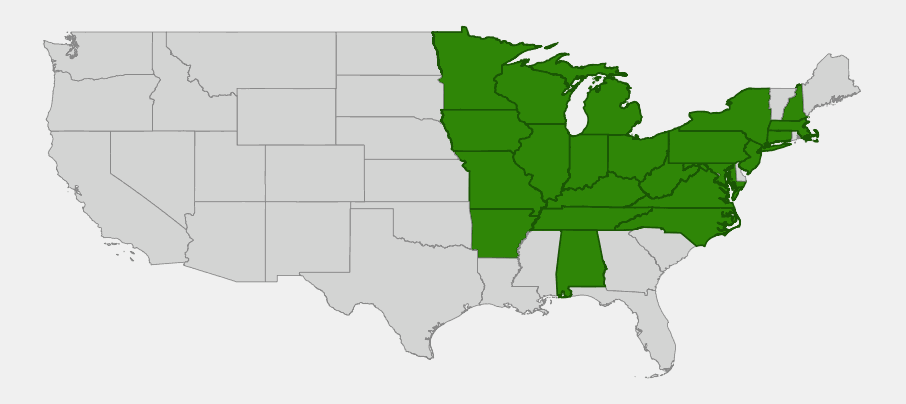
Purple cress is native to eastern North America. USDA PLANTS records it as native in Ontario and in 22 states plus the District of Columbia: from Minnesota, Wisconsin and Michigan east through Ohio, Pennsylvania and New York, and south to Missouri, Arkansas, Kentucky, Tennessee, Virginia, North Carolina and Alabama. Its center of abundance is the Ohio Valley and the southern Great Lakes region, where it is locally common in rich woods.
Toward the edges of its range it becomes scattered. The records from New England (Connecticut, Massachusetts and New Hampshire), New Jersey and Maryland are sparse and represent outlying populations, and in Minnesota it reaches only the southeastern part of the state. To the south, it is found mainly in the Ozarks of Missouri and northern Arkansas, the Nashville Basin and the Appalachian valleys of Tennessee, Virginia and North Carolina, and northern Alabama.
Its habitat is rich, moist deciduous woods: floodplain terraces and stream banks, wooded ravines, the base of bluffs and moist slopes, often on soils derived from limestone or other calcium-rich rock. It favors spots that are sunny in early spring before the canopy closes and shady for the rest of the year.
📋 Regional plant lists featuring Purple Cress: New York, Pennsylvania & Northern New Jersey · Ohio & Indiana · Michigan, Wisconsin & Eastern Minnesota · Kentucky & Tennessee · Connecticut, Massachusetts & Rhode Island · New Hampshire, Maine & Vermont · Maryland, Virginia & West Virginia · Delaware, Southern New Jersey & Long Island · Illinois, Iowa & Missouri · Alabama, Georgia & Mississippi · North & South Carolina · Arkansas, Louisiana, Eastern Oklahoma & Eastern Texas
Growing & Care Guide
Purple cress is easy to keep once it is established in the right spot, but it is not a plant for a sunny border. Think of it as part of a spring woodland layer: plant it where it can enjoy early spring light, rich leafy soil and summer shade, and let it go dormant without fuss. Buy nursery-propagated plants or seed; never dig plants from the wild.
Light
Give it full or partial sun in early spring and shade in summer, the conditions found under deciduous trees and shrubs. Because it finishes its growth before the canopy closes, it does well in spots that are quite shady from June onward.
Soil & Water
Plant it in rich, loose, humusy soil that stays moist in spring. It tolerates and often prefers neutral to slightly alkaline soil, but grows in slightly acidic woodland soil too. Spring moisture matters most; once dormant, the tubers tolerate drier summer conditions, though they should not bake in hot, bare soil.
Planting Tips
Plant potted plants in spring while in leaf, or dormant tubers in late summer or fall, about 1 inch deep. Set them in groups of several, as single stems are easily lost. Mark the spot, since the plants vanish in summer. Pair it with summer-leafy companions such as ferns, wild ginger, or woodland sedges that will fill the gap it leaves.
Pruning & Maintenance
No pruning is needed. Let the foliage yellow and die back naturally so the tubers can store energy for next year. Leave a light layer of fallen leaves in place each autumn; leaf litter mimics its natural habitat and keeps the soil cool and moist. Avoid digging or heavy mulching where the plants are dormant.
Propagation
Collect seed from your own plants in late spring just before the pods open, and sow it immediately outdoors or in pots left outside; it needs a warm-then-cold cycle and may take a year to germinate. Established clumps can be divided after the foliage dies down by lifting and replanting tubers. Plants take a few years to build into a showy patch.
Landscape Uses
- Woodland gardens: an early pink accent among ferns, wild ginger and later perennials
- Spring ephemeral plantings: with spring beauty, toothworts, trout lilies and bloodroot
- Shade under deciduous trees: blooms before the canopy fills in, then goes dormant
- Early pollinator support: nectar and pollen for native bees in March and April
- Woodland restoration: a native groundlayer species for rich, moist forest sites
Wildlife & Ecological Value
Purple cress blooms when few other flowers are open, which makes it more important to wildlife than its small size suggests.
For Pollinators
The flowers provide nectar and pollen for early-season insects, especially small native bees such as mining bees (Andrena) and small sweat bees, along with bee flies and early butterflies. Mustard-family plants, including native cresses and toothworts, are larval hosts for white and orangetip butterflies such as the falcate orangetip (Anthocharis midea).
For Birds
Purple cress has little direct value for birds, but the insects it supports in early spring are food for returning migrant songbirds foraging in the woodland understory.
For Mammals
Deer and rabbits may browse the tender spring growth, and small mammals may eat the tubers, but the plant is up for so short a time that it usually escapes heavy damage.
Ecosystem Role
As a spring ephemeral, purple cress helps capture nutrients released from the soil in early spring, before trees leaf out, and returns them to the forest floor when it dies back. Along with other spring wildflowers, it is a sign of rich, relatively undisturbed woodland soil.
Cultural & Historical Uses
The genus name Cardamine comes from an old Greek name for a cress-like plant, and the name bittercress refers to the sharp, peppery flavor shared by many species. Like watercress and other mustards, cresses contain mustard oils (glucosinolates) that give them their bite.
Purple cress was long placed in the genus Dentaria, together with the toothworts, and some field guides still use the name Dentaria douglassii. Botanists later merged Dentaria into Cardamine after studies showed the two groups are closely related. The common names purple cress and limestone bittercress are both in use.
In the Midwest, purple cress is a familiar sight to spring wildflower walkers. It is often the first pink flower to appear on the forest floor, sometimes blooming alongside lingering snow, and it is a good indicator plant for rich, moist, lime-influenced woodlands.
Frequently Asked Questions
When does purple cress bloom?
It is one of the earliest woodland wildflowers, blooming from March into May depending on latitude and weather, often a week or two before toothworts and trilliums.
Why did my purple cress disappear in summer?
That is normal. It is a spring ephemeral that dies back to underground tubers by early summer and reappears the following spring. Mark the spot so you do not dig into it.
Is purple cress the same as limestone bittercress?
Yes. Limestone bittercress is the USDA PLANTS common name for Cardamine douglassii. It is also listed in older books as Dentaria douglassii.
How is purple cress different from spring cress?
Spring cress (Cardamine bulbosa) has white flowers and smooth stems and grows in wetter, swampy places. Purple cress has pinkish flowers and hairy stems and grows in rich, moist woods.
Can I grow purple cress in a sunny garden?
Not well. It needs the spring sun and summer shade of a deciduous woodland, plus rich, moist, leafy soil. In hot, sunny, dry beds it dwindles.

Looking for a nursery that carries Purple Cress?
Browse our native plant nursery directory: Alabama & Arkansas · Connecticut · Illinois, Indiana & Iowa · Kentucky, Maryland, Massachusetts, Michigan, Minnesota & Missouri · New Hampshire, New Jersey, New York, North Carolina & Ohio · Pennsylvania, Tennessee & Virginia · West Virginia & Wisconsin