
Thickleaf Groundcherry (Physalis crassifolia)
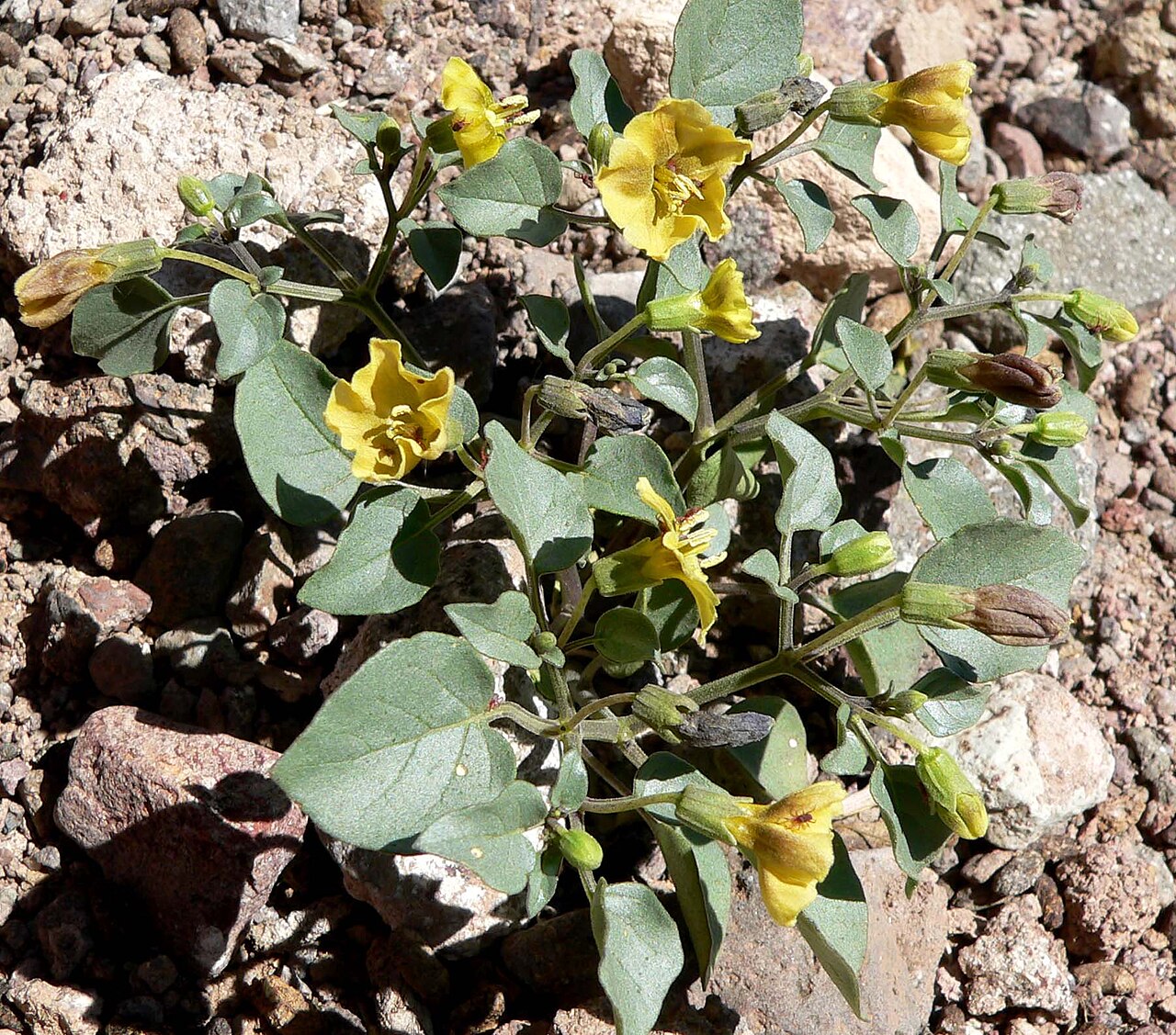
Physalis crassifolia, known as Thickleaf Groundcherry, is a low, bushy desert perennial in the nightshade family (Solanaceae). USDA PLANTS calls it yellow nightshade groundcherry, and it is also known as thick-leaved ground-cherry. It forms a mounded or sprawling clump of angular, zigzag stems up to about 2 1/2 feet long, with small, fleshy, gray-green oval leaves and open, pale yellow, bell-shaped flowers.
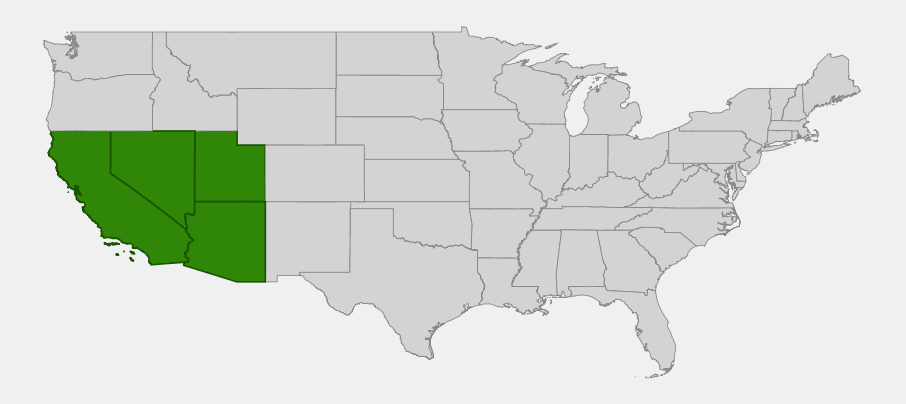
It grows on rocky slopes, canyon walls, gravelly washes and desert flats in the Mojave and Sonoran Deserts of southern California, southern Nevada, southwestern Utah and western Arizona, and south into northern Mexico. After rain it can bloom in almost any month from late winter to fall, and its flowers are followed by the papery, lantern-like husks typical of groundcherries.
Thickleaf groundcherry is a tough, heat-loving native for desert rock gardens and natural landscapes. Safety note: like other members of the nightshade family, its leaves, stems and unripe fruit contain toxic alkaloids. Do not eat any part of the plant, and keep children and pets from nibbling the berries.
Identification
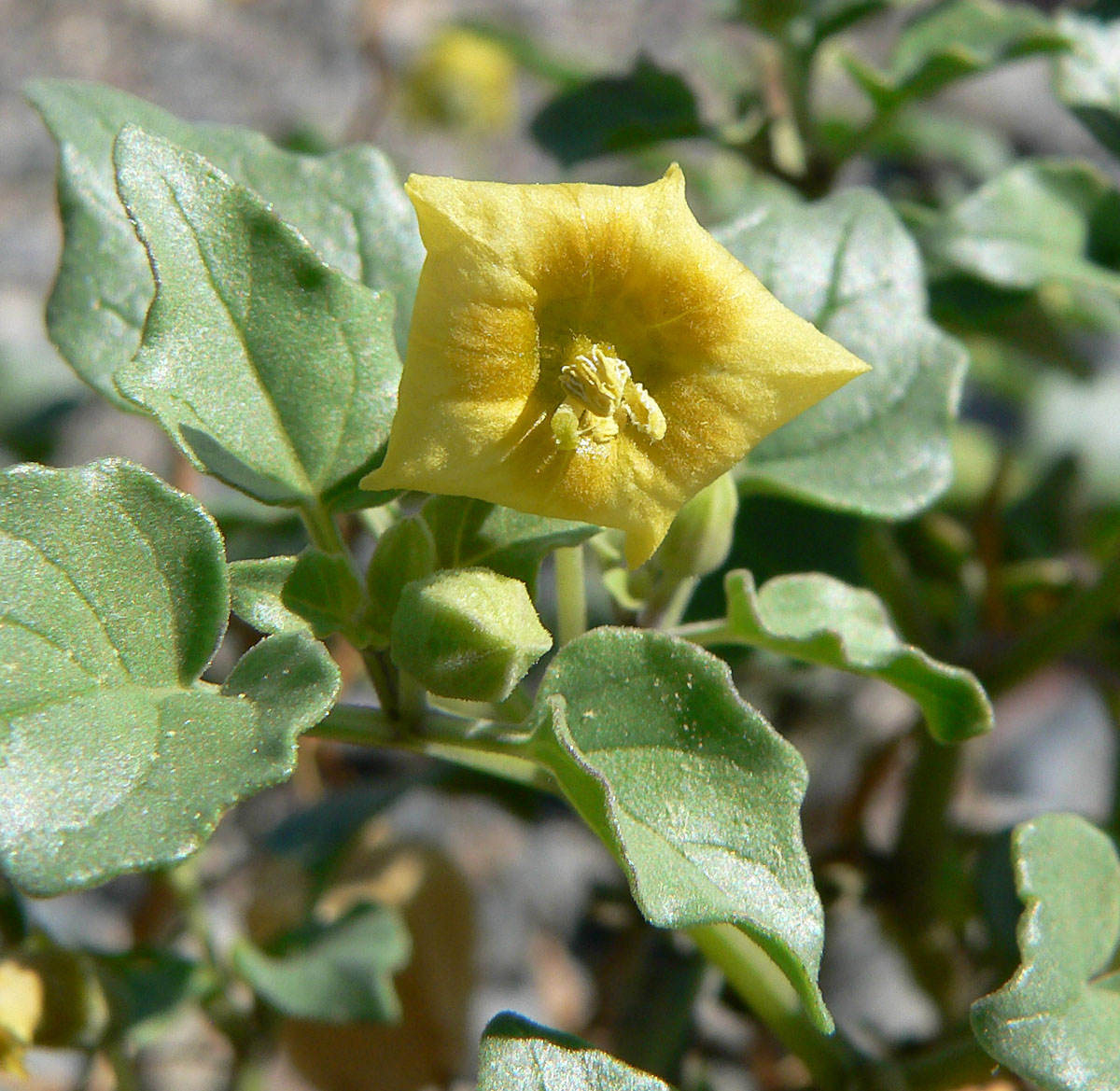
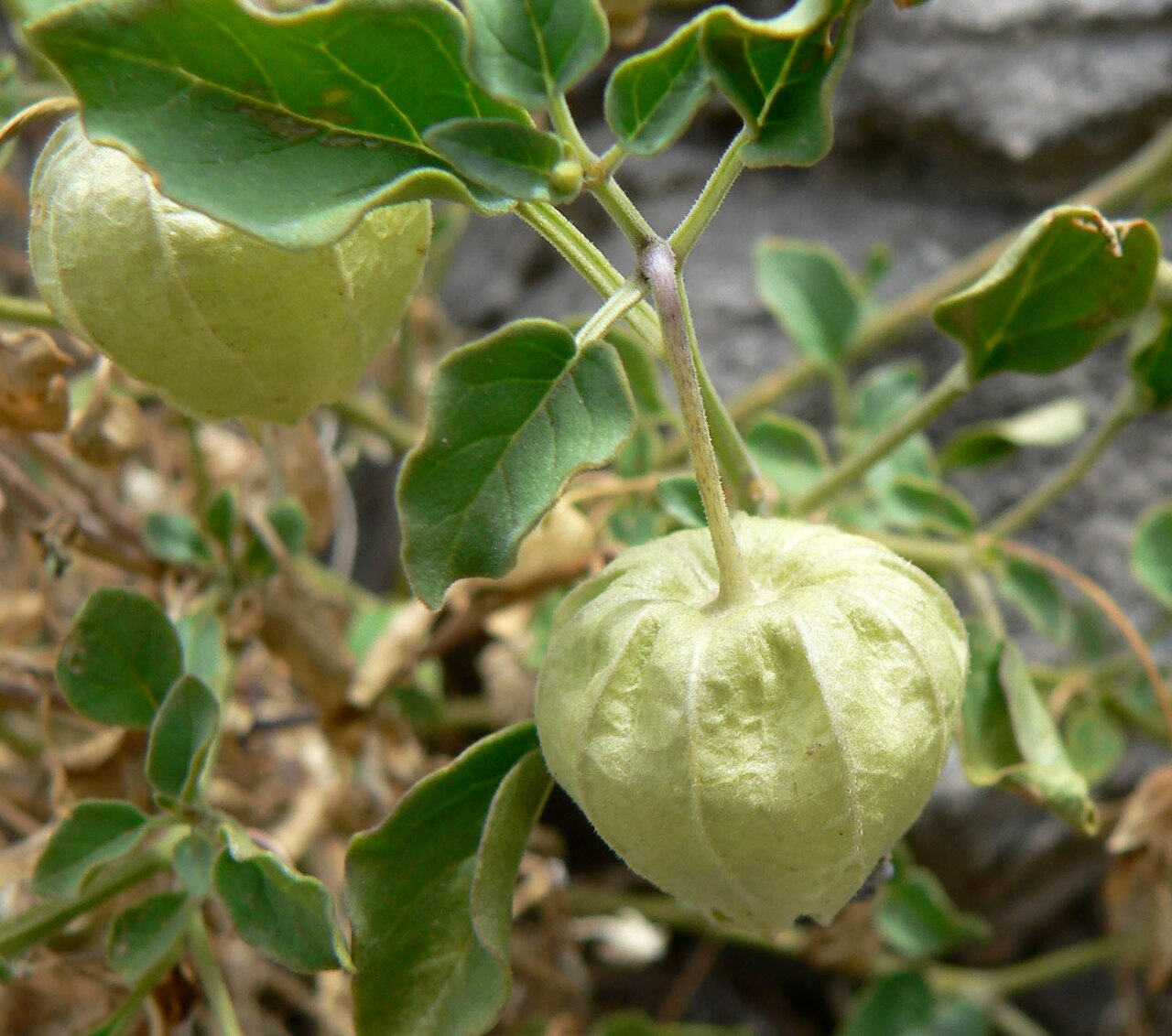
Look for a small, rounded desert clump with zigzag stems, thick, gray-green oval leaves, pale yellow saucer-shaped flowers and pale green or straw-colored lantern husks.
Growth Habit
It is a perennial herb, sometimes slightly woody at the base, forming a clumped, matted or more upright plant. The branching stems are ridged and angular and often bend back and forth at each node, giving a zigzag look. Most plants are under 1 1/2 feet tall, though stems can reach about 2 1/2 feet. In very dry years it may die back to the base and regrow after rain.
Leaves
The alternate leaves are oval to nearly round, about 1/2 to 1 1/4 inches long, on slender stalks. They are thick and somewhat fleshy, with smooth, wavy or bluntly toothed edges. The stems and leaves are covered in short, often glandular hairs that can feel slightly sticky.
Flowers
The flowers grow singly from the leaf axils on short stalks. Each is a broad, open bell or saucer about 3/4 inch across, pale to bright yellow, with five shallow angles or lobes and often a faintly darker center. Bright yellow anthers cluster in the middle. Flowering follows rain and can occur from about February to October.
Fruit
The five-angled calyx enlarges after flowering into an inflated, papery, lantern-like husk about 3/4 inch long. It hangs downward and encloses a small, round, yellowish-green berry with many tiny seeds.
Look-alikes
Other groundcherries, such as Fendler’s groundcherry (Physalis hederifolia), usually have flowers with darker markings in the throat and thinner leaves. Desert globe-mallows (Sphaeralcea), such as small-leaf globemallow, have orange, cup-shaped flowers and no lantern husk. True nightshades (Solanum) have star-shaped flowers with a projecting cone of anthers.
Quick Facts
| Scientific Name | Physalis crassifolia |
| Family | Solanaceae (nightshade family) |
| Plant Type | Herbaceous perennial (sometimes woody at the base) |
| Mature Height | 6–20 in |
| Mature Spread | 1–2 1/2 ft |
| Growth Rate | Moderate to fast after rain |
| Sun Exposure | Full sun |
| Water Needs | Very low; extremely drought tolerant |
| Soil Type | Rocky, gravelly or sandy, fast-draining desert soil |
| Soil pH | Neutral to alkaline (about 7.0–8.5) |
| Bloom Time | Late winter to fall after rain (Feb–Oct) |
| Flower Color | Pale to bright yellow |
| Fall Color | None |
| Fruit | Small berry inside a papery, lantern-like husk |
| Deer Resistant | Yes; foliage is toxic and rarely browsed |
| USDA Hardiness Zones | 8–11 |
Native Range
Thickleaf groundcherry is a plant of the hot deserts of the American Southwest and northwestern Mexico. USDA PLANTS lists it as native in four states: Arizona, California, Nevada and Utah. In Mexico it grows in Baja California and Sonora.
In California it grows mainly in the Mojave and Colorado Deserts, including Death Valley, the eastern Mojave mountains and the Anza-Borrego region. In Nevada it is found in the southern part of the state around Las Vegas, Red Rock Canyon and the Spring Mountains. It reaches southwestern Utah in the Mojave Desert of Washington County, and in Arizona it grows across the western and southern deserts.
It favors rocky hillsides, cliff bases, canyon walls, boulder piles, gravelly washes and desert flats, often in the shelter of rocks. It grows with creosote bush, white bursage, brittlebush and other desert shrubs from the low desert up into the lower desert mountains.
📋 Regional plant lists featuring Thickleaf Groundcherry: Utah & Western Colorado · Arizona & New Mexico · California & Nevada
Growing & Care Guide
Thickleaf groundcherry is rarely sold, but it is easy to grow from seed in hot, dry gardens within its native range. Give it the conditions of a rocky desert slope: full sun, sharp drainage and very little water.
Light
Full sun. It tolerates intense desert heat and reflected light from rocks and walls.
Soil & Water
Plant in rocky, gravelly or sandy soil that drains quickly. Once established it needs little or no supplemental water in the low desert; an occasional deep soak during long summer droughts keeps it leafy and blooming. Overwatering and heavy, wet soil cause rot.
Planting Tips
Sow seed in place in fall or late winter, or set out young plants in fall so they can root during the cool season. Tuck it among boulders, along the base of a wall or at the edge of a wash-style planting, where it can sprawl.
Pruning & Maintenance
Little care is needed. Cut back dry, leafless stems in late winter to tidy the clump. It may go partly dormant in drought and regrow after rain. Wear gloves if you have sensitive skin, since the hairy foliage is slightly sticky.
Propagation
Grow from seed collected from ripe, dry husks. Clean the seeds from the berry pulp, dry them and sow them shallowly in a gritty mix in warm conditions. Plants often self-sow lightly near the parent.
Landscape Uses
- Desert rock gardens: a low, gray-green clump with yellow flowers among boulders
- Natural desert landscapes: a native groundcover for slopes and wash edges
- Pollinator gardens: long-season flowers for native bees
- Habitat gardens: fruit and cover for desert birds and small animals
- Revegetation: a hardy perennial for disturbed rocky desert ground
Wildlife & Ecological Value
Thickleaf groundcherry blooms in desert seasons when few other flowers are open, making it a useful source of food for small desert animals.
For Pollinators
The open yellow flowers are visited mainly by native bees, which collect pollen from the clustered anthers. Its long, rain-triggered blooming season gives bees a food source in spring, summer and fall.
For Birds
Desert birds, such as quail and other ground-feeding birds, eat groundcherry berries and seeds. The low clumps also give small birds and lizards shade and cover.
For Mammals
Small desert mammals such as rodents eat the fallen fruits and seeds. The foliage is toxic and is rarely browsed by deer or livestock.
Ecosystem Role
As a long-lived perennial on rocky slopes and washes, it helps stabilize loose soil and provides shade and shelter around its base. It is part of the diverse perennial flora that responds quickly to desert rains.
Cultural & Historical Uses
The genus name Physalis comes from the Greek word for a bladder or bellows, referring to the inflated, lantern-like calyx. The species name crassifolia means “thick-leaved,” for its fleshy leaves.
Physalis is the same genus as the tomatillo and the cultivated cape gooseberry, and it is related to tomatoes, peppers and potatoes. Several wild groundcherries were gathered for food by Indigenous peoples of the Southwest, but the green parts and unripe fruits of groundcherries are toxic, and this species should not be eaten.
Thickleaf groundcherry is a familiar plant to desert hikers in places such as Death Valley National Park, Red Rock Canyon and Anza-Borrego Desert State Park, where its yellow flowers and papery lanterns are often seen tucked among rocks.
Frequently Asked Questions
Is thickleaf groundcherry edible?
No part of it should be eaten. Its leaves, stems and unripe fruits contain toxic alkaloids, like many members of the nightshade family, and it is not a reliable food plant.
Where does thickleaf groundcherry grow?
It is native to the Mojave and Sonoran Deserts of California, Nevada, southwestern Utah and Arizona, and to northwestern Mexico.
When does thickleaf groundcherry bloom?
It can bloom from about February to October, usually soon after rain.
Can I grow thickleaf groundcherry in my garden?
Yes, in hot, dry gardens with sharp drainage. Grow it from seed, plant it in full sun among rocks and water very sparingly.
How is it different from a tomatillo?
Both are in the genus Physalis and have lantern-like husks, but the tomatillo is a cultivated annual with larger leaves and fruit. Thickleaf groundcherry is a small, wild, thick-leaved desert perennial with tiny fruits.

Looking for a nursery that carries Thickleaf Groundcherry?
Browse our native plant nursery directory: Arizona · California · Nevada · Utah