
Pink Mountainheath (Phyllodoce empetriformis)
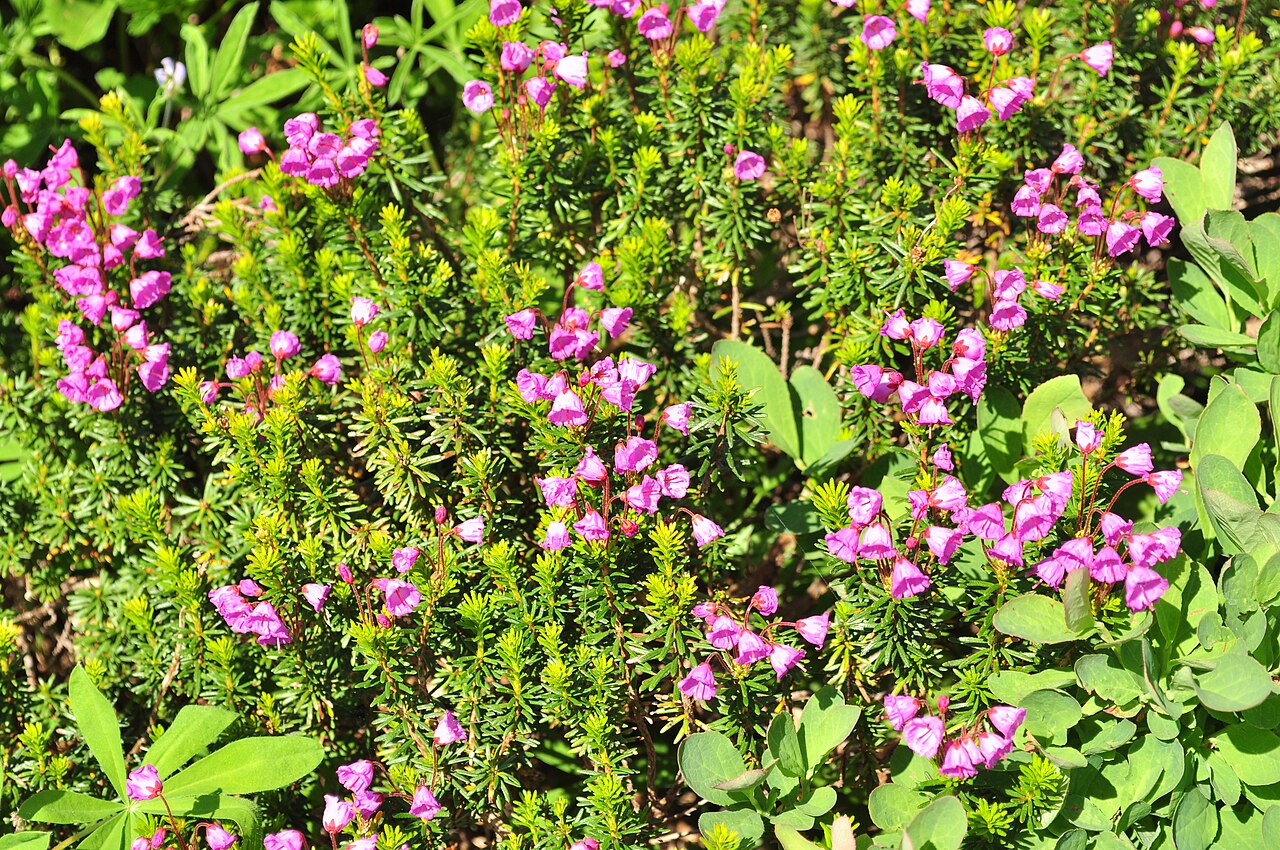
Phyllodoce empetriformis, known as Pink Mountainheath (also pink mountain heather), is a low, evergreen dwarf shrub of the heath family (Ericaceae) that carpets subalpine and alpine meadows of western North America. It forms dense, heather-like mats 4 to 16 inches tall, with short, needle-like leaves crowded along the stems. In mid to late summer the mats are covered with nodding, rose-pink, bell-shaped flowers, one of the iconic sights of mountain meadows from Alaska to California and the northern Rockies.
Pink mountainheath grows where snow lies late and the growing season is short: snowbed meadows, heath communities near treeline, rocky slopes and the edges of subalpine forest. It often grows with white mountain heather and yellow mountainheath, and in places it hybridizes with the latter, producing plants with pale pink or creamy flowers.
Honestly, it is a challenging garden plant outside cool, moist mountain or maritime climates. It needs acidic, humus-rich soil that never dries out, cool summers and good snow cover. Where those conditions exist, such as the Pacific Northwest and high-elevation gardens, it is a beautiful rock garden and heath garden plant. Like many members of the heath family, it contains grayanotoxins and should not be eaten.
Identification
Pink mountainheath is easy to recognize in bloom: a low, mat-forming evergreen shrub with needle-like leaves and clusters of nodding, rose-pink bells at the tips of the branches.
Growth Form
It is a dwarf, much-branched evergreen shrub, usually 4 to 16 inches tall, that spreads into dense mats several feet across. Older stems are woody and covered with old leaf scars; young stems are leafy to the base.
Leaves
The leaves are alternate but closely crowded, narrow and needle-like, about 1/4 to 5/8 inch long, glossy dark green above with a groove beneath and finely toothed edges. They stay on the plant for several years and give the stems a bottlebrush look, rather like a small conifer or a crowberry, hence the name empetriformis (“shaped like Empetrum,” crowberry).
Flowers
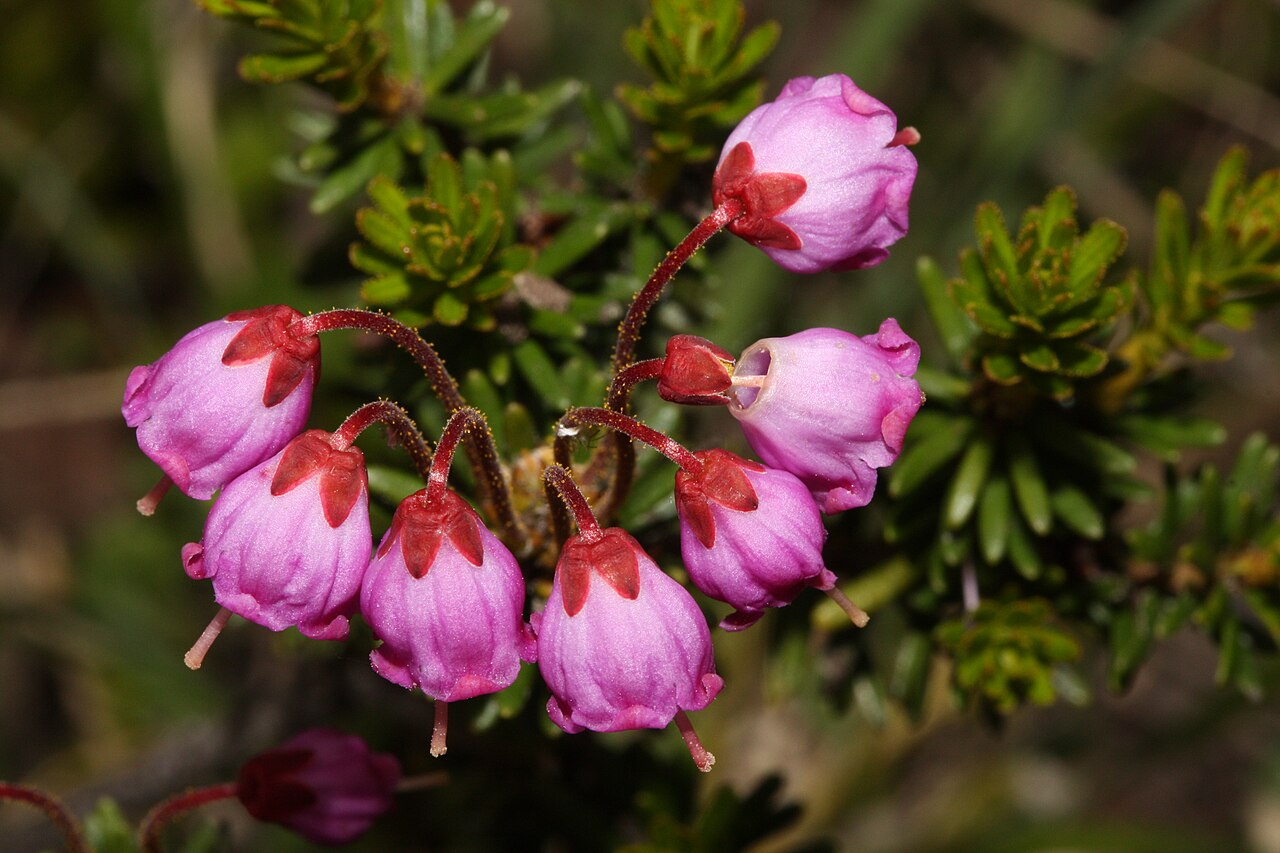
From June to August, depending on snowmelt, clusters of flowers appear at the tips of the branches. Each flower hangs or nods on a slender, glandular, often red stalk. The corolla is bell-shaped, about 1/4 to 3/8 inch long, rose-pink to magenta, with five short, flaring lobes. The stamens and style are hidden inside or barely protrude.
Fruit & Seeds
The fruit is a small, round capsule that turns upright and opens in late summer or fall to release many tiny seeds dispersed by wind.
Look-alikes
Yellow mountainheath (Phyllodoce glanduliflora) has pale yellow to greenish-white, urn-shaped flowers covered with sticky hairs. Hybrids between the two (Phyllodoce × intermedia) have pinkish to creamy flowers of intermediate shape. White mountain heather (Cassiope mertensiana) has tiny scale-like leaves pressed against the stem and white bells. Western alpine laurel (Kalmia microphylla) has broader, flat leaves and open, saucer-shaped pink flowers.
Quick Facts
| Scientific Name | Phyllodoce empetriformis |
| Family | Ericaceae (heath family) |
| Plant Type | Evergreen dwarf shrub |
| Mature Height | 4–16 in |
| Mature Spread | 1–3 ft or more (slowly) |
| Growth Rate | Slow |
| Sun Exposure | Full sun to partial shade |
| Water Needs | Moderate to high; consistently moist, well-drained |
| Soil Type | Acidic, humus-rich, gritty or peaty soil |
| Soil pH | About 4.5–6.0 (acidic) |
| Bloom Time | June–August |
| Flower Color | Rose-pink to magenta |
| Fall Color | Evergreen; may bronze in winter |
| Fruit | Small round capsule |
| Deer Resistant | Generally yes; rarely browsed |
| USDA Hardiness Zones | 3–6 |
Native Range
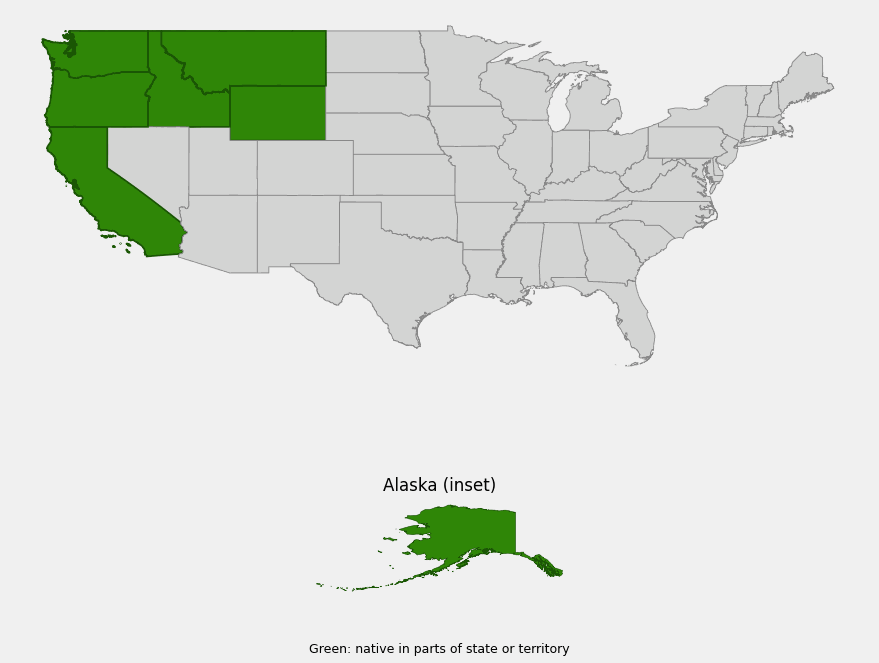
Pink mountainheath is native to the mountains of western North America. USDA PLANTS lists it as native in Alaska, Canada and the lower 48 states. In the United States it grows in Alaska, Washington, Oregon, California, Idaho, Montana and Wyoming; in Canada it ranges through British Columbia, Alberta, Yukon and the Northwest Territories. USDA and NatureServe also list Arizona, but no Arizona specimens with locality data could be found, the record is isolated far from the rest of the range, and Arizona is not treated as part of its native range here.
It is most abundant in the Coast Mountains, Cascades and Olympic Mountains of the Pacific Northwest, where it carpets subalpine meadows at places such as Mount Rainier and the North Cascades, and in the northern Rockies of Idaho, Montana and Alberta, including Glacier National Park. It also grows in the Wallowa and Blue Mountains of northeastern Oregon, east of the Cascades in Washington, and south through the Klamath Mountains and the Sierra Nevada of California. In Alaska it occurs mainly in the southeast and south-central parts of the state.
Typical habitats are subalpine and alpine meadows, heath communities near treeline, snowbed sites where snow lingers into summer, rocky slopes and open subalpine forests, usually on acidic soils that stay moist through the growing season.
📋 Regional plant lists featuring Pink Mountainheath: Idaho, Eastern Oregon & Eastern Washington · Montana & Wyoming · Alaska · Western Oregon & Western Washington · California & Nevada
Growing & Care Guide
Pink mountainheath is a plant for experienced rock and heath gardeners in cool climates, such as the maritime Pacific Northwest or mountain areas with reliable snow. In hot, dry or humid lowland gardens it usually struggles. Buy nursery-propagated plants from alpine or native specialty nurseries, and never dig plants from mountain meadows, where they grow very slowly and recover poorly from damage.
Light
Give it full sun in cool, cloudy climates, and morning sun with afternoon shade where summers are warmer. Too much shade reduces flowering.
Soil & Water
It needs acidic, humus-rich soil that drains well but never dries out, such as a mix of peat or leaf mold, coarse sand and grit. Water regularly in summer with rainwater or low-mineral water if your tap water is hard. Avoid lime, heavy clay and soggy soil.
Planting Tips
Plant in spring in a cool, moist rock garden, a raised peat bed, or a heath garden with other Ericaceae. A north- or east-facing slope or a spot between rocks that keep the roots cool works best. Mulch with conifer needles or bark to keep the soil cool and acidic.
Pruning & Maintenance
Little pruning is needed; lightly trim after flowering to keep the mat compact. In areas without reliable snow cover, protect plants from drying winter sun and wind with a light cover of evergreen boughs. Do not fertilize heavily; a light acid mulch is enough.
Propagation
Take semi-ripe cuttings in late summer and root them in a moist peat and sand mix. Rooted layers can be separated from established plants. Seeds are tiny and are sown on the surface of moist, acidic mix in fall or after cold stratification; seedlings grow slowly.
Landscape Uses
- Rock and heath gardens: for cool, moist, acidic sites
- Alpine troughs and peat beds: where moisture and drainage can be controlled
- Subalpine restoration: in mountain meadows and trailsides
- Wildflower viewing: a highlight of mountain meadows in summer
- Groundcover in cool climates: an evergreen mat under taller heaths
Wildlife & Ecological Value
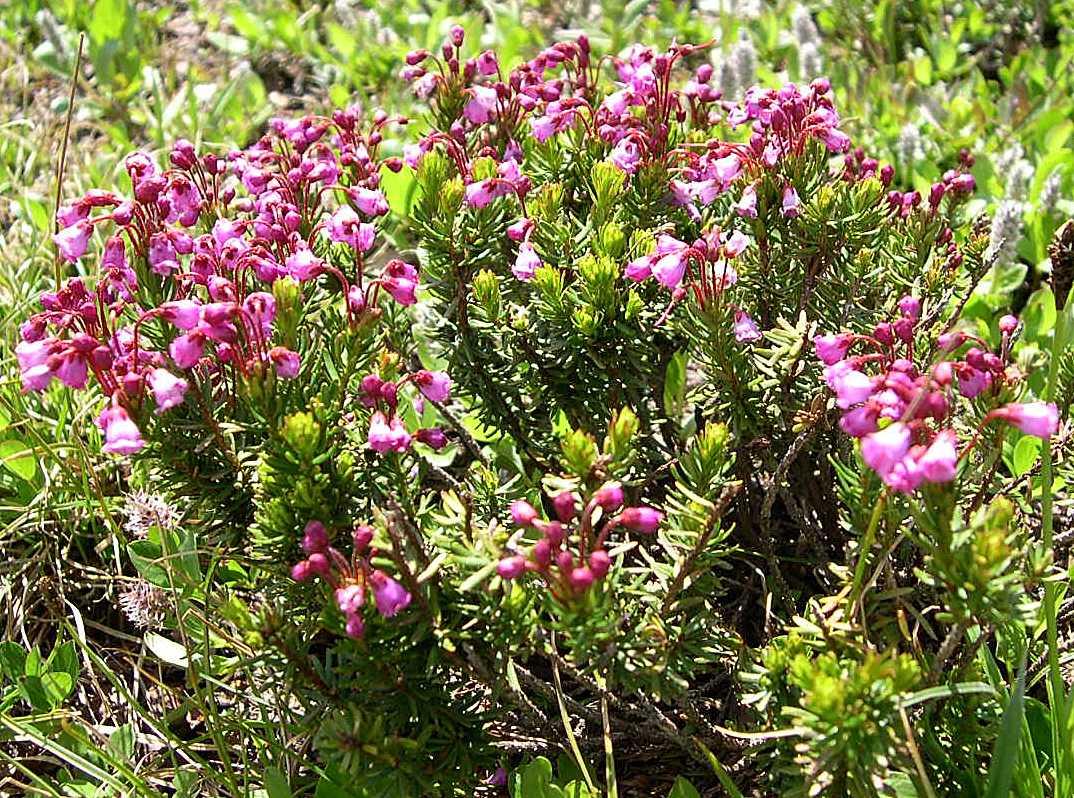
Pink mountainheath is a key plant of subalpine heath communities and an important nectar source in the short mountain summer.
For Pollinators
The pink bells are pollinated mainly by bumble bees, which hang beneath the flowers and buzz to shake out pollen. Hummingbirds and butterflies sometimes visit for nectar.
For Birds
The mats provide cover for ground-nesting birds of the high country, such as white-tailed ptarmigan and American pipits. Ptarmigan and grouse eat buds and leaves of heath shrubs in winter.
For Mammals
Pink mountainheath is rarely browsed by deer, elk or mountain goats, perhaps because of its toxic compounds. Pikas and other small mammals use the dense mats for cover.
Ecosystem Role
Along with white mountain heather and other dwarf shrubs, it forms heath communities that stabilize thin mountain soils and shelter other plants. These communities are very slow to recover from trampling, and damaged heath can take decades to regrow.
Cultural & Historical Uses
The genus Phyllodoce is named for a sea nymph in Greek mythology. The species name empetriformis means “shaped like Empetrum,” crowberry, which has similar needle-like leaves. The common names pink mountainheath and pink mountain heather reflect its resemblance to the true heathers of Europe, which belong to different genera in the same family.
Safety: like many members of the heath family, including rhododendrons, mountain laurels and alpine laurels, pink mountainheath contains grayanotoxins. These can cause vomiting, low blood pressure and heart rhythm problems if eaten. The leaves should not be eaten or used in teas, and livestock, dogs and cats should not be allowed to browse it. Honey made mainly from such plants can also be toxic, though this is rarely a concern in the wild.
For hikers in the Cascades, Olympics and northern Rockies, carpets of pink mountainheath are one of the classic sights of late summer. Parks such as Mount Rainier and North Cascades ask visitors to stay on trails and have used revegetation projects to restore heath meadows damaged by trampling.
Frequently Asked Questions
Is pink mountainheath a true heather?
No. True heathers are European plants in the genus Calluna or Erica. Pink mountainheath is a related member of the heath family native to western North America.
Is pink mountainheath poisonous?
Yes. Like rhododendrons and laurels, it contains grayanotoxins that can cause vomiting and heart problems if eaten. Keep children, pets and livestock from eating it.
Can I grow pink mountainheath in my garden?
Possibly, if you have a cool, moist climate and acidic, humus-rich, well-drained soil. It is difficult in hot, dry or humid lowland gardens. Buy nursery-propagated plants.
When does pink mountainheath bloom?
Usually from June to August, soon after snowmelt. At high elevations and in snowbed sites it may bloom into early September.
Why should I stay on the trail in heath meadows?
Pink mountainheath grows very slowly in a short growing season. Trampled mats can take decades to recover, and damaged meadows erode easily.

Looking for a nursery that carries Pink Mountainheath?
Browse our native plant nursery directory: Alaska · California · Idaho · Montana · Oregon · Washington · Wyoming