
Black Crowberry (Empetrum nigrum)
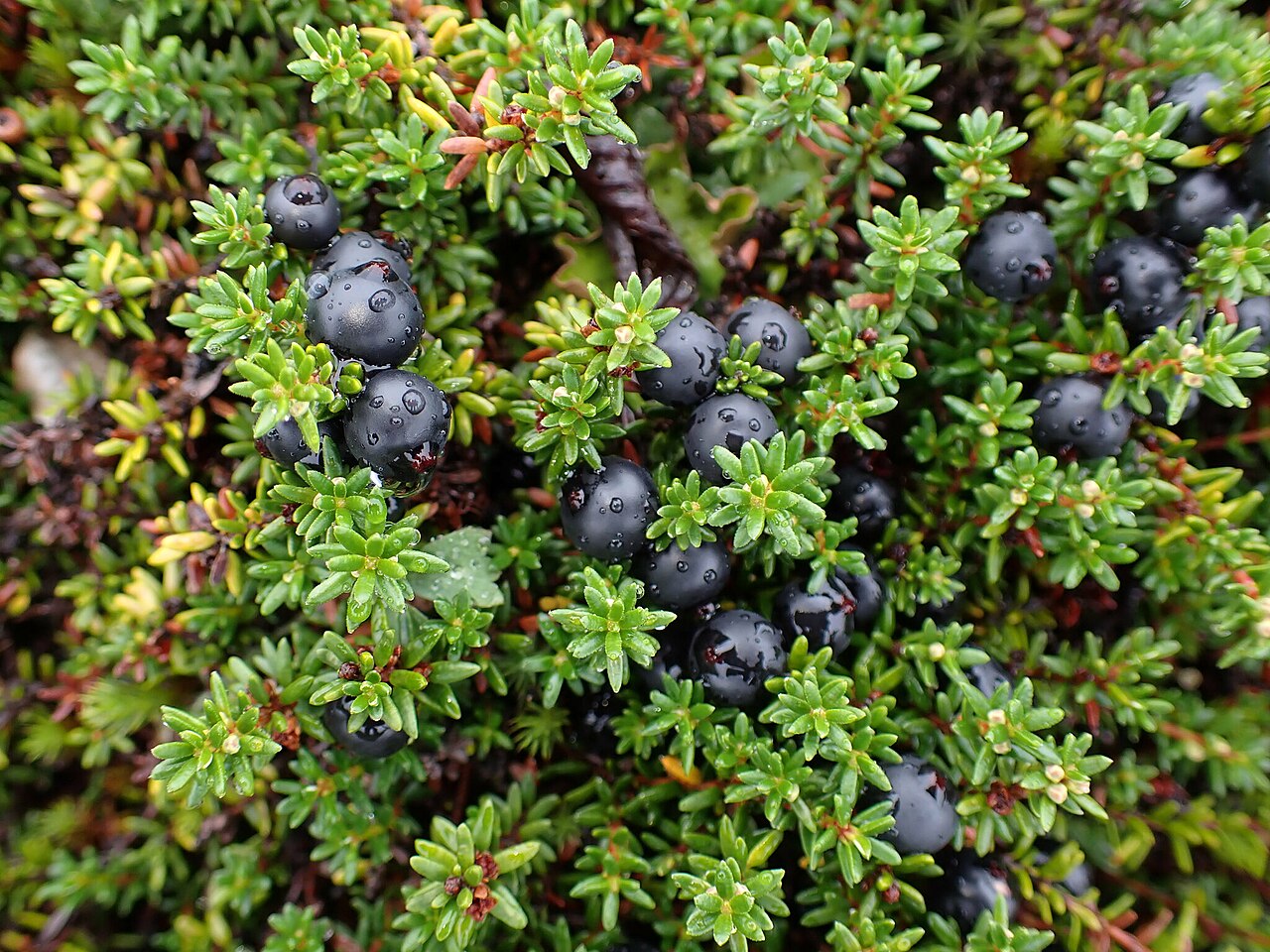
Empetrum nigrum, known as Black Crowberry, is a native evergreen dwarf shrub of arctic tundra, alpine summits, peat bogs and exposed coastal headlands across the cold regions of the Northern Hemisphere. It belongs to the heath family (Ericaceae); older books place it in its own family, Empetraceae. In North America it covers huge areas of Alaska and northern Canada, and it reaches south along the coasts and high mountains into the lower 48 states.
Plants form dense, springy mats usually just 2 to 6 inches tall, with trailing, branching stems clothed in short, needle-like leaves that make them look like a tiny heath or a creeping conifer. Inconspicuous purplish flowers open in early spring, followed by round, shiny black berries about 1/4 inch across that ripen in late summer and often hang on the plant through winter.
Black crowberry is a key food plant in the North. Its berries are eaten by birds, bears and people, and they have long been an important wild food for Indigenous peoples of Alaska, northern Canada and Scandinavia. In gardens it is a challenging plant outside cool, moist climates; it is best suited to rock gardens, coastal gardens and northern landscapes with cool summers.
Identification
Look for black crowberry on exposed, cold, often windy sites: tundra, alpine ridges, bogs, and rocky coastal headlands. The low, mat-forming habit, needle-like leaves with rolled edges and shiny black berries identify it.
Growth Habit
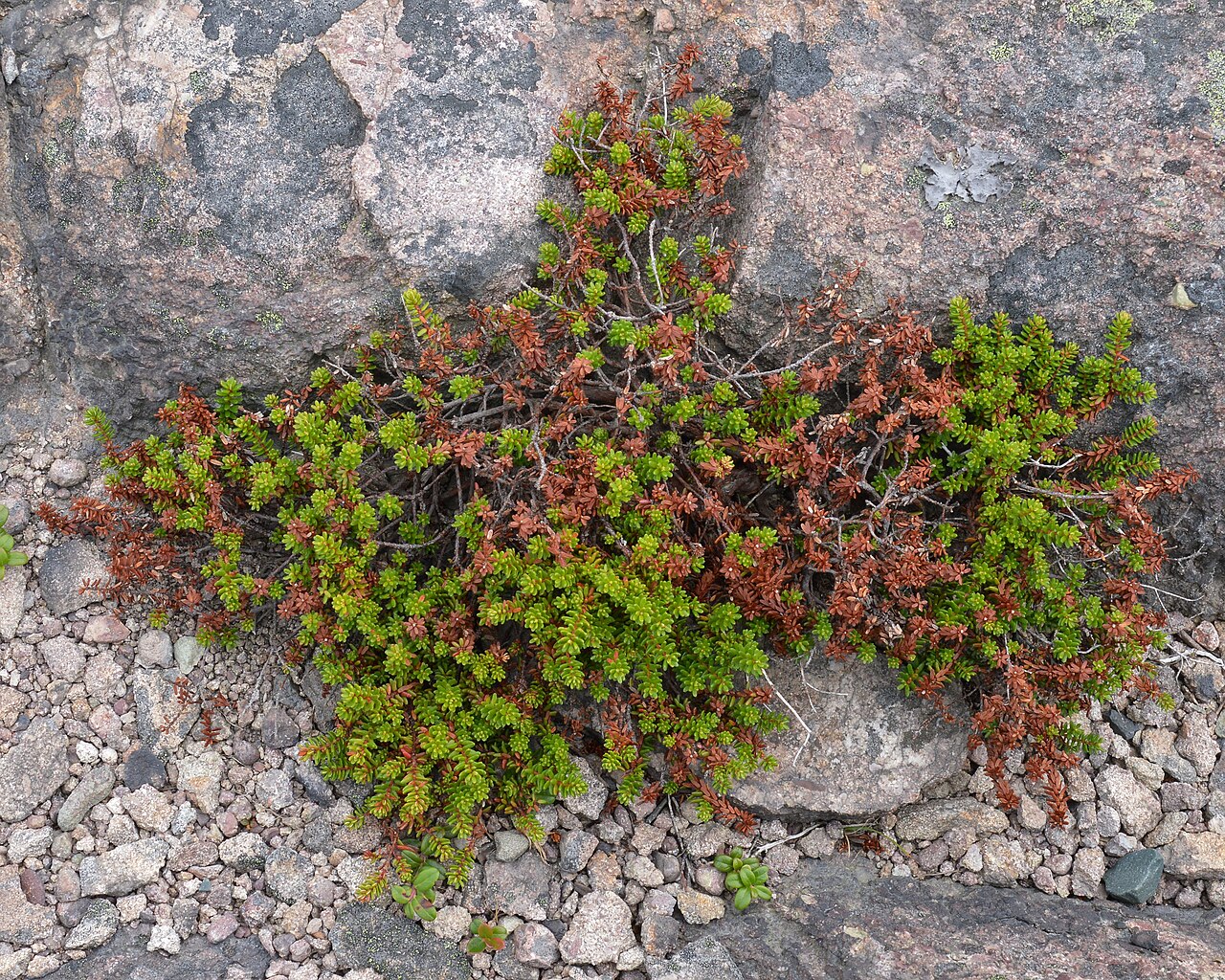
Black crowberry is a low, evergreen, mat-forming shrub, usually 2 to 6 inches tall, with trailing, freely branching stems that root where they touch the ground. Over time a single plant can form a mat several feet across. Young stems are reddish-brown and often finely hairy.
Leaves
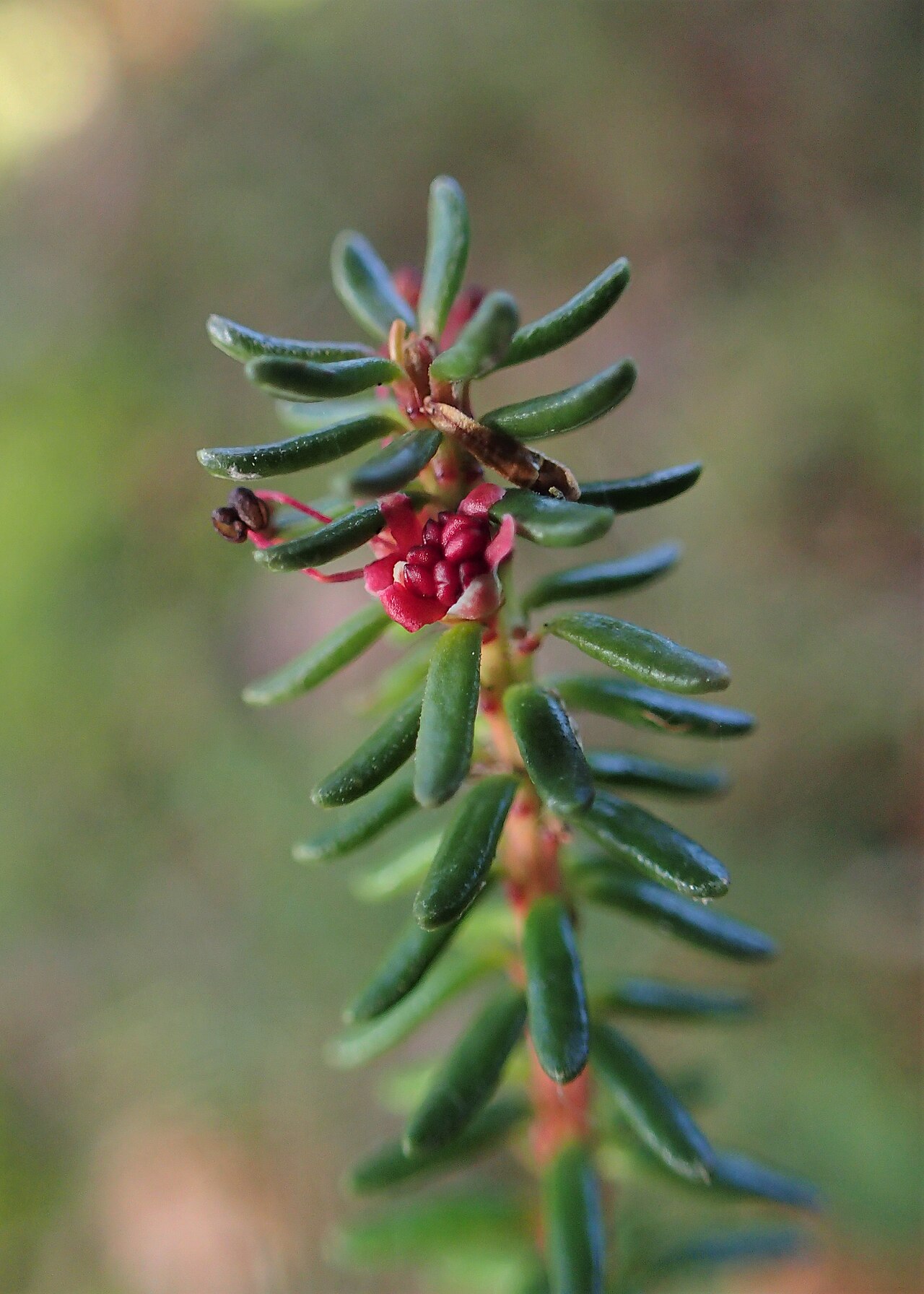
The leaves are narrow and needle-like, about 1/8 to 1/4 inch long, crowded along the stems, and dark green to yellowish green, sometimes turning bronze or reddish in winter. The leaf edges are rolled under so tightly that they nearly meet, leaving a thin whitish groove along the underside. The leaves stay on the plant for several years.
Flowers
The flowers are tiny, about 1/8 inch across, and open in early spring soon after snowmelt, singly in the leaf axils near the stem tips. They have three small purplish sepals and petals and long, reddish-purple stamens. Plants may have male, female or bisexual flowers; arctic and alpine plants, sometimes treated as subspecies hermaphroditum, usually have bisexual flowers.
Fruit & Seeds
The fruit is a round, juicy, black drupe about 1/4 inch across, containing six to nine small seed-like stones. Berries ripen from July to September and often persist on the plant through winter, providing food long after other fruits are gone. They are mild to slightly bitter, juicy and seedy.
Look-alikes
Mountain heaths (Phyllodoce) have similar needle-like leaves but larger, showy pink or yellow bell-shaped flowers and dry capsules instead of berries. Broom crowberry (Corema conradii) of the Atlantic coast has flowers in tip clusters and dry fruit. Lowbush blueberries and cranberries have flat, broad leaves. Some botanists treat the purple-fruited crowberries of eastern Canada and northern New England as separate species, Empetrum atropurpureum and E. eamesii.
Quick Facts
| Scientific Name | Empetrum nigrum |
| Family | Ericaceae (heath family); formerly Empetraceae |
| Plant Type | Evergreen dwarf shrub (groundcover) |
| Mature Height | 2–6 in |
| Mature Spread | 1–4 ft or more (mat-forming) |
| Growth Rate | Slow |
| Sun Exposure | Full sun to part shade |
| Water Needs | Medium; moist but well-drained, cool soil |
| Soil Type | Peat, sandy or gravelly soil, thin soil over rock |
| Soil pH | About 4.0–6.0 (acidic) |
| Bloom Time | April–June (soon after snowmelt) |
| Flower Color | Purplish to reddish-purple (inconspicuous) |
| Fall Color | Evergreen; foliage may bronze in winter |
| Fruit | Round, shiny black berry-like drupe, ripe July–September |
| Deer Resistant | Not well documented |
| USDA Hardiness Zones | 1–6 |
Native Range
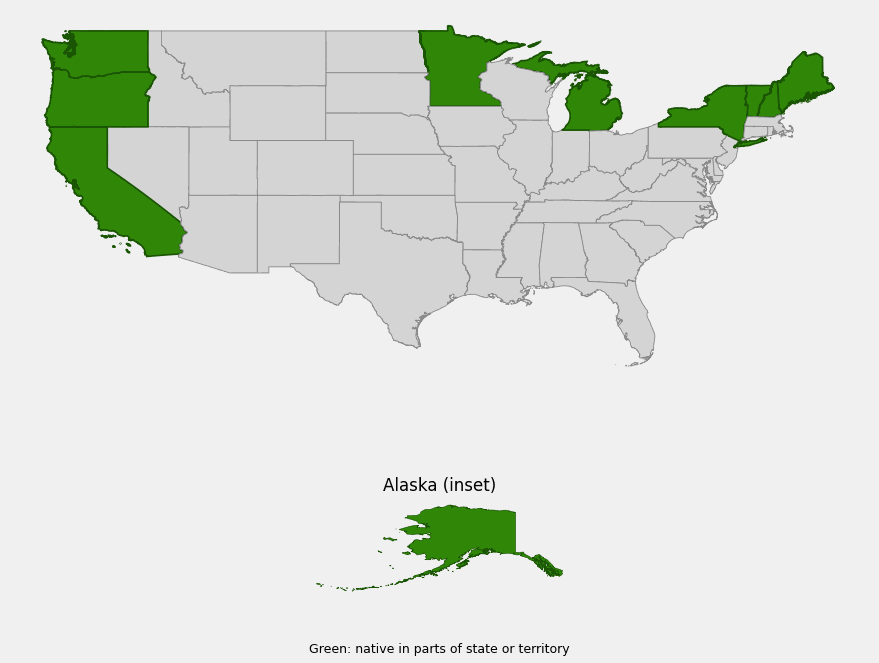
Black crowberry is circumboreal, growing across northern North America, Greenland, northern Europe and northern Asia. USDA PLANTS lists it as native in Alaska, the lower 48 states, Canada, Greenland and Saint Pierre and Miquelon. In Canada USDA records it from every province and territory. In the lower 48 states USDA records it from California, Oregon, Washington, Michigan, Minnesota, New York, New Hampshire and Vermont, and Go Botany also documents it as native in Maine, which is included here.
In the lower 48 states it is a plant of cold, exposed outliers of its northern range. In the West it grows on coastal bluffs and bogs from Washington and Oregon south to northern California, and in the high Cascades and Olympic Mountains. In the East it grows on alpine summits in the Adirondacks of New York, the White Mountains of New Hampshire, the Green Mountains of Vermont and the mountains of Maine, and on coastal headlands and bogs of Maine. Around the Great Lakes it occurs on the rocky Lake Superior shore of Michigan and Minnesota. NatureServe ranks these Minnesota, New York and Vermont occurrences as critically imperiled (S1), and Go Botany lists it as uncommon in New Hampshire.
Typical habitats are arctic and alpine tundra, rocky summits and ridges, peat bogs and muskeg, open spruce and pine woodland, coastal dunes, cliffs and headlands, and rocky lakeshores. It grows in acidic, nutrient-poor soils, often thin peat or gravel over rock, in places with cool summers, wind and good snow cover.
📋 Regional plant lists featuring Black Crowberry: New York, Pennsylvania & Northern New Jersey · Michigan, Wisconsin & Eastern Minnesota · New Hampshire, Maine & Vermont · Delaware, Southern New Jersey & Long Island · Alaska · Western Oregon & Western Washington · California & Nevada
Growing & Care Guide
Black crowberry is hard to grow well outside cool, humid, northern or coastal climates. In the right place it makes a tough, evergreen groundcover, but in hot, humid or dry summers it usually declines. A few specialist nurseries sell nursery-propagated plants. Never dig plants from the wild, especially from rare alpine and Great Lakes populations.
Light
Full sun is best in cool climates, where it stays dense and fruits well. In warmer areas give it light afternoon shade. Deep shade makes it thin and sparse.
Soil & Water
It needs acidic, nutrient-poor, well-drained soil that stays cool and evenly moist, such as a sandy peat mix or gravel with organic matter. It does not tolerate lime, heavy clay, fertilizer, drought or soggy, stagnant conditions. A mulch of gravel or pine needles helps keep roots cool.
Planting Tips
Plant in spring in a rock garden, on a cool slope, among boulders or in a coastal garden with other heaths. Space plants 18 to 24 inches apart. It is best suited to USDA zones 1 to 6, ideally where summers are cool and moist, such as coastal New England, the Pacific Northwest coast and Alaska.
Pruning & Maintenance
No pruning is needed. Water during dry spells in its first two summers. Do not fertilize. Protect it from reflected heat and hot, drying winds in summer. In snowy regions, snow cover protects it in winter.
Propagation
The easiest method is to root semi-hardwood cuttings in late summer in a moist mix of peat and sand, or to layer trailing stems that root where they touch the soil. Seed germinates slowly and irregularly and needs a long period of cold, moist stratification; seedlings grow very slowly.
Landscape Uses
- Rock gardens: evergreen mats among boulders in cool climates
- Coastal gardens: salt- and wind-tolerant groundcover on cool coasts
- Edible landscapes: berries for jams, juice and traditional dishes in the North
- Wildlife gardens: long-lasting berries for birds through winter
- Restoration: revegetating disturbed tundra, alpine and coastal heath
Wildlife & Ecological Value
Black crowberry is one of the most important wildlife food plants in the Arctic and subarctic, because its berries stay on the plant all winter.
For Pollinators
The tiny flowers open very early in the season and are pollinated mainly by wind, though early bumblebees, flies and other insects also visit. The Lady Bird Johnson Wildflower Center lists it as a larval host of the northern blue butterfly.
For Birds
Many birds eat the berries, including ptarmigan, grouse, geese, gulls, thrushes and migrating songbirds. Because the berries persist under snow and through winter, they are available in spring when migrating birds arrive before new food is available.
For Mammals
Bears, foxes, caribou and small mammals such as voles eat the berries, and caribou and reindeer browse the foliage in winter.
Ecosystem Role
As a dominant groundcover of tundra, alpine heath and coastal headlands, black crowberry helps stabilize thin soils and peat. Its dense mats shelter insects and small animals, and its allelopathic leaf litter can slow the establishment of other plants, shaping the composition of northern heaths.
Cultural & Historical Uses
The genus name Empetrum comes from the Greek for on a rock, a reference to the plant’s rocky habitats, and nigrum means black, for the fruit. The common name crowberry probably refers to the crow-black color of the fruit.
For many Indigenous peoples of Alaska and northern Canada, crowberry (also called blackberry or mossberry) is one of the most important wild berries. It is eaten fresh, frozen for winter, mixed with fat in Alaska Native akutaq, and made into juice, jam and pies. It is also widely used in Scandinavia and Newfoundland. The berries are not toxic, but they are mild and seedy, and most people prefer them cooked or mixed with other fruit.
In the lower 48 states, black crowberry is a relic of the cold climate of the last ice age, surviving on alpine summits, cold coastal headlands and the Lake Superior shore. Hikers in the White Mountains and Adirondacks often find it on the windswept summits, where it is protected along with the rest of the fragile alpine plant community.
Frequently Asked Questions
Are black crowberries edible?
Yes. The berries are edible and are an important traditional food in Alaska, northern Canada and Scandinavia, where they are eaten fresh, frozen or made into juice, jam and akutaq. They are mild and seedy.
Is black crowberry related to blueberries?
Yes. It is now placed in the heath family (Ericaceae), with blueberries, cranberries and heaths, although it was once placed in its own family.
Can I grow black crowberry in my garden?
Only in cool, moist climates with acidic, well-drained soil, such as northern coastal areas and Alaska. It usually declines in hot or dry summers.
Where does black crowberry grow in the lower 48 states?
On alpine summits of New York and northern New England, coastal headlands and bogs of Maine and the Pacific Northwest, the Lake Superior shore of Michigan and Minnesota, and high peaks of the Cascades.
Why do crowberry berries last through winter?
The berries stay firm and attached to the plant under snow, which makes them a valuable food for birds and mammals in early spring.

Looking for a nursery that carries Black Crowberry?
Browse our native plant nursery directory: Alaska · California · Maine, Michigan & Minnesota · New Hampshire & New York · Oregon · Vermont · Washington