
Bog Bilberry (Vaccinium uliginosum)
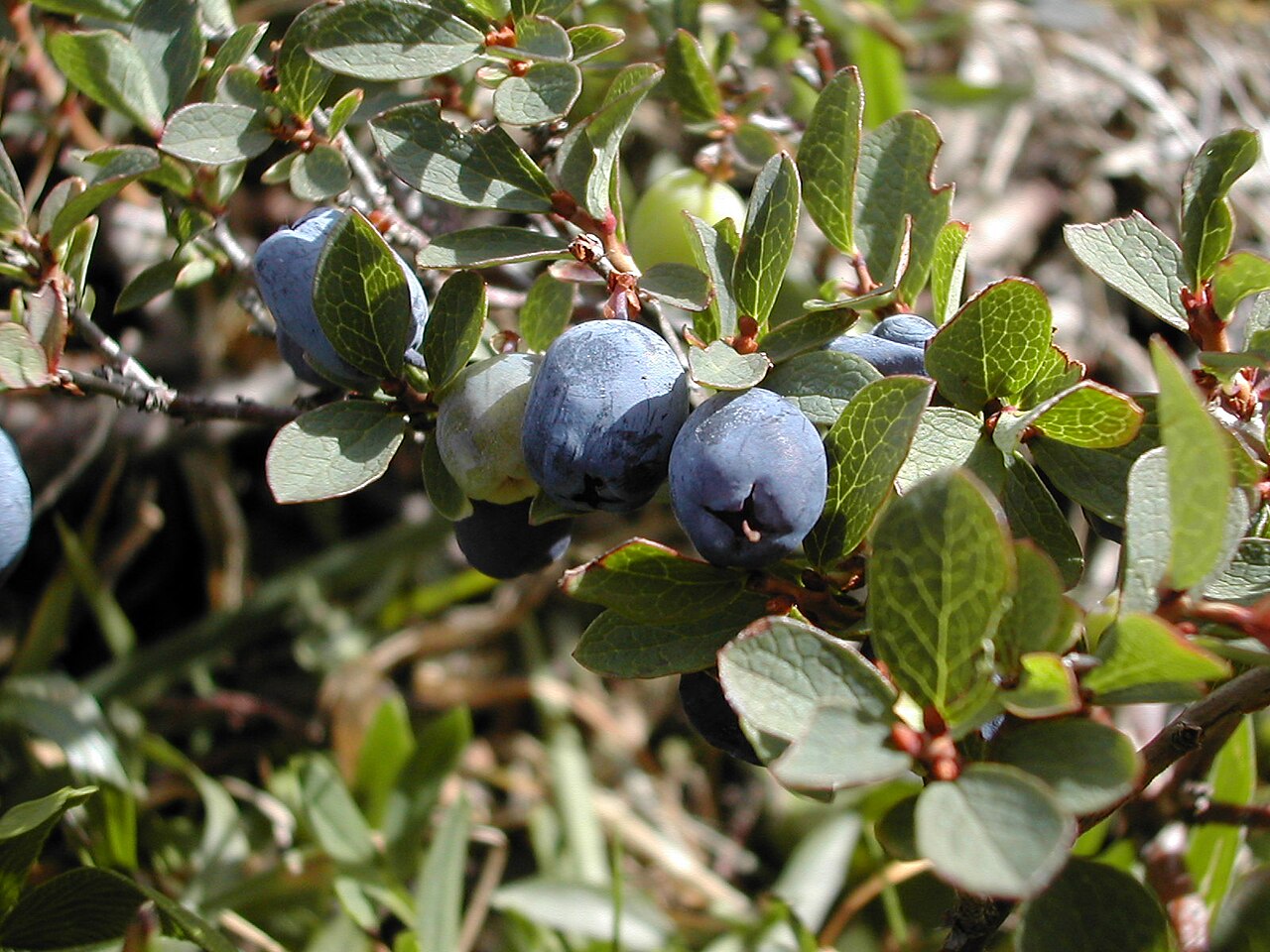
Vaccinium uliginosum, known as Bog Bilberry (USDA: bog blueberry), is a low, deciduous shrub of bogs, tundra and rocky mountain slopes across the cold parts of the Northern Hemisphere. It belongs to the heath family (Ericaceae) and is a close relative of the cultivated blueberries. Other common names include bog blueberry, northern bilberry, alpine blueberry and western blueberry. Plants are usually 4 inches to 2 feet tall, with small, blue-green, rounded leaves, pink urn-shaped flowers in early summer and sweet, dusty blue berries in late summer.
Bog bilberry is one of the most widespread shrubs of the far north. In Alaska it is the most common wild blueberry and an important traditional food, gathered by the gallon in late summer across the tundra and boreal forest. Farther south it is a plant of special places: alpine summits in New England and the Adirondacks, cold bogs and rocky shores around Lake Superior, coastal headlands and bogs in Maine, and high meadows and bogs in the Rockies, Cascades and Sierra Nevada.
For gardeners, bog bilberry is a tough, compact groundcover shrub for cold climates with acidic, moist soil. It suits rock gardens, bog gardens and northern native plantings, where its blue-green leaves turn red in fall. It does poorly in hot, humid summers. Where it grows wild on fragile alpine summits and bogs, enjoy it in place and buy nursery-propagated plants rather than digging them.
Identification
Bog bilberry is a small, stiff-branched shrub with smooth-edged, rounded, blue-green leaves and blue berries with pale green or whitish flesh. It often forms low mats on exposed sites and knee-high thickets in sheltered bogs.
Growth Form & Stems
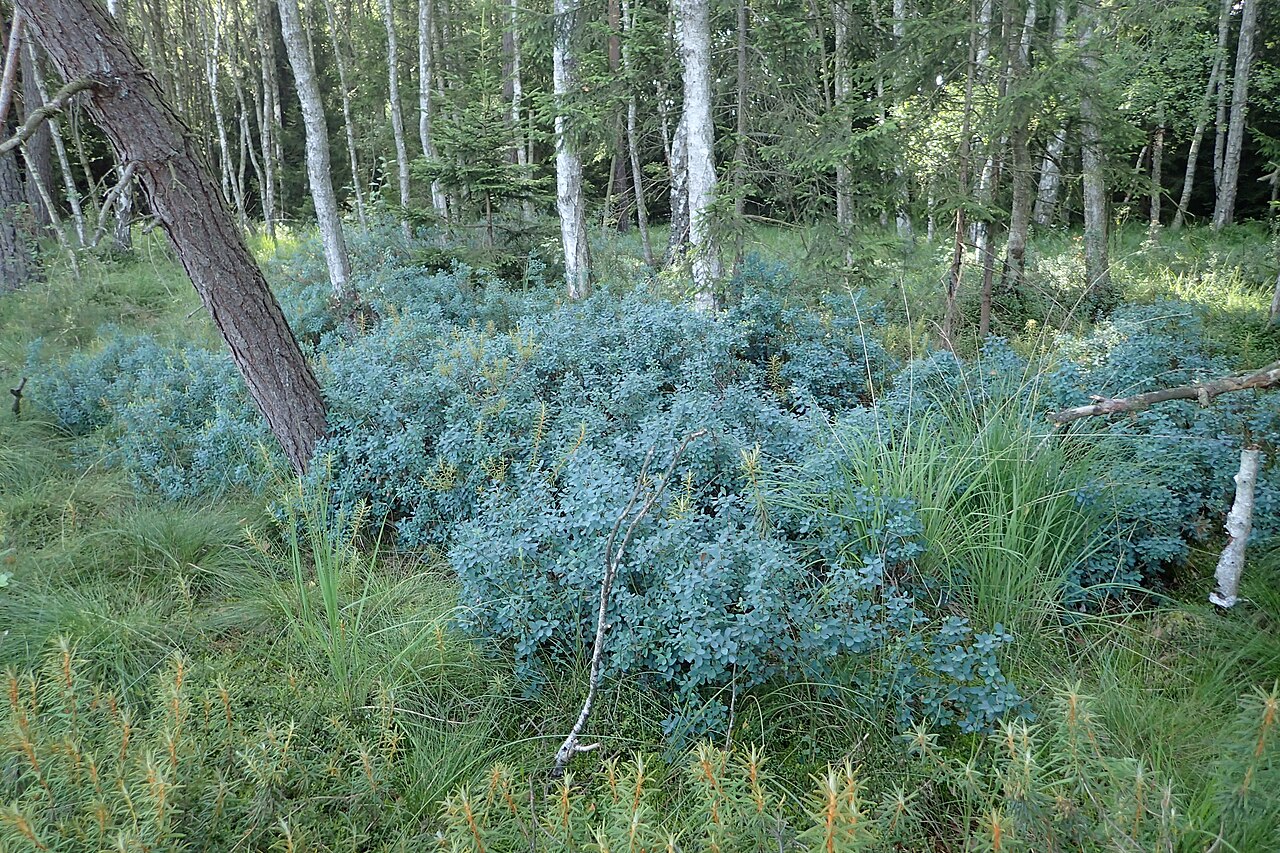
It is a much-branched, deciduous shrub, usually 4 to 24 inches tall, and only a few inches high on windswept tundra and alpine ridges. In sheltered bogs it can reach about 3 feet. The twigs are round (not angled or green like those of many blueberries) and brownish, with older stems gray with peeling bark. Plants spread slowly by underground stems to form patches.
Leaves
The leaves are alternate, about 1/2 to 1 1/4 inches long, oval to obovate (widest above the middle), with smooth, untoothed margins and a rounded or blunt tip. They are firm, dull blue-green above and paler with a raised net of veins beneath. In fall they turn red to purple before dropping.
Flowers
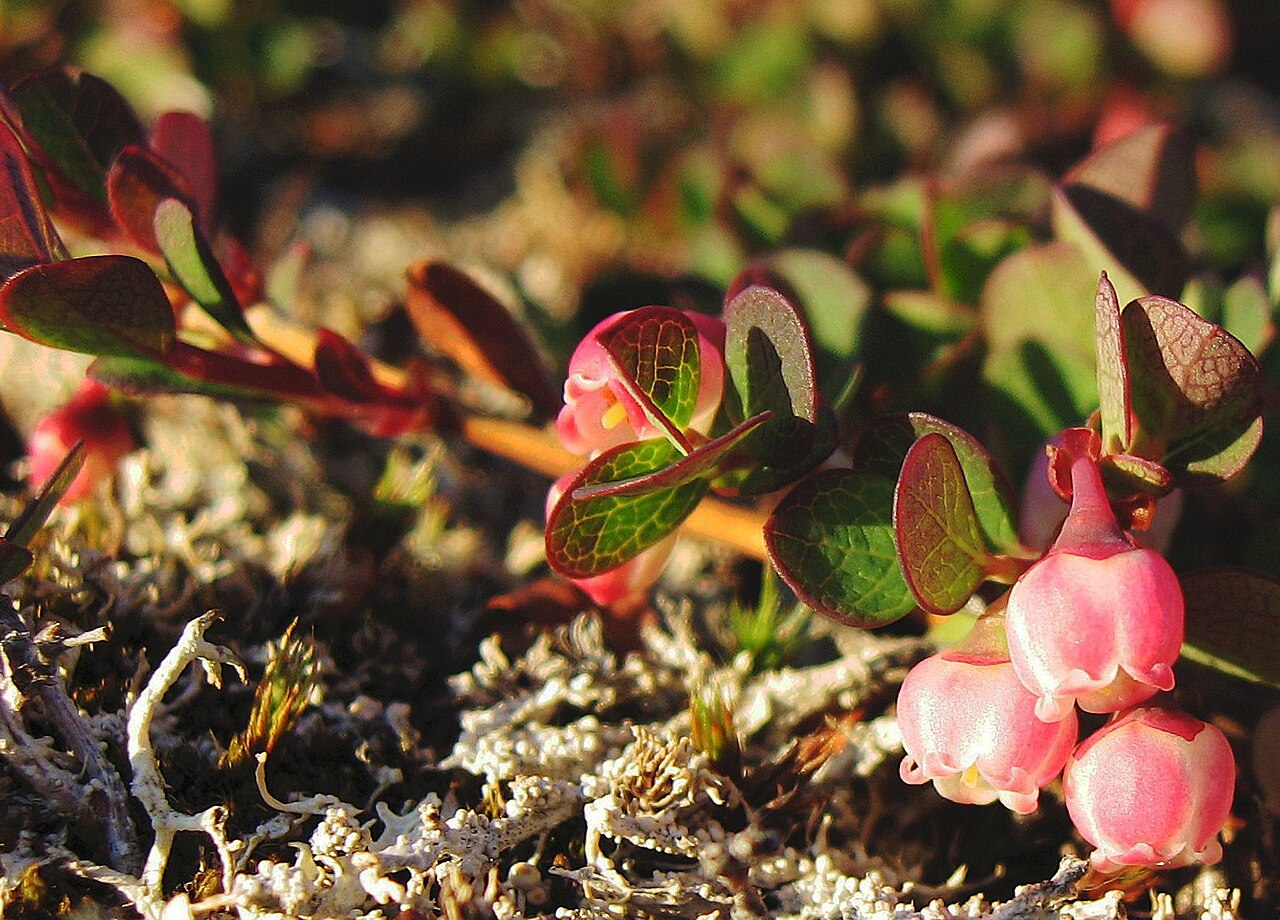
In June and July, small flowers open singly or in clusters of two to four from buds near the branch tips. Each is an urn- or bell-shaped corolla about 1/4 inch long, pink to white, usually with four (sometimes five) short lobes. The flowers hang downward and are pollinated mainly by bumble bees.
Fruit
The berries ripen in late July to September. They are round, about 1/4 to 3/8 inch across, blue-black with a whitish waxy bloom, and have pale green to whitish flesh and juice. The flavor is mildly sweet to tart. The pale flesh helps tell them apart from the European bilberry (V. myrtillus), which has dark purple flesh.
Look-alikes
Dwarf bilberry (V. cespitosum) has toothed leaves that are bright green and single flowers. Lowbush Blueberry has finely toothed, pointed leaves and green, warty twigs. Lingonberry is evergreen, with glossy leaves and red berries. Bog Laurel has narrow evergreen leaves with rolled edges and saucer-shaped flowers, and its leaves are toxic.
Edibility
The berries are edible raw or cooked and are widely harvested in Alaska, Canada and northern Europe. As with any wild food, be sure of your identification before eating, and do not confuse the plant with toxic bog shrubs such as bog laurel or Labrador tea, which do not produce blue berries.
Quick Facts
| Scientific Name | Vaccinium uliginosum |
| Family | Ericaceae (heath family) |
| Plant Type | Low deciduous shrub |
| Mature Height | 4–24 in (up to about 3 ft in sheltered sites) |
| Mature Spread | 1–3 ft; spreads slowly by underground stems |
| Growth Rate | Slow |
| Sun Exposure | Full sun to part shade |
| Water Needs | Medium to high; moist to wet acidic soil |
| Soil Type | Peat, sandy or rocky acidic soil; tundra and bog soils |
| Soil pH | About 4.0–5.5 (acidic) |
| Bloom Time | June–July |
| Flower Color | Pink to white |
| Fall Color | Red to purple |
| Fruit | Blue-black berry with a whitish bloom and pale flesh, July–September |
| Deer Resistant | Low; twigs and leaves are browsed |
| USDA Hardiness Zones | 1–6 |
Native Range
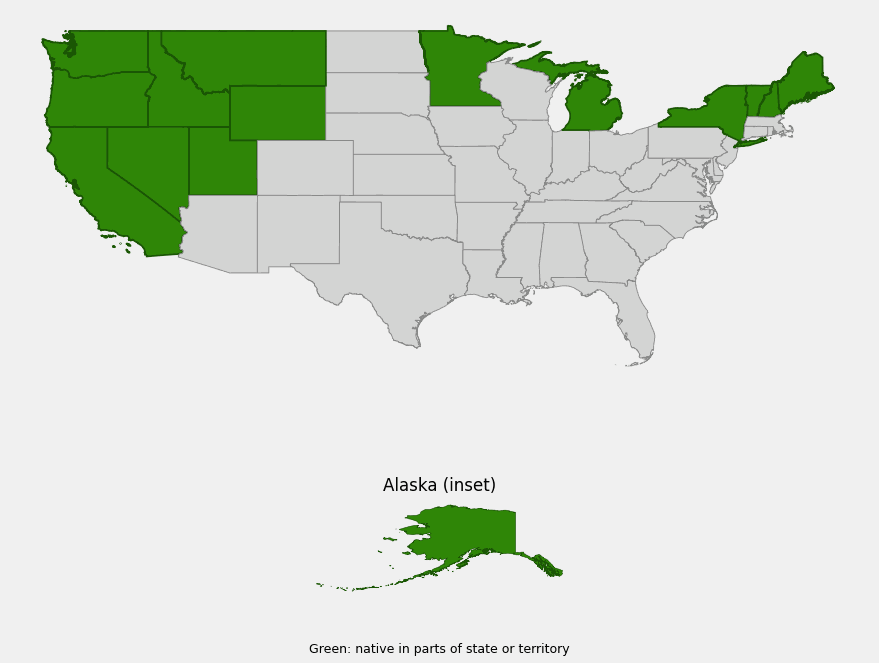
Bog bilberry is circumboreal, growing across northern North America, Greenland, Europe and Asia. USDA PLANTS lists it as native in Alaska, Canada, Greenland, Saint Pierre and Miquelon and the lower 48 states. In Canada it occurs in every province and territory, from Yukon and British Columbia to Newfoundland and Labrador. In the United States it is recorded from Alaska, California, Idaho, Maine, Michigan, Minnesota, Montana, New Hampshire, Nevada, New York, Oregon, Utah, Vermont, Washington and Wyoming.
The Lady Bird Johnson Wildflower Center summarizes its southern limit as northern New England, extreme northeastern Minnesota and Humboldt County, California. In the East it grows on alpine summits of the White Mountains, Mount Katahdin, the Green Mountains and the Adirondacks, and in coastal bogs and on headlands in Maine. Around the Great Lakes it occurs on the rocky Lake Superior shore of Michigan and Minnesota. In the West it grows in high bogs, meadows and subalpine slopes of the Rocky Mountains of Montana, Wyoming and Idaho, the Cascades and Olympic Mountains, the Klamath region and the Sierra Nevada, and in coastal bogs of northern California, Oregon and Washington. Records from Utah and Nevada are few and local.
Typical habitats are sphagnum bogs and fens, wet and dry tundra, alpine heaths and ridges, rocky lake shores, open boreal forests and muskeg. It is most common where summers are cool and soils are acidic and low in nutrients.
📋 Regional plant lists featuring Bog Bilberry: New York, Pennsylvania & Northern New Jersey · Idaho, Eastern Oregon & Eastern Washington · Montana & Wyoming · Michigan, Wisconsin & Eastern Minnesota · Utah & Western Colorado · New Hampshire, Maine & Vermont · Delaware, Southern New Jersey & Long Island · Alaska · Western Oregon & Western Washington · California & Nevada
Growing & Care Guide
Bog bilberry is a plant for cold climates. It is easiest in USDA zones 1 to 5 and cool coastal areas, and it struggles where summers are hot and humid. Buy nursery-propagated plants; never dig them from alpine summits or bogs, where plants grow slowly and the habitats are easily damaged.
Light
Full sun gives the most flowers and berries and the best fall color. It tolerates part shade, especially in warmer areas, but fruits less.
Soil & Water
It needs acidic soil, ideally pH 4 to 5.5, rich in peat or organic matter and well aerated. It grows in wet bogs as well as on drier rocky ground, but in gardens it does best in soil that stays evenly moist without standing water. Mulch with pine needles or bark to keep roots cool and moist. Avoid lime, alkaline water and heavy fertilizer.
Planting Tips
Plant in spring or early fall, about 18 to 24 inches apart for a groundcover. In alkaline or clay soils, grow it in a raised bed or large container of acidic peat-based mix. It pairs well with lingonberry, bearberry, Labrador tea and other small heaths in a rock garden or bog garden.
Pruning & Maintenance
Very little pruning is needed. Remove dead or weak stems in late winter. Older plants can be renewed by cutting a few of the oldest stems to the ground. Net the plants if birds take all the berries.
Propagation
Seeds from ripe berries need cleaning and several months of cold, moist stratification and germinate slowly. Softwood or hardwood cuttings root with patience, and rooted pieces of the spreading underground stems can be divided from established plants in early spring.
Landscape Uses
- Cold-climate groundcover: a tough, low shrub for zones 1–5 and cool coastal gardens
- Bog and rock gardens: with other small heaths in acidic, peaty soil
- Edible landscaping: wild-type blueberries for jams, pies and fresh eating
- Fall color: blue-green leaves turn red to purple in autumn
- Northern restoration: tundra, bog and alpine plantings within its native range
Wildlife & Ecological Value
Bog bilberry is a key food plant in the far north, feeding everything from bumble bees and butterflies to grouse, songbirds and bears.
For Pollinators
The flowers are pollinated mainly by bumble bees, which buzz the hanging bells to release pollen; other native bees and flies also visit. The Xerces Society notes special value to native bees. It is a larval host plant for the heath sulphur (Colias chippewa) and the Polaris fritillary (Boloria polaris), two northern butterflies.
For Birds
The berries are eaten by ptarmigan, grouse, thrushes, waxwings, gulls and many migrating songbirds. Spruce grouse and ptarmigan also eat the buds and leaves, and shorebirds and other tundra-nesting birds use the low thickets for cover.
For Mammals
Grizzly and black bears eat large amounts of the berries in late summer, as do foxes, voles and other small mammals. Caribou, moose and snowshoe hares browse the twigs and leaves.
Ecosystem Role
As one of the most common shrubs of tundra and northern bogs, bog bilberry helps form the low shrub layer that holds snow, shelters seedlings and stabilizes peat. Its roots partner with specialized mycorrhizal fungi that help it take up nutrients from acidic, nutrient-poor soils.
Cultural & Historical Uses
Bog bilberry berries are a traditional food for many Alaska Native and northern First Nations peoples. They are eaten fresh, mixed with fat and other foods (for example in Yup’ik akutaq), frozen or stored for winter. In Alaska, wild blueberry picking remains a major late-summer activity, and bog blueberry is the species most people pick.
In northern Europe and Asia the berries are also gathered for jams, juices and wines. The scientific name uliginosum comes from Latin uliginosus, “of marshes” or “wet places,” referring to its bog habitat. Folk names in Europe sometimes linked the berries to dizziness or drunkenness, but these reports are anecdotal and the berries are widely and safely eaten in normal amounts.
In the lower 48 states, bog bilberry is a classic plant of alpine summits such as Mount Washington and Mount Katahdin, where it grows with other arctic plants left behind after the last ice age. Hikers who stay on marked trails help protect these fragile alpine heaths.
Frequently Asked Questions
Are bog bilberry berries edible?
Yes. They are sweet to tart and can be eaten fresh or used like blueberries in jams, pies and baking. Make sure of your identification before eating any wild berry.
Is bog bilberry the same as a blueberry?
It is a true Vaccinium and a close relative of cultivated blueberries. Its fruit is a blueberry with pale flesh, and in Alaska it is usually called bog blueberry.
Can I grow bog bilberry in a warm climate?
Usually not well. It is adapted to cool summers and cold winters (zones 1 to 6) and suffers in hot, humid weather. In marginal areas give it afternoon shade, cool, moist acidic soil and good mulch.
How tall does bog bilberry grow?
Most plants are 4 inches to 2 feet tall. On exposed tundra and alpine ridges it forms mats a few inches high, while in sheltered bogs it can reach about 3 feet.
Can I dig bog bilberry from the wild?
No. Wild plants grow slowly, rarely survive transplanting, and many grow in fragile alpine or bog habitats or protected areas. Buy nursery-propagated plants.

Looking for a nursery that carries Bog Bilberry?
Browse our native plant nursery directory: Alaska · California · Idaho · Maine, Michigan, Minnesota & Montana · Nevada, New Hampshire & New York · Oregon · Utah & Vermont · Washington · Wyoming