
Showy Milkwort (Polygala grandiflora)
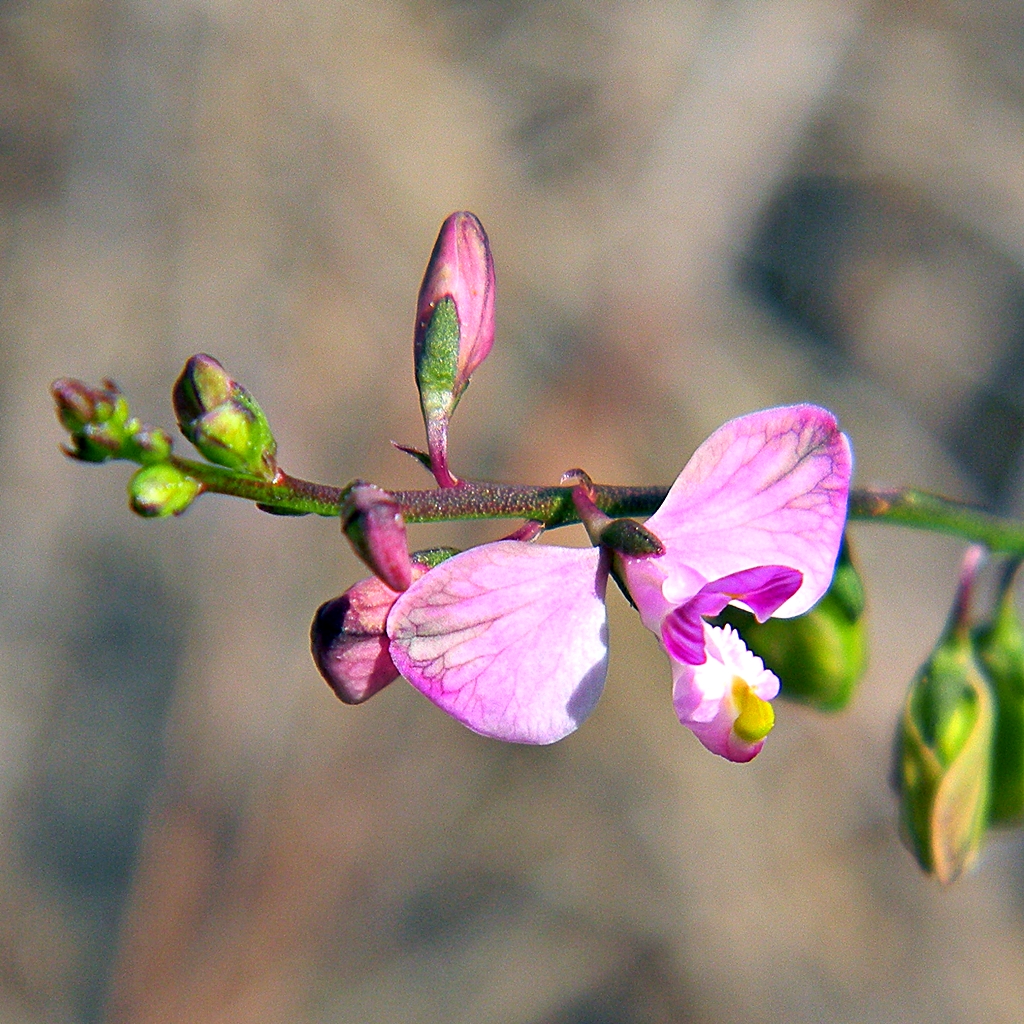
Polygala grandiflora, known as Showy Milkwort, is a small, delicate wildflower of the sandy pinelands of the southeastern Coastal Plain. Slender, often branched stems 1 to 2 feet tall carry loose spikes of rose-pink to purple flowers, each with two large, rounded, petal-like wings. It belongs to the milkwort family (Polygalaceae), and many botanists now place it in the segregate genus Asemeia as Asemeia grandiflora.
The species name grandiflora means “large-flowered,” and that is the point of comparison: most of its milkwort relatives have tiny flowers packed into dense heads or spikes, while showy milkwort’s individual flowers are about half an inch across and easy to appreciate up close. It is still a plant that many people walk past without noticing, scattered among wiregrass, palmettos and other low plants in open pine woods, sandhills, scrub and dry flatwoods.
Showy milkwort is not a common nursery plant, and it is best known as a wildflower to find on a walk through a well-burned pineland. This guide covers how to identify it, where it grows, what it needs, and how gardeners within its range can honestly approach growing it, mainly by protecting and encouraging plants that are already present in sandy, sunny native landscapes.
Identification
Showy milkwort is easiest to identify by its flower shape. Like other milkworts, its flowers look superficially like tiny pea flowers, but the structure is different: the showy parts are two enlarged sepals, not petals. Among the southeastern milkworts, the loose spike of relatively large pink-purple flowers on a leafy stem is distinctive.
Stems & Habit
Plants have one to several slender, upright to somewhat sprawling stems, usually 10 to 20 inches tall and occasionally taller, branching from a woody-based taproot. The stems are finely hairy. Showy milkwort is usually described as a biennial or short-lived perennial herb; some references, including USDA PLANTS, list it as an annual, and individual plants in the wild rarely persist for many years. In south Florida plants can be found in flower almost any month.
Leaves
The leaves are alternate, narrow, and variable: oblanceolate to linear, about ½ to 2 inches long and up to about ⅔ inch wide, and finely hairy, especially on the veins beneath. The lower leaves are usually broader than the upper ones. Leaf width varies a lot across the range, and several narrow-leaved and broad-leaved forms were once named as separate varieties or species.
Flowers
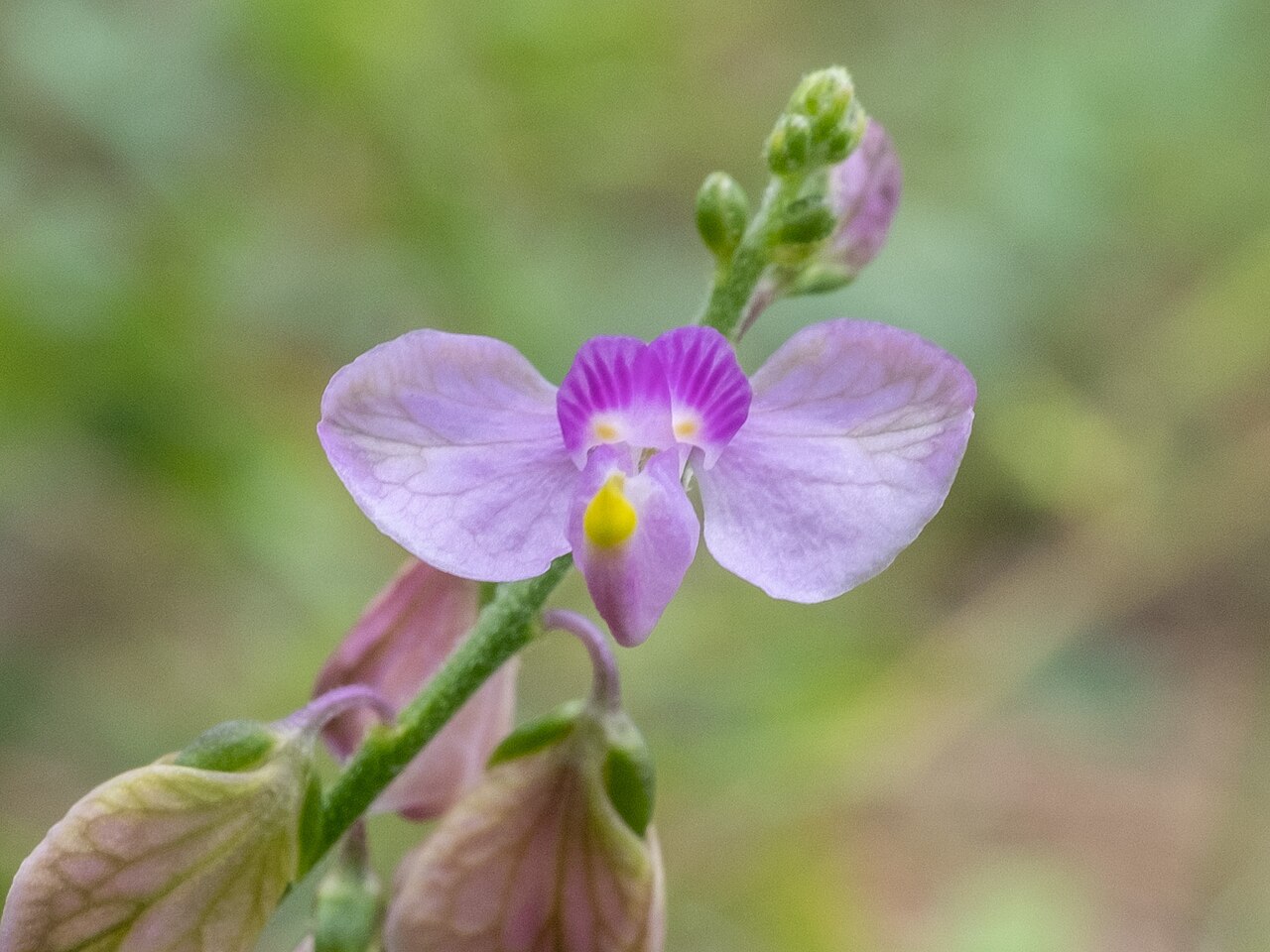
Flowers are borne in a loose, elongating raceme 2 to 7 inches long, opening a few at a time from the bottom upward. Each flower has two large, rounded wing sepals, rose-pink, lavender or purple and about ¼ to ⅔ inch long, that spread like a pair of petals. Between them sit the true petals, which form a small tube and a keel with a fringed or crested tip. The center is often magenta with a bright yellow tip. The three outer sepals are small and green.
Fruit & Seeds
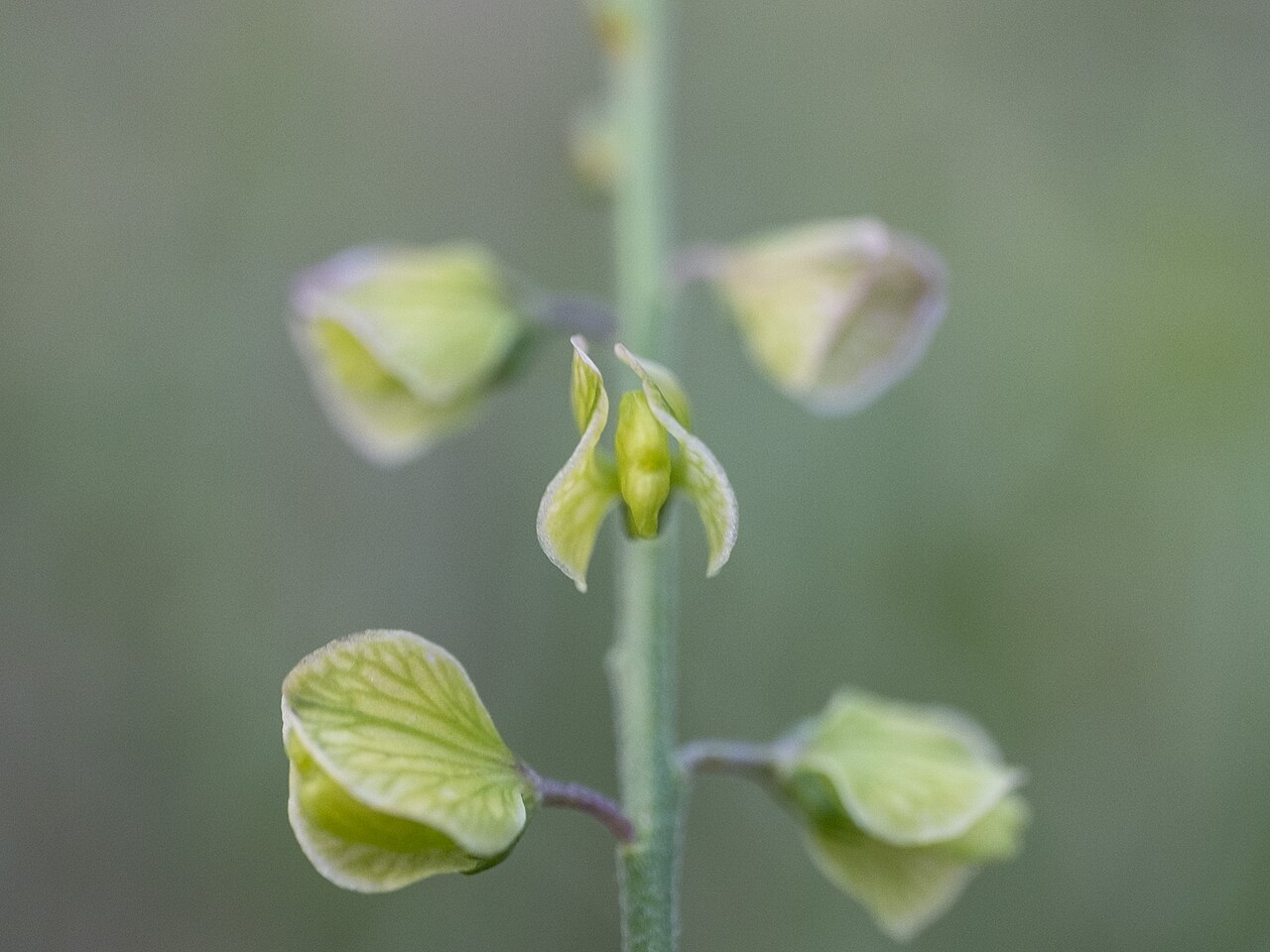
After the petals fall, the wing sepals usually stay on the stem, turn green, and cup the developing fruit. The fruit is a small, flattened, two-seeded capsule. The seeds are about 2 mm long, black and hairy. Because the plant flowers over a long season, a single stem often carries buds at the tip, open flowers in the middle and green fruiting wings below.
Quick Facts
| Scientific Name | Polygala grandiflora (syn. Asemeia grandiflora, Polygala cumulicola) |
| Family | Polygalaceae (milkwort family) |
| Plant Type | Herbaceous wildflower; biennial or short-lived perennial (listed as annual by USDA PLANTS) |
| Mature Height | 1–2 ft (occasionally to about 30 in) |
| Mature Spread | 6–12 in |
| Growth Rate | Moderate |
| Sun Exposure | Full sun to part shade |
| Water Needs | Low to moderate; well-drained sand |
| Soil Type | Sandy, low-nutrient soils; also thin soils over limestone in south Florida |
| Soil pH | Acidic to slightly alkaline (about 5.0–7.5) |
| Bloom Time | Spring through fall; nearly year-round in south Florida |
| Flower Color | Rose-pink to lavender or purple, with a yellow-tipped center |
| Fall Color | None |
| Fruit | Small flattened capsule held between persistent green wing sepals |
| Deer Resistant | Not well documented; rarely noted as browsed |
| USDA Hardiness Zones | 8–11 |
Native Range
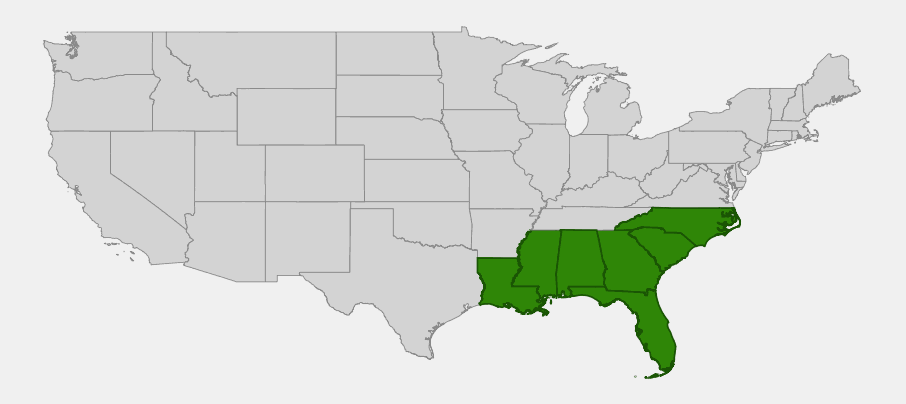
Showy milkwort is a plant of the southeastern Coastal Plain. USDA PLANTS records it as native in seven states: North Carolina, South Carolina, Georgia, Florida, Alabama, Mississippi and Louisiana. Florida is the heart of its range, and it occurs throughout most of the peninsula and the Panhandle, from the Georgia line south to the pine rocklands of Miami-Dade County and the edges of the Everglades. Beyond the United States it grows in the Bahamas and the Caribbean.
North and west of Florida it becomes more local. In Georgia, the Carolinas, Alabama and Mississippi it is found mostly in the outer Coastal Plain, in sandhills, dry pine flatwoods and coastal dunes and scrub. Louisiana is at the western edge of its range, and records there are few compared with Florida.
The plant was described by Thomas Walter in 1788 from South Carolina. Over the following century and a half, botanists named many variants based on leaf width, hairiness and flower size, including Polygala cumulicola of Florida dunes and scrub. These are now generally treated as a single variable species. USDA lists the plant as Polygala grandiflora var. grandiflora, while many current treatments use Asemeia grandiflora.
📋 Regional plant lists featuring Showy Milkwort: Alabama, Georgia & Mississippi · North & South Florida · North & South Carolina · Arkansas, Louisiana, Eastern Oklahoma & Eastern Texas
Growing & Care Guide
Showy milkwort is rarely sold, and there is little established horticultural experience with it. It is a short-lived plant that depends on reseeding to persist, so growing it is more like managing a small wildflower meadow than planting a perennial. The best opportunities are in sunny, sandy native landscapes within its range, where existing plants can be protected and allowed to self-sow. Never dig plants from the wild: they have deep taproots, rarely survive moving, and are short-lived anyway.
Light
Give it full sun or light, open shade, such as under scattered pines. In the wild it fades as shrubs and palmettos thicken after years without fire, so keep surrounding vegetation low and open.
Soil & Water
Showy milkwort grows in sandy, well-drained, low-nutrient soil, from deep dry sand to moister flatwoods sand and thin soils over limestone in south Florida. Do not amend the soil or fertilize; richer soil mainly feeds taller competitors. Once established it needs no regular watering, though young seedlings benefit from occasional water during long dry spells.
Planting Tips
If you find seed or seedlings from a reputable native plant source in your region, sow or plant them in an open, sunny patch of bare to sparsely vegetated sand among low companions such as wiregrass, low gayfeathers and other sandhill wildflowers. Scatter seed on the surface and press it in lightly; the seeds are small and should not be buried deeply. Expect plants to come and go from year to year rather than staying in one spot.
Pruning & Maintenance
Little care is needed. Leave plants standing so the seeds ripen and drop, and avoid heavy mulch, which buries seeds and smothers seedlings. In larger natural areas, prescribed fire or occasional mowing in the dormant season keeps the open conditions that showy milkwort and its pineland companions need.
Propagation
Propagation is by seed. Collect seed only from plants on your own property or with permission, and only a small share from any one plant. Seeds ripen continuously over a long season, so check plants often. Fresh seed sown outdoors on bare sand is the simplest approach; there is little published information on germination requirements for this species.
Landscape Uses
- Sandhill and pineland restoration: a characteristic wildflower of fire-maintained longleaf pine and scrub communities
- Native meadows on sand: a small, long-blooming accent among native grasses and low wildflowers
- Coastal landscapes: tolerates the dry, sandy soils of dune swales and coastal scrub within its range
- Butterfly and bee gardens: adds small but frequent flowers over a long season
- Protecting existing plants: on undeveloped sandy lots, leaving patches unmowed during flowering allows plants to set seed
Wildlife & Ecological Value
Showy milkwort is a small part of a large community. Its value to wildlife comes less from any single plant than from the long bloom season it adds to the diverse groundcover of southeastern pinelands.
For Pollinators
The flowers are visited mainly by bees, including small native bees, and occasionally by butterflies and other insects. As in other milkworts, the stamens and stigma are tucked inside the keel, so insects that probe the flower brush against them. Because plants bloom for many months, they offer nectar and pollen at times when few other pineland flowers are open, especially in south Florida.
For Birds
Seed-eating birds of pinelands, such as Bachman’s sparrow and northern bobwhite, forage in the open grassy groundcover where showy milkwort grows. Its small seeds are a minor part of that food supply, and there is little information on its direct use by birds.
For Mammals
Showy milkwort is of minor importance to mammals. Small rodents and gopher tortoises forage in the same habitats, but there is little specific information about their use of this plant.
Ecosystem Role
Showy milkwort is part of the species-rich groundcover that defines healthy longleaf pine and pine rockland ecosystems. These communities depend on frequent fire, which clears out shrubs and leaf litter and opens bare sand where short-lived wildflowers like this one can germinate. Plants often flower vigorously in the seasons after a burn. Its presence is one small sign of a pineland that is still being managed with fire.
Cultural & Historical Uses
Thomas Walter, a planter and botanist on the Santee River in South Carolina, described showy milkwort in his Flora Caroliniana of 1788, one of the first floras of North America to use Linnaean names. In 1933 John Kunkel Small moved it to the genus Asemeia. That name was ignored by most botanists for decades but was revived in 2012 after DNA studies showed that this group of New World milkworts forms a distinct lineage.
The common name “milkwort” comes from Europe, where related Polygala species were once thought to increase the milk supply of cattle and nursing mothers. The genus name has the same origin: Greek polys, much, and gala, milk. There is no evidence that showy milkwort shares those folk uses, and little is recorded about its use by Native American peoples.
Today showy milkwort is mainly valued by naturalists and native plant enthusiasts in Florida and the Southeast, who know it as one of the prettier small flowers of the pinewoods. It is a frequent subject for wildflower photographers, partly because its flowers reward a close look with their intricate fringed centers.
Frequently Asked Questions
Is showy milkwort an annual or a perennial?
Sources differ. USDA PLANTS lists it as an annual, while many floras and field guides describe it as a perennial, often a short-lived one, or as a biennial. In practice individual plants live only a few years, and populations persist by reseeding.
Can I buy showy milkwort plants?
It is rarely offered by nurseries. Occasionally native plant nurseries and seed suppliers in Florida carry it. Never dig wild plants; they have taproots and seldom survive transplanting.
Is showy milkwort related to peas?
Not closely. Its flowers resemble small pea flowers, but milkworts belong to their own family, Polygalaceae. In milkworts the two showy “wings” are sepals, while in pea flowers the wings are petals.
Why is it sometimes called Asemeia grandiflora?
DNA studies showed that showy milkwort and its close relatives form a group separate from the main body of Polygala, and in 2012 the old genus name Asemeia was revived for them. USDA PLANTS and many older references still use Polygala grandiflora.
When does showy milkwort bloom?
It has an unusually long bloom season. In central and south Florida plants can be found in flower in almost any month, and farther north it blooms mainly from spring through fall.

Looking for a nursery that carries Showy Milkwort?
Browse our native plant nursery directory: Alabama · Florida & Georgia · Louisiana & Mississippi · North Carolina · South Carolina
