
Saw-Toothed Goldenbush (Hazardia squarrosa)
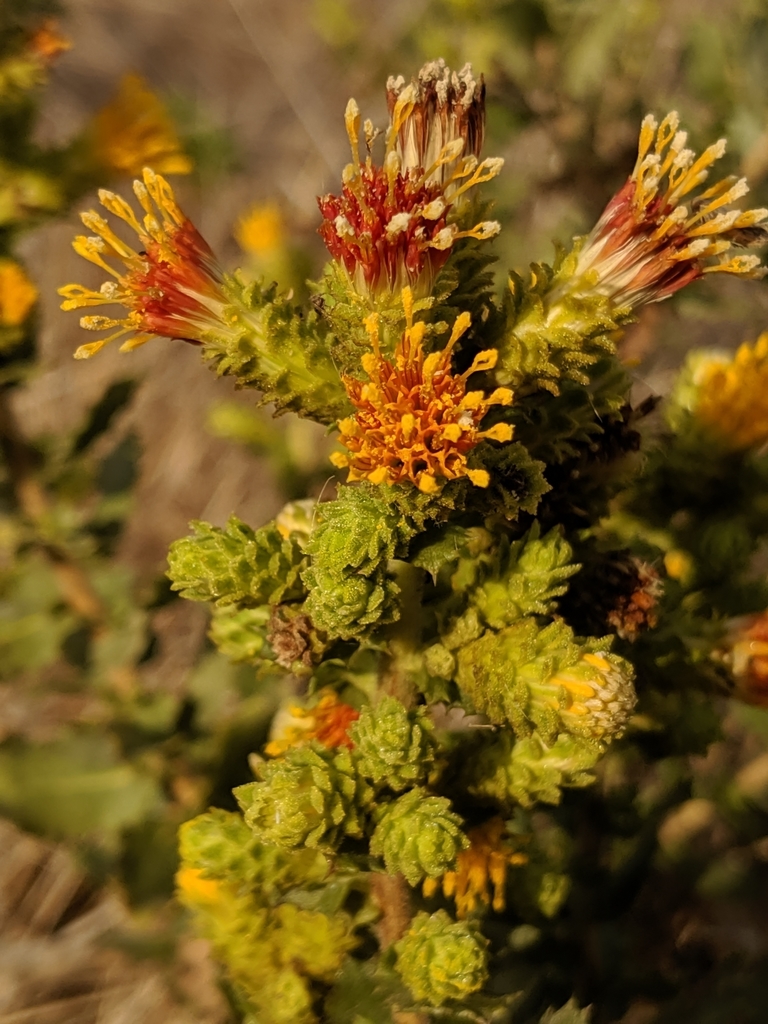
Hazardia squarrosa, known as Saw-Toothed Goldenbush or sawtooth goldenbush, is an evergreen shrub of the sunflower family (Asteraceae) native to the coastal sage scrub and chaparral of central and southern California and northern Baja California. It usually grows 2 to 5 feet tall, occasionally taller, with stiff, leathery, sharply toothed leaves and dense clusters of small, rayless flower heads that open yellow and age to orange and red.
Its great garden value is timing. Saw-toothed goldenbush blooms from midsummer into late fall, when most of the coastal scrub around it is dormant and dry. The flowers feed native bees, butterflies and other insects at a time when nectar is scarce, and the seed heads attract small birds into winter.
It is a tough, drought-tolerant plant for dry, sunny slopes and habitat gardens within its home range, and is grown by several California native plant nurseries. Older references place it in Haplopappus as Haplopappus squarrosus.
Identification
Look for a stiff, rounded, evergreen shrub with oblong, saw-toothed leaves that clasp the stems, and tight clusters of narrow, bristly flower heads with no petals, blooming in late summer and fall.
Growth Habit
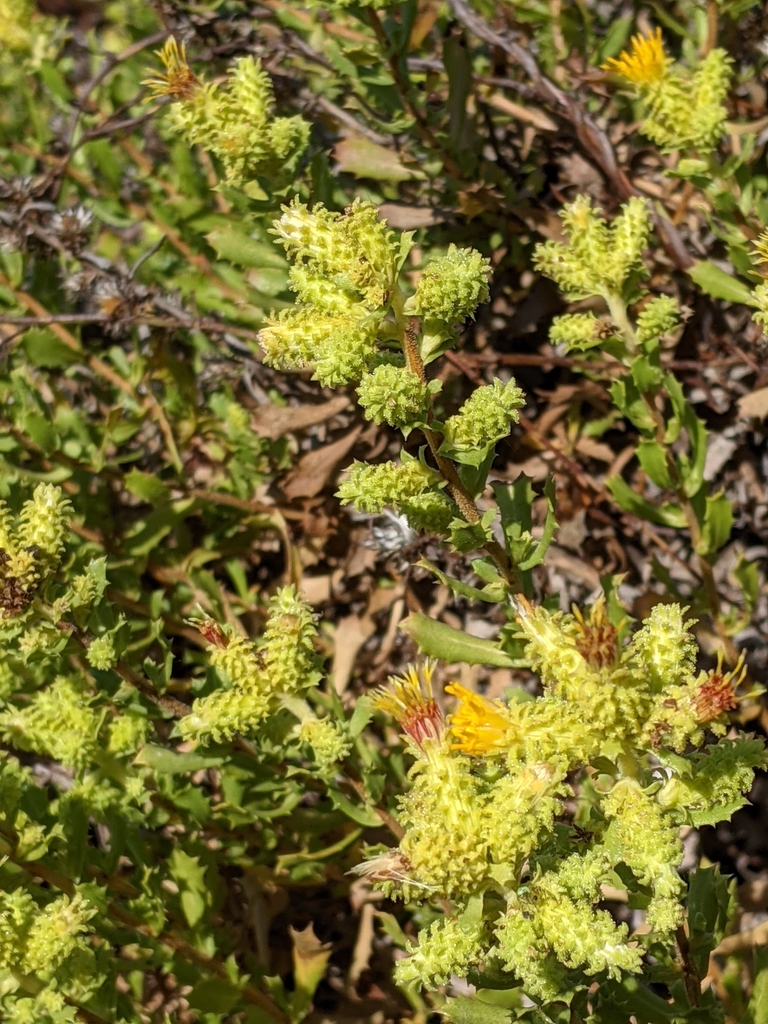
Saw-toothed goldenbush is a woody shrub or subshrub, usually 2 to 5 feet tall and about as wide, with many erect to spreading, leafy branches from a woody base. Some plants stay low and clumped; others sprawl or reach 6 feet or more in sheltered sites. Young stems are green and slightly glandular.
Leaves
The leaves are alternate, stiff and leathery, about 3/4 inch to 2 inches long, oblong to obovate, and stalkless, with the base often clasping the stem. Their edges are lined with sharp, spine-tipped teeth, the “saw teeth” of the common name. They are bright to dark green and sometimes a little sticky with resin glands, but not woolly.
Flower Heads
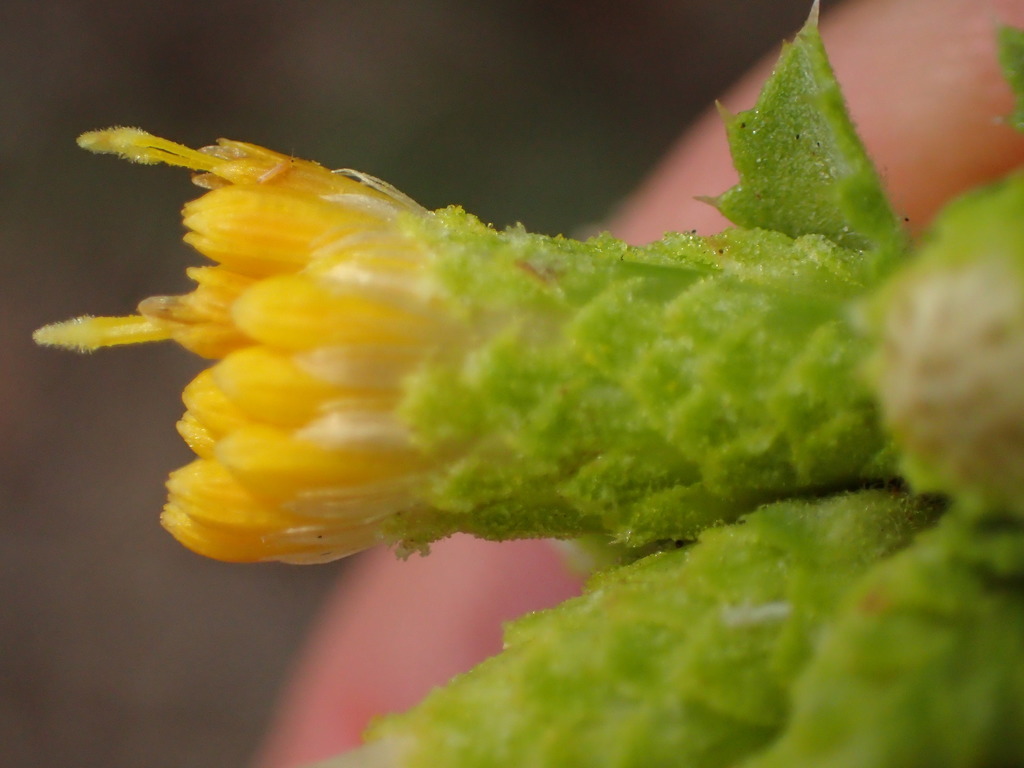
The narrow, cylindrical flower heads, about 1/2 to 3/4 inch long, are crowded in dense clusters at the ends of the branches. Each head is wrapped in overlapping bracts (phyllaries) whose green, leafy tips spread outward, giving a bristly, “squarrose” look. There are no ray flowers; each head holds a tuft of tubular disc florets that open yellow and turn orange to reddish-purple as they age, so a plant in full bloom shows a mix of colors. Bloom runs from about July to November.
Fruit
The small, dry fruits (cypselae) carry a tuft of tan to reddish-brown bristles that help them drift on the wind. The papery seed heads stay on the plant into winter.
Varieties
Three varieties are recognized. Variety squarrosa grows from San Benito County south to San Diego County. Variety grindelioides grows from Monterey County south into Baja California, including the Channel Islands. Variety obtusa, with blunter leaves, grows in Kern, Santa Barbara, Ventura and Los Angeles counties.
Look-alikes
Gumweeds (Grindelia) have similar toothed leaves but large, sticky heads with yellow ray petals. Coast goldenbush (Isocoma menziesii) also has rayless yellow heads in fall, but smaller, softer leaves and smaller heads without spreading bract tips. Narrowleaf goldenbush blooms in spring, with showy rayed flowers and thread-like leaves.
Quick Facts
| Scientific Name | Hazardia squarrosa |
| Family | Asteraceae (aster family) |
| Plant Type | Evergreen shrub |
| Mature Height | 2–5 ft (occasionally to 6 ft or more) |
| Mature Spread | 2–5 ft |
| Growth Rate | Moderate |
| Sun Exposure | Full sun to light shade |
| Water Needs | Very low once established |
| Soil Type | Well-drained sandy, rocky or clay soils |
| Soil pH | Slightly acidic to slightly alkaline (about 6.0–8.0) |
| Bloom Time | July–November |
| Flower Color | Yellow, aging to orange and red |
| Fall Color | Evergreen; fall flowers |
| Fruit | Small cypselae with tan bristles |
| Deer Resistant | Generally yes; tough, resinous foliage |
| USDA Hardiness Zones | 8–10 |
Native Range
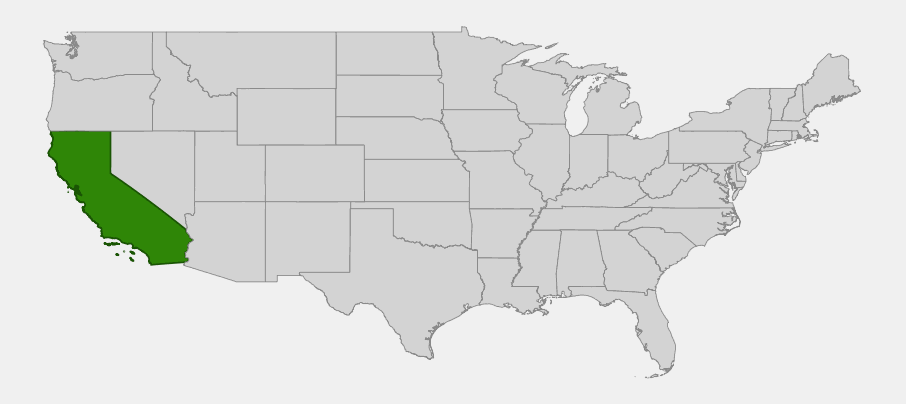
Saw-toothed goldenbush is native to California and northern Baja California, Mexico. USDA PLANTS lists it as native only in California in the United States, where it ranges through the Coast Ranges and southern California from Monterey and San Benito counties south through San Luis Obispo and Santa Barbara counties to San Diego County, including some of the Channel Islands.
It is most common in the coastal and inland foothills of southern California, from the Santa Monica, San Gabriel and Santa Ana Mountains to the hills of western Riverside and San Diego counties, and becomes less frequent toward the north. It grows mainly in the coastal plains, foothills and lower mountain slopes.
Its habitats are dry, sunny slopes, ridges and canyons in coastal sage scrub, chaparral and openings in oak woodland, often on rocky or clay soils. It frequently grows with California sagebrush, buckwheat, laurel sumac and other drought-deciduous and evergreen shrubs, and it recovers after fire by resprouting and from seed.
📋 Regional plant lists featuring Saw-Toothed Goldenbush: California & Nevada
Growing & Care Guide
Saw-toothed goldenbush is an easy, long-lived shrub for dry California gardens. Give it sun, good drainage and little summer water, and it will reward you with flowers when the rest of the garden is resting.
Light
Full sun is best for dense growth and heavy bloom. It tolerates light afternoon shade, especially inland, but becomes leggy and flowers less in deep shade.
Soil & Water
It grows in sandy, rocky or heavy clay soils as long as water does not stand around the roots. Water regularly through the first summer, then taper off. Established plants need little or no summer water near the coast and only an occasional deep soaking inland. Frequent summer watering shortens its life.
Planting Tips
Plant in fall or early winter so the roots can grow with winter rains. Space plants 3 to 4 feet apart. It looks best in groups on a slope or mixed with sages, buckwheats and California sagebrush in a coastal sage scrub planting. Avoid heavy mulch against the stems.
Pruning & Maintenance
Cut old flowering stems back by about a third in winter, after birds have had the seed, to keep the plant compact and encourage new growth. Avoid cutting deep into old, leafless wood. It is rarely bothered by pests and needs no fertilizer.
Propagation
Grow it from fresh seed sown in fall or winter; germination is usually fair without special treatment. Semi-hardwood cuttings taken in late summer or fall can also root. Buy plants from California native nurseries, and collect seed from the wild only where it is allowed.
Landscape Uses
- Late-season bloom: yellow-to-red flowers from midsummer into fall
- Pollinator gardens: nectar for bees and butterflies when little else blooms
- Dry slopes: deep roots and low water use for hillside plantings
- Habitat restoration: a component of coastal sage scrub and chaparral restoration
- Wildlife gardens: seed heads for small birds through winter
Wildlife & Ecological Value
In coastal sage scrub, saw-toothed goldenbush is one of the few shrubs in full bloom in late summer and fall, which makes it valuable for insects and the animals that feed on them.
For Pollinators
The flowers are visited by many native bees, butterflies, flies, beetles and wasps. Because it blooms late, after most sages and buckwheats are done, it helps carry pollinators through the dry season.
For Birds
Finches, sparrows and other seed-eating birds feed on the seeds, and insect-eating birds forage among the flowers. The dense, stiff branches give cover to birds of the scrub.
For Mammals
Its tough, toothed, resinous leaves are seldom browsed heavily, but small mammals use the shrub for cover.
Ecosystem Role
As part of the coastal sage scrub and chaparral community, it helps hold soil on steep slopes and adds structure and late-season food. It regrows after fire, helping these fire-adapted shrublands recover.
Cultural & Historical Uses
The genus Hazardia was named by botanist Edward Lee Greene in honor of Barclay Hazard (1852–1938) of Santa Barbara, a plant collector. The species name squarrosa describes the bracts around each flower head, whose tips spread or curve outward.
The species was first described in 1833 as Haplopappus squarrosus from plants collected in California, and it was later moved to Hazardia, a small genus of shrubs found mostly in California and Baja California. Some older guides still use the Haplopappus name.
Gardeners and restoration ecologists value it as a reliable late bloomer for southern California landscapes, where it extends the flowering season of native plantings well into fall.
Frequently Asked Questions
When does saw-toothed goldenbush bloom?
It usually blooms from July to November, with the heaviest flowering in late summer and early fall.
Why are the flowers yellow and red at the same time?
The disc florets open yellow and turn orange to reddish as they age, so a plant in bloom carries a mix of colors.
Is saw-toothed goldenbush drought tolerant?
Yes. Once established it needs little or no summer water, especially near the coast.
Does it have ray petals?
No. The heads contain only tubular disc florets, which is why they look like small brushes rather than daisies.
Where is saw-toothed goldenbush native?
It is native to central and southern California and northern Baja California, in coastal sage scrub and chaparral.

Looking for a nursery that carries Saw-Toothed Goldenbush?
Browse our native plant nursery directory: California
