
Granite Prickly Phlox (Linanthus pungens)
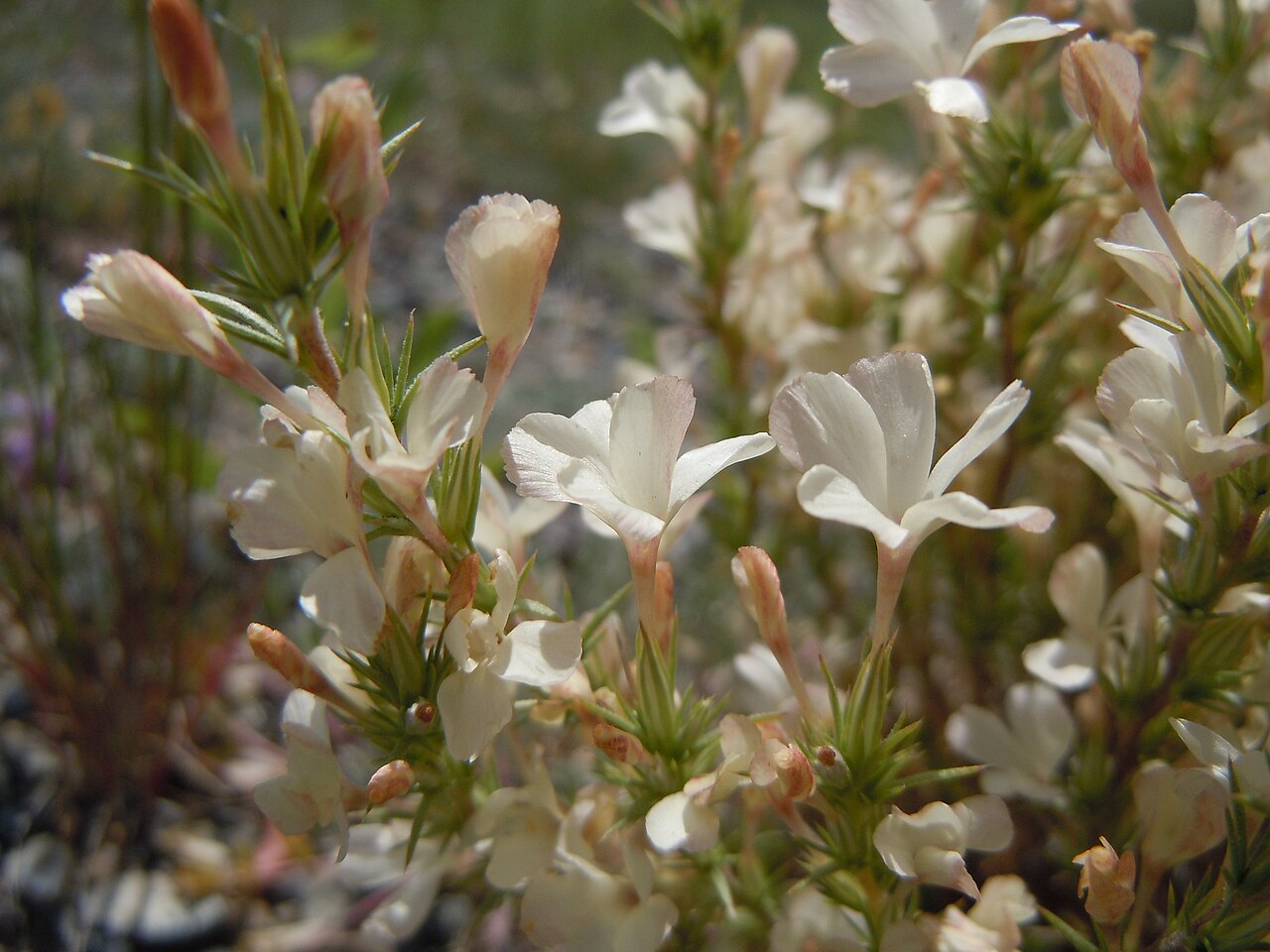
Linanthus pungens, known as Granite Prickly Phlox, granite gilia or prickly phlox, is a low, woody-based subshrub of dry, rocky places across the interior West. It belongs to the phlox family (Polemoniaceae). Many field guides still list it under its older name, Leptodactylon pungens; it was moved into Linanthus in 2000 based on DNA studies.
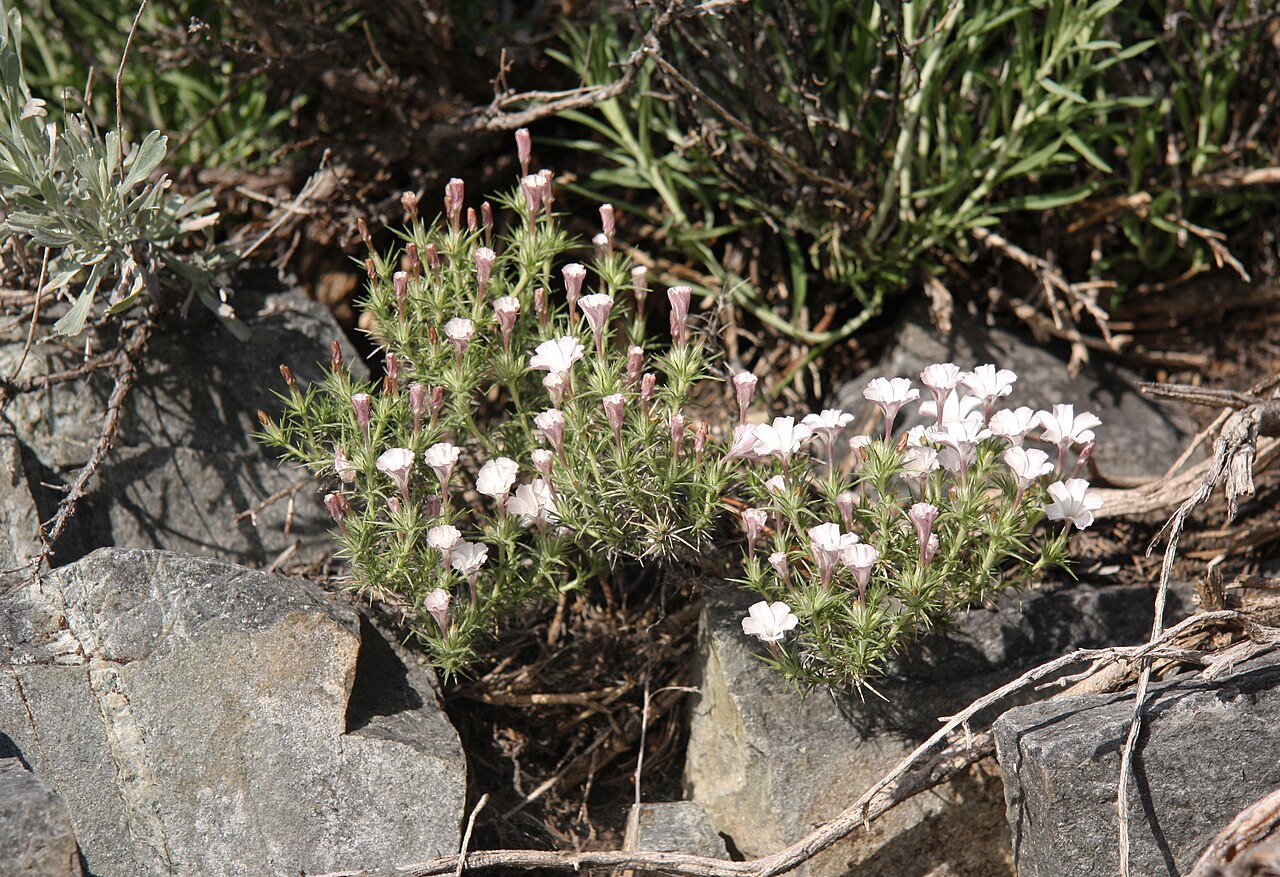
The plant forms a small, bristly bush or mat, usually under a foot tall, densely covered in stiff, needle-like leaves that prick the hand. From spring into summer it bears funnel-shaped flowers about 1/2 to 1 inch long, white to cream, yellowish or pinkish, often streaked with purple on the outside. The flowers tend to open in the evening and stay half closed on hot afternoons, releasing a sweet scent that draws night-flying moths.
Granite prickly phlox grows from sagebrush plains and pinyon-juniper woodland up to rocky alpine ridges, often on granite, volcanic rock or thin soil over bedrock. It is a tough, drought-tolerant plant for rock gardens and dry native landscapes within its range, and a familiar sight to hikers on dry mountain trails.
Identification
Look for a small, prickly, woody-based plant crowded with stiff, needle-like leaves and scattered, pale, funnel-shaped flowers that open wide at dusk.
Growth Habit
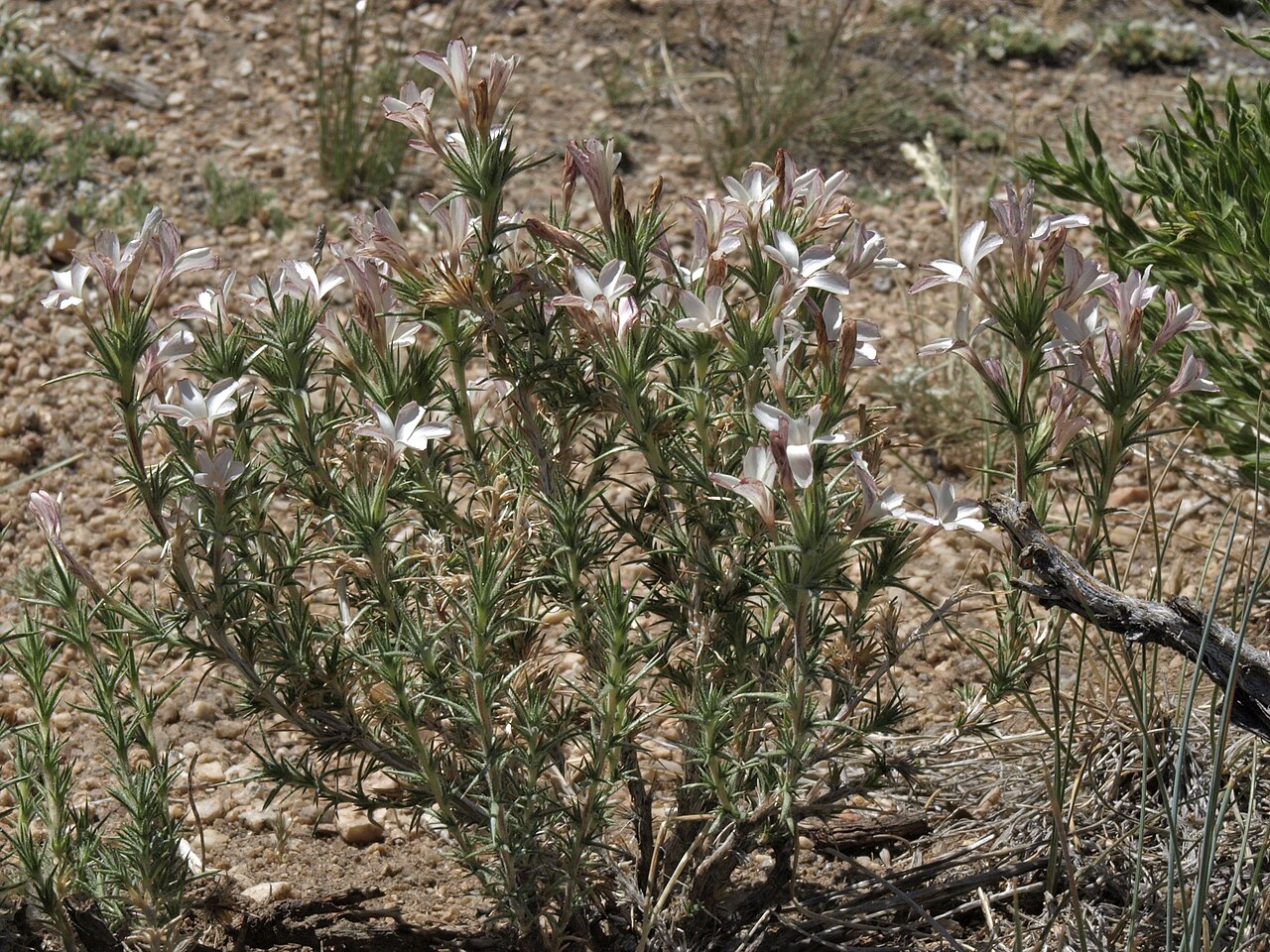
Granite prickly phlox is a perennial subshrub with a branched, woody base. Stems grow upright or spread to form a mat; mat-forming plants are more common at high elevations. Most plants are 4 to 12 inches tall, though upright plants in sheltered spots can reach about 2 feet. Old stems keep their dry, gray leaves, giving the plant a grizzled look.
Leaves
The leaves are the best field mark. Each leaf is divided to the base into three to seven stiff, narrow, sharp-pointed lobes, so it looks like a small cluster of needles. The leaves are crowded along the stems, alternate above and opposite below, often with short leafy shoots in their axils. They are green to gray-green and slightly sticky and aromatic.
Flowers
Flowers appear from about April to July, depending on elevation, and are borne singly or in small clusters at the stem tips. Each has a slender tube and five spreading lobes, forming a funnel or pinwheel 1/2 to 1 inch across. Colors range from white and cream to pale yellow or pink, and the outside of the petals is often tinged purple. Flowers open mostly in the evening and at night and are fragrant.
Fruit & Seeds
The fruit is a small, cylindrical capsule that splits into three parts, each holding about 5 to 10 seeds. Seeds ripen in mid to late summer.
Look-alikes
Spiny phlox (Phlox hoodii) and other cushion phloxes also have stiff, narrow leaves, but their leaves are undivided and their flowers open by day on short, flat-faced tubes. Prickly sandwort (Eremogone) has grass-like, prickly leaves in basal tufts and small, white, star-shaped flowers with separate petals. Granite prickly phlox is the only one in its habitats with palmately divided, needle-like leaves.
Safety Notes
Granite prickly phlox is not known to be toxic, but its sharp leaves can prick bare skin. Wear gloves when handling it.
Quick Facts
| Scientific Name | Linanthus pungens |
| Family | Polemoniaceae (phlox family) |
| Plant Type | Evergreen perennial subshrub |
| Mature Height | 4–12 in (to about 2 ft) |
| Mature Spread | 6–18 in |
| Growth Rate | Slow |
| Sun Exposure | Full sun |
| Water Needs | Very low; dry, well-drained soil |
| Soil Type | Rocky, sandy or gravelly; granite or volcanic soils |
| Soil pH | About 6.0–8.0 |
| Bloom Time | April–July (later at high elevations) |
| Flower Color | White, cream, pale yellow or pink |
| Fall Color | Evergreen; gray-green foliage |
| Fruit | Small three-part capsules |
| Deer Resistant | Yes; prickly foliage |
| USDA Hardiness Zones | 4–8 |
Native Range
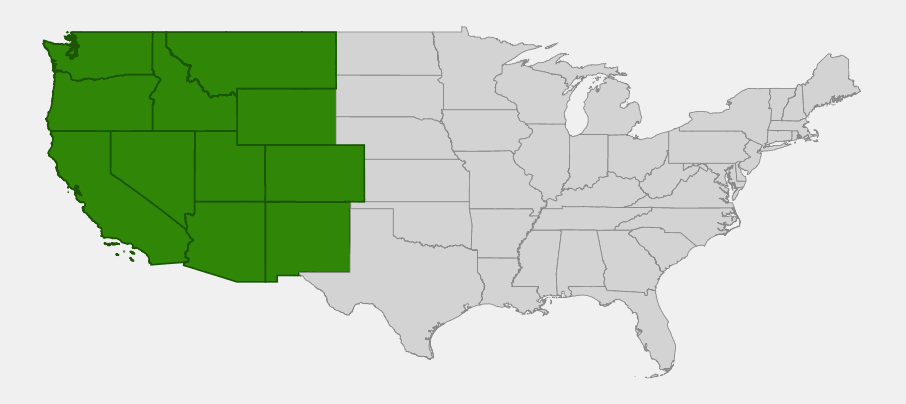
Granite prickly phlox is native to western North America from British Columbia south to Baja California and east to Montana, Wyoming, Colorado and New Mexico. USDA PLANTS lists it as native in Arizona, California, Colorado, Idaho, Montana, Nevada, New Mexico, Oregon, Utah, Washington and Wyoming. USDA and BONAP also carry an isolated record from Maryland, far outside the natural range; it is not treated as part of the native range here.
It is common throughout the Great Basin, the Columbia Plateau, the eastern Sierra Nevada and the mountains of the Southwest. In Washington and Oregon it grows mainly east of the Cascade crest, in sagebrush steppe and dry pine country, and it reaches high in the Cascades, Sierra Nevada and Rocky Mountains on rocky ridges.
Typical habitats are dry, open, rocky places: sagebrush steppe, pinyon-juniper and ponderosa pine woodland, desert washes, cliffs, talus, granite outcrops, pumice and lava flows, and alpine fell fields. It tolerates poor, shallow, sandy or salty soil and is sometimes a dominant shrub on volcanic soils.
📋 Regional plant lists featuring Granite Prickly Phlox: Idaho, Eastern Oregon & Eastern Washington · Montana & Wyoming · Utah & Western Colorado · Arizona & New Mexico · California & Nevada
Growing & Care Guide
Granite prickly phlox is rarely sold, but specialist rock-garden and native seed suppliers in the West sometimes offer it. It is a plant for dry, rocky, sunny spots in cold-winter climates, not for rich, watered beds.
Light
Give it full sun. It tolerates a little afternoon shade but gets sparse and flowers less.
Soil & Water
It needs sharp drainage: gravel, sand, decomposed granite, pumice or a rock crevice. Water new plants lightly until they root in, then let them live on natural precipitation in their home range. Wet soil, especially in winter, and summer irrigation quickly rot the roots.
Planting Tips
Plant it in a rock garden, crevice garden, gravel bed or on a dry slope among boulders, together with buckwheats, penstemons and bunchgrasses. Small plants establish best; plant in fall or early spring and top-dress with gravel to keep the crown dry.
Pruning & Maintenance
Little care is needed. Do not fertilize. Trim off dead stems in early spring if you want a tidier look, wearing gloves, and avoid heavy cutting into old wood.
Propagation
Sow fresh seed in fall outdoors or give it a period of cold, moist stratification before spring sowing. Seedlings grow slowly. Softwood cuttings taken in early summer can root in a very gritty mix. Do not dig wild plants; their deep roots rarely survive transplanting.
Landscape Uses
- Rock and crevice gardens: a tidy, prickly mound with fragrant evening flowers
- Dry native landscapes: very low water once established in its home range
- Moth gardens: night-opening, scented flowers for hawkmoths and other moths
- Restoration: sagebrush steppe and rocky slopes, especially on volcanic soils
- Erosion control on rocky sites: roots hold thin soil on slopes and ledges
Wildlife & Ecological Value
Granite prickly phlox is a small plant, but it supplies flowers and cover in harsh, open places where few other plants grow.
For Pollinators
The evening-opening, fragrant flowers are pollinated mainly by moths, including hawkmoths, which hover and sip nectar from the long tubes. Bees and other insects also visit the flowers by day.
For Birds
The dense, prickly mounds give cover to ground-nesting and ground-feeding birds of sagebrush and rocky slopes, and some seed-eating birds take the small seeds.
For Mammals
Its prickly foliage is rarely browsed, though small mammals may eat seeds and shelter under the plants.
Ecosystem Role
As a pioneer of rock, gravel and volcanic soils, granite prickly phlox helps hold thin soil and creates small sheltered spots where other plants can establish. It is one of the dominant small shrubs in some sagebrush and high-elevation communities.
Cultural & Historical Uses
The species was first described in 1827 by John Torrey as Cantua pungens. It was later placed in Gilia and then in Leptodactylon, a name meaning “slender finger,” for the narrow leaf lobes. In 2000, botanists J. Mark Porter and Leigh Johnson moved it into Linanthus. The species name pungens means “sharp-pointed,” for its prickly leaves.
Several subspecies are recognized, differing in growth form and flower size, including forms native to California, Oregon and the Pacific Northwest.
The common names “granite gilia” and “granite prickly phlox” reflect how often it grows on granite in the Sierra Nevada and other ranges. Hikers often notice its sweet scent drifting over rocky slopes on summer evenings before they see the pale flowers.
Frequently Asked Questions
Is granite prickly phlox a true phlox?
It is in the phlox family (Polemoniaceae), but not in the genus Phlox. Its current name is Linanthus pungens, and it was long known as Leptodactylon pungens.
Why are the flowers closed during the day?
The flowers open mainly in the evening and at night, when they are pollinated by moths, and are often half closed in the heat of the afternoon.
Can I grow granite prickly phlox in my garden?
Yes, in a cold-winter, dry climate with sharp drainage, such as a rock or crevice garden. It does poorly in wet, rich soil or with regular watering.
Is it prickly to touch?
Yes. The leaves are divided into stiff, needle-like lobes with sharp tips, so wear gloves when handling it.
Where does granite prickly phlox grow?
It grows in dry, rocky places across the West, from British Columbia to Baja California and east to Montana and New Mexico, from sagebrush plains to above timberline.

Looking for a nursery that carries Granite Prickly Phlox?
Browse our native plant nursery directory: Arizona · California · Colorado · Idaho · Montana · Nevada & New Mexico · Oregon · Utah · Washington · Wyoming
