
Checkered Rattlesnake Plantain (Goodyera tesselata)
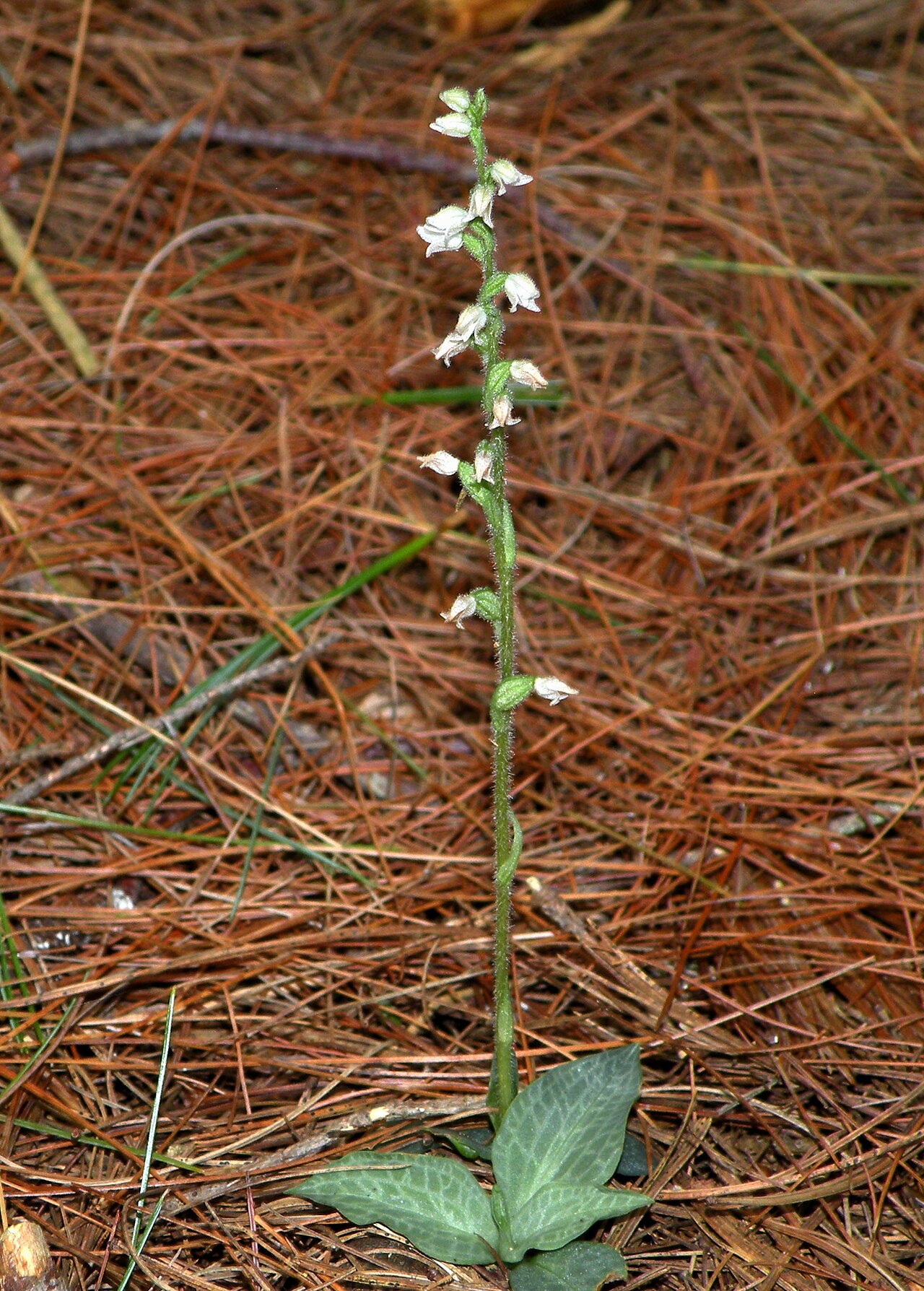
Goodyera tesselata, known as Checkered Rattlesnake Plantain or tesselated rattlesnake plantain, is a small evergreen orchid of northern forests. Most of the year it is just a low rosette of blue-green leaves, 1 to 2½ inches long, finely netted with paler veins in a checkered pattern. In mid to late summer it sends up a downy stalk 4 to 12 inches tall with a loose spiral of small white flowers.
It belongs to the orchid family (Orchidaceae) and grows in coniferous and mixed forests from Newfoundland and Manitoba south to New England, the Great Lakes states and the northern Mid-Atlantic. It is commonly found in dry to moist, acid, needle-covered soil under pines, hemlock, spruce and fir, often near its look-alike relatives, downy and lesser rattlesnake plantain.
Like all orchids it depends on soil fungi to germinate and to grow, so it is a plant to find and appreciate in the woods rather than one to plant in the garden. This guide explains how to identify it, how to tell it apart from other rattlesnake plantains, where to look for it, and why it should never be dug from the wild.
Identification
The rattlesnake plantains are named for their patterned leaves, which reminded early settlers of snakeskin. Four species grow in the Northeast and Great Lakes region, and checkered rattlesnake plantain is intermediate between several of them, so a careful look at leaves and flowers is worth the effort.
Leaves
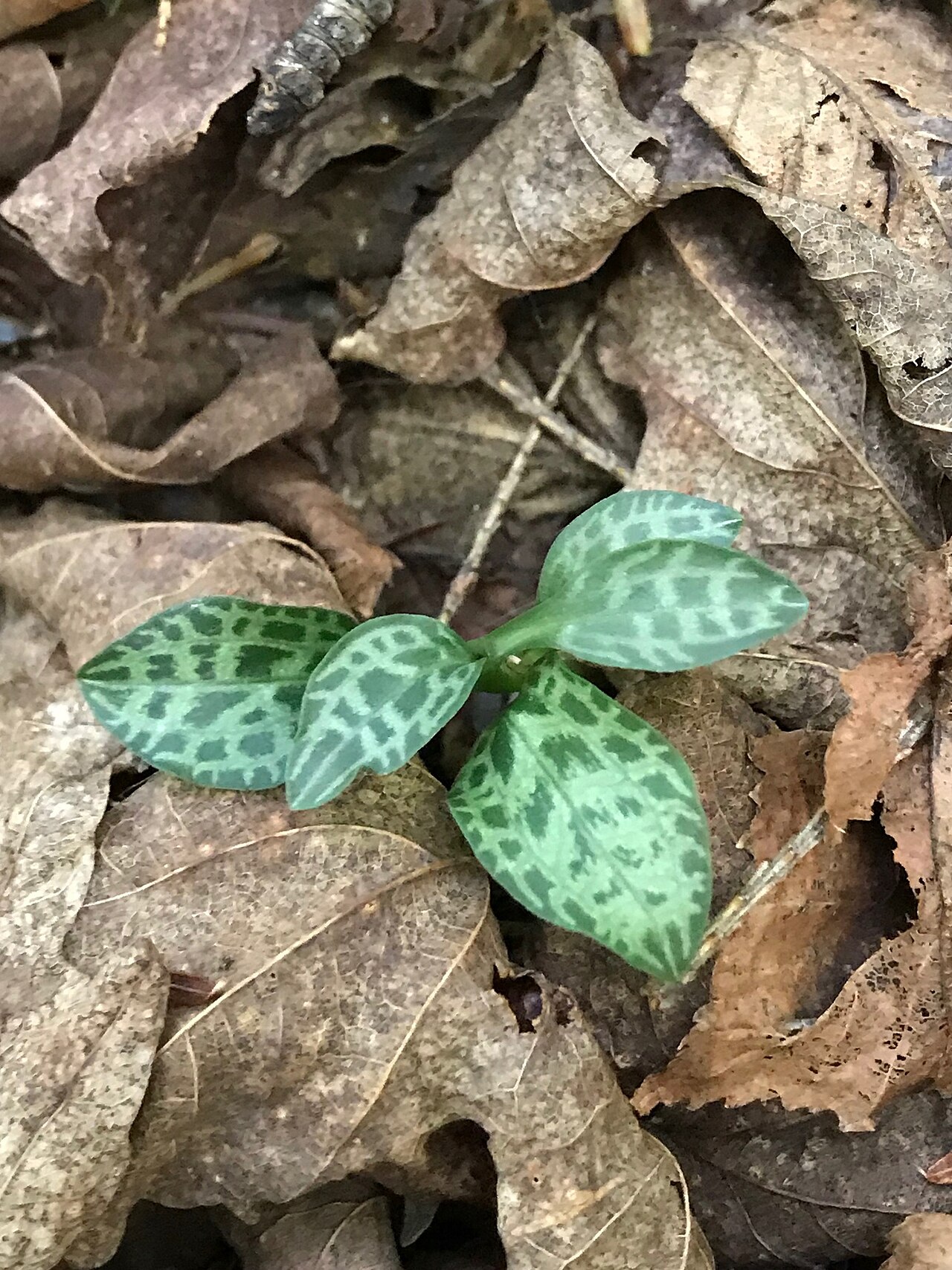
The plant forms a basal rosette of 3 to 7 evergreen leaves, each oval to lance-shaped, 1 to 2½ inches long and pointed at the tip. They are dull blue-green with a fine, pale reticulate network that gives a checkered or tessellated look. The pattern ranges from bold to faint, and some plants have almost plain leaves. Unlike downy rattlesnake plantain, the midrib does not carry a broad white stripe. The rosettes persist through winter under the snow.
Stems
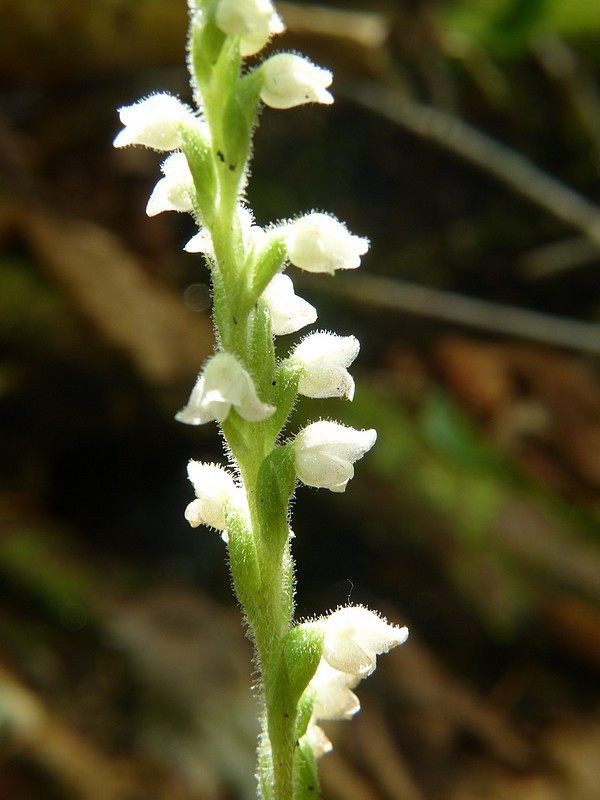
A single flowering stalk, 4 to 12 inches tall, rises from the center of the rosette in summer. It is covered in fine, glandular hairs and carries a few small, scale-like bracts. Plants spread slowly by creeping rhizomes, so rosettes are often found in small, loose groups.
Flowers
The flowers are borne in a loose, one-sided or weakly spiraled spike of about 10 to 30 small white flowers, opening from July to September. Each is roughly ¼ inch long. The upper sepal and the two petals form a hood over a short, pouch-like lip with a slightly recurved, beak-like tip. The outside of the flower is downy, like the stalk.
Fruit & Seeds
Pollinated flowers form small, upright, oval capsules that ripen in fall and release thousands of dust-like seeds. The dry stalks with split capsules often stand above the rosette into winter.
Look-alikes
Downy Rattlesnake Plantain (G. pubescens) has dark green leaves with a bold white midrib stripe and white netting, and a dense, cylindrical flower spike with a globe-shaped lip. Lesser rattlesnake plantain (G. repens) is smaller, with leaves usually under 1¼ inches and a strongly one-sided spike. Western Rattlesnake Plantain (G. oblongifolia) has longer, darker leaves with a white midrib stripe and grows mainly in the West, the upper Great Lakes and Maine. Checkered rattlesnake plantain is thought to have originated from hybridization between lesser and western rattlesnake plantains, and it combines features of both, so intermediate plants can be hard to name.
Quick Facts
| Scientific Name | Goodyera tesselata |
| Family | Orchidaceae (orchid family) |
| Plant Type | Terrestrial orchid; evergreen herbaceous perennial |
| Mature Height | Leaves 1–2 in high; flower stalk 4–12 in |
| Mature Spread | 3–5 in per rosette; slowly forms loose colonies |
| Growth Rate | Very slow |
| Sun Exposure | Part to full shade |
| Water Needs | Moderate; dry to moist forest duff |
| Soil Type | Acid, humus-rich forest duff over sand or rocky soil, often under conifers |
| Soil pH | About 4.5–6.5 (acidic) |
| Bloom Time | July–September |
| Flower Color | White |
| Fall Color | None; leaves are evergreen |
| Fruit | Small oval capsule with dust-like seeds |
| Deer Resistant | Unknown; small and inconspicuous, occasionally nibbled |
| USDA Hardiness Zones | 2–6 |
Native Range
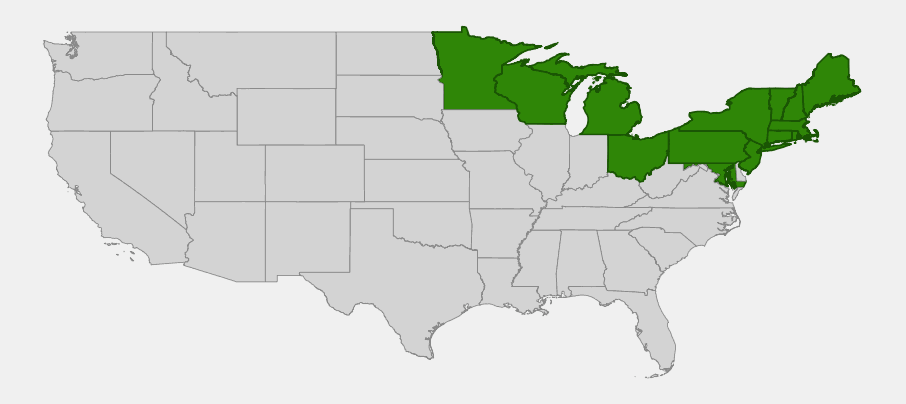
Checkered rattlesnake plantain is a plant of the northern forests of eastern North America. In Canada it ranges from Newfoundland, Nova Scotia, New Brunswick and Prince Edward Island west through Quebec and Ontario to Manitoba. In the United States USDA PLANTS records it from all six New England states, New York, New Jersey, Pennsylvania, Maryland and Ohio, and west through Michigan and Wisconsin to Minnesota.
It is most common in the boreal and northern hardwood-conifer forests of northern New England, the Adirondacks, the upper Great Lakes and adjacent Canada. Toward the southern edge of its range, in southern New England, New Jersey, Pennsylvania, Ohio and Maryland, it becomes scarce, and the Maryland and Ohio records are outlying ones. In Minnesota it grows mostly in the northeastern conifer forests.
It grows in shaded to partly shaded, dry to moist forests on acid soils: under white pine, red pine, jack pine, hemlock, spruce and balsam fir, in mixed hardwood-conifer woods, and sometimes on mossy banks and old forested dunes. It often appears in second-growth conifer stands and pine plantations once a deep needle layer has developed.
📋 Regional plant lists featuring Checkered Rattlesnake Plantain: New York, Pennsylvania & Northern New Jersey · Ohio & Indiana · Michigan, Wisconsin & Eastern Minnesota · Connecticut, Massachusetts & Rhode Island · New Hampshire, Maine & Vermont · Maryland, Virginia & West Virginia · Delaware, Southern New Jersey & Long Island
Can You Grow It?
Checkered rattlesnake plantain is not a garden plant in the usual sense. Its seeds can only germinate with the help of specific soil fungi, and the adult plants continue to rely on those fungal partners for part of their nutrition. Plants dug from the wild almost always decline and die, and digging them harms wild populations. It is uncommon in many states, especially near the southern edge of its range.
Light
In the wild it grows in shade to dappled light under conifers and mixed forest. It does not tolerate full sun or the drying of an open garden bed.
Soil & Water
It depends on a deep, undisturbed layer of acid forest duff, usually pine or hemlock needles over sand or rocky soil, with the fungi that live in it. That combination cannot be recreated by adding peat or mulch to a garden bed.
Planting Tips
Do not plant it, and never dig it from the wild. Native orchid specialists occasionally offer laboratory-propagated Goodyera, most often downy rattlesnake plantain. If you buy one, choose a nursery that clearly states its plants are propagated, not collected, and expect them to need a shaded woodland site with an established conifer duff layer. The best way to “grow” checkered rattlesnake plantain is to protect the woods where it already lives.
Pruning & Maintenance
Where it grows on your land, leave the forest floor alone. Avoid raking out needles, compacting the soil with trails or vehicles, or spraying herbicides nearby. Keep invasive shrubs and groundcovers such as Japanese barberry and periwinkle from overrunning the area.
Propagation
In nature it spreads slowly by rhizomes and by dust-like seed carried on the wind. Seed propagation requires sterile laboratory culture or a compatible fungus and is a job for specialists and conservation programs, not home gardeners.
Where to See It
- Conifer and mixed forests of the North: look under white pine, hemlock, spruce and fir in New England, the Adirondacks and the upper Great Lakes
- Pine plantations and second-growth woods: older pine stands with a deep needle layer often host rattlesnake plantains
- State parks and forests: many northern parks and nature preserves have populations along shaded trails
- Winter walks: the evergreen rosettes are easiest to spot in late fall and early spring, when the forest floor is open
- Native orchid outings: a fine introduction to orchid identification, often found alongside downy and lesser rattlesnake plantains
Wildlife & Ecological Value
Checkered rattlesnake plantain is small and easy to overlook, but it is part of the web of fungi, insects and plants that makes up a healthy northern forest floor.
For Pollinators
The small white flowers produce a little nectar in the pouch of the lip and are pollinated mainly by bumble bees. As a bee probes for nectar, the sticky pollen masses (pollinia) attach to its mouthparts or head and are carried to the next flower. Some flowers also self-pollinate.
For Birds
The plant has no special value to birds as food. It grows in the conifer forests used by many northern breeders, such as warblers, thrushes and grouse.
For Mammals
Deer, hares and other mammals may occasionally nibble the leaves, but the plant is too small and scattered to be an important food.
Ecosystem Role
Like all orchids, checkered rattlesnake plantain depends on mycorrhizal fungi. The fungi feed its tiny seeds and young underground seedlings, and adult plants continue to exchange nutrients with them. Because the plant needs those fungi, intact forest duff and a stable canopy, its presence is a good sign of an undisturbed forest floor.
Cultural & Historical Uses
The genus Goodyera honors John Goodyer, a seventeenth-century English botanist. The species was described in 1824 by the English nurseryman Conrad Loddiges, whose firm grew and sold North American plants. The epithet tesselata means checkered or mosaic-like and describes the pattern on the leaves.
The name rattlesnake plantain comes from the snakeskin-like leaf patterns of the genus and from an old belief, based on the doctrine of signatures, that such plants could treat snakebite. Several Native American peoples used rattlesnake plantains medicinally, mostly the more common downy species. These plants have no proven medicinal value.
Botanists consider checkered rattlesnake plantain to be of hybrid origin, a stabilized species that arose from crosses between lesser and western rattlesnake plantains. Its leaf patterns and flower details vary widely, which makes it a favorite puzzle for native orchid enthusiasts.
Frequently Asked Questions
Can I grow checkered rattlesnake plantain in my garden?
Not in an ordinary garden. It needs specific soil fungi and undisturbed conifer forest duff, and wild-dug plants almost always die. Never dig it from the wild. If you have it on your land, protect the site.
How do I tell checkered from downy rattlesnake plantain?
Downy rattlesnake plantain has dark green leaves with a bold white stripe down the midrib and a dense, cylindrical flower spike. Checkered rattlesnake plantain has blue-green leaves with a fine, even, checkered net and no strong midrib stripe, and a looser flower spike.
Is checkered rattlesnake plantain rare?
It is fairly common in northern New England, the upper Great Lakes and Canada, but uncommon to rare toward the southern edge of its range, including Maryland and Ohio.
When does it bloom?
From July to September. The evergreen leaf rosettes can be seen all year.
Why is it called rattlesnake plantain?
The patterned leaves of the genus were thought to resemble snakeskin, and old folk medicine held that they could cure snakebite. It is not related to plantains (Plantago) at all; it is an orchid.

Looking for a nursery that carries Checkered Rattlesnake Plantain?
Browse our native plant nursery directory: Connecticut · Maine, Maryland, Massachusetts, Michigan & Minnesota · New Hampshire, New Jersey, New York & Ohio · Pennsylvania, Rhode Island & Vermont · Wisconsin

