
Ross’ Avens (Geum rossii)
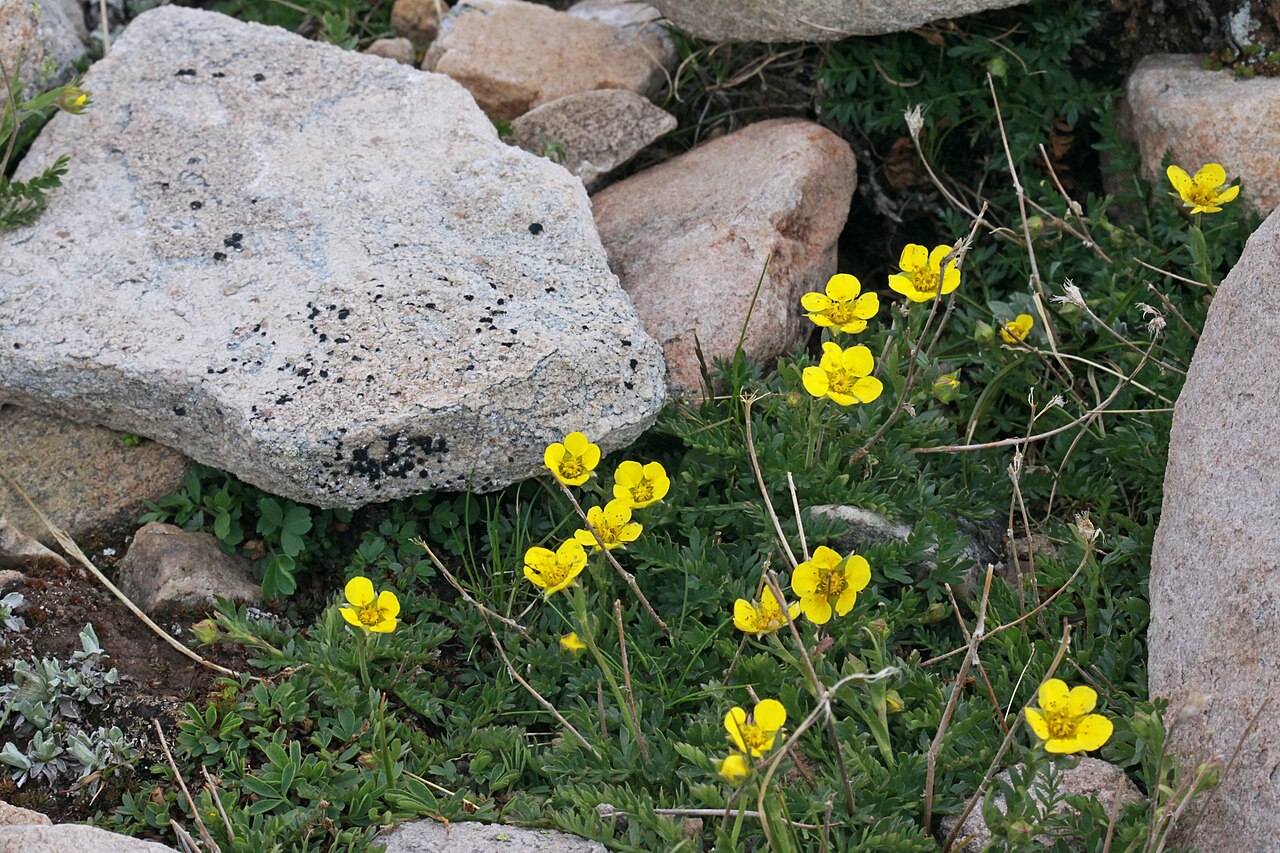
Geum rossii, known as Ross’ Avens or alpine avens, is a low, tufted perennial in the rose family (Rosaceae) that grows above treeline in the mountains of the western United States and on the arctic and alpine tundra of Alaska and northern Canada. It is often listed under the older name Acomastylis rossii. In early and mid summer it produces bright yellow, five-petaled flowers about an inch across above mats of finely divided, fern-like leaves.
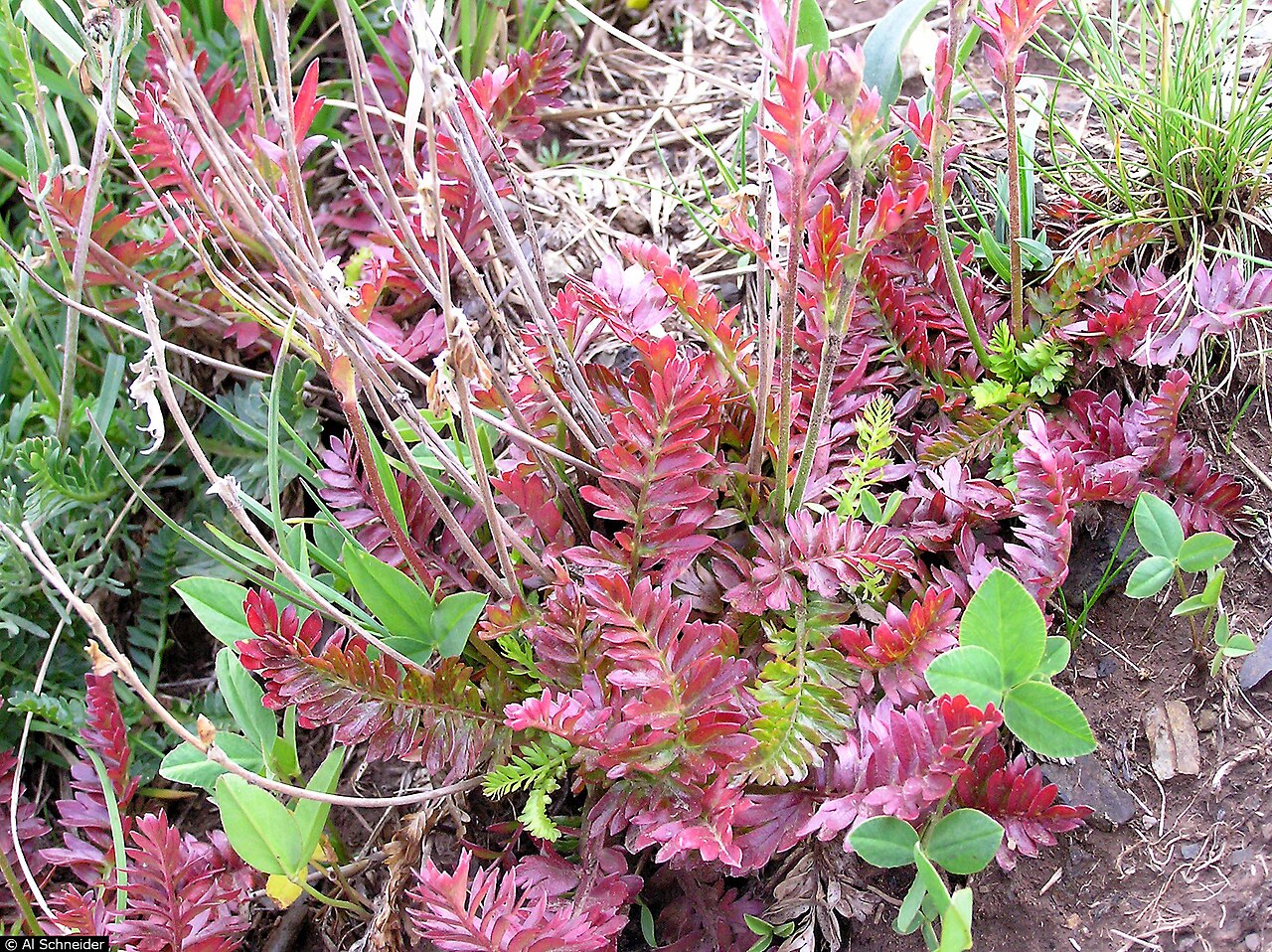
Ross’ avens is one of the most common and characteristic plants of the Rocky Mountain alpine zone. In places such as Colorado’s Front Range it dominates dry alpine meadows, and in late summer and fall its leaves turn glossy red to deep maroon, coloring entire slopes of tundra. Its flowers look much like those of cinquefoils (Potentilla), but its leaves are more finely divided and fern-like, and each stem carries only a few flowers.
This is a plant to admire in the high country rather than a typical garden plant. It needs the cold winters, short summers and gritty soils of the alpine zone and is grown mainly by specialist rock gardeners in cold climates. Never dig plants from the wild; mountain tundra recovers very slowly from disturbance.
Identification
Look for low tufts of crowded, fern-like basal leaves and short stems with one to a few bright yellow, buttercup-like flowers, on alpine tundra above treeline.
Growth Habit
A long-lived, clump-forming perennial from a thick, branching rootstock. Plants form dense tufts or mats of basal leaves, and old clumps can cover large patches. Flowering stems are usually 2 to 12 inches tall, rising a little above the leaves.
Leaves
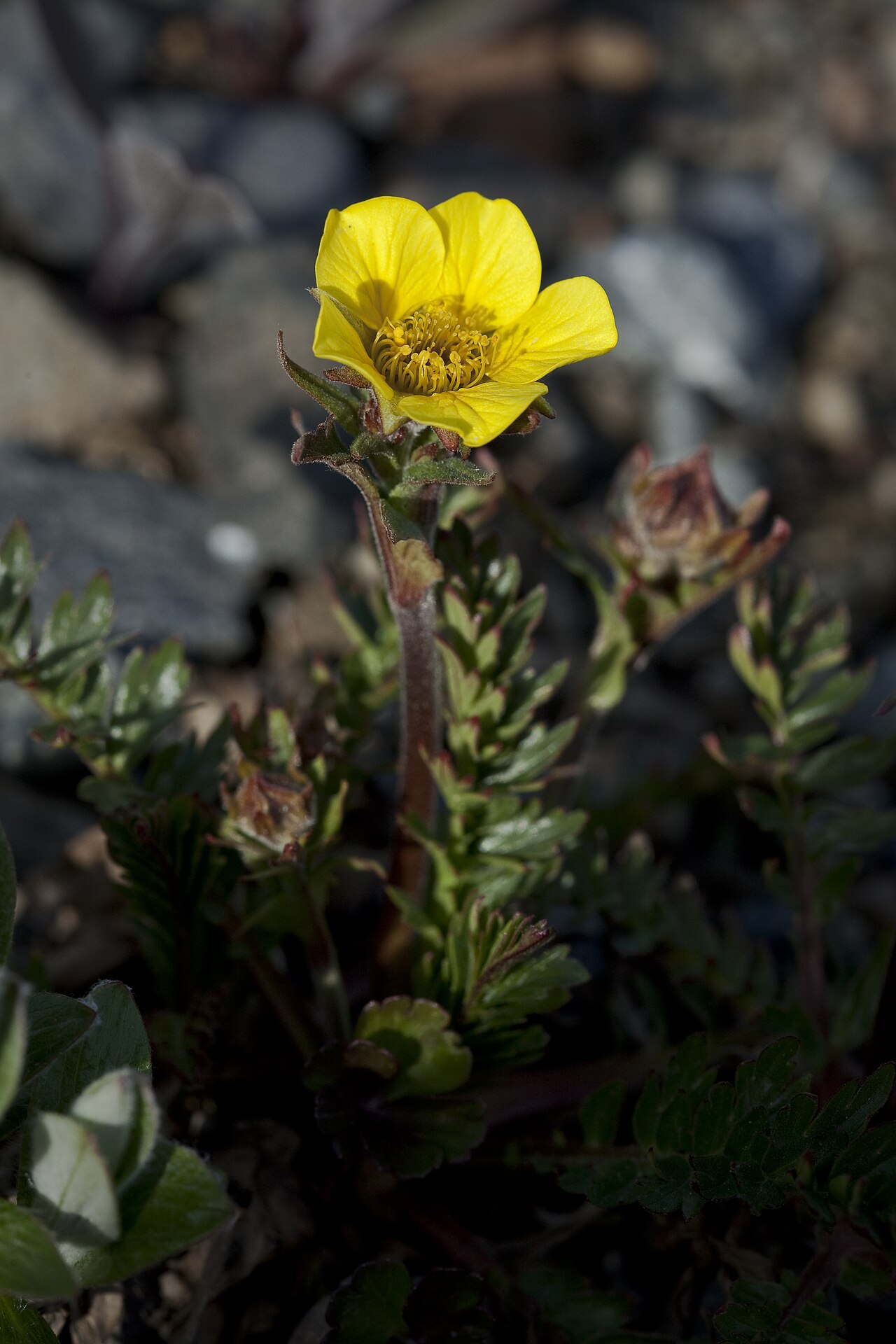
Most leaves are basal, 1 1/2 to 6 inches long and pinnately divided into many small, crowded, toothed or lobed leaflets that overlap along the leaf axis, giving a fern-like or feathery look. The leaves are mostly hairless to slightly hairy and bright green in summer, turning red to maroon in late summer and fall. A few small leaves grow on the flowering stems.
Flowers
Each stem carries one to four flowers, usually one to three. The flowers are about 3/4 to 1 1/4 inches across, with five broad, rounded, bright yellow petals, five green to purplish sepals alternating with five small bractlets, and many stamens around a central cluster of pistils. Flowering is mostly from June to August, starting soon after snowmelt.
Fruit
The flowers are followed by a small head of dry, one-seeded fruits (achenes), each with a short style. Unlike the long, feathery plumes of prairie smoke, the styles of Ross’ avens are short.
Varieties
Three varieties are recognized. Variety rossii grows in Alaska and northern Canada; variety turbinatum is the common form in the Rocky Mountains, Great Basin ranges and Southwest; and variety depressum is a rare, low form known only from the Wenatchee Mountains of Washington.
Look-alikes
Alpine cinquefoils (Potentilla) have similar yellow flowers, but most have leaves with fewer, larger leaflets, often palmate or silvery-hairy, and more flowers per stem. Large-leaved avens grows at lower elevations and has a large, rounded terminal leaflet and hooked fruit styles.
Quick Facts
| Scientific Name | Geum rossii (syn. Acomastylis rossii) |
| Family | Rosaceae (rose family) |
| Plant Type | Alpine clump-forming perennial |
| Mature Height | 2–12 in |
| Mature Spread | 6–12 in; forms mats |
| Growth Rate | Slow |
| Sun Exposure | Full sun |
| Water Needs | Medium; moist in spring, dry summer tolerant |
| Soil Type | Gravelly, rocky, well-drained alpine soils |
| Soil pH | Acidic to neutral (about 5.0–7.0) |
| Bloom Time | June–August |
| Flower Color | Bright yellow |
| Fall Color | Red to maroon |
| Fruit | Small head of achenes with short styles |
| Deer Resistant | Not usually an issue; grows above typical deer range |
| USDA Hardiness Zones | 2–6 |
Native Range
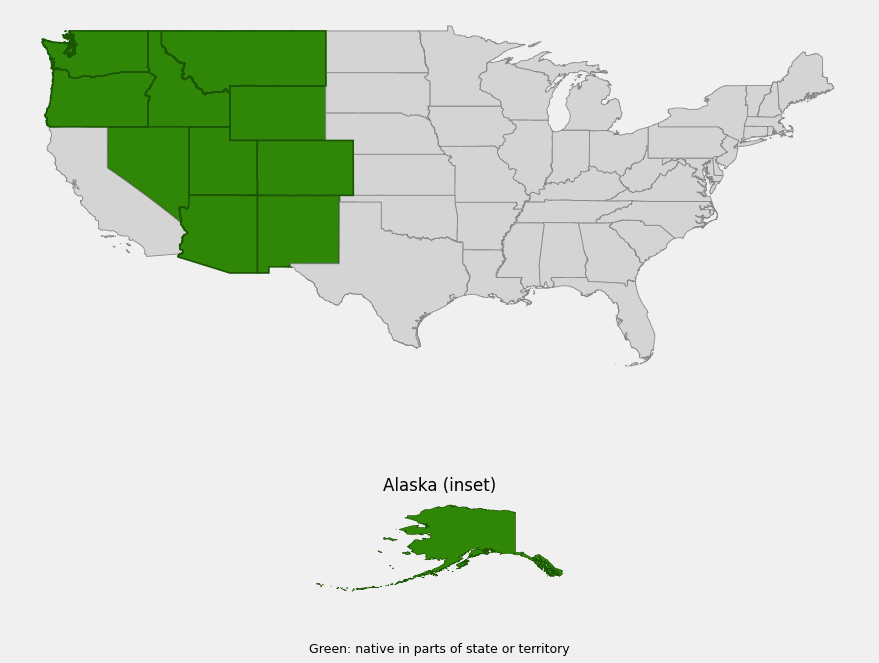
Ross’ avens grows in the arctic and alpine zones of western North America. USDA PLANTS lists it as native in Alaska, Arizona, Colorado, Idaho, Montana, Nevada, New Mexico, Oregon, Utah, Washington and Wyoming. In Canada it ranges across Yukon, the Northwest Territories and Nunavut and south in the mountains of British Columbia and Alberta. Variety rossii also grows across the Bering Strait in the Russian Far East.
In the lower 48 states it is a plant of the high mountains, especially the Rocky Mountains of Colorado, Wyoming, Montana, Utah and Idaho, and the higher Great Basin ranges of Nevada. In Oregon it grows in the high mountains of the northeast and southeast, such as the Wallowa Mountains and Steens Mountain, and in Washington the rare variety depressum is limited to the Wenatchee Mountains east of the Cascade crest. The New Mexico populations are in the Sangre de Cristo and San Juan Mountains at the southern end of the Rockies, and the Arizona record is an isolated, outlying population on the San Francisco Peaks near Flagstaff.
It grows on alpine tundra, dry to moist alpine meadows, fellfields, rocky ridges and talus slopes, usually above treeline, from about 9,000 feet to over 14,000 feet in Colorado. In Alaska and the Arctic it grows at much lower elevations, on tundra and gravelly slopes.
📋 Regional plant lists featuring Ross’ Avens: Idaho, Eastern Oregon & Eastern Washington · Montana & Wyoming · Utah & Western Colorado · Arizona & New Mexico · Alaska · California & Nevada
Growing & Care Guide
Ross’ avens is a true alpine. It is hardy to the coldest zones but struggles in hot, humid summers and warm lowland gardens. It is best suited to specialist rock gardens, troughs and high-elevation gardens.
Light
Full sun. In lowland gardens with hot summers, light afternoon shade helps keep the roots cool.
Soil & Water
Plant in a lean, gritty, very well-drained mix, such as coarse sand and gravel with a little compost. It likes moisture in spring and early summer, as on tundra after snowmelt, and tolerates drier soil later in summer. Avoid wet soil around the crown in winter.
Planting Tips
Grow it in a rock garden, crevice garden, scree bed or alpine trough with other small alpines. It performs best where winters are cold and snowy and summer nights are cool, as in mountain towns of the Rockies. Use only seed-grown, nursery-propagated plants; never collect plants from the tundra.
Pruning & Maintenance
Little care is needed. Remove spent flower stems if you want a tidier look, and keep faster-growing neighbors from crowding the low clumps.
Propagation
Grow from seed sown in fall or given a cold, moist treatment over winter before spring sowing. Established clumps can be divided carefully in early spring or early fall.
Landscape Uses
- Rock and crevice gardens: low tufts of fern-like leaves with yellow flowers
- Alpine troughs: a compact plant for cold-climate containers
- High-elevation gardens: native groundcover for mountain homes
- Fall color: leaves turn red to maroon in late summer
- Where to see it: alpine tundra trails in Rocky Mountain parks and peaks
Wildlife & Ecological Value
Ross’ avens is a dominant plant of many alpine meadows and an important part of the tundra food web.
For Pollinators
The open, bowl-shaped yellow flowers offer pollen and nectar to the flies, small bees, bumble bees and butterflies that are active during the short alpine summer.
For Birds
White-tailed ptarmigan and other alpine birds forage among tundra plants, and seeds and leaves of low tundra herbs are part of their diet. The low mats also give some cover to ground-nesting birds such as American pipits.
For Mammals
American pikas cut and store Ross’ avens in their haypiles for winter. Its leaves are rich in bitter compounds, and studies have suggested these compounds break down during storage, making the stored leaves more palatable later. Elk, bighorn sheep, mountain goats and marmots also graze alpine meadows where it grows.
Ecosystem Role
Ross’ avens often dominates dry alpine meadows and can make up a large part of the plant cover there. Its long-lived clumps stabilize thin, rocky soils on exposed ridges and slopes, and it is one of the best-studied plants in alpine ecology research on sites such as Niwot Ridge in Colorado.
Cultural & Historical Uses
The species was named for Sir John Ross, the British naval officer who led arctic expeditions in search of the Northwest Passage, during which botanical collections were made in the Canadian Arctic. The name Geum is an old Latin plant name used for avens.
The older genus name Acomastylis means roughly “style without hairs,” referring to the short, smooth fruit styles that set this group apart from avens with long, feathery or hooked styles. Many field guides and research papers still use the name Acomastylis rossii.
For hikers in the Rocky Mountains, the red and maroon fall color of Ross’ avens is one of the signs that the short alpine summer is ending, often appearing by late August.
Frequently Asked Questions
Where can I see Ross’ avens?
On alpine tundra above treeline in the Rocky Mountains, for example along Trail Ridge Road in Rocky Mountain National Park, and on arctic and alpine tundra in Alaska, including Denali National Park.
Is Ross’ avens the same as Acomastylis rossii?
Yes. Acomastylis rossii is an older name for the same plant. Most current references place it in Geum.
Can I grow Ross’ avens in my garden?
Only in cold climates with excellent drainage, such as rock gardens and troughs in the mountain West or the far north. It usually fails in hot, humid lowland summers. Use seed-grown plants.
Why does the tundra turn red in fall?
In many Rocky Mountain alpine meadows, much of the red and maroon color comes from the leaves of Ross’ avens as they change color in late summer and fall.
Is Ross’ avens a cinquefoil?
No, although its yellow flowers look similar. It is an avens (Geum), with more finely divided, fern-like leaves and fewer flowers per stem than most alpine cinquefoils.

Looking for a nursery that carries Ross’ Avens?
Browse our native plant nursery directory: Alaska & Arizona · Colorado · Idaho · Montana · Nevada & New Mexico · Oregon · Utah · Washington · Wyoming

