
Pale Gentian (Gentiana alba)
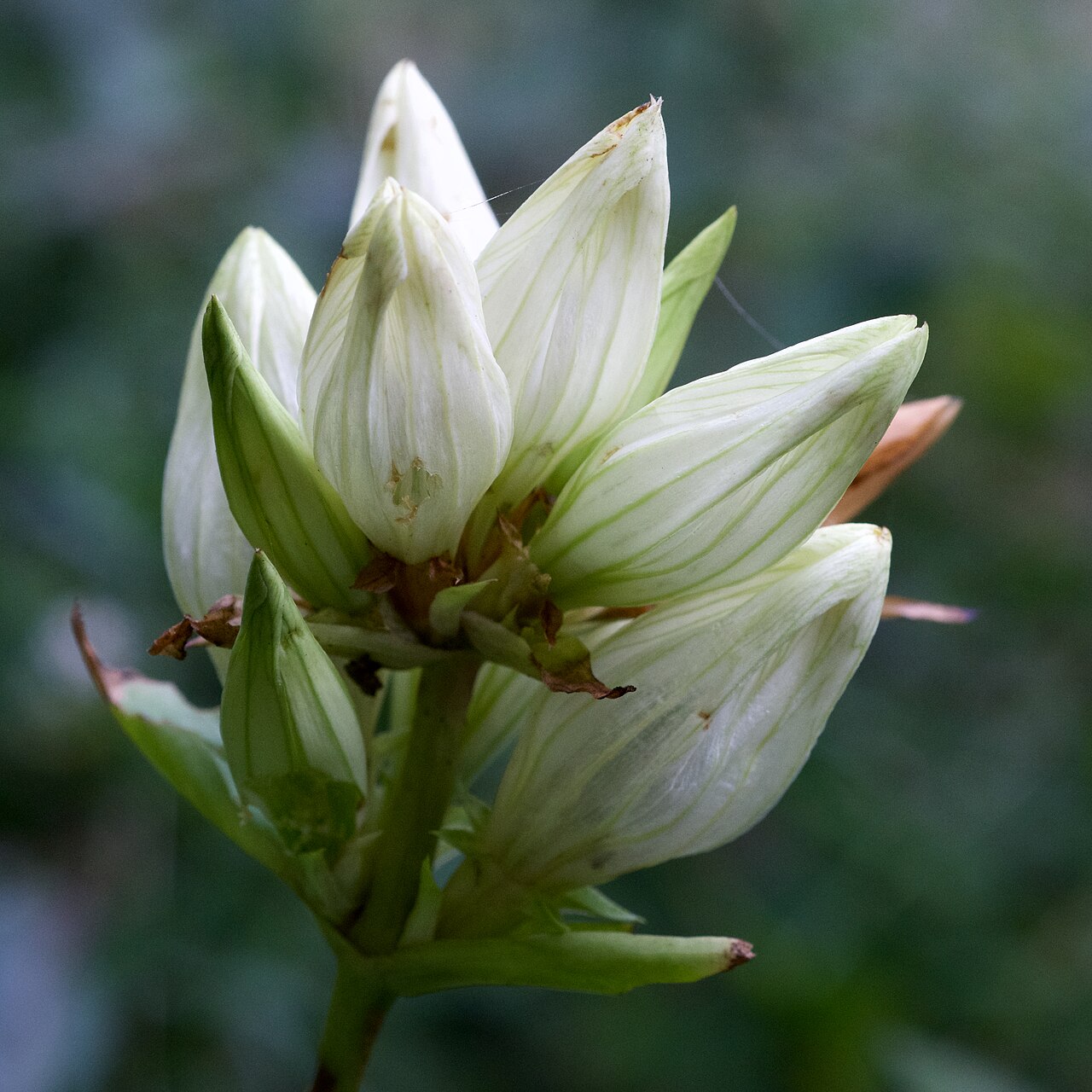
Gentiana alba, known as Pale Gentian, cream gentian, yellowish gentian or plain gentian (the USDA common name), is a late-blooming perennial wildflower of prairies, savannas and open woods in the Midwest and the Ohio Valley. In late summer and fall its sturdy, unbranched stems, usually 1 to 3 feet tall, end in a tight cluster of cream to greenish-white, bottle-shaped flowers that open only slightly at the tips. Older books call it Gentiana flavida.
Like its better-known relative bottle gentian, pale gentian has flowers built for strong insects. Bumble bees push their way through the narrow opening at the tip of each flower to reach the nectar inside, and in doing so they pick up and carry pollen from plant to plant. Few other insects can get in, so the plant depends heavily on bumble bees, and its flowers are among the last nectar sources of the season in many prairies.
Pale gentian is long-lived but slow to establish, and it has become uncommon in much of its range because most of the tallgrass prairie and oak savanna it grew in has been plowed or overgrown. It makes an elegant, unusual addition to a prairie planting or a lightly shaded woodland edge. This guide covers how to identify it, where it grows, how to grow it from seed or nursery plants, and its value to wildlife.
Identification
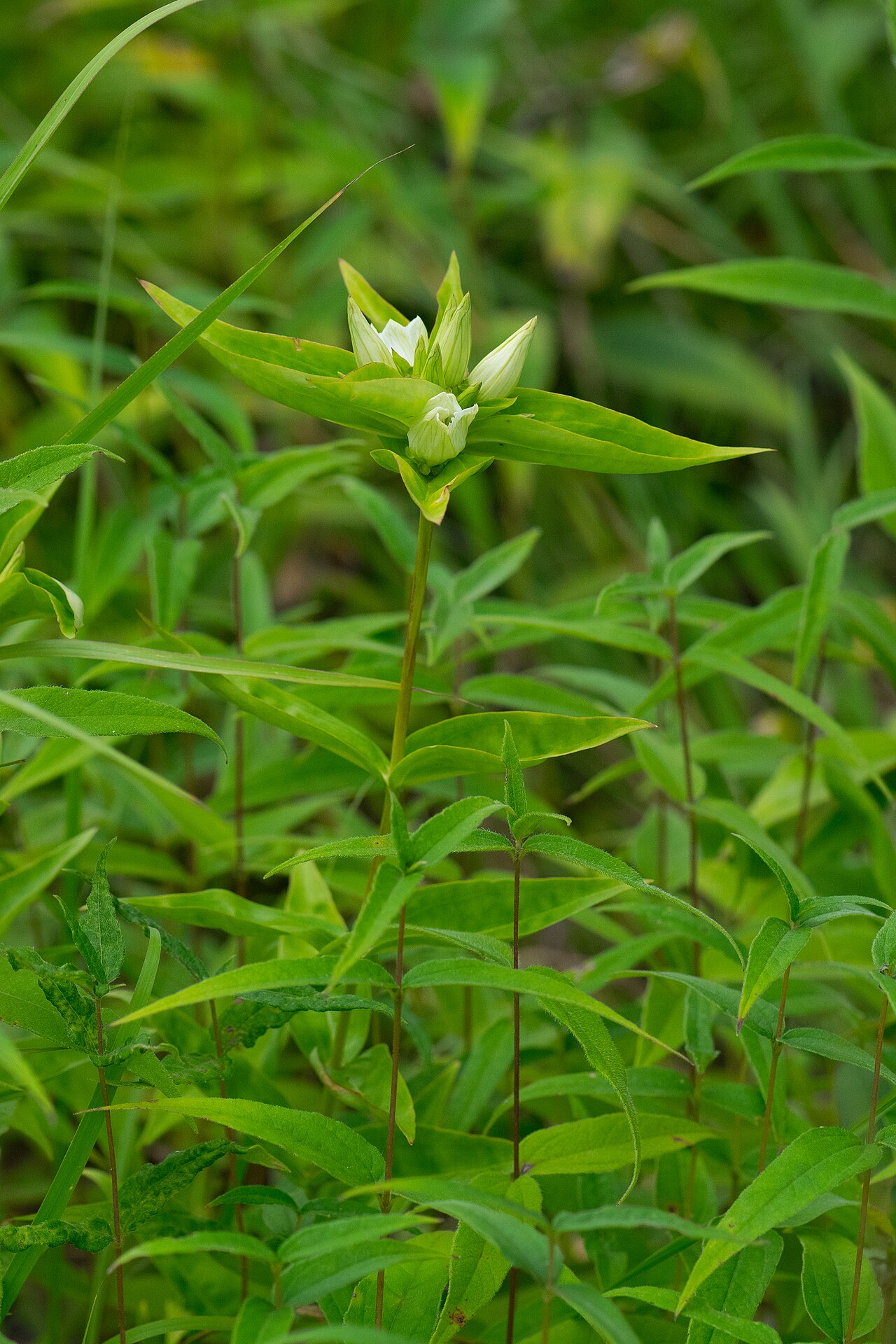
Pale gentian is easiest to recognize in late summer and fall, when the clustered, cream-colored flowers appear at the tops of the stems. Before it blooms, look for its stout, unbranched stems lined with pairs of smooth, shiny, clasping leaves.
Growth Habit
Pale gentian grows from a short, thick root system and sends up one to several upright, unbranched stems, usually 1 to 3 feet tall. The stems are smooth and stout and often lean slightly when heavy with flowers. Older plants form small clumps that can live for many years in the same spot.
Leaves
The leaves are opposite, stalkless and partly clasp the stem. They are lance-shaped to narrowly oval, about 2 to 4 inches long, smooth and slightly shiny, and bright to yellowish green with a single prominent central vein. The upper pair of leaves forms a collar just beneath the flower cluster.
Flowers
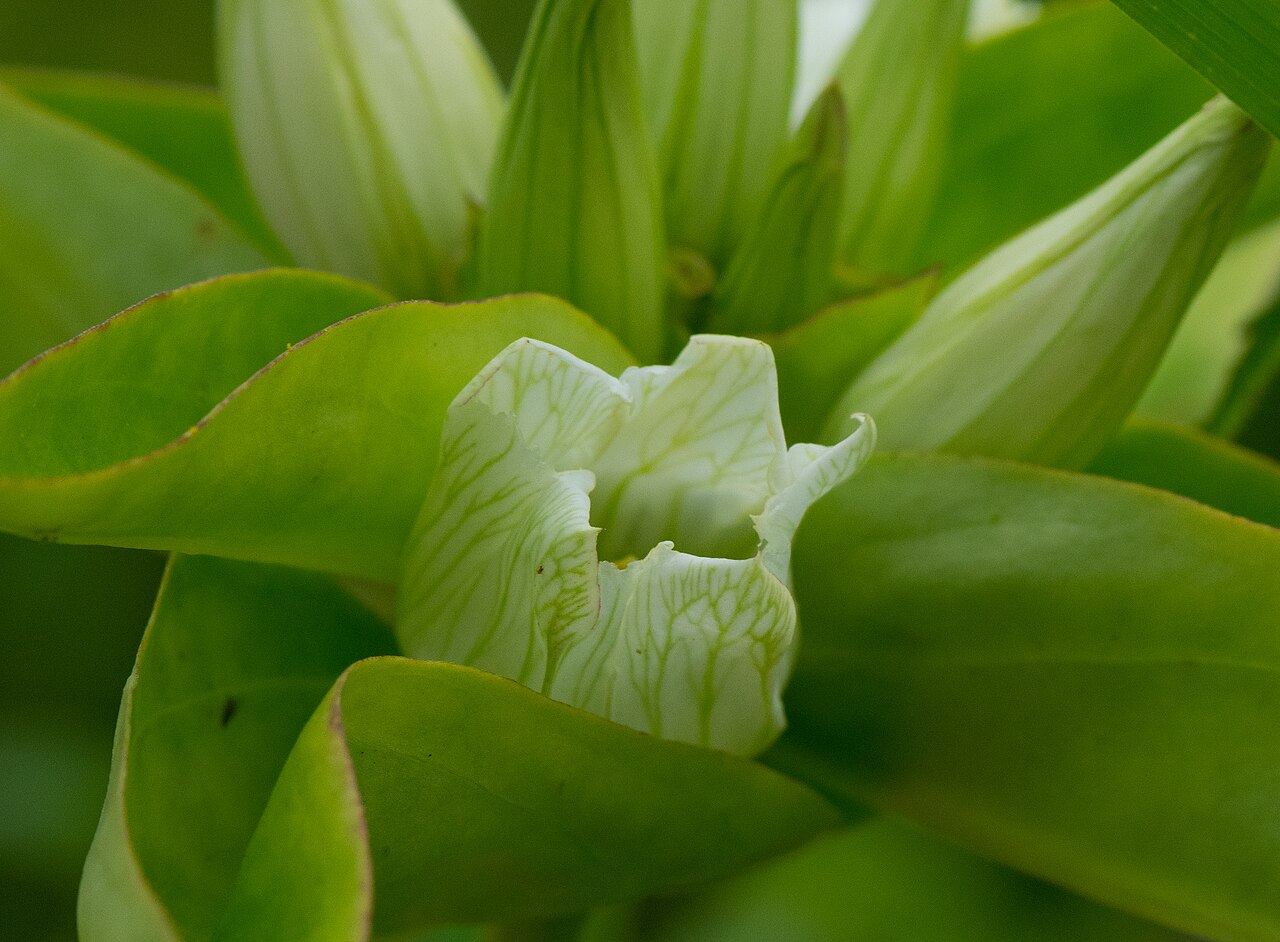
The flowers are tubular to club-shaped, about 1 1/2 to 2 inches long, and grouped in a dense terminal cluster, with a few more in the upper leaf axils. They are creamy white to pale greenish-yellow, sometimes with a faint purplish tinge, and marked with fine green lines. Unlike many gentians, the flowers open a little at the tip, showing short, pointed lobes, but they never spread wide open. Bloom time is August into October.
Fruit & Seeds
Each flower develops an upright, two-parted capsule that splits open in late fall. The seeds are very small, flat and winged, and they are scattered by wind and by the stems swaying in the wind through the winter.
Look-alikes
Bottle gentian (Gentiana andrewsii) has a similar habit but blue to violet flowers that stay completely closed. Soapwort gentian (Gentiana saponaria) also has blue flowers. Rare white-flowered forms of these blue gentians exist, but their flowers keep the closed or nearly closed shape of the species. Pale gentian occasionally hybridizes with bottle gentian where they grow together, producing plants with pale bluish flowers.
Quick Facts
| Scientific Name | Gentiana alba Muhl. ex Nutt. (syn. Gentiana flavida A. Gray) |
| Family | Gentianaceae (gentian family) |
| Plant Type | Herbaceous perennial wildflower |
| Mature Height | 1–3 ft |
| Mature Spread | 1–1.5 ft |
| Growth Rate | Slow |
| Sun Exposure | Full sun to partial shade |
| Water Needs | Medium; moist but well-drained soil |
| Soil Type | Loam, clay loam or sandy loam; prairie and open woodland soils |
| Soil pH | About 6.0–7.5 |
| Bloom Time | August–October |
| Flower Color | Cream to greenish-white |
| Fall Color | Leaves turn yellowish to bronze in late fall |
| Fruit | Small upright capsule with tiny winged seeds |
| Deer Resistant | Not well documented |
| USDA Hardiness Zones | 3–7 |
Native Range
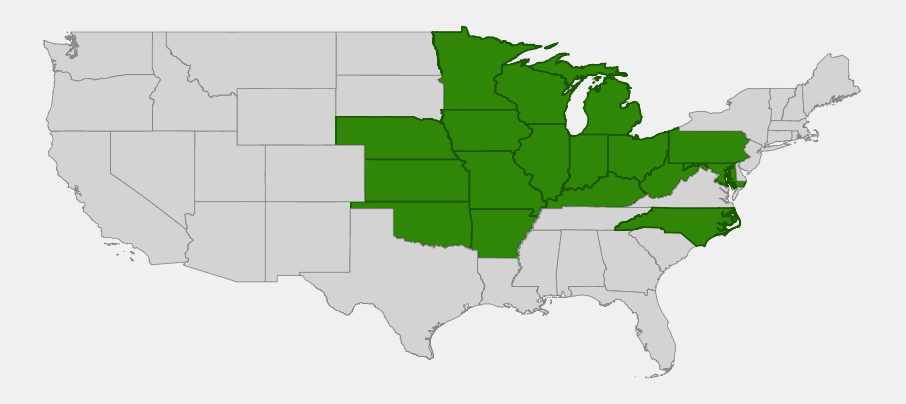
Pale gentian is native to the central and eastern United States and southern Ontario. USDA PLANTS lists it in 17 states, from Pennsylvania, Maryland and West Virginia west through Ohio, Indiana, Illinois and Michigan to Wisconsin, Minnesota, Iowa, Nebraska and Kansas, and south to Kentucky, Missouri, Arkansas, Oklahoma and northwestern North Carolina. The Lady Bird Johnson Wildflower Center describes the range as Pennsylvania, southern Ontario, Michigan and Manitoba, south to northwestern North Carolina, northern Arkansas and Kansas.
Its center of abundance is the prairie and savanna country of the upper Midwest, especially Wisconsin, Illinois, Iowa, Missouri and Minnesota. Eastward, in Pennsylvania, Maryland, West Virginia and North Carolina, it is scattered and local, mostly in remnant openings, barrens and mountain meadows. In Arkansas and Oklahoma it grows mainly in the Ozark and Ouachita uplands; one of the best-known southern sites is Mount Magazine in Arkansas.
Typical habitats are moist to dry-mesic tallgrass prairies, oak savannas, open woodlands, woodland edges, glades and meadows. It does best where fire, mowing or grazing keeps woody plants from shading it out, and it often persists along old railroad and roadside prairie strips.
📋 Regional plant lists featuring Pale Gentian: New York, Pennsylvania & Northern New Jersey · Ohio & Indiana · Michigan, Wisconsin & Eastern Minnesota · Kentucky & Tennessee · Nebraska, Kansas & Eastern Colorado · Maryland, Virginia & West Virginia · Illinois, Iowa & Missouri · North & South Carolina · Arkansas, Louisiana, Eastern Oklahoma & Eastern Texas
Growing & Care Guide
Pale gentian is not difficult to keep once it is established, but it is slow to get going. Specialist native plant nurseries in the Midwest sell plants and seed, and the Lady Bird Johnson Wildflower Center lists it as commercially available. Buy nursery-propagated plants or seed, and never dig plants from the wild: wild populations are small and the plants rarely survive transplanting.
Light
Plant pale gentian in full sun to partial shade. In a prairie garden it does well in full sun when the soil stays reasonably moist; in hotter, drier sites it appreciates light afternoon shade, such as at the edge of a woodland or under the high canopy of an oak.
Soil & Water
It prefers moist but well-drained loam or clay loam, the kind of deep soil found in mesic prairies. It tolerates somewhat drier soil once established but does poorly in very sandy, droughty soil and in sites that stay waterlogged. Water young plants during dry spells in their first two summers; established clumps need little care in a normal Midwest summer.
Planting Tips
Set out young plants in spring, spaced about 12 to 18 inches apart, among short to medium-sized prairie grasses and wildflowers that will not overwhelm them. Like other gentians, the seed is tiny and needs cold, moist stratification and light to germinate: sow it on the surface of a fine seed mix in fall or after 60 days of cold, moist treatment, and do not cover it. Seedlings grow very slowly and usually take two to three years to flower.
Pruning & Maintenance
No pruning is needed. Leave the stems standing through winter so the capsules can release their seed. Cut back or burn old growth in early spring. Keep aggressive neighbors and woody seedlings from crowding it, and avoid disturbing the roots once the plant is established, since gentians resent being moved.
Propagation
Grow it from seed, sown fresh in fall or stratified for spring sowing as described above. Mature clumps can sometimes be divided carefully in early spring, but division is slow and often sets the plant back, so seed is the usual method.
Landscape Uses
- Prairie and meadow gardens: pale gentian adds an unusual cream-colored accent among late-season prairie plants such as goldenrods, asters and grasses.
- Woodland edges and savanna plantings: it fits the light shade under scattered oaks, where it blooms after most spring woodland flowers have faded.
- Pollinator gardens: its flowers are an important late-season food source for bumble bees, especially queens fattening up before winter.
- Restoration plantings: it is a good species to add to mesic and dry-mesic prairie and savanna restorations within its native range, using local-origin seed.
- Specimen and conversation plant: the closed, bottle-shaped flowers are a curiosity, and watching bumble bees force their way in is a good way to introduce children to pollination.
Wildlife & Ecological Value
Pale gentian supports a small but specialized group of wildlife, mainly the bumble bees that pollinate it.
For Pollinators
Bumble bees (Bombus species) are the main pollinators. They are large and strong enough to pry apart the tip of the nearly closed flower and crawl inside to reach the nectar. The Xerces Society lists pale gentian as having special value to bumble bees. Because it blooms from late summer into October, it provides nectar and pollen when few other prairie flowers are still open.
For Birds
Pale gentian has little direct value to birds; the seeds are tiny. Prairie and savanna plantings that include it, however, provide insect food and cover for grassland birds.
For Mammals
The bitter foliage is not a preferred food for most mammals, although deer and rabbits occasionally browse gentians. Small mammals may use the dense prairie vegetation around it for cover.
Ecosystem Role
As a long-lived, late-blooming prairie perennial, pale gentian helps sustain bumble bee colonies at the end of the season. It is also a useful indicator of high-quality prairie and savanna remnants, since it rarely survives heavy disturbance.
Cultural & Historical Uses
The genus name Gentiana honors Gentius, a king of ancient Illyria who, according to tradition, discovered the medicinal value of gentian roots. European yellow gentian (Gentiana lutea) is still used as a bitter flavoring today.
The species name alba means “white”, while the older name flavida means “yellowish”. Both describe the pale, cream-colored flowers that set this species apart from the blue gentians of the same prairies.
Native American and settler medicine used the bitter roots of several North American gentians as tonics. These uses are historical only; do not collect wild plants, and do not use gentians medicinally without professional advice.
Frequently Asked Questions
Is pale gentian the same as cream gentian?
Yes. Pale gentian, cream gentian, yellowish gentian and plain gentian are all common names for Gentiana alba. Older references call it Gentiana flavida.
Do the flowers ever open?
Only slightly. The tips of the petals part a little to show short lobes, but the flower stays bottle-shaped. Bumble bees push their way inside to feed and pollinate it.
When does pale gentian bloom?
From August into October, depending on latitude and the weather. It is one of the last prairie wildflowers to bloom each year.
How do I grow pale gentian from seed?
Sow the tiny seed on the soil surface in fall, or give it about 60 days of cold, moist stratification before a spring sowing. Do not cover the seed, keep it moist, and be patient: plants usually take two to three years to flower.
Can I grow it in a shady garden?
It tolerates partial shade, such as a woodland edge or the light shade of scattered oaks, but it flowers best with at least half a day of sun. Deep shade leads to weak stems and few flowers.

Looking for a nursery that carries Pale Gentian?
Browse our native plant nursery directory: Arkansas · Illinois, Indiana, Iowa & Kansas · Kentucky, Maryland, Michigan, Minnesota & Missouri · Nebraska, North Carolina, Ohio & Oklahoma · Pennsylvania · West Virginia & Wisconsin

