
Hairy Yerba Santa (Eriodictyon trichocalyx)
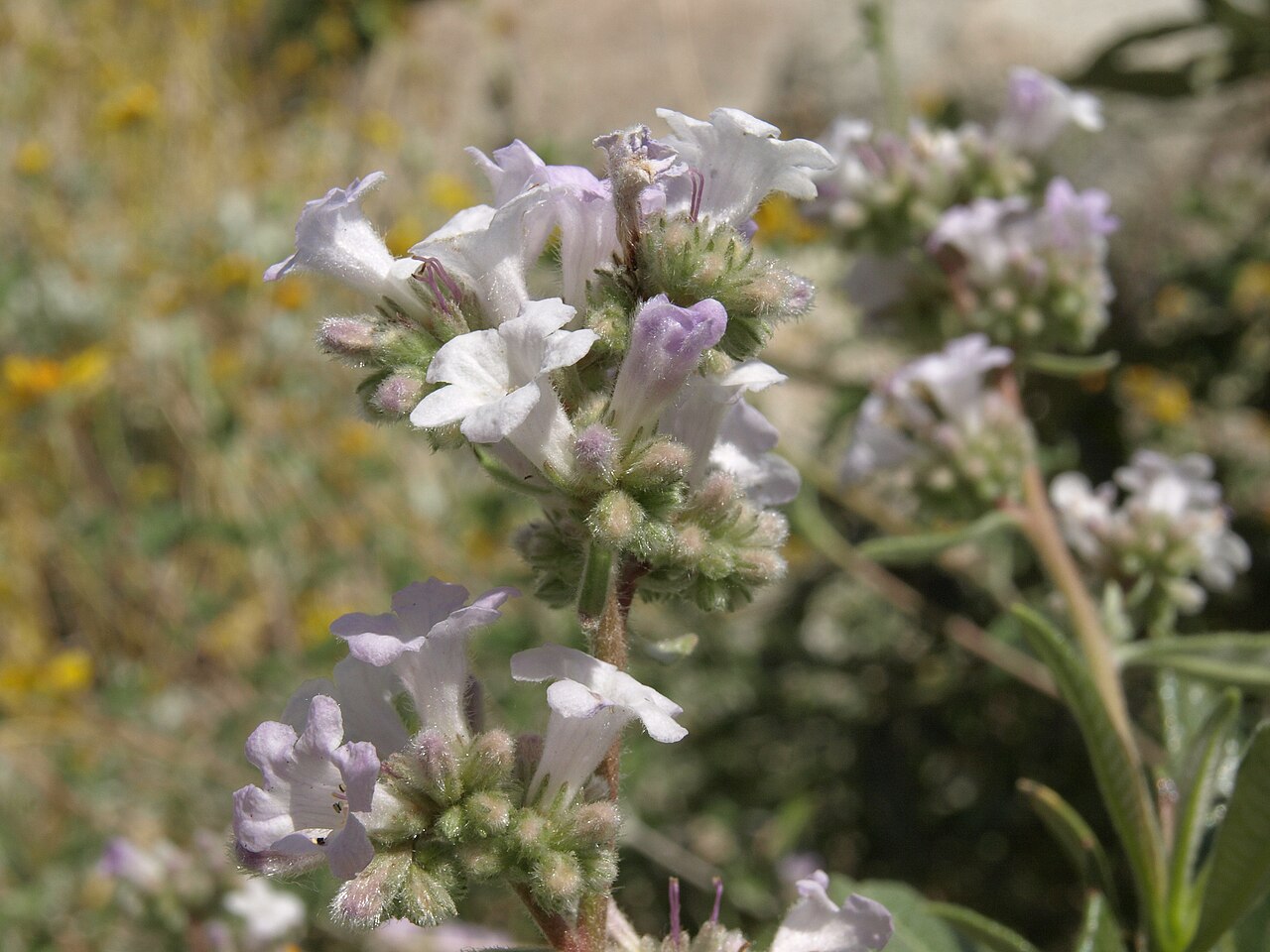
Eriodictyon trichocalyx, known as Hairy Yerba Santa, is an aromatic evergreen shrub of southern California and northern Baja California. It belongs to the family Namaceae, a small group long included in the waterleaf family (Hydrophyllaceae) and later in the borage family. It grows on dry slopes, mesas and ravines in chaparral, sage scrub, pinyon-juniper woodland and open pine forest, from the Transverse Ranges south through the Peninsular Ranges and along the western edges of the Mojave and Colorado deserts.
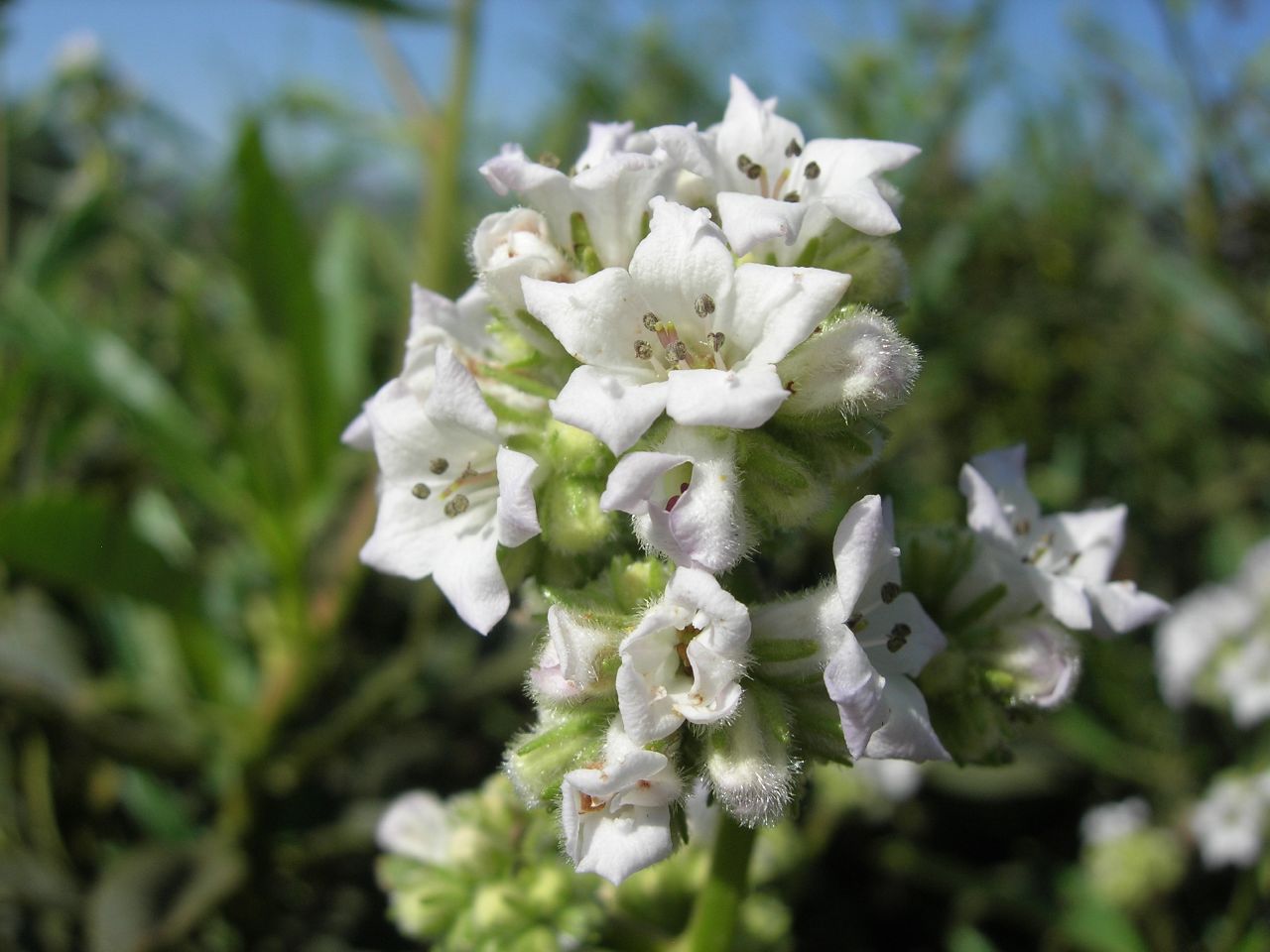
Plants are usually 2 to 6 feet tall and spread by underground stems into open thickets. The long, narrow leaves are sticky with resin and fragrant when crushed. In spring and early summer, coiled clusters of small, funnel-shaped flowers, white to pale lavender, open at the tips of the stems. The species name trichocalyx means “hairy calyx,” for the bristly hairs on the green cup at the base of each flower. Two varieties are recognized: the typical var. trichocalyx, with green, hairless, very sticky leaves, and San Diego yerba santa (var. lanatum), with leaves densely covered in gray wool.
Hairy yerba santa is a tough, drought-tolerant shrub for dry, sunny slopes, habitat gardens and erosion control in southern California. It thrives on neglect, recovers quickly after fire and attracts many bees and butterflies. Like other yerba santas, it was an important medicinal plant for the Cahuilla, Chumash and other Native peoples.
Identification
Look for an open, aromatic shrub with long, narrow, toothed leaves that feel sticky (or woolly in San Diego County), and coiled clusters of white to lavender trumpet-shaped flowers in spring.
Growth Habit
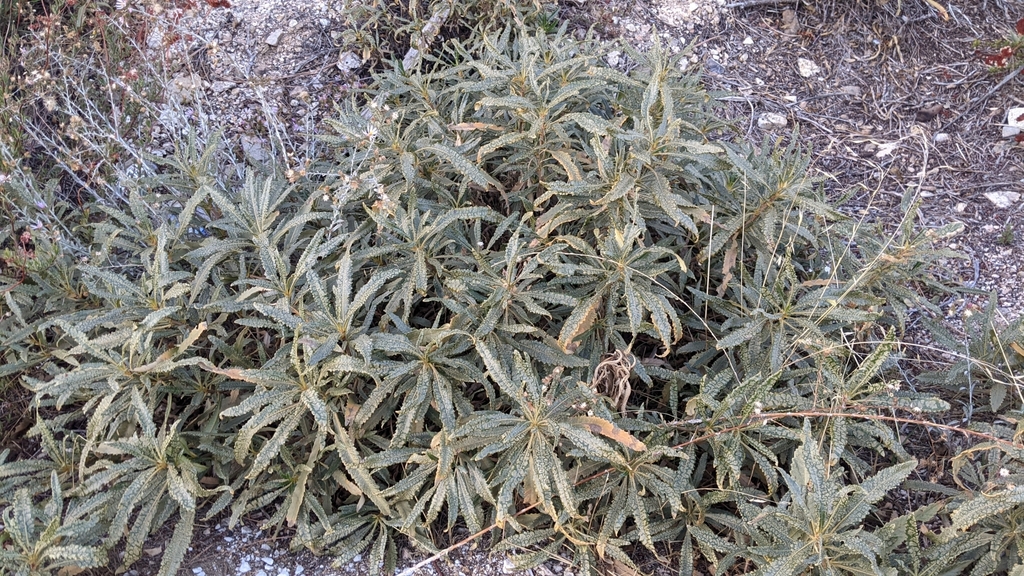
Hairy yerba santa is an erect, sparsely branched evergreen shrub, usually 2 to 6 feet tall, spreading by rhizomes into loose colonies. Stems are often reddish and sticky when young. At higher elevations plants tend to be smaller and scraggly, especially in dry years, and older stems often look rather ragged.
Leaves
The leaves are alternate, narrowly lance-shaped to linear, about 2 to 5 inches long (sometimes longer) and 1/4 to 1 inch wide, with edges that are toothed to nearly smooth and often slightly rolled under. In var. trichocalyx the upper surface is green, hairless and glossy-sticky with resin, while the underside has fine, net-like veins and short hairs between them. In var. lanatum both surfaces are covered with dense, gray, woolly hairs. The leaves are often blackened by a harmless sooty mold that grows on the resin.
Flowers
From about April to July, flowers open in branched, coiled (scorpioid) clusters at the stem tips. Each flower is funnel- to bell-shaped, about 1/4 to 1/2 inch long, with five rounded lobes, white to pale lavender or light purple. The calyx lobes are narrow and covered with long, bristly hairs, the feature behind the name trichocalyx.
Fruit
The fruit is a small, egg-shaped capsule that splits to release tiny, dark seeds. Dry flower clusters often stay on the plant through summer.
Look-alikes
Thick-leaf yerba santa (E. crassifolium) has thicker, broader, densely felted leaves and usually lavender flowers; it overlaps with hairy yerba santa in parts of southern California. California yerba santa (E. californicum) is a central and northern California species with sticky green leaves and calyx lobes that are not as long-hairy.
Quick Facts
| Scientific Name | Eriodictyon trichocalyx |
| Family | Namaceae (formerly Hydrophyllaceae) |
| Plant Type | Evergreen shrub; rhizomatous |
| Mature Height | 2–6 ft |
| Mature Spread | 3–6 ft; spreads into colonies |
| Growth Rate | Moderate |
| Sun Exposure | Full sun |
| Water Needs | Very low; no summer water once established |
| Soil Type | Well-drained sandy, gravelly or rocky soil |
| Soil pH | Slightly acidic to slightly alkaline (about 6.0–8.0) |
| Bloom Time | April–July |
| Flower Color | White to pale lavender |
| Fall Color | None; evergreen |
| Fruit | Small capsule with tiny seeds |
| Deer Resistant | Yes; resinous, bitter leaves |
| USDA Hardiness Zones | 7–10 |
Native Range
Hairy yerba santa is native to southern California and northern Baja California, Mexico. USDA PLANTS lists it only for California in the United States. It grows in the Transverse Ranges (the San Gabriel, San Bernardino and San Jacinto areas and nearby foothills), the Peninsular Ranges of Riverside and San Diego counties, and along the western margins of the Mojave and Colorado deserts, including the desert slopes of the Anza-Borrego region.
The typical variety, var. trichocalyx, is the widespread one, found mostly in the Transverse and northern Peninsular ranges. San Diego yerba santa, var. lanatum, is restricted to the mountains of southern San Diego County and northern Baja California.
It grows on dry, open slopes, mesas, ravines and washes, in chaparral, coastal and desert-edge sage scrub, pinyon-juniper woodland and open yellow pine forest, from foothills to the lower montane zone. It is common on disturbed and recently burned ground, roadcuts and slopes where the shrub cover has been opened up.
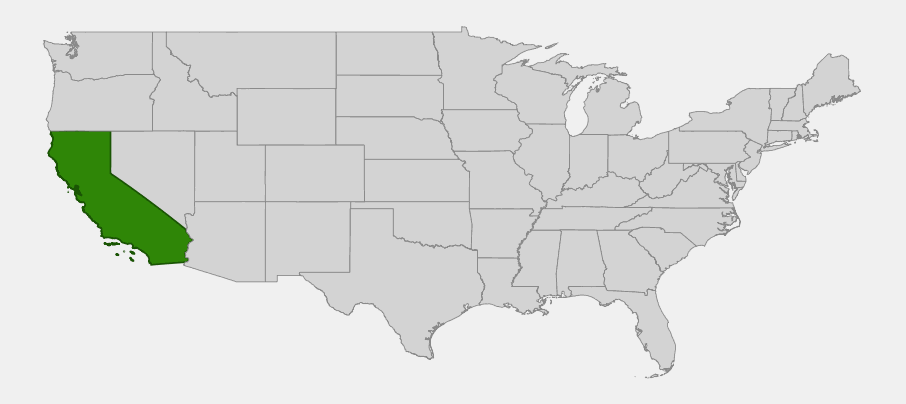
📋 Regional plant lists featuring Hairy Yerba Santa: California & Nevada
Growing & Care Guide
Hairy yerba santa is easy in the right spot: full sun, sharp drainage and little or no summer water. It is not a tidy formal shrub, so use it where its loose, spreading habit and fragrant foliage can be appreciated in a natural setting.
Light
Full sun. In shade it becomes leggy and flowers poorly.
Soil & Water
It needs well-drained sandy, gravelly or rocky soil and does well on slopes. Water regularly for the first summer, then taper off; established plants need no summer water and can rot if watered often in warm weather, especially in heavy soil.
Planting Tips
Plant in fall or winter, at the start of the rainy season, so roots can establish before summer. Because it spreads by rhizomes, give it room or plant it where suckers are welcome, such as a slope, a hillside meadow or the back of a habitat garden. Pair it with sages, buckwheats and manzanitas.
Pruning & Maintenance
Plants look best with occasional renewal. Cut old, ragged stems to the ground in fall or winter, and the plant will sprout new shoots from the base. Leaves blackened by sooty mold are normal and do not harm the plant. No fertilizer is needed.
Propagation
It is usually propagated from rhizome divisions or root cuttings taken in winter. Seed germination is erratic; in the wild, seeds often germinate after fire, and smoke or heat treatments can help in cultivation.
Landscape Uses
- Slope and erosion control: spreading rhizomes help hold dry hillsides
- Habitat gardens: long spring bloom for bees and butterflies
- Fire-recovery plantings: resprouts quickly after burns
- Fragrance garden: resinous, aromatic foliage
- Low-water landscapes: needs no summer irrigation once established
Wildlife & Ecological Value
Hairy yerba santa is a valuable nectar plant in the dry hills of southern California, blooming from spring into early summer.
For Pollinators
The flowers are visited by native bees, honey bees, bumble bees, butterflies and moths, and occasionally by hummingbirds. Its long bloom season bridges the gap between early spring and summer flowers in chaparral and sage scrub.
For Birds
Its thickets give cover to wrentits, towhees, quail and other shrubland birds, and birds feed on the insects that visit the flowers.
For Mammals
Deer and rabbits generally avoid the bitter, resinous leaves. Thickets give shelter to woodrats and other small mammals.
Ecosystem Role
Yerba santa is a fire follower: it resprouts from rhizomes and germinates from seed after fire, quickly covering burned slopes and helping hold soil until slower shrubs return. Leaf beetles in the genus Trirhabda feed on yerba santas.
Cultural & Historical Uses
The name yerba santa means “holy herb” in Spanish. Spanish missionaries learned of the plant from Native Californians, who used yerba santas widely as medicine. The Cahuilla used hairy yerba santa to treat coughs, colds, sore throats and asthma, and as a liniment, a poultice and a soaking bath for aches and sores; the Chumash also used it as a liniment. It should not be used as a home remedy without expert guidance.
The genus name Eriodictyon comes from the Greek for “woolly net,” for the fine, net-like veins and hairs on the leaf undersides of many species. Yerba santa leaves have been used in syrups and lozenges to mask bitter flavors and to soothe coughs, and compounds from yerba santa, such as the flavonoid eriodictyol, have been studied for their bitter-masking properties.
San Diego yerba santa (var. lanatum) is the rare, woolly-leaved form of the species, found only in the mountains near the border with Mexico. It is included in the California Native Plant Society inventory of rare plants.
Frequently Asked Questions
How do I tell hairy yerba santa from thick-leaf yerba santa?
Hairy yerba santa usually has narrower leaves that are green and sticky (or woolly in San Diego County) and long bristly hairs on the calyx. Thick-leaf yerba santa has broader, thick, densely felted leaves.
Does hairy yerba santa need summer water?
No. Once established, it is very drought tolerant and does best with no summer irrigation in well-drained soil.
Why are the leaves black?
The sticky resin often hosts a harmless sooty mold. It is common on yerba santas in the wild and does not hurt the plant.
Does hairy yerba santa spread?
Yes. It spreads by underground stems into loose thickets, which makes it useful on slopes.
Is hairy yerba santa deer resistant?
Yes. Its bitter, resinous leaves are seldom browsed by deer or rabbits.

Looking for a nursery that carries Hairy Yerba Santa?
Browse our native plant nursery directory: California

