
Scarlet Fritillary (Fritillaria recurva)
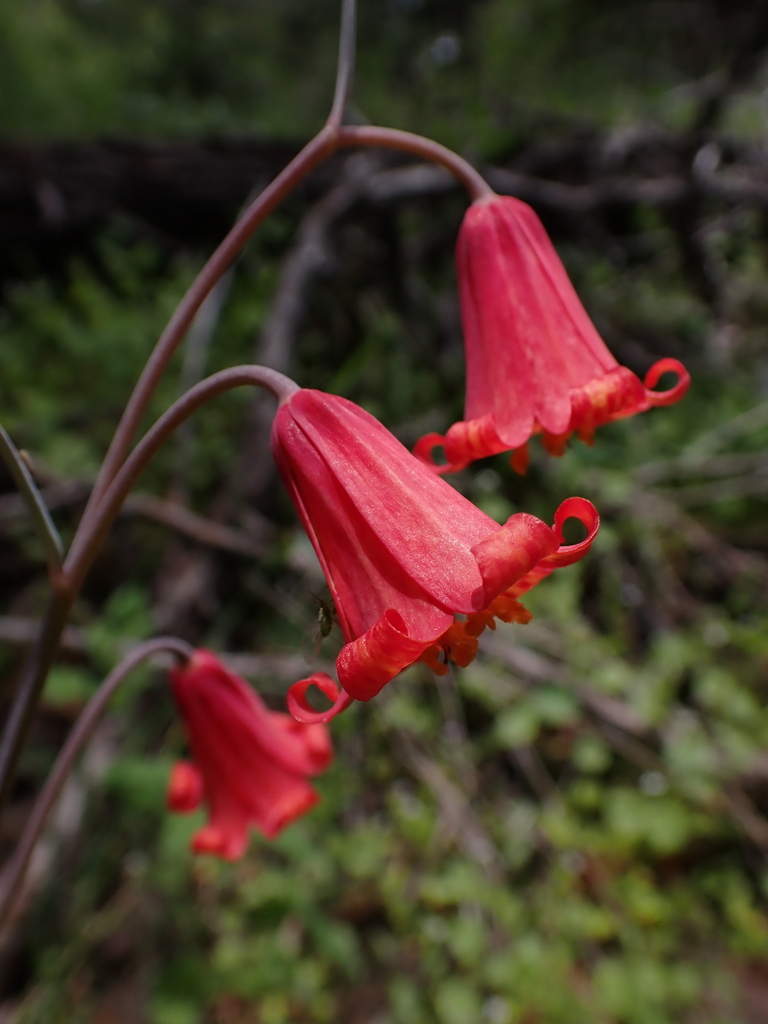
Fritillaria recurva, known as Scarlet Fritillary, is one of the most striking wildflowers of the far West. In spring, a slender stem 1 to 3 feet tall carries one to several nodding, narrow bells of brilliant scarlet to orange-red, checkered with yellow inside, with petal tips that curl outward and back. It grows from a small bulb in open oak woodland, chaparral and conifer forest in northern California, southwestern Oregon and the westernmost edge of Nevada.
It is a member of the lily family (Liliaceae), related to the checker lily and chocolate lily, and together with its close relative Gentner’s fritillary it is one of the few red-flowered fritillaries in North America. The species name recurva refers to the recurved tips of the tepals. Its color, tubular shape and nodding habit are classic signs of hummingbird pollination, and hummingbirds are its main pollinators.
Scarlet fritillary is widespread but rarely common, and it is a prized find on spring hikes. Like all wild bulbs, it should never be dug up: the bulbs are fragile, and wild plants seldom survive being moved. This guide covers how to identify it, where it grows, how to grow it from nursery-propagated bulbs or seed, and its relationship with hummingbirds.
Identification
In flower, scarlet fritillary is hard to mistake: no other wildflower in its range has narrow, nodding, scarlet bells with recurved tips and yellow checkering. Out of flower, its whorled, narrow leaves look much like other fritillaries.
Bulb & Growth Habit
Each plant grows from a small, scaly bulb surrounded by many tiny, rice-grain-like bulblets, a feature of many western fritillaries. Young or small bulbs produce only a single leaf. Mature bulbs send up one smooth, often bluish-green stem, usually 1 to 3 feet tall. The plant dies back to the bulb after setting seed in early summer.
Leaves
The leaves are narrow and lance-shaped to linear, 2 to 6 inches long, smooth and bluish-green, and arranged in one to three whorls of several leaves on the lower half of the stem, with a few scattered, smaller leaves above.
Flowers
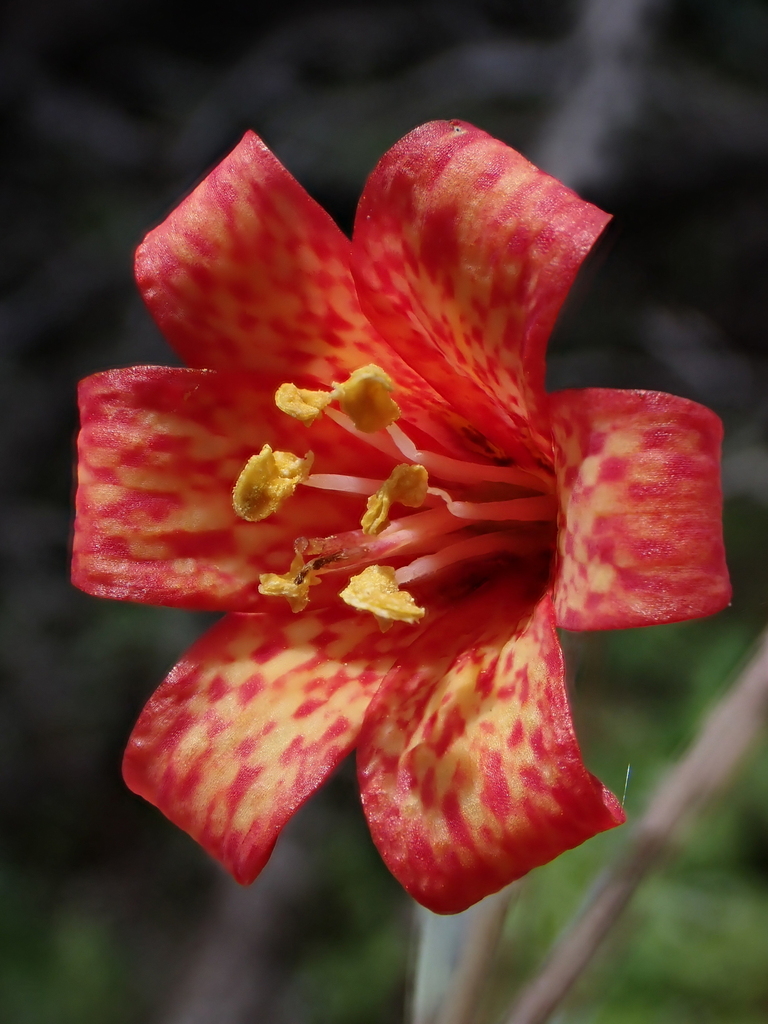
The flowers hang from the upper part of the stem, one to about nine per plant. Each is a narrow, nodding bell about 1 to 1.5 inches long, made of six tepals that are scarlet to orange-red outside and yellow checkered or spotted with red inside. The tips of the tepals flare and curl back. Bloom time is March to July, earliest in the low foothills and latest at higher elevations.
Fruit & Seeds
After flowering, each flower develops an upright, six-sided capsule that dries and splits in summer to release many flat, papery seeds, which are scattered by wind.
Look-alikes
Checker lily (Fritillaria affinis) has wider, open bells mottled in brown, purple and greenish yellow. Gentner’s fritillary (Fritillaria gentneri), a federally endangered species of southwestern Oregon and northern California, has deeper red to purplish flowers whose tips flare outward without strongly curling back; it is believed to have arisen from hybridization between scarlet fritillary and checker lily. The red, tubular firecracker flower grows in the same areas but has clustered flowers on a leafless stalk.
Quick Facts
| Scientific Name | Fritillaria recurva Benth. |
| Family | Liliaceae (lily family) |
| Plant Type | Perennial bulb; summer-dormant |
| Mature Height | 1–3 ft |
| Mature Spread | 4–8 in |
| Growth Rate | Slow (several years from seed to flower) |
| Sun Exposure | Part shade to full sun |
| Water Needs | Low; dry summer dormancy |
| Soil Type | Well-drained, rocky or gravelly loam, including serpentine and volcanic soils |
| Soil pH | About 5.5–7.0 |
| Bloom Time | March–July |
| Flower Color | Scarlet to orange-red, checkered yellow inside |
| Fall Color | None; dormant from summer to the winter rains |
| Fruit | Upright, six-sided capsule with flat, papery seeds |
| Deer Resistant | No; flowers and buds are browsed |
| USDA Hardiness Zones | 6–9 |
Native Range
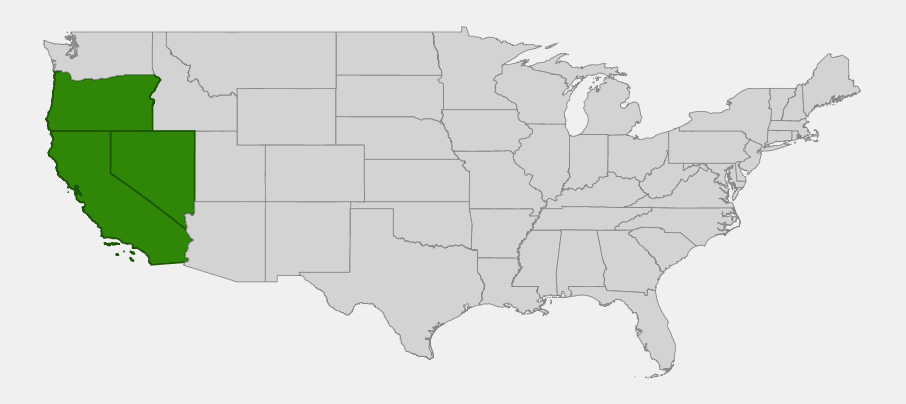
Scarlet fritillary is native to the far western United States. USDA PLANTS lists it in California, Oregon and Nevada. It does not occur in Canada or Mexico.
In Oregon it grows in the southwestern part of the state, in the Siskiyou Mountains and the Rogue and Applegate valleys of Jackson and Josephine Counties and nearby. In California it ranges through the Klamath Mountains, the North Coast Ranges south to the hills of Napa, Sonoma, Lake and Solano Counties, the southern Cascades and the western slope of the Sierra Nevada south to about the central Sierra. Its Nevada range is limited to the westernmost edge of the state, on the eastern slope of the Sierra Nevada in the Lake Tahoe area.
It grows in open, often rocky places: oak woodland and savanna, chaparral openings, mixed evergreen and ponderosa pine forest, and rocky slopes, including serpentine and volcanic soils. It is found from low foothill elevations to roughly 6,000 feet, usually in partial shade under trees or shrubs where the bulbs are protected and the soil stays dry in summer.
📋 Regional plant lists featuring Scarlet Fritillary: Western Oregon & Western Washington · California & Nevada · Idaho, Eastern Oregon & Eastern Washington
Growing & Care Guide
Scarlet fritillary is a choice plant for experienced bulb growers in dry-summer climates. It is offered only occasionally by specialist bulb and native plant nurseries. Buy only nursery-propagated bulbs or seed. Never dig bulbs from the wild: they are fragile, break apart easily, and wild-dug plants rarely survive, while digging damages the populations that hummingbirds and hikers depend on.
Light
Give it light shade or dappled sun, such as under oaks or pines, or morning sun and afternoon shade. In cool coastal or mountain gardens it can take more sun.
Soil & Water
It needs sharply drained soil, such as a gritty loam with added pumice or crushed rock, on a slope, in a raised bed or in a deep pot. Water during winter and spring if rains are lacking, then keep the bulb completely dry once the plant goes dormant in summer. Summer water is the most common cause of bulb rot.
Planting Tips
Plant bulbs in fall, about 3 to 4 inches deep, handling them gently since the bulblets break off easily. Many growers keep fritillaries in deep pots or bulb frames to control summer dryness and to protect them from gophers, or use a wire basket in the ground. Plant it near hummingbird-friendly shrubs and wildflowers that share its dry-summer cycle.
Pruning & Maintenance
No pruning is needed. Let the leaves yellow and die back naturally, since they feed the bulb for the next year. Protect plants from slugs, snails, deer and gophers, which eat the shoots, flowers and bulbs. Clumps can be left undisturbed for years.
Propagation
Grow it from seed sown in fall in deep pots of gritty mix left outdoors for winter. Seedlings produce a single leaf for several years and usually take four or more years to flower. The rice-grain bulblets around mature bulbs can be separated when the bulbs are dormant and grown on in pots, which is a faster route to flowering plants.
Landscape Uses
- Hummingbird gardens: red, tubular, nodding flowers adapted for hummingbird pollination
- Woodland and oak gardens: grows in dappled shade under oaks and pines
- Rock gardens and containers: suits gritty, well-drained soil and a dry summer
- Native bulb collections: a prized western fritillary for specialist growers
- Habitat restoration: a characteristic spring wildflower of oak and pine woodlands
Wildlife & Ecological Value
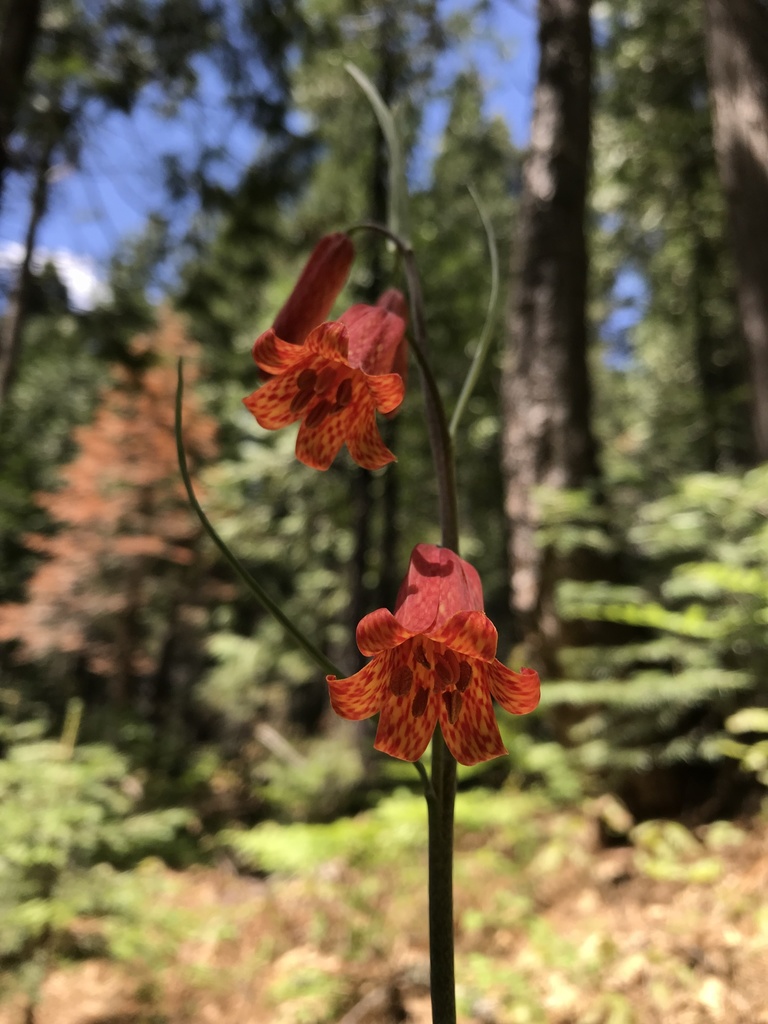
Scarlet fritillary is a textbook example of a hummingbird flower, and it is one of the spring nectar sources for hummingbirds in the mountains of northern California and southern Oregon.
For Pollinators
The scarlet color, nodding, tubular shape and lack of scent are typical of flowers pollinated by hummingbirds, which hover beneath the bells and probe for nectar, touching the anthers and stigma as they feed. Bees visit the flowers occasionally, but hummingbirds are considered its principal pollinators.
For Birds
Hummingbirds, including Anna’s, rufous and Allen’s hummingbirds during spring migration and nesting, feed from the flowers. The plant offers little else for birds.
For Mammals
Deer browse the flowering stems, and gophers and other rodents eat the bulbs. These pressures are one reason scarlet fritillary often survives best in rocky sites or under shrubs.
Ecosystem Role
As a hummingbird-pollinated bulb, scarlet fritillary is part of a group of red-flowered western wildflowers, including firecracker flower, western columbine and California fuchsia, that bloom in sequence and help support hummingbirds through the season.
Cultural & Historical Uses
The genus name Fritillaria comes from the Latin fritillus, a dice cup or checkerboard, referring to the checkered pattern of many fritillary flowers. The species name recurva means curved backward, describing the curled tips of the tepals. George Bentham described the species in the nineteenth century from plants collected in California.
Bulbs of several western fritillaries, especially chocolate lily and yellow fritillary, were traditional foods of Indigenous peoples. Scarlet fritillary is uncommon enough that harvesting from the wild today is inappropriate, and its bulbs are best left in place.
Gentner’s fritillary, a rare relative of southwestern Oregon and northern California, is thought to have arisen from crosses between scarlet fritillary and checker lily. It is listed as endangered under the U.S. Endangered Species Act, and both species share the oak woodlands and forest edges of the Rogue Valley region, which makes careful identification important for land managers.
Frequently Asked Questions
What pollinates scarlet fritillary?
Mainly hummingbirds. Its red, tubular, nodding flowers without scent are classic hummingbird flowers.
Where does scarlet fritillary grow?
In southwestern Oregon, northern California, including the Klamath Mountains, North Coast Ranges and western Sierra Nevada, and on the western edge of Nevada, in oak woodland, chaparral openings and open conifer forest.
When does scarlet fritillary bloom?
From March to July, earliest in the foothills and latest at higher elevations.
Can I dig up scarlet fritillary to grow in my garden?
No. Wild bulbs are fragile and rarely survive being moved. Buy nursery-propagated bulbs or grow it from seed.
How is it different from Gentner’s fritillary?
Gentner’s fritillary is a rare, federally endangered species with deeper red to purplish flowers whose tips flare out rather than curling back. Scarlet fritillary has brighter scarlet bells with strongly recurved tips.

Looking for a nursery that carries Scarlet Fritillary?
Browse our native plant nursery directory: California · Nevada · Oregon

