
Gnome Plant (Hemitomes congestum)
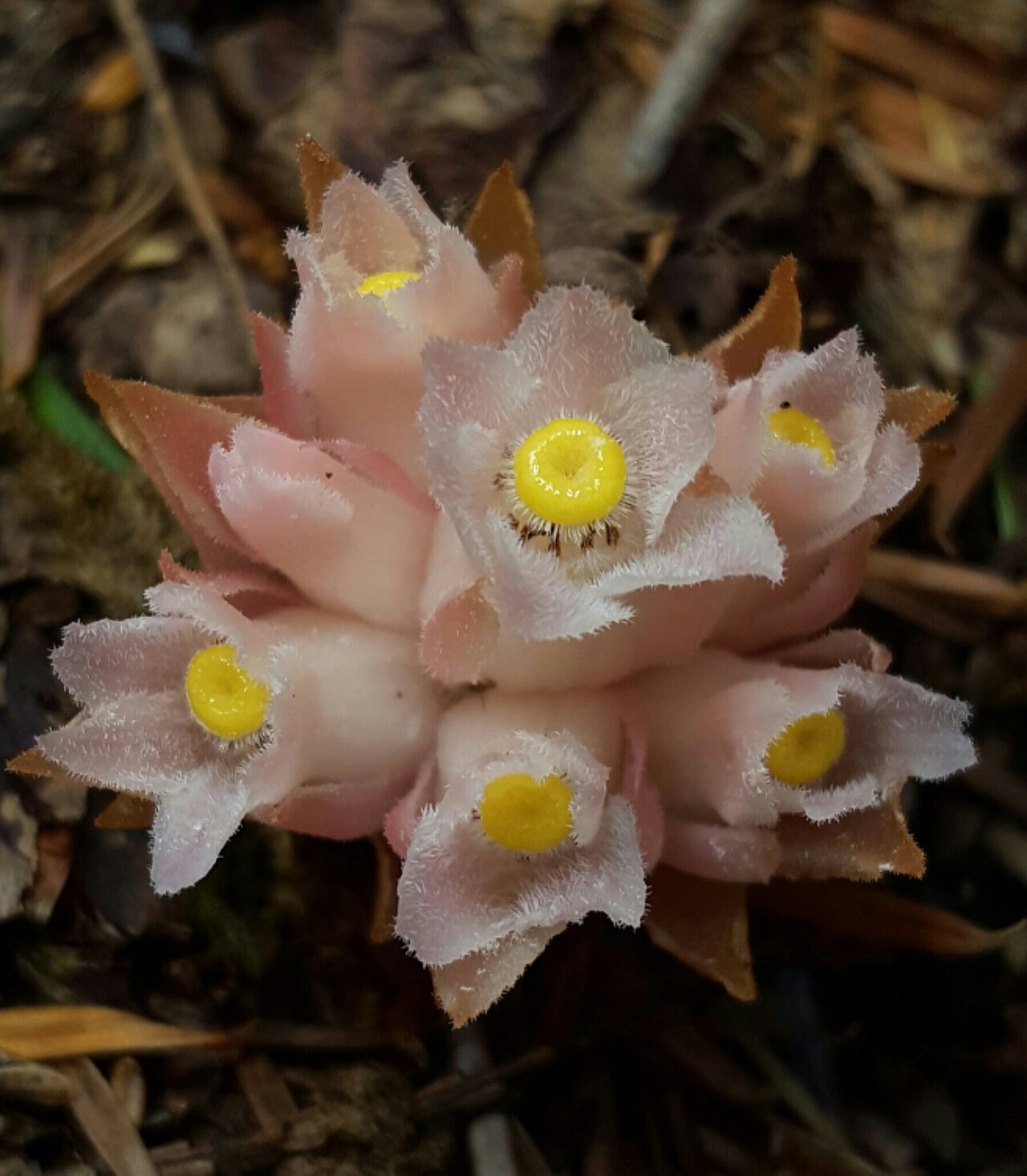
Hemitomes congestum, known as Gnome Plant or cone plant (USDA lists it as coneplant), is one of the strangest wildflowers of the Pacific Northwest and northern California. It has no green leaves and no chlorophyll at all. For most of the year it lives hidden underground, and in late spring and summer it pushes up a fleshy, knobby cluster of pink, cream or yellowish flowers that sits almost flat on the forest floor, often only an inch or two tall. It is the only species in its genus and belongs to the heath family (Ericaceae), in the same group as Indian pipe, pinesap, sugarstick and snowplant.
Gnome plant is fully mycoheterotrophic: instead of making its own food from sunlight, it takes sugars from soil fungi that are themselves connected to the roots of conifers such as Douglas-fir, western hemlock and redwood. That makes it completely dependent on an intact, shaded old forest. It cannot be grown from nursery stock or seed, and it must never be dug up or transplanted; a dug plant simply dies.
It is also uncommon. Gnome plant turns up sporadically in deep, shady, moist conifer forests from British Columbia to central California, and in most years only a few people see one. This page is an identification and appreciation guide: how to recognize it, where it grows, how it lives, and why finding one is a reason to leave it exactly where it is.
Identification
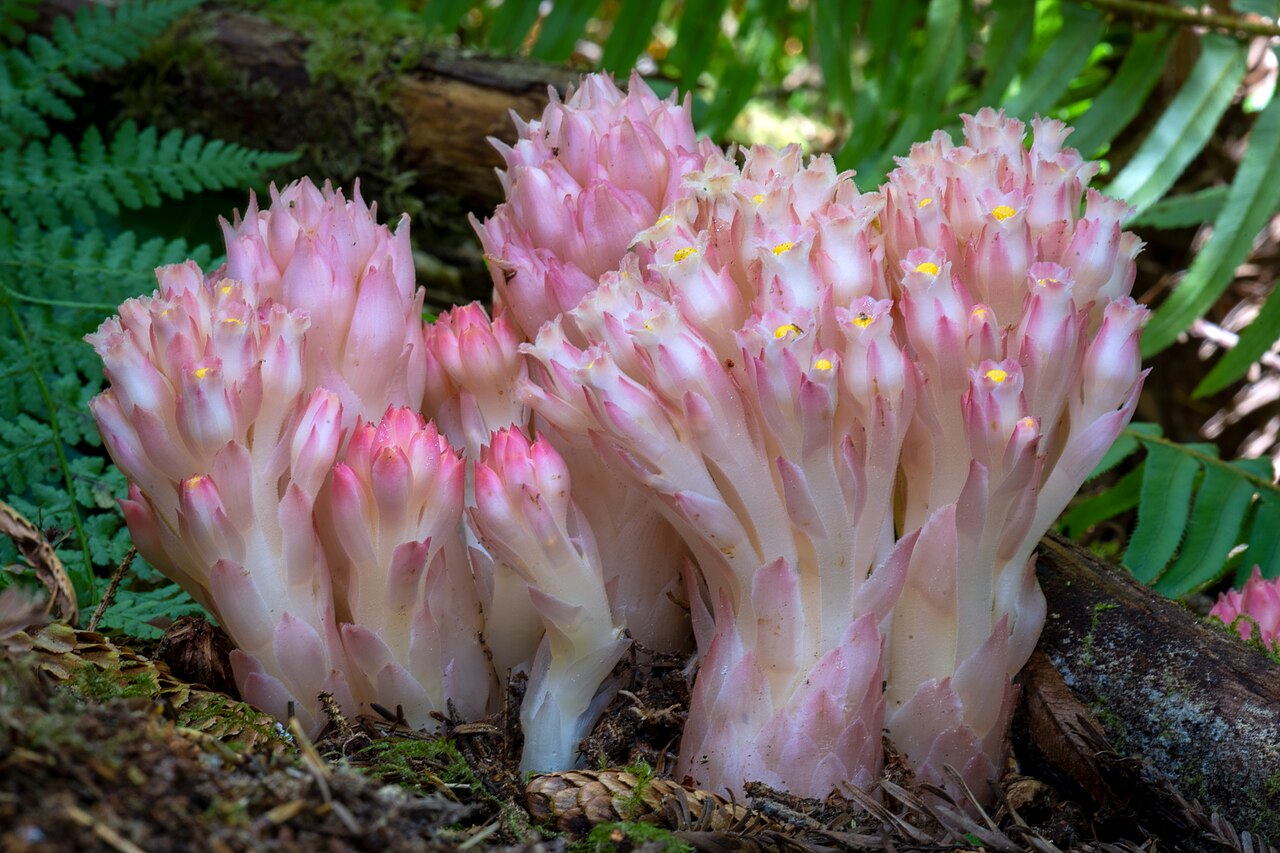
Several chlorophyll-free plants of the heath family share western conifer forests, and gnome plant is the most compact and lumpy of them. Look for a low, crowded mound of stout, scaly shoots topped by fringed, bell-shaped flowers with large yellow stigmas, rather than a tall single stalk.
Shoots & Scales
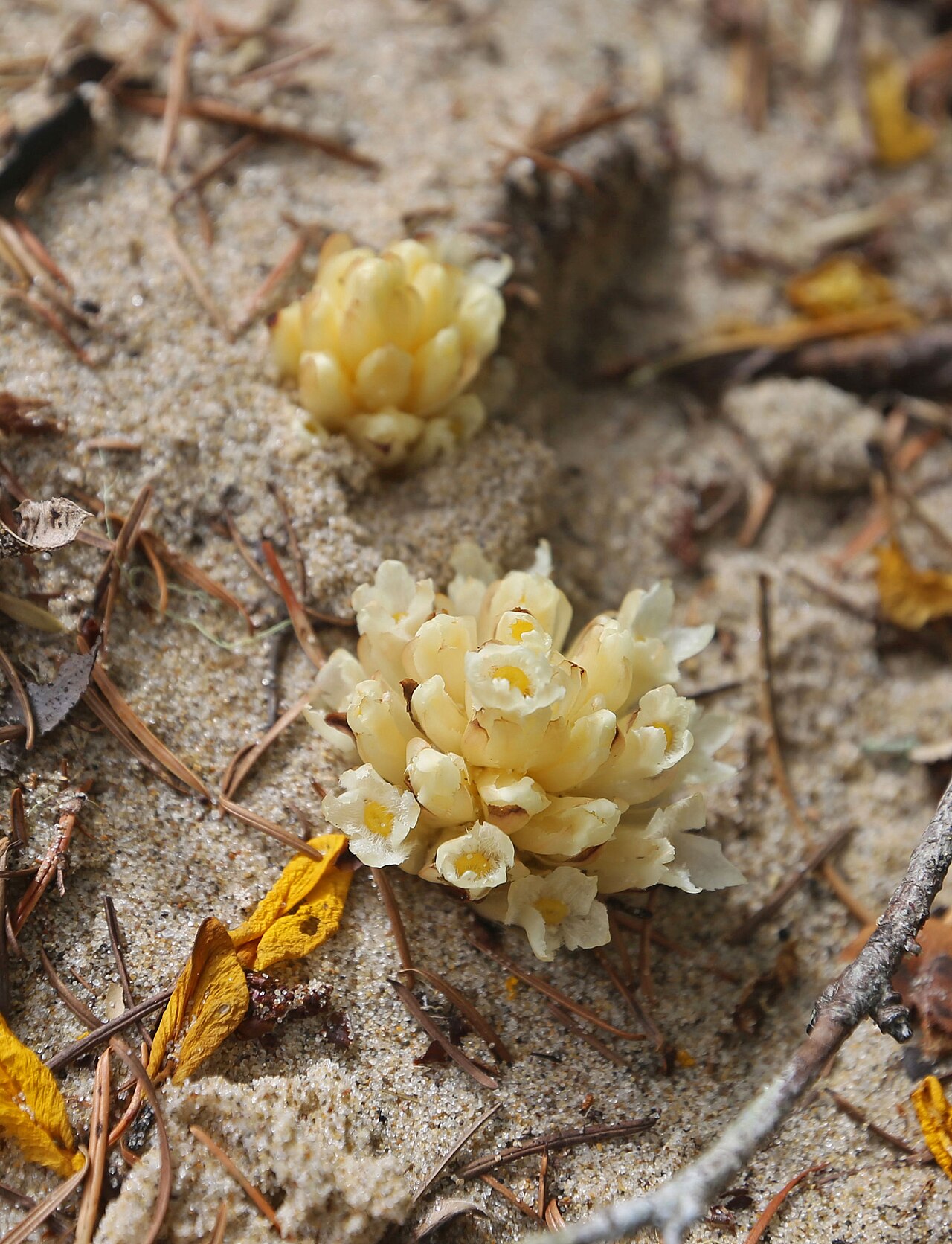
Gnome plant grows from a short underground rootstock with a mass of brittle, fibrous roots. Above ground it produces one to many thick, fleshy shoots, usually 1 to 4 inches tall, packed so tightly that they look like a single knob or cone. The shoots are covered in overlapping scale-like bracts, the remains of leaves. The whole plant is white, cream, pale yellow, pink or reddish-pink, and it often barely clears the layer of needles and duff.
Leaves
There are no green leaves. The scales on the shoots are its only leaves, and they are the same pinkish or creamy color as the rest of the plant. Lacking chlorophyll, it does not photosynthesize at all, which is why it can grow in shade too deep for most green plants.
Flowers
The flowers are crowded at the tips of the shoots, often so densely that the whole cluster looks like one compound flower. Each flower is about ½ inch long, tubular to bell-shaped, with usually four (sometimes up to six) petals that are pink, white or yellowish and fringed with hairs along their edges. Inside, a large, flat, round yellow stigma is the most obvious feature and makes the open flowers look like small yellow-eyed stars. Flowering runs from late spring through summer, mainly June to August.
Look-alikes: pinesap (Monotropa hypopitys) has nodding yellow to reddish flowers on a taller, curved stalk; Indian pipe (Monotropa uniflora) carries a single white, nodding flower per stem; sugarstick (Allotropa virgata) is a tall, red-and-white striped stalk; and snowplant (Sarcodes sanguinea) is bright red and much larger. The fungus-like fringed pinecone of Pleuricospora (fringed pinesap) is the closest look-alike but has a looser, more elongated cluster of cream flowers.
Fruit & Seeds
Each flower develops into a fleshy, whitish, berry-like fruit containing many tiny seeds. The seeds have almost no stored food and can only grow if they meet the right fungus in the soil, which is one reason the plant is scattered and unpredictable. The cluster darkens and decays after fruiting.
Quick Facts
| Scientific Name | Hemitomes congestum A. Gray (only species in the genus) |
| Family | Ericaceae (heath family), subfamily Monotropoideae |
| Plant Type | Perennial mycoheterotrophic herb without chlorophyll |
| Mature Height | 1–4 in (to about 6 in) |
| Mature Spread | Clusters 1–4 in across |
| Growth Rate | Not applicable; appears sporadically |
| Sun Exposure | Deep shade of closed conifer forest |
| Water Needs | Moist forest soil and duff |
| Soil Type | Deep, undisturbed conifer duff and humus |
| Soil pH | Acidic |
| Bloom Time | May–August (mostly June–August) |
| Flower Color | Pink, white, cream or yellowish, with yellow stigmas |
| Fall Color | None; shoots wither after fruiting |
| Fruit | Fleshy whitish berry with many tiny seeds |
| Deer Resistant | Not applicable; rarely encountered |
| USDA Hardiness Zones | Not cultivated (wild in roughly zones 7–9) |
Native Range
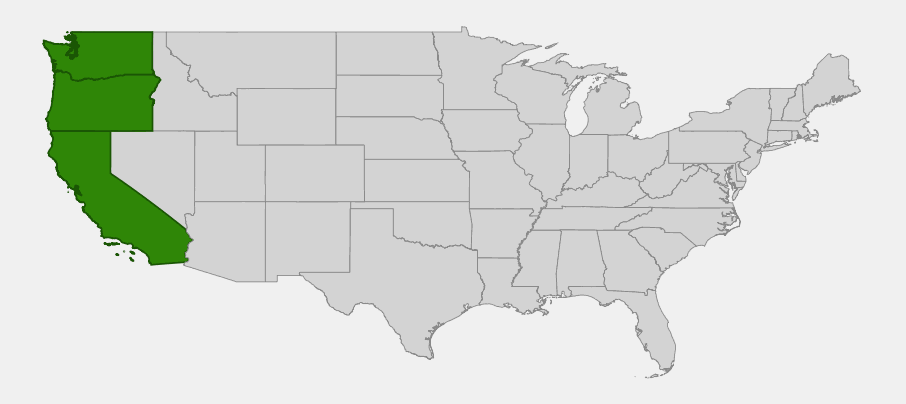
Gnome plant is a Pacific Coast species. USDA PLANTS lists it as native in California, Oregon and Washington, and it also grows in southwestern British Columbia. Its range runs from Vancouver Island and the Washington Cascades south through the Coast Ranges and Cascades of Oregon to northwestern California, with scattered populations in the Sierra Nevada and the central Coast Ranges of California.
Most records come from the moist forests west of the Cascade crest, such as the Olympic Peninsula, the Oregon Coast Range and the redwood belt of northern California. It also occurs locally on the drier east slope of the Washington Cascades, for example in the Okanogan-Wenatchee National Forest. Everywhere it is uncommon and appears unpredictably; it is tracked as a rare plant in parts of its range.
Its habitat is deep, dark, moist conifer forest with a thick layer of needles and humus: old Douglas-fir and western hemlock forests, coast redwood forests, and mixed conifer stands with true firs and pines. It is usually found under a closed canopy, often near rotting logs, in places with little or no green understory.
📋 Regional plant lists featuring Gnome Plant: Western Oregon & Western Washington · California & Nevada
Can You Grow It?
No. Gnome plant cannot be grown in a garden, bought from a nursery, raised from seed or transplanted. It has no chlorophyll and lives entirely on sugars it takes from soil fungi, which in turn get them from living conifers. Moving the plant breaks that connection and it dies. It should never be dug up. The only way to “keep” gnome plant is to protect the old forests where it already grows.
Light
Light does not matter to the plant itself, since it does not photosynthesize. What it needs is the closed conifer canopy that keeps the forest floor cool, moist and full of the trees and fungi it depends on. When forests are clear-cut, gnome plant disappears.
Soil & Water
It lives in deep, moist, undisturbed duff and humus laced with fungal threads. Soil compaction, trampling, raking and removal of logs and litter all damage the fungal network.
Planting Tips
Do not try. There is no nursery stock, and wild plants must not be dug, picked or moved. If you find gnome plant, photograph it, keep to the trail or step carefully around it, and leave the duff around it undisturbed.
Pruning & Maintenance
None. On forested land where it occurs, the best help is to keep old trees standing, leave fallen logs and needle litter in place, avoid driving or piling material on the spot, and keep invasive plants such as English ivy out of the understory.
Propagation
Not possible in practice. Its dust-like seeds need a specific fungus to germinate, and the plant draws its whole living from fungi tied to large trees. Protecting habitat is the only way to conserve it.
Where to See It
- Old-growth and mature conifer forests: redwood, Douglas-fir and western hemlock forests from northern California to British Columbia
- Parks and protected areas: coast redwood parks in northern California and forests of the Oregon and Washington Cascades and Coast Ranges are good places to watch for it in summer
- Wildflower walks: look closely at the duff beside trails in deep shade from June to August, near rotting logs and other chlorophyll-free plants
- Botanical photography: a remarkable subject; shoot it in place without clearing duff around it
- Citizen science: record sightings on iNaturalist or report them to state rare plant programs; exact locations of rare plants are often best kept private
Wildlife & Ecological Value
Gnome plant is a small but telling part of the western conifer forest, a visible sign of the vast fungal networks that link trees underground.
For Pollinators
Little is known about its pollination. The flowers are crowded and partly hidden in the duff, and bumble bees and other small insects have been reported visiting monotropoid flowers of this type. The large stigmas and fleshy flowers suggest insects crawling over the cluster do most of the work.
For Birds
It has no known importance as bird food. The forests where it grows support spotted owls, varied thrushes, winter wrens and other birds of old conifer forest.
For Mammals
The fleshy berries may be eaten by small mammals such as mice and voles, which could help spread the seeds, but this is not well documented. Deer do not seek it out.
Ecosystem Role
Gnome plant is a mycoheterotroph: it taps into ectomycorrhizal fungi that link to the roots of conifers, so its sugars ultimately come from the trees through the fungi. Like other members of its group, it is thought to associate with a narrow range of fungal partners. Its presence shows a healthy, long-undisturbed fungal network, and it is sensitive to logging, soil disturbance and the loss of large trees.
Cultural & Historical Uses
The species was described by the American botanist Asa Gray in 1858 from material collected in the Pacific Northwest. The species name congestum means crowded, for its tightly packed shoots and flowers. It is the only member of its genus.
Its common names, gnome plant and cone plant, describe its look: a squat, knobby cluster that resembles a small pine cone or a group of gnome caps poking out of the needles. Older references sometimes call it Newberrya congesta.
Because it is so rarely seen and so unlike an ordinary plant, gnome plant has become a favorite find among Pacific Northwest naturalists and mushroom hunters, who often come across it while searching the same shady duff for fungi. Finding one is a matter of luck and of walking quiet old forests in summer.
Frequently Asked Questions
Can I grow gnome plant?
No. It has no chlorophyll and depends completely on soil fungi connected to living conifers. It is not sold by nurseries, cannot be raised from seed at home, and dies if it is dug up or transplanted. Never remove it from the wild.
Is gnome plant a fungus?
No. It is a flowering plant in the heath family, related to blueberries and madrones, that has lost its chlorophyll. It gets its food from fungi instead of sunlight, which is why it looks a bit like a mushroom.
Where can I see gnome plant?
In deep, shady, moist conifer forests from British Columbia through western Washington and Oregon to northern and central California, including coast redwood forests. Look for it from June to August in thick duff near rotting logs, but expect it to be rare.
How is it different from Indian pipe and pinesap?
Indian pipe has white, single nodding flowers on separate stems, and pinesap has a taller curved stalk with nodding yellowish to reddish flowers. Gnome plant is a squat, crowded knob of fleshy shoots with fringed pink to cream flowers and conspicuous yellow stigmas.
Is gnome plant rare?
It is uncommon throughout its range and appears sporadically, so it can be absent from a site for years. It is tracked as a rare plant in parts of its range. Its main threats are logging and disturbance of old forest soils.

Looking for a nursery that carries Gnome Plant?
Browse our native plant nursery directory: California · Oregon · Washington

