
Roundleaf Snowberry (Symphoricarpos rotundifolius)
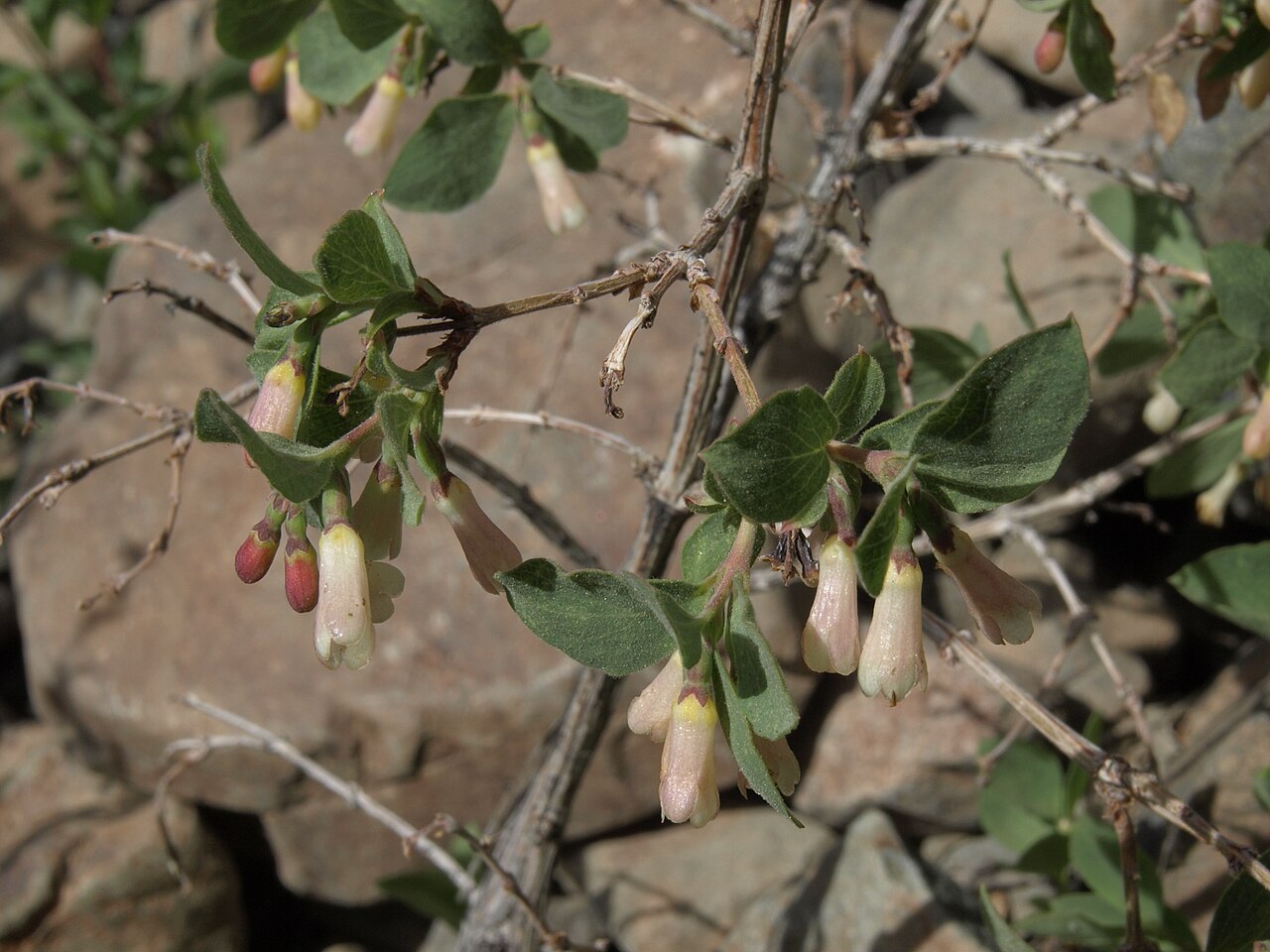
Symphoricarpos rotundifolius, known as Roundleaf Snowberry or round-leaved snowberry, is a small, twiggy shrub of the dry mountains of the American West. It grows on rocky slopes, canyon walls and open woodland from Idaho and Colorado south to California, Arizona, New Mexico and the mountains of West Texas, usually between the pinyon-juniper zone and the high conifer forests. In early summer it hangs narrow pink or creamy flowers from its leaf axils, and in late summer and fall these turn into white berries that stand out against the gray rock.
It belongs to the honeysuckle family (Caprifoliaceae), and like its relatives common snowberry and coralberry it has opposite leaves, small tubular flowers and soft, pale berries. Its leaves are small, about ¼ to ¾ inch long, and broadly oval rather than truly round despite the name. Botanists have long debated where to draw the line between this species and the closely related mountain snowberry (Symphoricarpos oreophilus); some treat them as one variable species, while USDA PLANTS keeps them separate.
For gardeners in the Intermountain West and Southwest, roundleaf snowberry is a tough, drought-tolerant native shrub for dry slopes, rock gardens and wildlife plantings. It feeds hummingbirds and native bees, its berries hang on into winter for birds, and its dense, low branches hold soil on steep ground. This guide covers how to identify it, where it grows, and how to grow it.
Identification
Roundleaf snowberry is easy to recognize as a snowberry: a low, many-branched shrub with small opposite leaves, little tubular flowers and white berries. Separating it from other western snowberries takes a closer look at the leaves, the flower shape and the hairs on the twigs.
Growth Habit & Bark
It is an erect to spreading or sometimes trailing shrub, usually 2 to 4 feet tall, with many stiff, slender branches. Older stems have gray to reddish-brown bark that shreds into thin strips. Young twigs are often finely hairy. Plants on cliffs and rock outcrops tend to be low and sprawling, while those in sheltered woodland openings are taller and more upright.
Leaves
The leaves are opposite, simple and small, about ¼ to ¾ inch long, oval to elliptic or nearly round, with smooth edges (occasionally a few shallow teeth on vigorous shoots). They are dull green above and paler beneath, with a network of fine veins, and often finely hairy. They are deciduous and drop in fall, leaving a twiggy shrub.
Flowers
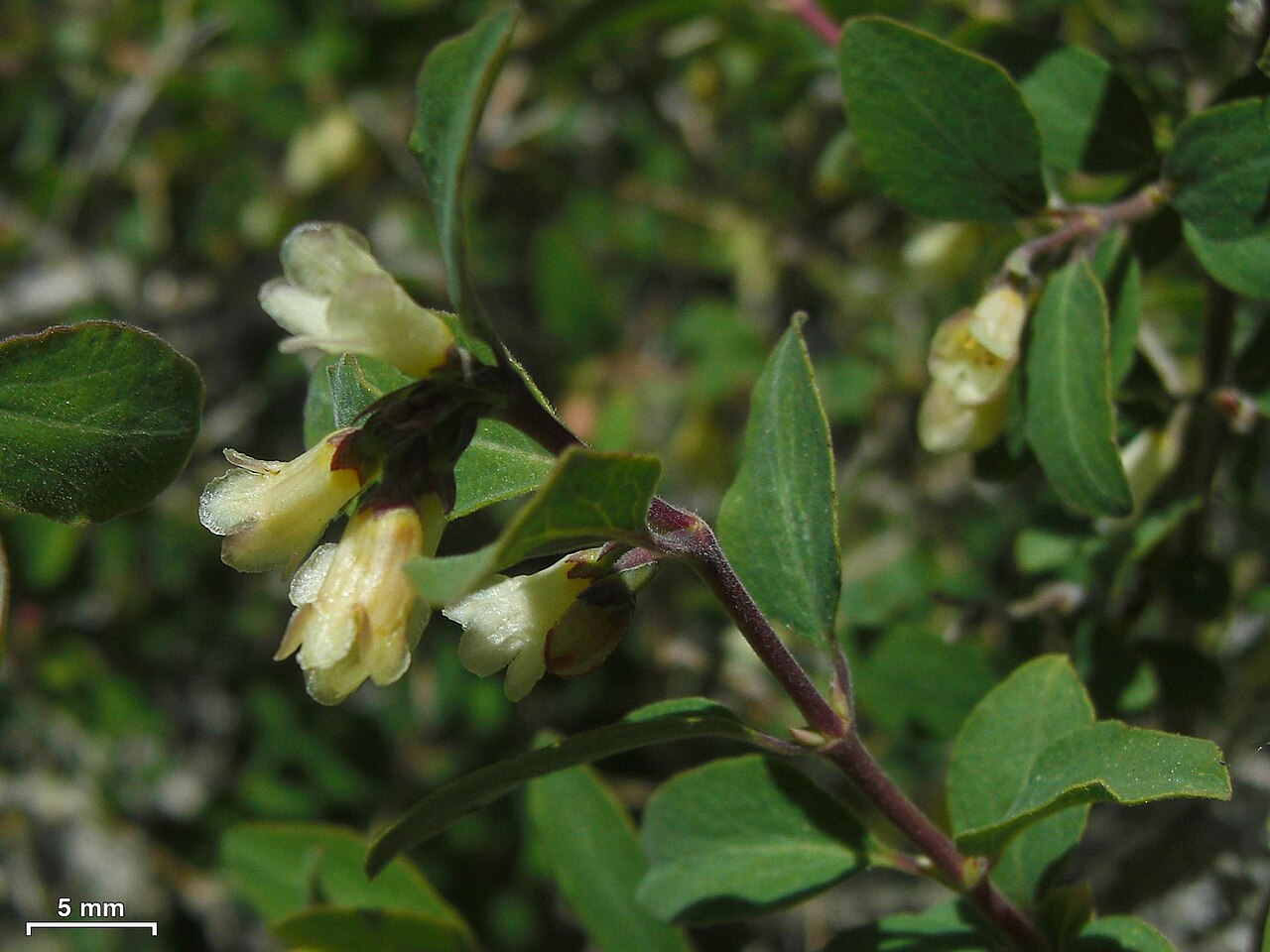
The flowers hang singly or in pairs from the leaf axils near the ends of the branches. Each is a narrow tube or slender bell, up to about ⅖ inch (1 cm) long, pink, pinkish-white or pale yellowish-white, with five short lobes at the mouth. Compared with common snowberry, whose flowers are short, open bells, roundleaf snowberry has longer, narrower tubes. It blooms mainly from late spring into summer (about May to August depending on elevation).
Fruit
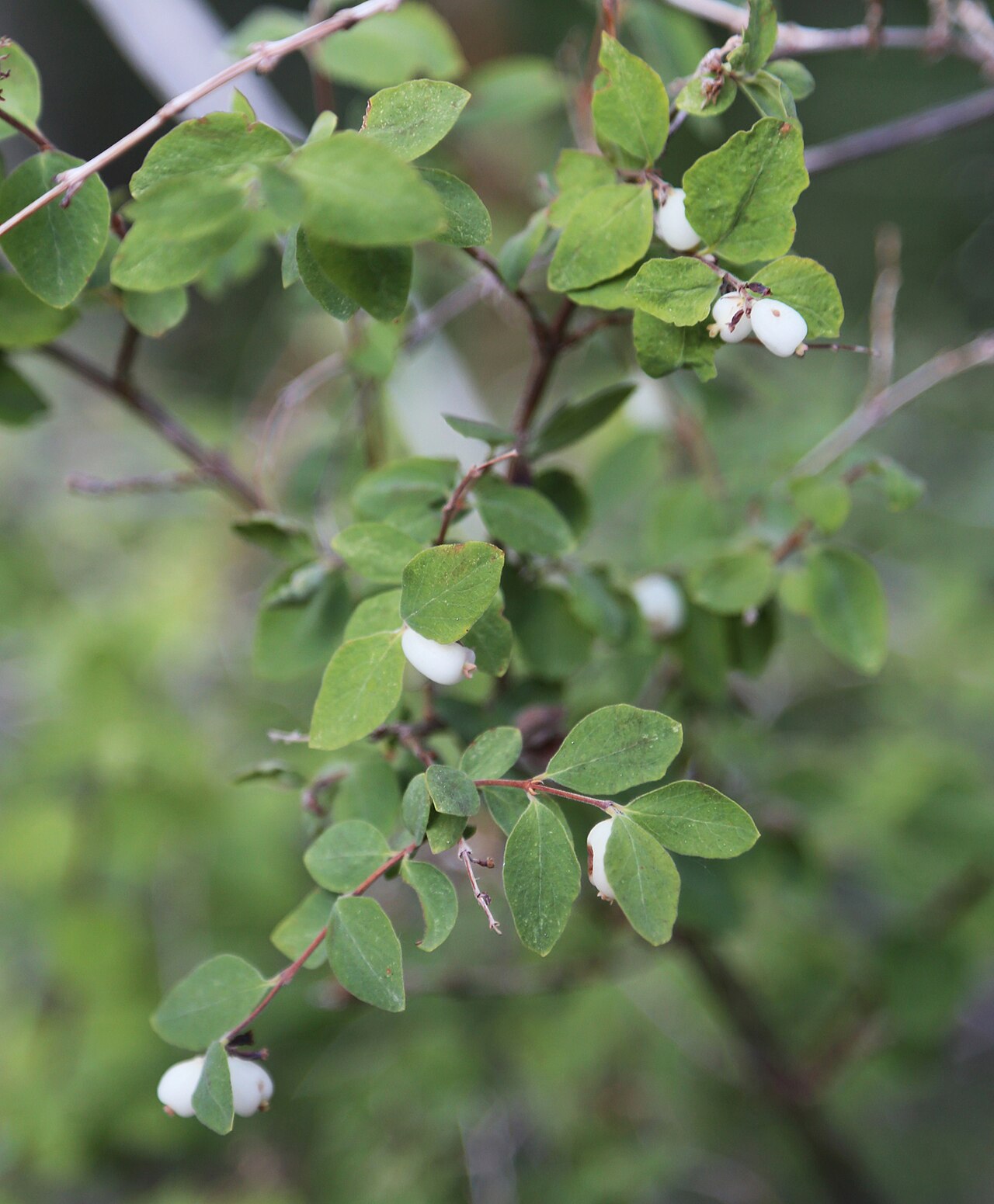
The fruit is a white, oval berry-like drupe about ⅓ inch long, usually borne singly or in pairs. Each holds two small nutlets. The berries ripen in late summer and persist on the bare twigs into fall and early winter. Like other snowberries, the fruit is considered mildly poisonous to people and should not be eaten.
Quick Facts
| Scientific Name | Symphoricarpos rotundifolius A. Gray |
| Family | Caprifoliaceae (honeysuckle family) |
| Plant Type | Deciduous shrub |
| Mature Height | 2–4 ft |
| Mature Spread | 2–4 ft; may spread slowly by rooting stems |
| Growth Rate | Slow to moderate |
| Sun Exposure | Full sun to partial shade |
| Water Needs | Low once established; drought tolerant |
| Soil Type | Well-drained rocky, gravelly or sandy soils |
| Soil pH | About 6.0–8.0 |
| Bloom Time | May–August, depending on elevation |
| Flower Color | Pink, pinkish-white or pale yellowish-white |
| Fall Color | Inconspicuous; leaves turn dull yellow before dropping |
| Fruit | White berry-like drupe, about ⅓ in, persistent into winter |
| Deer Resistant | No; browsed by deer, elk and livestock |
| USDA Hardiness Zones | 4–9 |
Native Range
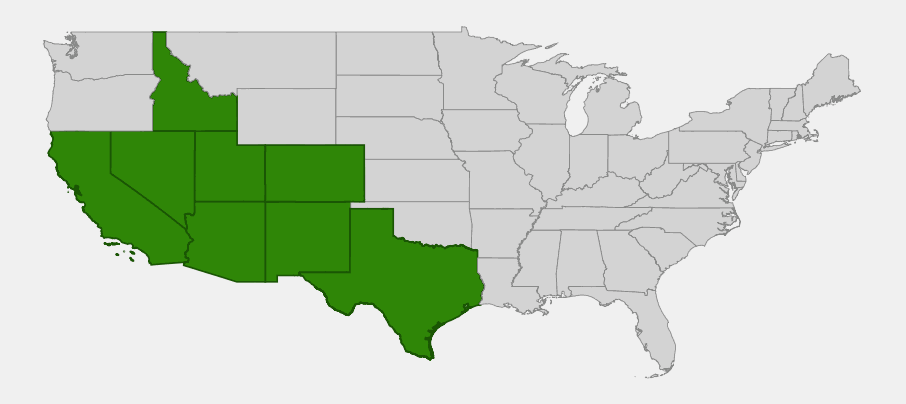
Roundleaf snowberry is a plant of the interior West and Southwest. USDA PLANTS and the Lady Bird Johnson Wildflower Center record it as native in eight states: Arizona, California, Colorado, Idaho, Nevada, New Mexico, Texas and Utah. Some floras also report it from eastern Oregon and the Oklahoma Panhandle, and its range continues south into northern Baja California in Mexico.
Across this range it is a mountain shrub. It is most common on rocky, sunny slopes, ridges and canyon walls in pinyon-juniper woodland, mountain brush, ponderosa pine forest and dry mixed-conifer forest, and it reaches into the subalpine zone on exposed rock. In California it grows mostly in the eastern Sierra Nevada, the desert mountains and the Transverse and Peninsular Ranges, and in Texas it is limited to the high mountains of the Trans-Pecos.
Botanists split the species in different ways. USDA PLANTS recognizes roundleaf snowberry separately from mountain snowberry (Symphoricarpos oreophilus), which is more widespread in the Rocky Mountains, while some recent treatments merge them under S. rotundifolius with several varieties. In the field the two intergrade, and the names are often used interchangeably on plant lists and in nurseries.
📋 Regional plant lists featuring Roundleaf Snowberry: Arizona & New Mexico · California & Nevada · Idaho, Eastern Oregon & Eastern Washington · Utah & Western Colorado · South & West Texas
Growing & Care Guide
Roundleaf snowberry is an easy, low-maintenance shrub in the dry West if it gets good drainage. It is less common in nurseries than common snowberry, so look for it at native plant nurseries and plant society sales in the Intermountain region and Southwest, or grow it from cuttings or seed collected with permission.
Light
Give it full sun to partial shade. In hot, low-elevation gardens it does best with some afternoon shade, as it gets in canyon and woodland openings in the wild. In cool mountain gardens it takes full sun and flowers and fruits most heavily there.
Soil & Water
Plant it in well-drained rocky, gravelly or sandy soil. It tolerates poor, lean soils and neutral to alkaline conditions but rots in heavy, wet clay. Water regularly through the first summer to establish roots. After that, a deep soaking every few weeks in hot, dry weather is enough, and in many mountain gardens it needs no supplemental water at all.
Planting Tips
Plant container stock in fall or early spring so roots can grow before summer heat. Space plants about 3 feet apart for a loose mass. It looks most natural tucked among boulders, on a slope, or at the edge of a dry woodland planting with other mountain shrubs such as mountain mahogany, bitterbrush and Gambel oak.
Pruning & Maintenance
Little pruning is needed. Remove dead or crossing stems in late winter. If an old plant becomes sparse, cut a few of the oldest stems near the base to encourage new growth. Avoid fertilizing, which produces soft, leggy growth. Leave the berries on the shrub for birds.
Propagation
Softwood or semi-hardwood cuttings taken in early to midsummer root fairly well, and low branches that touch the ground can be layered. Seed is slow: the hard nutlets usually need a warm, moist period followed by several months of cold stratification, and germination may take more than one season.
Landscape Uses
- Rock gardens and dry slopes: a compact, drought-tolerant shrub that looks at home among boulders
- Erosion control: dense, twiggy growth and spreading roots help hold soil on steep, rocky ground
- Wildlife and hummingbird gardens: tubular flowers for hummingbirds and bees, persistent berries for birds
- Xeriscapes: low-water landscapes in the Intermountain West and Southwest uplands
- Restoration: revegetation of disturbed slopes in pinyon-juniper, mountain brush and ponderosa pine country
Wildlife & Ecological Value
Roundleaf snowberry is a modest shrub, but on dry mountain slopes it provides flowers, fruit, cover and browse in places where few other shrubs grow.
For Pollinators
The narrow tubular flowers are visited by hummingbirds and by bumble bees and other native bees, which collect nectar from the base of the tube. Snowberries in general are larval host plants for sphinx moths of the genus Hemaris (clearwing or hummingbird moths), and the flowers attract a variety of small butterflies and moths.
For Birds
The white berries ripen in late summer and stay on the twigs into winter, when they are eaten by grouse, wild turkeys, American robins, thrushes, Townsend’s solitaires and other birds. The dense branches give small birds cover and nesting sites on otherwise open slopes.
For Mammals
Mule deer, elk, bighorn sheep and domestic livestock browse the twigs and leaves, especially in late summer and fall. Small mammals such as chipmunks and woodrats take the berries and seeds and shelter under the shrubs.
Ecosystem Role
On rocky slopes and in mountain brush communities, roundleaf snowberry helps stabilize loose soil and catches leaf litter that builds soil over time. Snowberries generally resprout from the root crown after fire, so they are among the shrubs that help slopes recover after burns.
Cultural & Historical Uses
Asa Gray described Symphoricarpos rotundifolius in 1853 from specimens collected in the Southwest during the era of the boundary and railroad surveys. The genus name comes from Greek words meaning “fruit borne together,” for the clustered berries of many species, and the species name means “round-leaved.”
Snowberries in general had many uses among Native American peoples of the West. Their slender, straight stems were used for arrow shafts, brooms and small tools, and preparations of the leaves, bark and roots were used externally in traditional medicine. The berries were generally regarded as inedible or poisonous and were rarely eaten. Specific records for this species are scattered, so these uses are best understood as typical of the genus in the region.
Today roundleaf snowberry is valued mainly by land managers and native plant gardeners. It is used in revegetation of mountain rangelands and disturbed slopes, and native plant societies in Utah, Colorado, Nevada and New Mexico recommend it as a water-wise shrub for wildlife gardens.
Frequently Asked Questions
Are roundleaf snowberry berries edible?
No. Like other snowberries, the berries contain saponins and are considered mildly poisonous to people. Eating them can cause vomiting and stomach upset. Birds and other wildlife eat them without harm.
What is the difference between roundleaf snowberry and mountain snowberry?
They are very similar. Roundleaf snowberry usually has smaller, rounder, often hairier leaves and grows on drier, rockier sites in the Southwest and Great Basin, while mountain snowberry (S. oreophilus) is more widespread in the Rocky Mountains. USDA PLANTS treats them as separate species, but some botanists combine them.
How big does roundleaf snowberry get?
It usually grows 2 to 4 feet tall and about as wide. In very exposed, rocky sites it may stay under 2 feet and sprawl over the rocks.
Is roundleaf snowberry drought tolerant?
Yes. Once established it needs little or no summer water in most of its native range. Good drainage matters more than water: it does poorly in heavy, wet soils.
Does roundleaf snowberry attract hummingbirds?
Yes. Its narrow, tubular pink to whitish flowers are visited by hummingbirds as well as bumble bees and other native bees during early summer.

Looking for a nursery that carries Roundleaf Snowberry?
Browse our native plant nursery directory: Arizona · California · Colorado · Idaho · Nevada & New Mexico · Texas & Utah

