
Coast Range Lomatium (Lomatium martindalei)
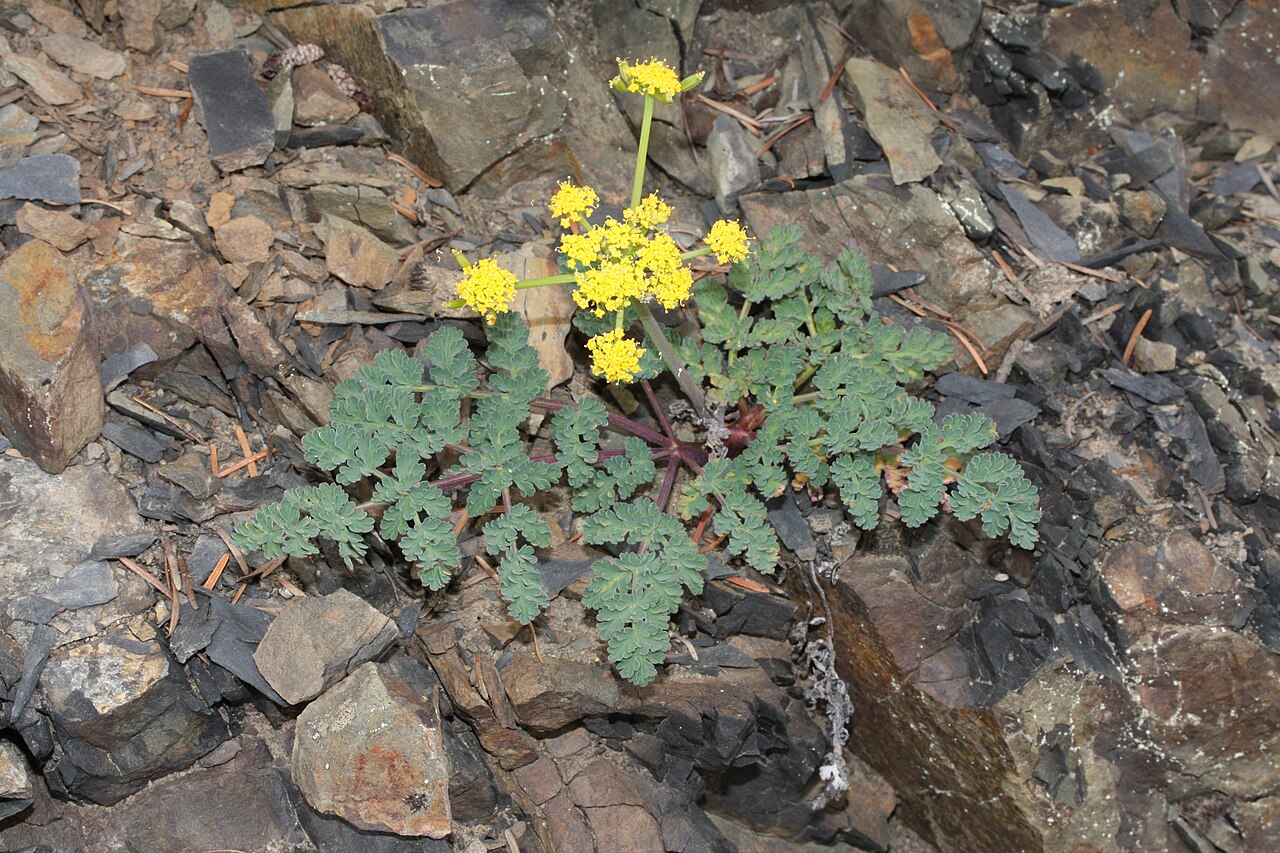
Lomatium martindalei, known as Coast Range Lomatium or Cascade desertparsley, is a low, tufted perennial of the carrot family (Apiaceae) that grows on rocky slopes, talus, cliffs, balds and mountain meadows in the Pacific Northwest. Its blue-green, finely divided leaves often lie almost flat on the ground, and in late spring or summer short stalks carry flat-topped umbels of small yellow flowers. The whole plant is usually less than a foot tall.
Unlike most lomatiums, which are plants of dry sagebrush and grassland east of the Cascades, coast range lomatium belongs to the wetter, mountainous west side of the region. It grows on the rocky summits of the Oregon Coast Range, in the Olympic Mountains, along the Cascade Range and in the Klamath Mountains of northwestern California, and it reaches north to Vancouver Island in British Columbia. On peaks like Saddle Mountain and Marys Peak in Oregon it is one of the characteristic wildflowers of open rocky ground.
It is a plant for people who enjoy alpine and rock-garden wildflowers rather than a common garden perennial. This guide explains how to identify it, where it grows, what it needs if you want to try it from seed, and the role it plays in the rocky mountain habitats where it lives.
Identification
Coast range lomatium is easiest to recognize by the combination of a low, stemless or nearly stemless habit, thick blue-green leaves cut into small rounded segments, and small umbels of yellow flowers on short stalks. Several other lomatiums grow in the region, so check the leaves and the habitat.
Roots & Growth Habit
The plant grows from a thick, carrot-like taproot. There is usually no true leafy stem: the leaves and flowering stalks rise directly from the root crown, spreading outward or standing partly upright. Flowering stalks are about 6 to 16 inches (15 to 40 cm) tall, and plants on wind-swept ridges are often much smaller.
Leaves
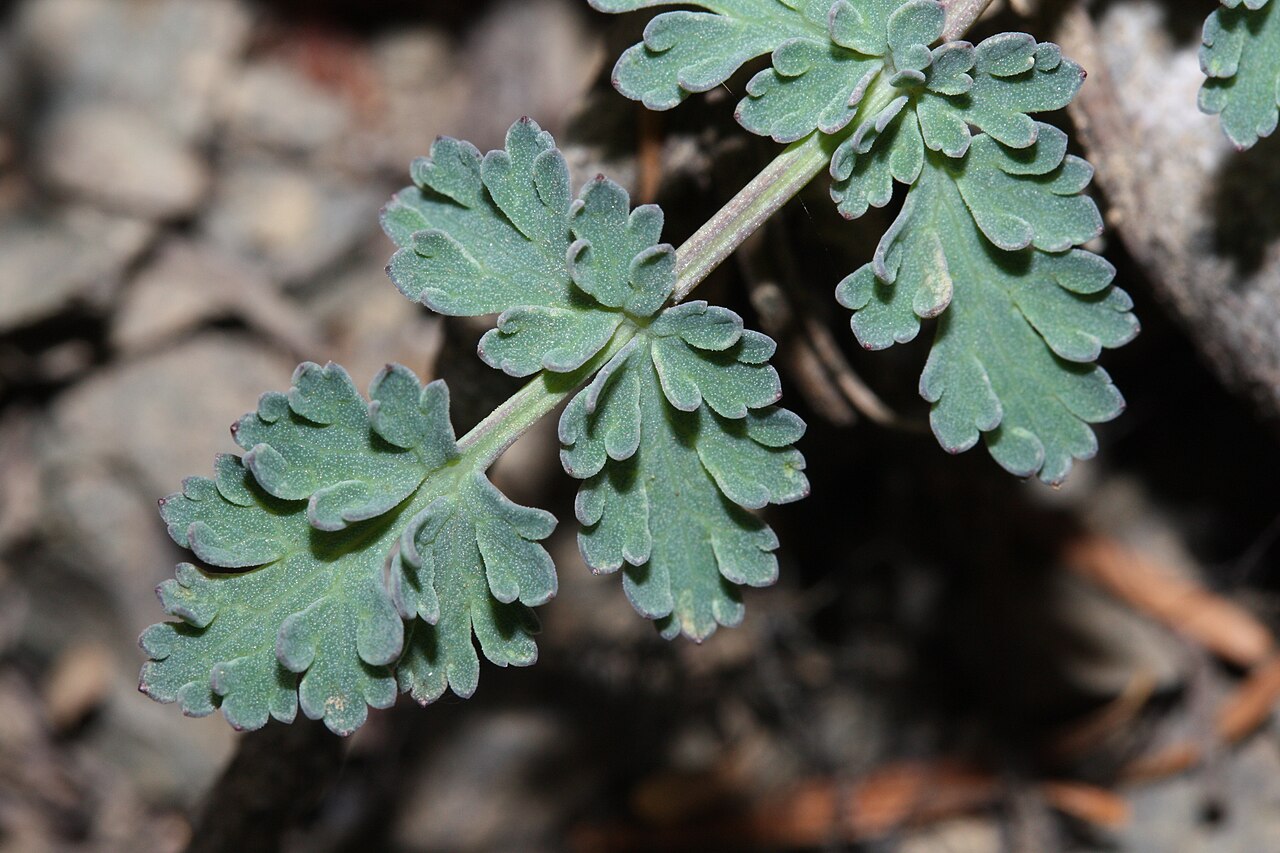
The leaves are somewhat fleshy, smooth and blue-green to gray-green, up to about 8 inches long including the leaf stalk. Each blade is divided once or twice into leaflets, and the leaflets are cut into many small, oval or rounded, crowded segments. The result looks more like a lacy parsley than the thread-like leaves of many desert lomatiums.
Flowers
The tiny five-petaled flowers are packed into compound umbels, each made of several small rays that hold rounded clusters of flowers. They are usually bright yellow, but some populations have pale yellow or creamy flowers. Bloom begins in May at lower elevations and continues into July or August near timberline as the snow melts.
Fruit & Seeds
As with other lomatiums, each flower ripens into a dry, flattened fruit that splits into two one-seeded halves. The fruits are oblong and have thin wings along their edges, which help them drift a short distance in the wind. They ripen in mid to late summer.
Quick Facts
| Scientific Name | Lomatium martindalei (J.M. Coult. & Rose) J.M. Coult. & Rose |
| Family | Apiaceae (carrot family) |
| Plant Type | Herbaceous perennial from a taproot |
| Mature Height | 6–16 in in flower; often lower on exposed ridges |
| Mature Spread | 6–12 in |
| Growth Rate | Slow |
| Sun Exposure | Full sun |
| Water Needs | Moderate in spring; tolerates dry summers once established |
| Soil Type | Rocky, gravelly, fast-draining soil; talus, scree and thin soil over rock |
| Soil pH | Slightly acidic to neutral |
| Bloom Time | May–August, depending on elevation |
| Flower Color | Yellow; sometimes pale yellow or cream |
| Fall Color | None; leaves dry and wither in late summer |
| Fruit | Flattened, winged dry fruit (schizocarp) |
| Deer Resistant | Not well documented |
| USDA Hardiness Zones | 5–8 |
Native Range
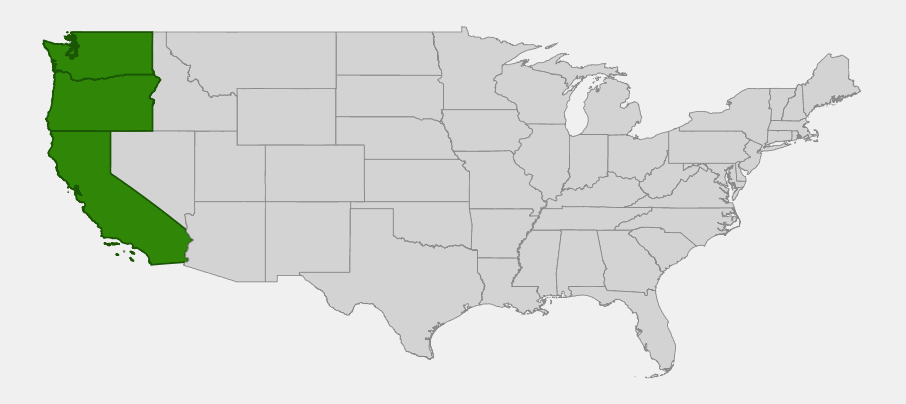
Coast range lomatium is a Pacific Northwest endemic. USDA PLANTS records it as native in Washington, Oregon and California, and it also grows in southwestern British Columbia, including Vancouver Island. Its range runs from the Olympic Mountains and the Cascades of Washington south through the Oregon Coast Range and Oregon Cascades to the Klamath and Siskiyou Mountains of far northern California.
The species lives in open, rocky places where trees cannot close in: summit balds and rock gardens in the Coast Range, talus and scree in the Cascades and Olympics, subalpine and alpine meadows, cliff ledges and, at the northern end of its range, rocky coastal bluffs. It grows from fairly low elevations near the coast to well above timberline in the mountains, where it blooms in early summer after the snow melts.
In Oregon it is well known from the rocky summits of Saddle Mountain and Marys Peak in the Coast Range, both protected natural areas with unusual concentrations of mountain wildflowers. In California it is limited to the northwestern mountains.
📋 Regional plant lists featuring Coast Range Lomatium: Western Oregon & Western Washington · California & Nevada
Growing & Care Guide
Coast range lomatium is rarely offered in nurseries, and it is best grown from seed by rock-garden enthusiasts and native plant growers within its range. Like many lomatiums, it puts its early energy into a deep taproot, so it is slow to reach flowering size and does not like to be moved. Never dig plants from the wild; collect only a small amount of seed where collecting is allowed.
Light
Give it full sun. In the wild it grows on open, rocky ground where nothing shades it, and plants grown in shade become weak and sparse.
Soil & Water
Sharp drainage matters more than anything else. Use a gravelly, lean mix such as a scree bed, a raised rock garden or a deep trough with plenty of grit, and avoid rich garden soil and heavy clay. In the Pacific Northwest, winter and spring rain is usually enough. Plants tolerate dry summers once established, since the leaves wither and the plant goes partly dormant after seed set. Do not fertilize.
Planting Tips
Sow seed outdoors in fall, or give it a cold, moist stratification of at least two to three months before sowing in late winter. Grow seedlings in deep pots so the taproot can develop, and plant them out while still small. Set plants between rocks, where the root stays cool and the crown stays dry.
Pruning & Maintenance
Little care is needed. Keep taller plants and weeds from crowding it, and remove dried leaves in late summer if you like. Leave some fruiting stalks to ripen if you want seed. A top-dressing of gravel around the crown helps prevent rot.
Propagation
Propagate by seed. Dividing or transplanting established plants is seldom successful because of the long taproot. Seedlings may take two or more years to flower.
Landscape Uses
- Rock gardens and scree beds: a low, blue-green mound with yellow umbels for Pacific Northwest rock gardens
- Troughs and containers: deep, gritty troughs suit its size and drainage needs
- Native plant restoration: on rocky balds and mountain sites within its range, using local seed
- Pollinator plantings: its early, open flowers feed small native bees and flies
- Wildflower viewing: summit trails such as Saddle Mountain and Marys Peak in Oregon show it in bloom in late spring
Wildlife & Ecological Value
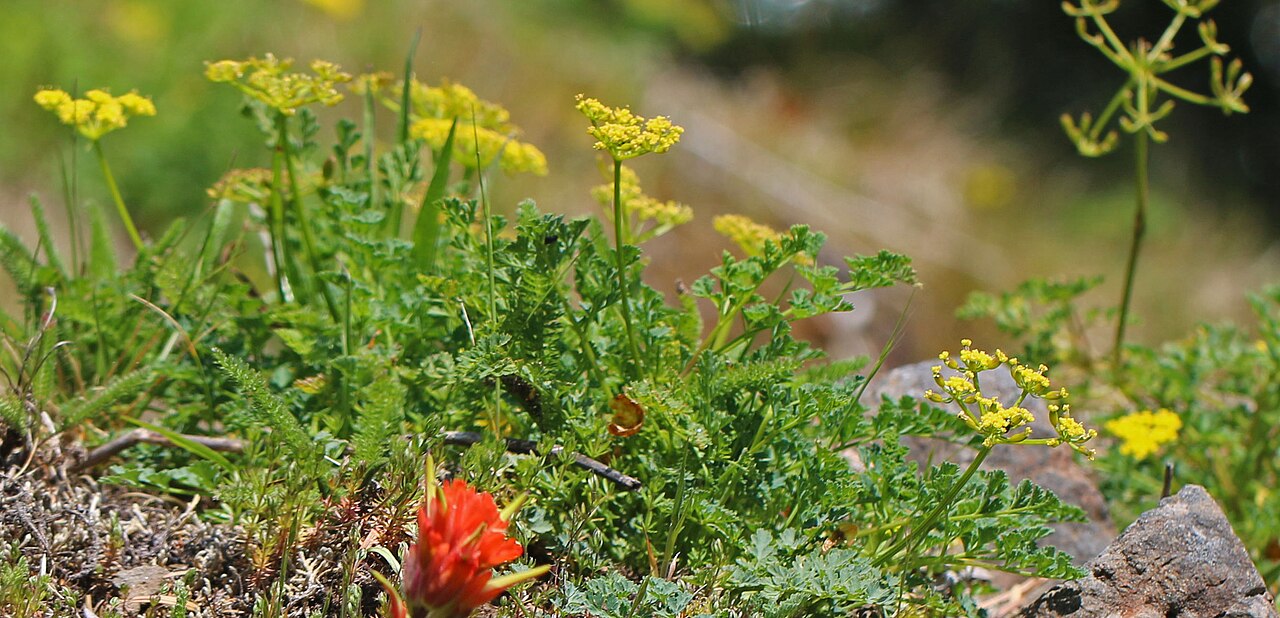
Coast range lomatium is a small plant, but it is part of the specialized community of rocky balds, talus and alpine meadows in the Pacific Northwest, where many plants are found nowhere else.
For Pollinators
Like other members of the carrot family, its small, open flowers offer easy nectar and pollen to short-tongued insects. Small native bees, flies and beetles visit the umbels. Lomatiums in general are larval host plants for swallowtail butterflies such as the anise swallowtail, whose caterpillars feed on the foliage.
For Birds
It has little direct food value for birds, though the seeds may be eaten by ground-foraging birds and the insects it attracts feed insect-eating birds of open mountain habitats.
For Mammals
Lomatium roots are eaten by rodents such as pocket gophers, and mountain herbivores may graze the foliage. Its importance to mammals is otherwise small.
Ecosystem Role
On rocky balds and scree, plants like this one help hold thin soil in place and add organic matter to otherwise bare ground. Because these open habitats are slowly invaded by trees and shrubs in some places, coast range lomatium is one of the wildflowers that depend on the rocky, open conditions being maintained.
Cultural & Historical Uses
The species was first described in 1888 by John Merle Coulter and Joseph Nelson Rose as Peucedanum martindalei, and the same authors later moved it into Lomatium. The species name honors Isaac C. Martindale, a nineteenth-century botanist and plant collector from the Philadelphia area. The genus name comes from the Greek loma, border, referring to the winged edges of the fruit.
Many lomatiums were important foods for Indigenous peoples of the Northwest, who dug and dried their roots, and the genus is often called biscuitroot for that reason. Most of those uses involved larger, more abundant species of the dry interior, and there is little specific record of the use of coast range lomatium.
Today it is valued mainly by hikers, botanists and rock gardeners. Its summit populations in the Oregon Coast Range are part of what makes places like Saddle Mountain State Natural Area and Marys Peak botanically notable.
Frequently Asked Questions
Is coast range lomatium edible?
Some lomatiums have edible roots, but the carrot family also includes deadly poisonous plants such as water hemlock and poison hemlock, which can look similar. Do not eat any wild plant in this family unless you are certain of its identity, and do not dig wild plants of this species.
How is it different from other lomatiums?
Most lomatiums of the Northwest grow on dry, open ground east of the Cascades and have very finely divided, thread-like or feathery leaves. Coast range lomatium grows in the mountains of the wetter west side and has thicker, blue-green leaves cut into small rounded segments, with a low, nearly stemless habit.
Can I grow it in my garden?
Yes, if you can give it full sun and a very well-drained, gravelly site such as a rock garden or trough. Start it from seed with a cold, moist stratification, grow seedlings in deep pots, and be patient, since it can take several years to flower.
When does it bloom?
Bloom starts in May at lower elevations and in the Coast Range, and continues into July or August at high elevations in the Cascades and Olympics, following snowmelt.
Why is it called both coast range lomatium and Cascade desertparsley?
The plant grows in both the Coast Range and the Cascades. USDA PLANTS uses the name Cascade desertparsley, while coast range lomatium is common in Oregon and Washington wildflower guides. Both refer to Lomatium martindalei.

Looking for a nursery that carries Coast Range Lomatium?
Browse our native plant nursery directory: California · Oregon · Washington

