
Mat Saxifrage (Saxifraga bronchialis)
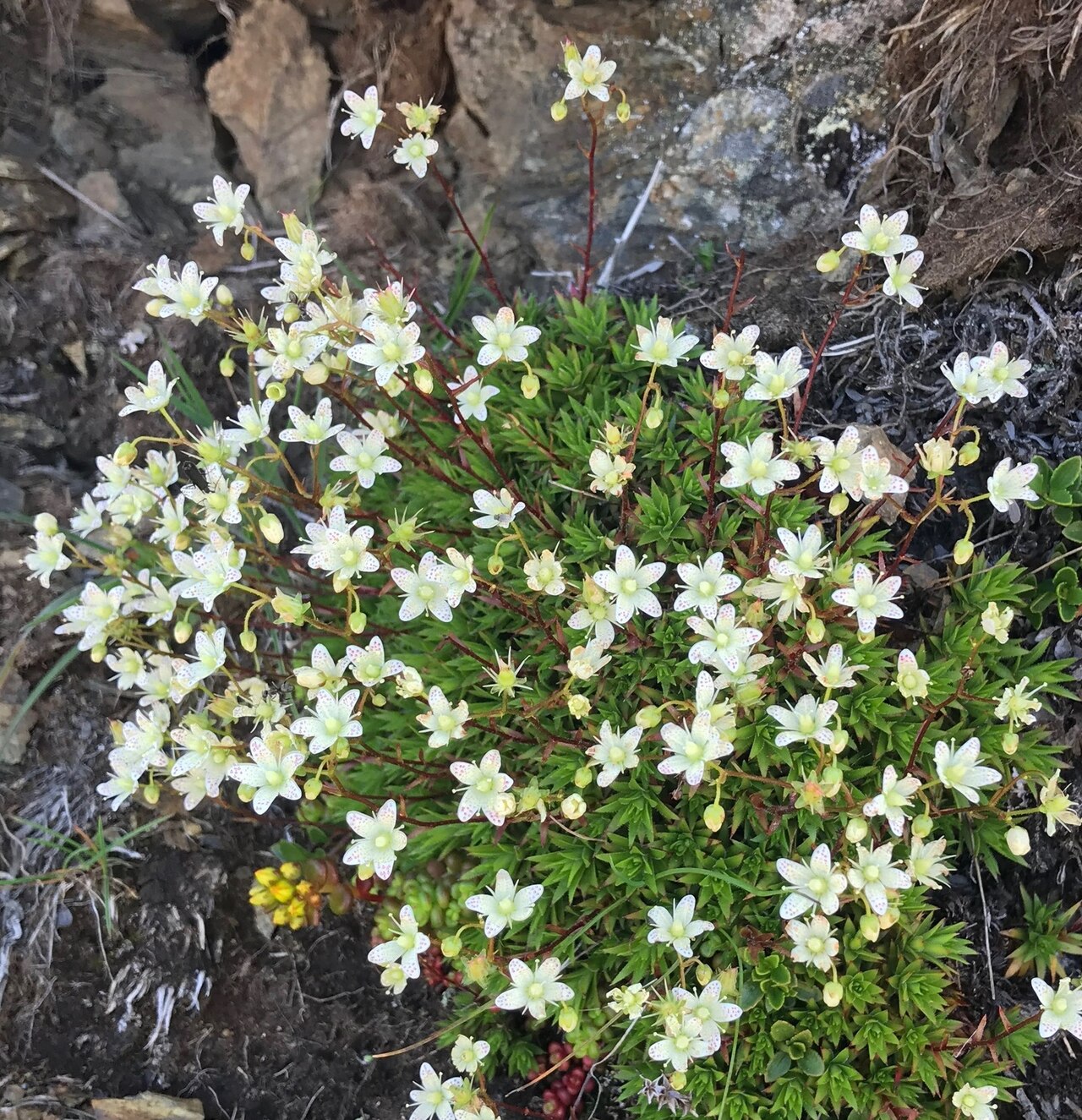
Saxifraga bronchialis, known as Mat Saxifrage, matted saxifrage, spotted saxifrage or yellowdot saxifrage (the USDA name), is a small evergreen perennial of rocky mountain slopes in western North America and northern Asia. It forms dense, moss-like mats of stiff, spiny-tipped leaf rosettes that hug rock crevices, talus and gravelly ridges. In summer, thin red stems rise 2 to 6 inches above the mats, each bearing a few starry white flowers delicately spotted with red, orange and yellow.
It belongs to the saxifrage family (Saxifragaceae). The name saxifrage means “rock breaker,” and mat saxifrage lives up to it, rooting into cracks in bare rock where few other plants can grow. In the lower 48 states it is found from the Cascades and northern Rockies south to Colorado and northern New Mexico; it is also widespread in Alaska and northern and western Canada.
Mat saxifrage is a favorite of hikers and photographers in the high country and an excellent plant for specialists growing alpine plants in rock gardens and troughs. This guide covers how to identify it, where it grows, and what it needs in cultivation.
Identification
Many saxifrages grow in western mountains. Mat saxifrage is distinguished by its dense mats of narrow, stiff, bristle-edged leaves with a sharp point, and by its white petals marked with tiny red and yellow spots.
Growth Habit
A low, evergreen, cushion-forming perennial that spreads by short, branching stems into mats several inches to more than a foot across. Old leaves persist on the stems, and the mats may be green, bronze or reddish depending on exposure.
Leaves
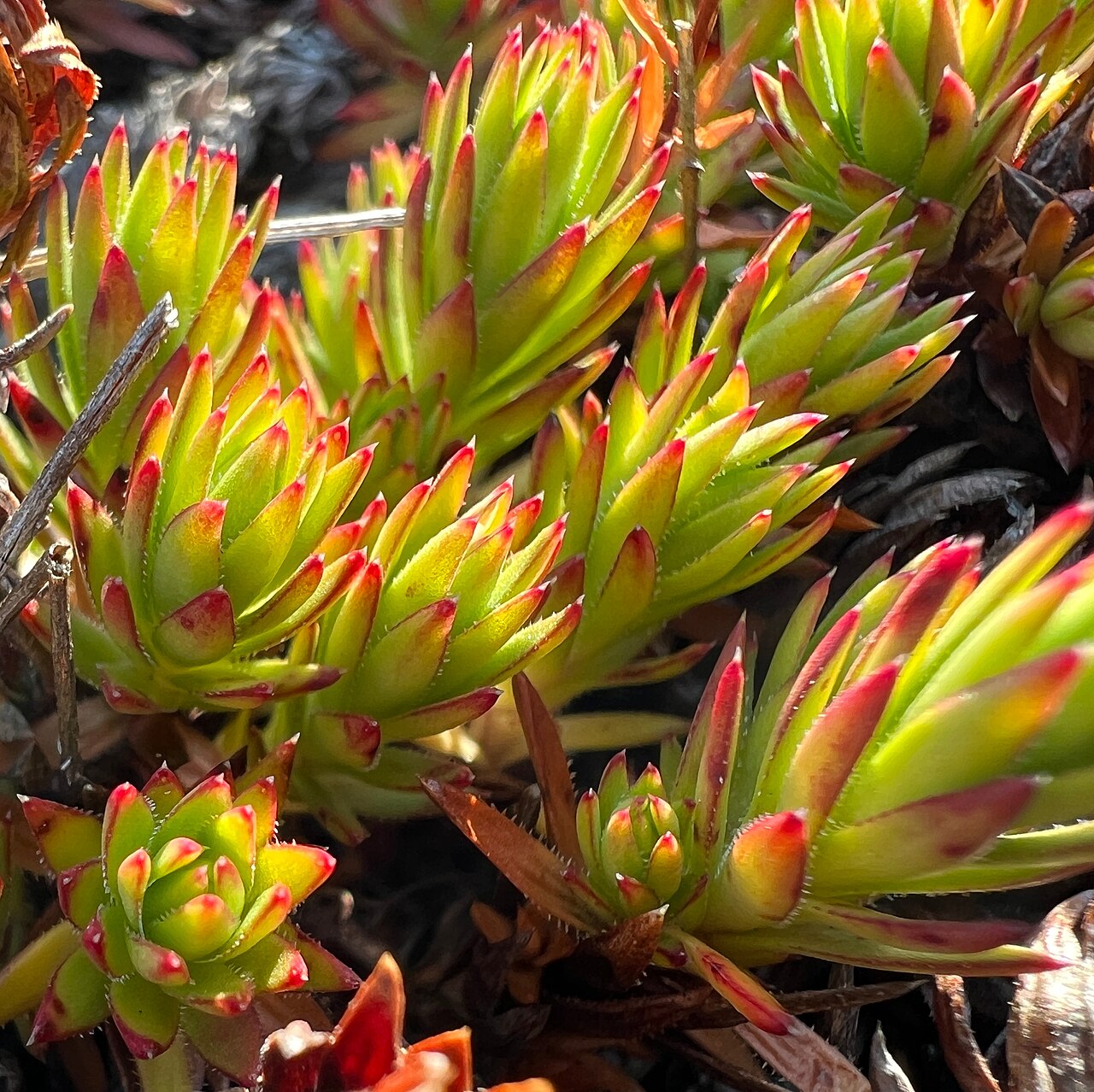
The leaves are crowded in tight, overlapping rosettes. Each is narrow and lance-shaped, about ¼ to ⅝ inch long, leathery and stiff, with a fringe of short, stiff hairs along the edges and a small spine-like point at the tip. Leaves are green, often with reddish tips or undersides.
Flowers
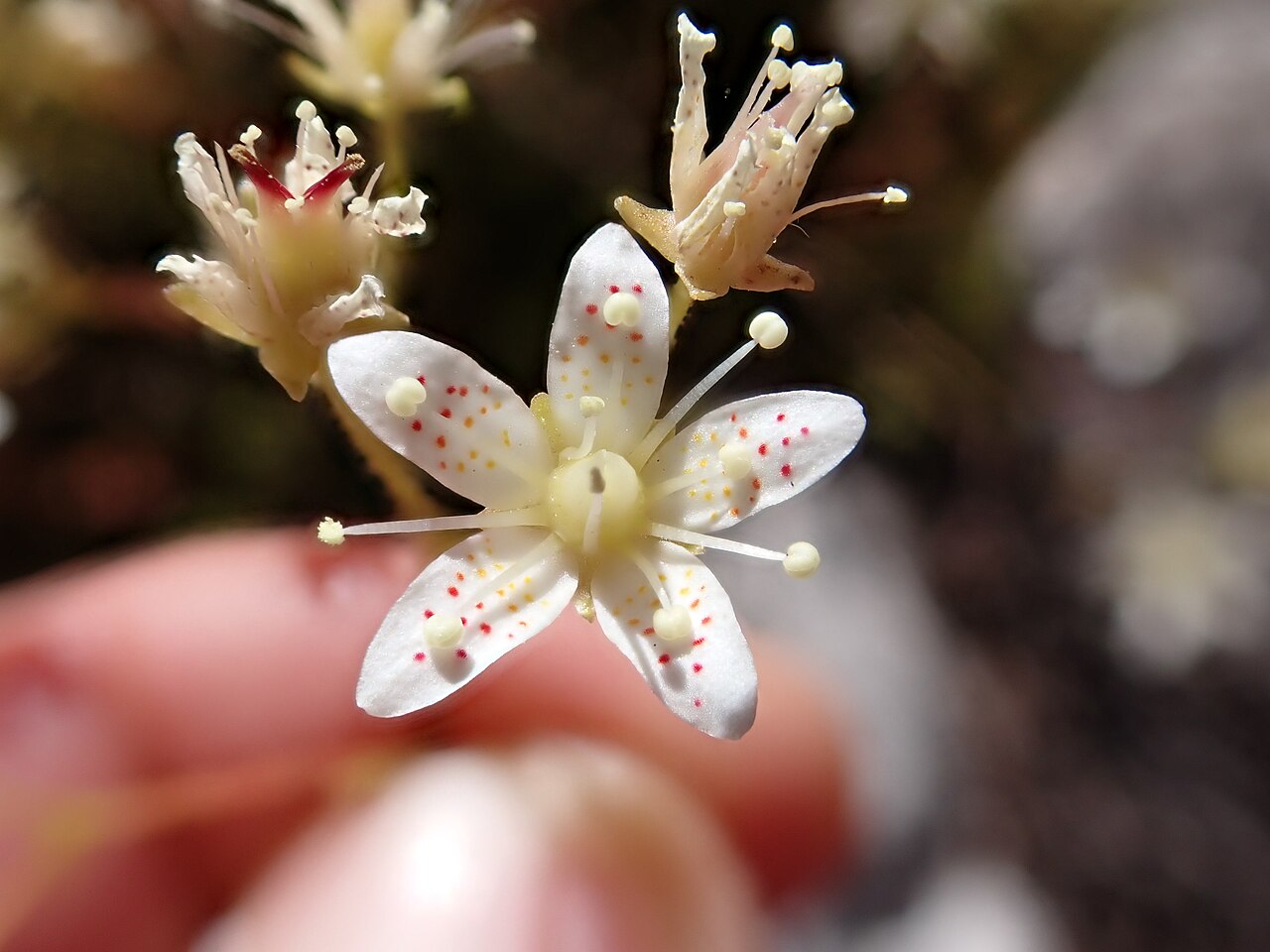
Slender, reddish flowering stems 2 to 6 inches tall (rarely to 8 inches), with a few small leaves, carry loose clusters of usually 3 to 5 (up to 15) flowers. Each flower is about ½ inch across, with five white to cream, oblong petals dotted with tiny red, orange or yellow spots, and ten conspicuous white stamens that radiate outward around a central ovary. Bloom time is June to August.
Spotted saxifrage is sometimes confused with prickly saxifrage (Saxifraga tricuspidata) of the far north, which has three-toothed leaf tips. Rusty saxifrage and other western saxifrages have broader, softer leaves in basal rosettes rather than spiny mats.
Fruit & Seeds
The fruit is a small, two-beaked capsule that turns red-brown and releases many tiny seeds that are carried by wind and water into nearby crevices.
Quick Facts
| Scientific Name | Saxifraga bronchialis L. (incl. S. austromontana) |
| Family | Saxifragaceae (saxifrage family) |
| Plant Type | Evergreen, mat-forming perennial |
| Mature Height | 2–6 in in flower; mats 1–2 in tall |
| Mature Spread | 6–18 in |
| Growth Rate | Slow |
| Sun Exposure | Full sun to partial shade |
| Water Needs | Low to moderate; sharp drainage |
| Soil Type | Rock crevices, scree, talus and gravelly soils |
| Soil pH | Acidic to neutral (about 5.0–7.5) |
| Bloom Time | June–August |
| Flower Color | White with red, orange and yellow spots |
| Fall Color | Rosettes often turn bronze or red |
| Fruit | Small two-beaked capsule |
| Deer Resistant | Mostly; rarely browsed |
| USDA Hardiness Zones | 2–7 |
Native Range
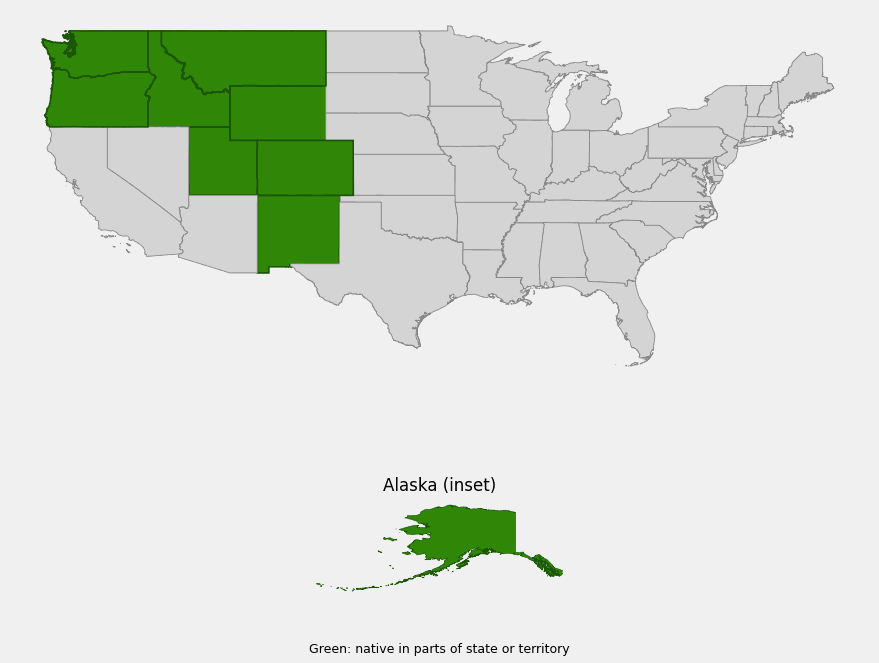
Mat saxifrage is a plant of the northern and western mountains. USDA PLANTS lists it as native in Alaska, Washington, Oregon, Idaho, Montana, Wyoming, Utah, Colorado and New Mexico. In Canada it grows in British Columbia, Alberta, Yukon and the Northwest Territories, and the species in its broad sense also extends across northern Asia.
In the lower 48 states it is common in the Cascades and Olympic Mountains of Washington, the mountains of northern and eastern Oregon, the northern Rockies of Idaho, Montana and Wyoming, and the high ranges of Utah and Colorado. Its southern limit is in the mountains of northern New Mexico. North American plants are often separated as subspecies or species (Saxifraga bronchialis ssp. austromontana, or S. austromontana), and Alaskan plants as ssp. funstonii.
It grows in rock crevices, cliffs, talus and scree slopes, gravelly ridges, rocky meadows and open forest on rocky ground, from the montane zone to above timberline. It is found on many kinds of rock, including granite, basalt and limestone.
📋 Regional plant lists featuring Mat Saxifrage: Alaska · Western Oregon & Western Washington · Idaho, Eastern Oregon & Eastern Washington · Montana & Wyoming · Utah & Western Colorado
Growing & Care Guide
Mat saxifrage is a plant for experienced rock gardeners in cool climates. It needs sharp drainage, cool roots and bright light, conditions best met in a crevice garden, trough or scree bed. It is occasionally offered by specialist alpine nurseries; never collect it from the wild.
Light
Full sun in cool, high-elevation or northern gardens; partial shade, especially in the afternoon, in warmer climates.
Soil & Water
Plant in a very gritty, fast-draining mix of crushed rock and a little humus, or in a crevice between rocks. Water during dry spells in spring and summer but never let it sit in wet soil, especially in winter, when crown rot is a risk.
Planting Tips
Tuck young plants into vertical or sloping crevices between rocks, or into troughs topdressed with gravel. Keep larger, faster-growing perennials away. Dig nursery-grown plants only; wild mats are slow-growing and should never be dug.
Pruning & Maintenance
Remove spent flower stems after blooming if desired. Clear fallen leaves off the mats in autumn to prevent rot. It dislikes hot, humid summers.
Propagation
Sow seed on the surface of a gritty mix in fall and leave it outside for winter cold, or take individual rosettes as cuttings in summer and root them in sand.
Landscape Uses
- Rock and crevice gardens: evergreen mats in rock cracks
- Alpine troughs: compact and slow-growing
- High-elevation restoration: on talus and rocky disturbed slopes
- Wildflower viewing and photography: showy spotted flowers along high-country trails
- Green roofs in cold climates: for experimental, very well-drained alpine plantings
Wildlife & Ecological Value
Mat saxifrage is one of the pioneer plants of mountain rocks and an important part of alpine plant communities.
For Pollinators
The open, spotted flowers are visited by small flies, including flower flies, and by small native bees. In alpine habitats flies are often the main pollinators, and the colored spots may act as nectar guides.
For Birds
Its small seeds are of minor food value, but the rocky habitats it shares with rosy-finches, ptarmigan and American pipits are important breeding and foraging areas for those birds.
For Mammals
American pikas gather mat saxifrage among the plants they store as “haypiles” for winter, and mountain goats, marmots and bighorn sheep graze in its habitat.
Ecosystem Role
As a cushion plant it traps soil, organic debris and moisture in rock cracks, gradually building the thin soils that let other alpine plants establish. Its mats also offer microhabitat for insects and spiders in harsh, windy terrain.
Cultural & Historical Uses
The species was described by Carl Linnaeus in 1753 from Siberian material. The genus name Saxifraga comes from the Latin saxum (rock) and frangere (to break), referring to plants that grow in rock cracks.
In North America, the plant is a familiar sight to mountaineers and hikers in places such as the North Cascades, Glacier National Park and the Colorado high country, where its mats brighten rock walls in midsummer.
The many common names, including spotted, matted and yellowdot saxifrage, all describe either its dense mats or the small colored spots on its petals. Botanists continue to debate how best to divide this widespread, variable group into species and subspecies.
Frequently Asked Questions
Where does mat saxifrage grow?
In rocky mountain habitats of Alaska, western Canada and the western United States from Washington and Oregon to Montana, Wyoming, Utah, Colorado and northern New Mexico, and in northern Asia.
Can I grow mat saxifrage in my garden?
Yes, if you have a cool climate and can give it a sunny, extremely well-drained spot such as a rock crevice, scree bed or trough. It does poorly in hot, humid summers and wet winter soils.
Why is it called yellowdot or spotted saxifrage?
Its white petals are marked with tiny dots of red, orange and yellow.
When does mat saxifrage bloom?
From June to August, depending on elevation and snowmelt.
Is mat saxifrage the same as Saxifraga austromontana?
Many North American floras treat the plants of the lower 48 states as Saxifraga austromontana or S. bronchialis ssp. austromontana. USDA PLANTS includes them under S. bronchialis, which this page follows.

Looking for a nursery that carries Mat Saxifrage?
Browse our native plant nursery directory: Alaska · Colorado · Idaho · Montana · New Mexico · Oregon · Utah · Washington · Wyoming

