
Davidson’s Penstemon (Penstemon davidsonii)
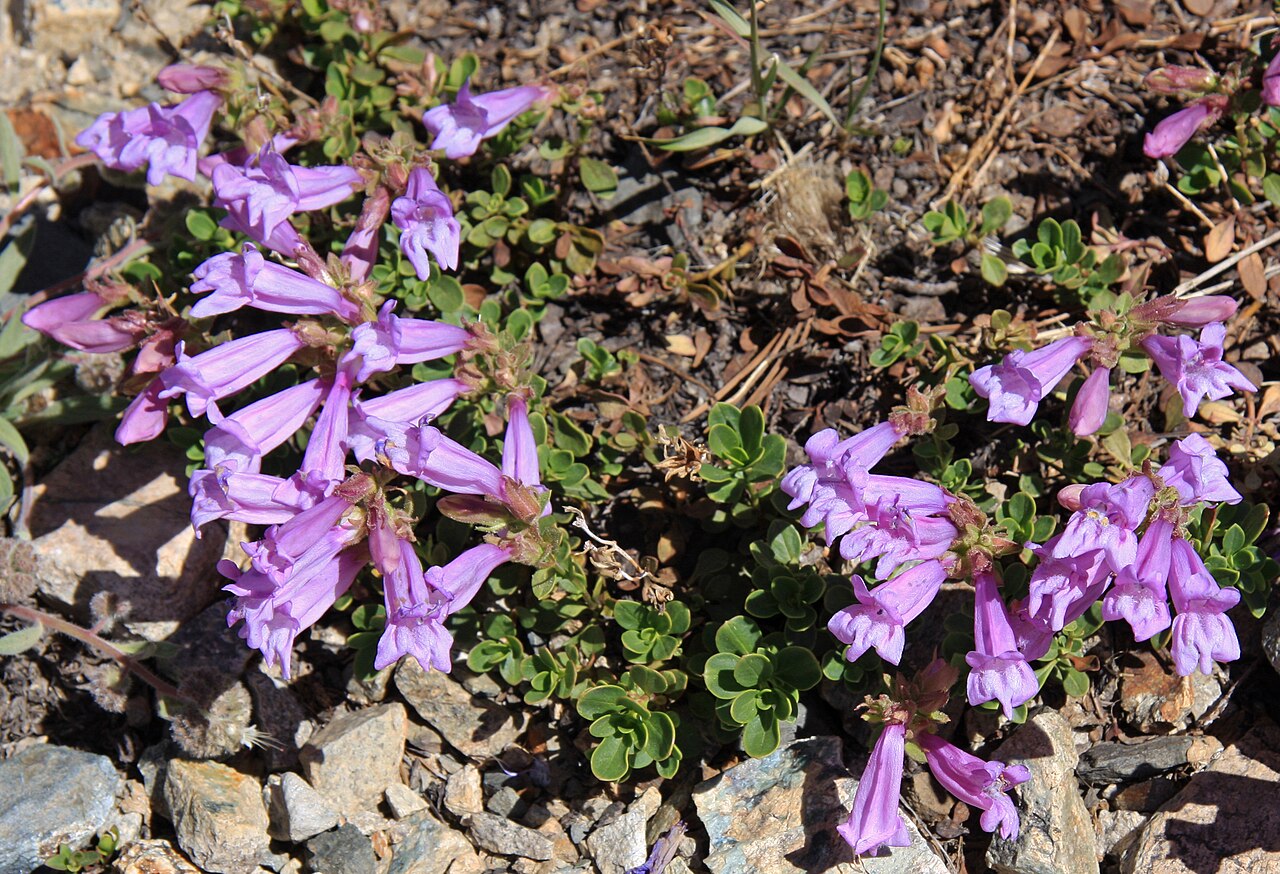
Penstemon davidsonii, known as Davidson’s Penstemon (also timberline penstemon or Davidson’s beardtongue), is a mat-forming, evergreen subshrub of high mountain rock in the Cascades, the Sierra Nevada and nearby ranges. It belongs to the plantain family (Plantaginaceae). Its woody, creeping stems hug the rock, forming flat mats of small, thick, rounded leaves only an inch or two high.
From June to August, depending on elevation and snowmelt, short upright stems 2 to 6 inches tall carry a few remarkably large flowers, each 1 to 1 1/2 inches long, in shades of blue-lavender to purple-violet. In full bloom, the mats can be almost hidden under flowers. It belongs to the shrubby penstemon group (section Dasanthera), whose members have woolly anthers, along with shrubby penstemon and mountain pride.
Davidson’s penstemon is a prized plant for rock gardens, troughs and crevice gardens in cool climates. It needs full sun, sharp drainage and cool roots, and does best where summers are not hot and humid. Buy nursery-grown plants or grow it from seed or cuttings; never dig plants from wild mountain slopes.
Identification
Look for flat, woody mats of small, thick, rounded leaves on alpine and subalpine rock, with large, blue-lavender to purple tubular flowers on very short stems in summer.
Growth Habit
This is a low, evergreen subshrub with creeping, woody stems that root as they spread, forming dense mats up to a foot or more across. Flowering stems are erect, 1 1/2 to 6 inches tall, and finely hairy. Older mats become a tangle of woody branches that wedge into cracks between rocks.
Leaves
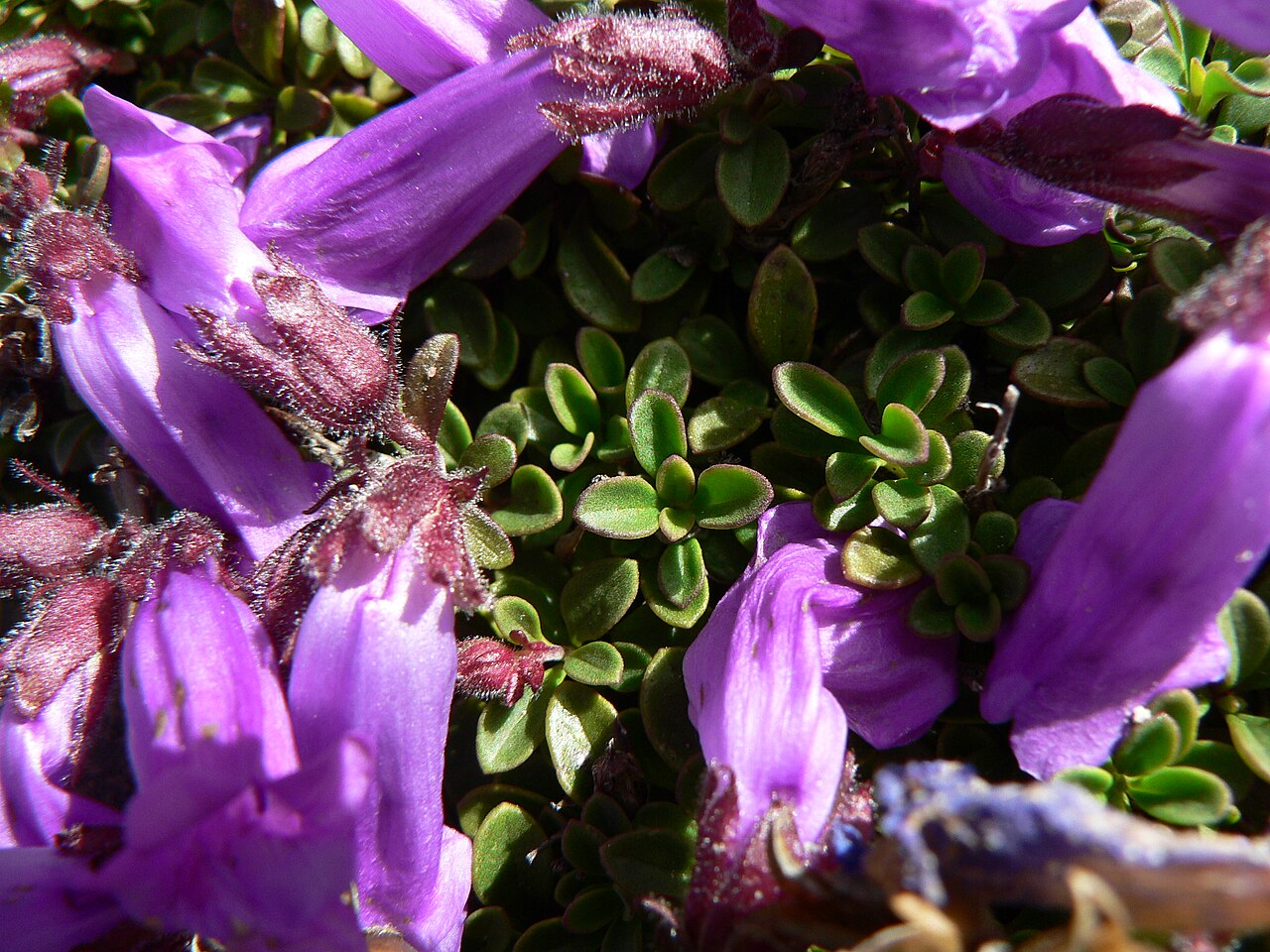
The leaves are opposite, thick and firm, smooth, oval to almost round, usually 1/4 to 3/4 inch long, with smooth or finely toothed edges and short stalks. They are dark green and sometimes tinged red. The few leaves on the flowering stems are much smaller and bract-like.
Flowers
Each flowering stem carries a short, few-flowered cluster with glandular hairs. The flowers are tubular and two-lipped, about 1 to 1 3/8 inches long, blue-lavender to purple-violet (occasionally rosy-purple), smooth on the outside, with hairs inside near the base of the lower lip. The anthers are covered in long, woolly hairs, and the sterile stamen (staminode) is slender and bearded near the tip.
Varieties
Three varieties are usually recognized. Variety davidsonii has smooth-edged leaves and grows in the Sierra Nevada and the southern Cascades. Variety menziesii has finely toothed leaves and grows in the Cascades and Olympics of Washington and British Columbia and on Vancouver Island. Variety praeteritus is found in the mountains of eastern Oregon and northern Nevada, such as Steens Mountain.
Look-alikes
Shrubby penstemon is taller (to 16 inches), with longer, narrower leaves, and grows mainly east of the Cascades and in the northern Rockies. Mountain pride is taller, with toothed leaves and rose-pink to red flowers. Cliff penstemon (Penstemon rupicola) has blue-gray leaves and rose-pink flowers. Davidson’s penstemon hybridizes with these relatives where they meet.
Quick Facts
| Scientific Name | Penstemon davidsonii |
| Family | Plantaginaceae (plantain family) |
| Plant Type | Mat-forming evergreen subshrub |
| Mature Height | 2–6 in in bloom |
| Mature Spread | 6–18 in |
| Growth Rate | Slow |
| Sun Exposure | Full sun |
| Water Needs | Low to medium; sharp drainage, some summer moisture |
| Soil Type | Rocky, gravelly, sandy or scree soils |
| Soil pH | Acidic to neutral (about 5.5–7.0) |
| Bloom Time | June–August |
| Flower Color | Blue-lavender to purple-violet |
| Fall Color | Evergreen; leaves may redden in cold weather |
| Fruit | Small woody capsule |
| Deer Resistant | Moderate; low mats rarely browsed |
| USDA Hardiness Zones | 4–8 |
Native Range
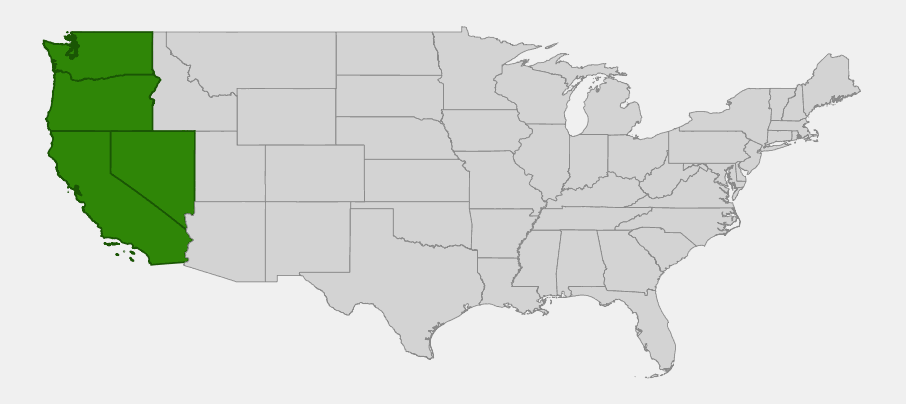
Davidson’s penstemon grows in the high mountains of western North America, from southern British Columbia and Vancouver Island south through the Olympic Mountains and the Cascades of Washington and Oregon to the Sierra Nevada of California, reaching south to about Tulare County. USDA PLANTS lists it as native in Washington, Oregon, California, Nevada and British Columbia.
In Washington it grows on both sides of the Cascade crest, as well as in the Olympics. In Oregon it grows in the Cascades and in mountains east of them such as Steens Mountain. In Nevada it grows mainly in the Carson Range near Lake Tahoe and in a few high ranges in the north.
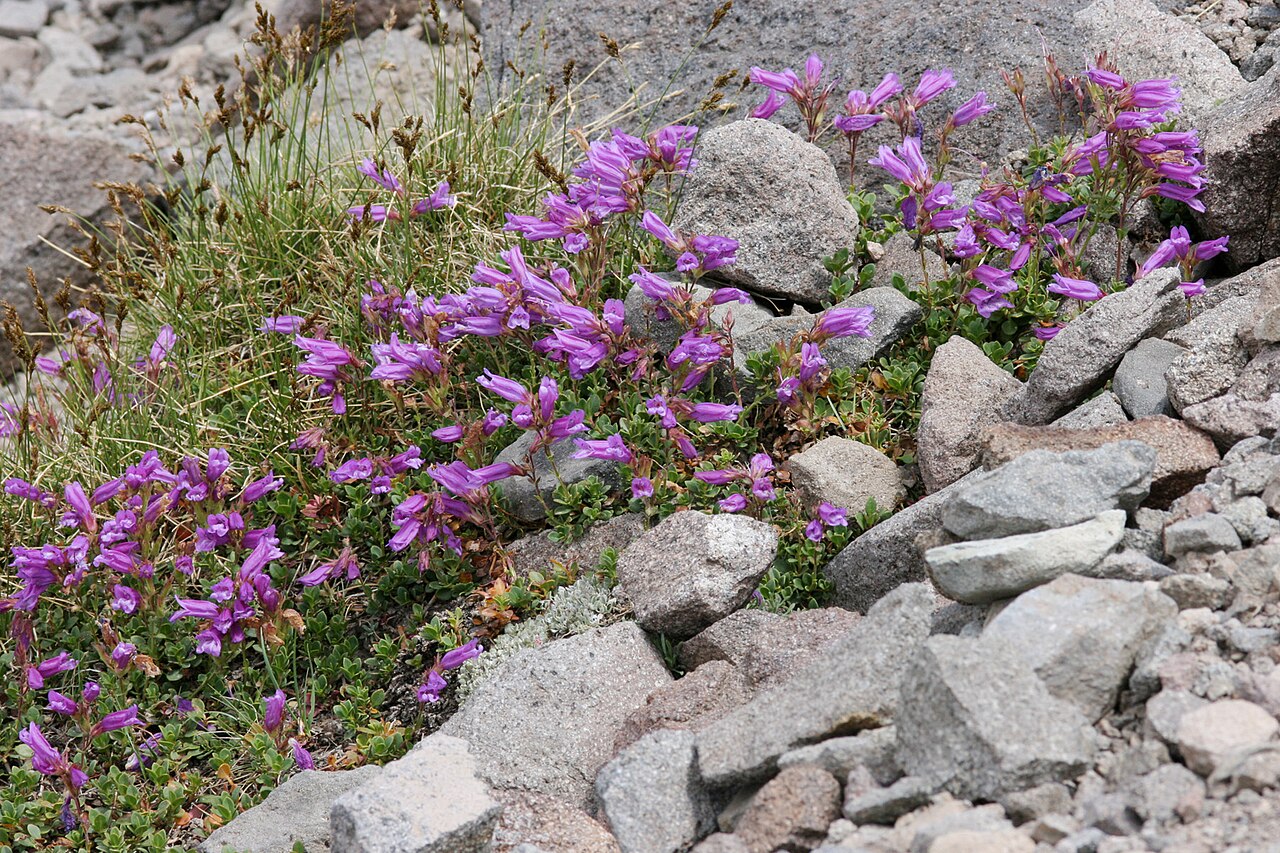
It grows in open, rocky places from middle elevations up to the alpine zone, often above timberline: cliffs and ledges, talus and scree, rocky ridges, lava flows and granite outcrops. It depends on deep winter snow cover, which protects it from extreme cold and drying winds.
📋 Regional plant lists featuring Davidson’s Penstemon: Idaho, Eastern Oregon & Eastern Washington · Western Oregon & Western Washington · California & Nevada
Growing & Care Guide
Davidson’s penstemon is one of the best penstemons for rock and crevice gardens. It is long-lived when its needs are met: full sun, cool roots, gritty soil and good drainage, especially in winter.
Light
Full sun in cool or mountain climates. In hot, low-elevation gardens, give it light afternoon shade to keep it from baking.
Soil & Water
Plant in very well-drained, gritty soil: a mix of coarse sand, gravel or crushed rock with a little compost. It does not tolerate heavy clay, standing water or wet winter soil. Unlike desert penstemons, it likes some summer moisture; water deeply during dry spells but let the soil dry between waterings.
Planting Tips
Plant in spring or early fall between rocks, in a crevice garden, raised bed, wall or trough, so the mat can drape over stone and its roots can run under cool rock. A gravel mulch keeps the crown dry. It struggles in hot, humid summers and in mild, wet winters without good drainage.
Pruning & Maintenance
Trim off spent flower stems after bloom to keep mats tidy. Remove dead patches in spring. Avoid fertilizing, which makes the plant soft and short-lived.
Propagation
Take softwood or semi-hardwood cuttings in summer; they root fairly easily. Rooted stems can also be separated from the edge of a mat. Seed needs about two months of cold, moist stratification and grows slowly.
Landscape Uses
- Rock and crevice gardens: a classic alpine penstemon for stony sites
- Troughs and walls: drapes over stone in a small space
- Hummingbird and bee gardens: large purple flowers in early summer
- Evergreen groundcover: small, glossy, evergreen leaves all year
- Mountain landscapes: well suited to cool, high-elevation gardens
Wildlife & Ecological Value
On high, windswept rock where few flowers grow, Davidson’s penstemon provides a burst of nectar during the short alpine summer.
For Pollinators
Bumble bees are the main visitors, pushing into the wide flowers to reach the nectar. Other bees, flies and wasps also visit.
For Birds
Hummingbirds, especially rufous and calliope hummingbirds migrating through the mountains, feed at the flowers. Seeds are tiny and of little food value.
For Mammals
Pikas and marmots, which live in the same talus and rocky habitats, may eat the leaves and stems occasionally.
Ecosystem Role
Its woody mats help stabilize scree and rock debris and trap soil in crevices, aiding the slow development of alpine plant communities.
Cultural & Historical Uses
The species is named after George Davidson (1825–1911), a geographer and astronomer with the U.S. Coast Survey who did much of his work on the West Coast and was a longtime figure in California science.
The genus name Penstemon is usually explained as “five stamens,” from the Greek pente (five) and stemon (stamen). Penstemons have four fertile stamens and a fifth, sterile stamen, which in many species is hairy, giving the common name “beardtongue.”
Davidson’s penstemon is popular with alpine gardeners in North America and Europe, and selections and hybrids with its relatives are sometimes sold. In the wild it is a familiar sight for hikers on rocky trails in Mount Rainier, Crater Lake, Lassen and Yosemite National Parks.
Frequently Asked Questions
Is Davidson’s penstemon evergreen?
Yes. The small, thick leaves stay on the woody stems all year, though they may turn reddish in cold weather.
How tall does Davidson’s penstemon get?
The mats are only an inch or two high, and the flowering stems reach 2 to 6 inches.
Can I grow Davidson’s penstemon in my garden?
Yes, in a rock or crevice garden with full sun, gritty soil and excellent drainage. It is easiest in cool climates and struggles in hot, humid summers.
When does it bloom?
From June to August, depending on elevation and how early the snow melts.
Does Davidson’s penstemon attract hummingbirds?
Yes. Hummingbirds visit the flowers, as do bumble bees and other native bees.

Looking for a nursery that carries Davidson’s Penstemon?
Browse our native plant nursery directory: California · Nevada · Oregon · Washington

