
Silvery Scurfpea (Pediomelum argophyllum)
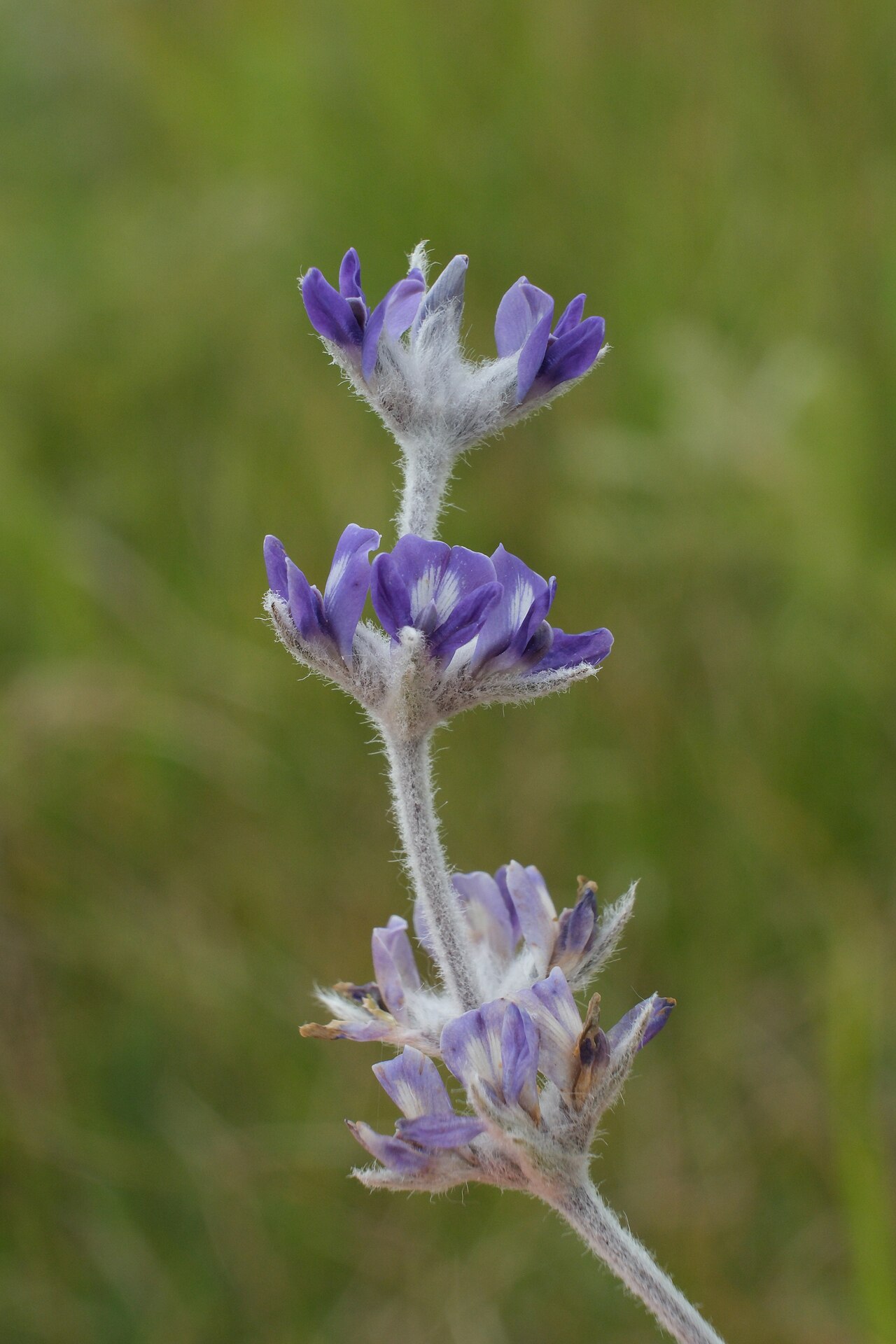
Pediomelum argophyllum, known as Silvery Scurfpea or silverleaf Indian breadroot, is a bushy prairie wildflower in the pea family (Fabaceae). Its branching stems and three- to five-parted leaves are covered with silky, silvery-white hairs, making the plant glow among the grasses. In summer it carries slender spikes of small, deep blue to purple pea flowers in separated tiers.
Silvery scurfpea is a plant of the northern and central Great Plains. It grows from Alberta, Saskatchewan and Manitoba south through Montana, the Dakotas, Minnesota and Wisconsin to Nebraska, Kansas, Colorado, Oklahoma, northern Texas and New Mexico, with eastern outposts in Iowa, Missouri and Illinois. It grows on dry to mesic upland prairies, hillsides, sandy and gravelly soils, and in sagebrush steppe in the West.
For prairie gardeners, silvery scurfpea is a long-lived, drought-tolerant plant whose silver foliage looks good from spring to frost. Its flowers feed native bees, and as a legume it adds nitrogen to the soil. It is best grown from seed in a sunny, well-drained prairie planting. It is listed under its older names Psoralea argophylla and Psoralidium argophyllum in many references.
Identification
Look for a bushy, silver-white plant on dry prairie with leaves divided like fingers into three to five leaflets and thin spikes of small blue-purple flowers arranged in widely spaced tiers.
Growth Habit
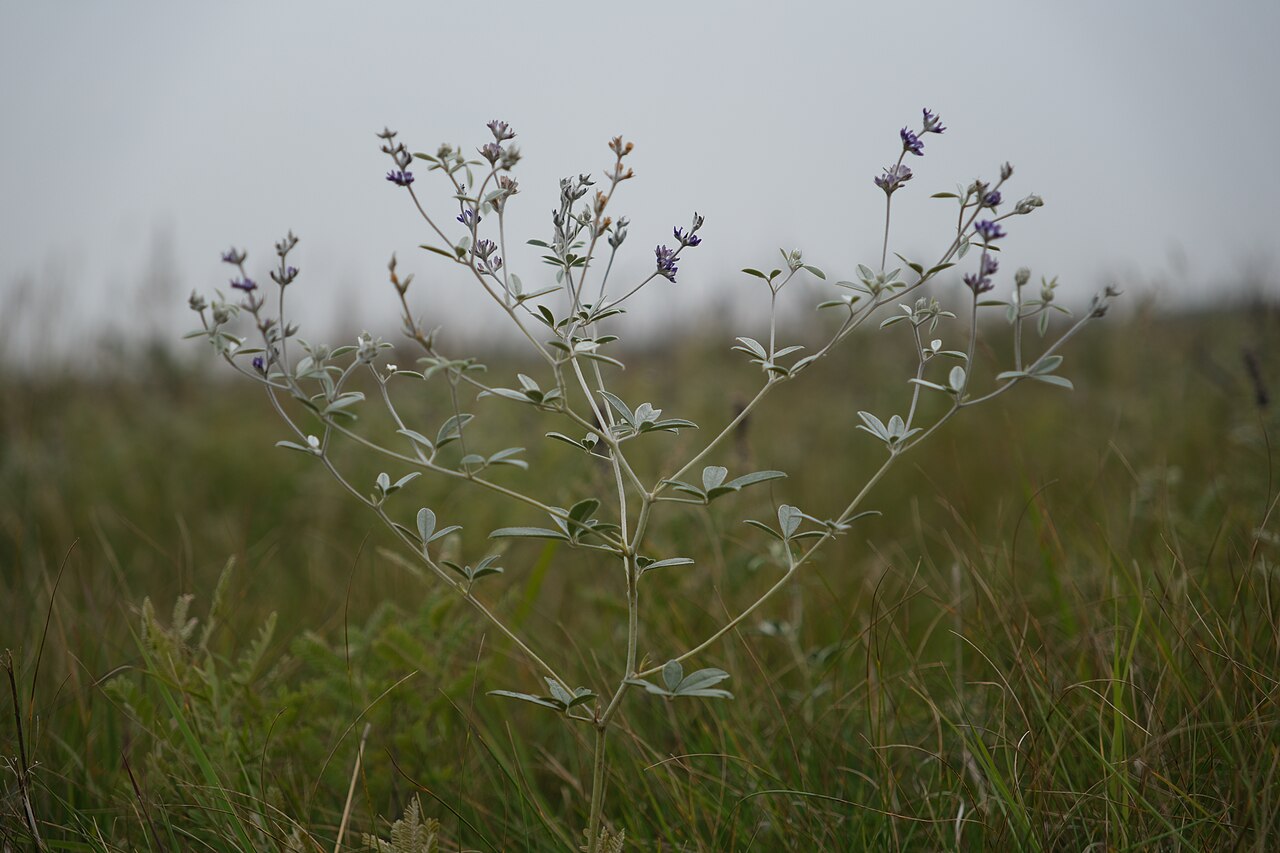
Silvery scurfpea is a perennial that grows from a deep, tough root. It sends up one to several stems that branch widely, forming a rounded, airy plant 1 to 2 feet tall (occasionally to 3 feet). The whole plant is covered with flat-lying, silky, silvery hairs.
Leaves
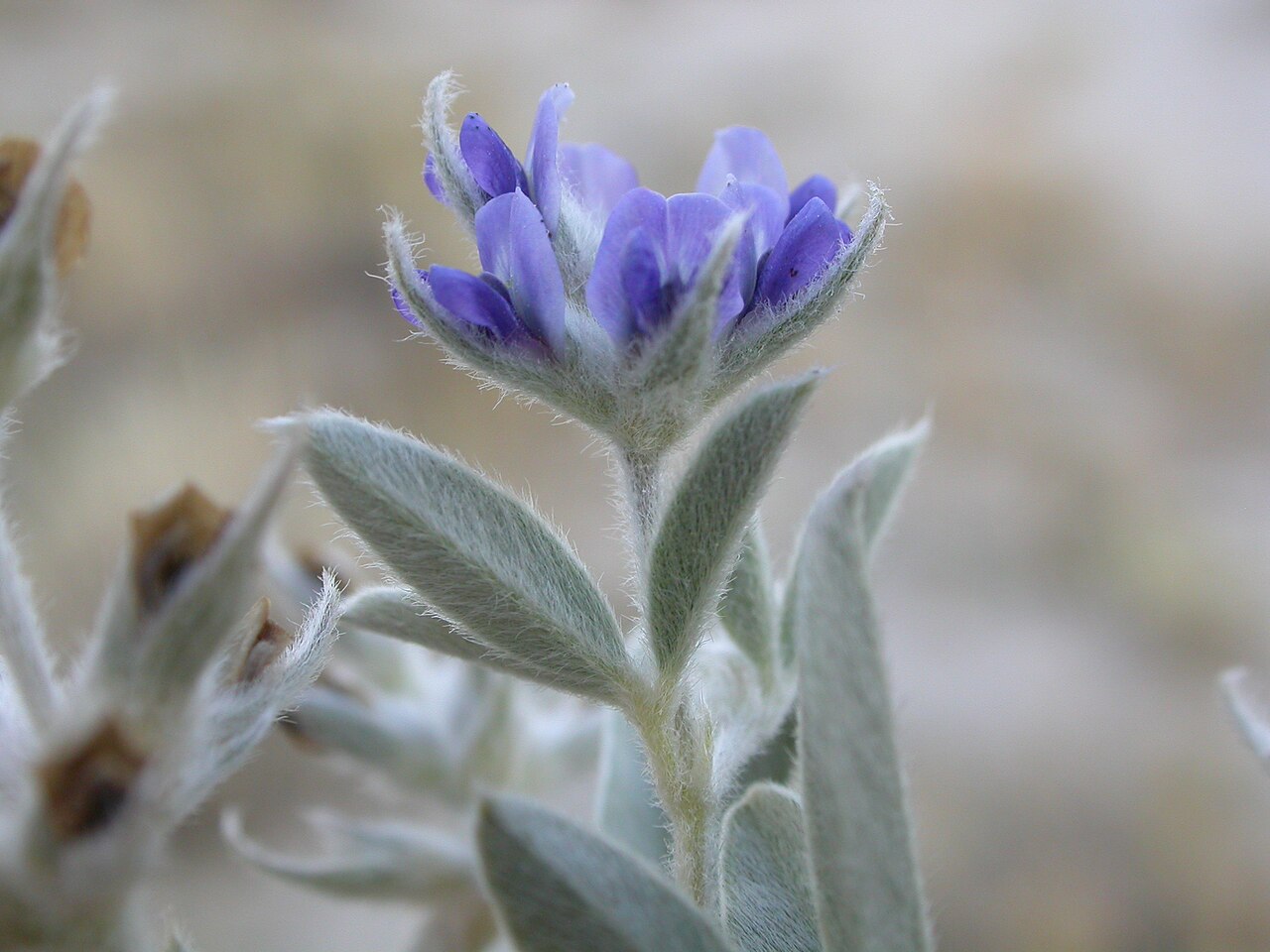
The leaves are alternate and palmately compound, with three to five oval to elliptic leaflets 1/2 to 1 1/2 inches long, all joined at the tip of the leaf stalk. They are silvery on both sides and especially bright on the undersides. Like other scurfpeas, the leaves have tiny glandular dots, though these are often hidden by the hairs.
Flowers
It blooms from June to August. The flowers grow in slender, interrupted spikes from the leaf axils, with two to eight separated whorls of a few flowers each. Each flower is pea-shaped, only about 1/3 inch long, and deep blue to violet-purple, set in a silky, silvery calyx.
Fruit
The pod is small, egg-shaped, hairy and short-beaked, containing a single seed. It stays enclosed by the calyx and ripens in late summer and fall.
Look-alikes
Prairie turnip (Pediomelum esculentum) is shorter and hairy rather than silvery, with a dense, thick flower spike and a large, starchy root. Slimflower scurfpea (Psoralidium tenuiflorum) is greener, with sparse, loose spikes of tiny flowers. Leadplant (Amorpha canescens) is also silvery-gray but is a small shrub with pinnate leaves of many small leaflets and dense spikes of purple flowers with orange anthers.
Quick Facts
| Scientific Name | Pediomelum argophyllum |
| Family | Fabaceae (pea family) |
| Plant Type | Herbaceous perennial wildflower |
| Mature Height | 1–2 ft |
| Mature Spread | 1–2 ft |
| Growth Rate | Slow to moderate |
| Sun Exposure | Full sun |
| Water Needs | Low; dry to medium, well-drained soil |
| Soil Type | Sandy, loamy or gravelly prairie soil |
| Soil pH | About 6.0–8.0 |
| Bloom Time | June–August |
| Flower Color | Deep blue to violet-purple |
| Fall Color | Silvery foliage fades to tan |
| Fruit | Small, hairy, one-seeded pods |
| Deer Resistant | Moderately |
| USDA Hardiness Zones | 3–7 |
Native Range
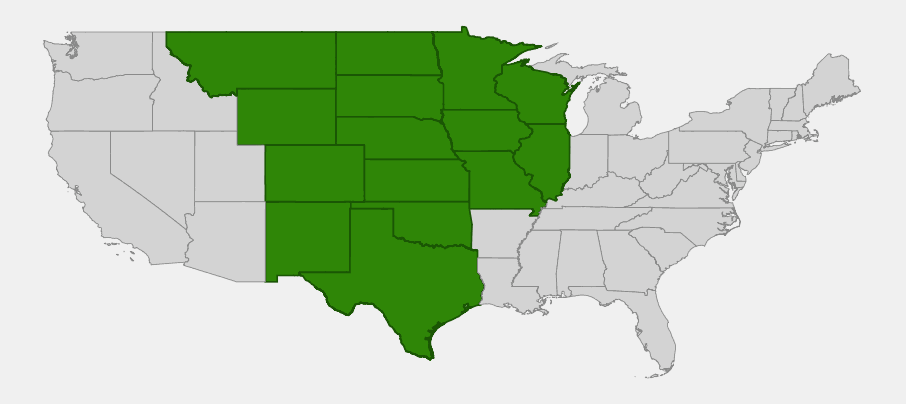
Silvery scurfpea is native to the Great Plains and prairie regions of central North America. USDA PLANTS lists it from 15 states: Montana, Wyoming, Colorado, New Mexico, North Dakota, South Dakota, Nebraska, Kansas, Oklahoma, Texas, Minnesota, Iowa, Missouri, Wisconsin and Illinois. In Canada it grows in Alberta, Saskatchewan and Manitoba.
It is most common on the northern and central Great Plains, from the Dakotas and eastern Montana to Nebraska and western Minnesota. It becomes less frequent to the south and west, in the Texas Panhandle, northeastern New Mexico and western Oklahoma, and to the east, where it reaches western Wisconsin, Iowa, northern Missouri and northern Illinois as scattered, local populations on remnant prairies.
Its habitat is upland prairie: dry to mesic mixed-grass and tallgrass prairies, rolling hills, sandy and gravelly ridges, and open bluffs. In Montana and Wyoming it also grows in sagebrush steppe and grassy openings. It is a “decreaser” that declines under heavy grazing, so it is a good indicator of healthy native rangeland.
📋 Regional plant lists featuring Silvery Scurfpea: Nebraska, Kansas & Eastern Colorado · Illinois, Iowa & Missouri · North Dakota, South Dakota & Western Minnesota · Michigan, Wisconsin & Eastern Minnesota · Montana & Wyoming · Arizona & New Mexico · South & West Texas
Growing & Care Guide
Silvery scurfpea is a tough, long-lived plant for sunny prairie gardens and restorations. It is slow to establish and dislikes being moved, so start it from seed or small plants and leave it in place.
Light
Full sun. It becomes floppy and flowers poorly in shade.
Soil & Water
It grows best in well-drained sandy, loamy or gravelly soil of average to low fertility. It is very drought-tolerant once established and needs no supplemental water in its native range. Avoid wet, heavy clay and rich, irrigated garden beds.
Planting Tips
Sow seed in fall or plant small, deep-potted seedlings in spring. Space plants 18 to 24 inches apart among short to mid-height prairie grasses such as little bluestem and sideoats grama, which support its airy stems. Its deep root makes established plants hard to move.
Pruning & Maintenance
No pruning is needed. Leave the stems standing over winter or cut them back in spring. Do not fertilize. In prairie plantings, prescribed fire or mowing in early spring helps keep competing woody plants away.
Propagation
Grow it from seed. The hard-coated seed germinates best after scarification (nicking or sanding) followed by about 30 to 60 days of cold, moist stratification. Seedlings are slow and may take two or three years to flower. It is not propagated by division.
Landscape Uses
- Prairie gardens and meadows: silver foliage all season and blue summer flowers
- Xeriscapes and dry slopes: drought-tolerant on well-drained soil
- Prairie restoration: a characteristic legume of upland prairies
- Pollinator plantings: summer flowers for native bees
- Foliage contrast: silvery leaves set off green grasses and bright flowers
Wildlife & Ecological Value
Silvery scurfpea is a valued member of the prairie legume community, feeding insects and improving the soil.
For Pollinators
Its small blue flowers are visited by bumble bees, leafcutter bees, other native bees and some butterflies. Scurfpeas and their relatives are larval host plants for some sulphur, blue and duskywing butterflies, and for various moths.
For Birds
Grassland birds such as grouse and prairie-chickens may eat the seeds and the insects found on the plants, and the clumps provide cover in prairie habitat.
For Mammals
Pronghorn, deer and other grazers browse it lightly. It declines under heavy livestock grazing, so its presence is a sign of well-managed range.
Ecosystem Role
Like other legumes, it hosts nitrogen-fixing bacteria in its root nodules, adding nitrogen to prairie soils. Its deep root helps it survive drought and fire, and it contributes to the diversity of native grasslands.
Cultural & Historical Uses
The genus name Pediomelum comes from the Greek pedion, “plain,” and melon, “apple” or “fruit,” a reference to the edible roots of some species, such as the prairie turnip. The species name argophyllum means “silver-leaved.”
Some Plains peoples used silvery scurfpea in traditional medicine. Its roots are much smaller than those of the prairie turnip and were not an important food.
The name “scurfpea” refers to the gland-dotted, slightly scurfy surface of the leaves of many species in this group, and “breadroot” refers to the starchy roots of its relatives.
Frequently Asked Questions
Why is silvery scurfpea silver?
Its stems and leaves are covered with dense, flat-lying, silky hairs. They reflect sunlight and reduce water loss, helping it survive dry prairie summers.
When does silvery scurfpea bloom?
From June to August, with slender spikes of small deep blue to purple flowers.
Is silvery scurfpea the same as prairie turnip?
No. Prairie turnip (Pediomelum esculentum) is a related plant with a large, edible root and a dense flower head. Silvery scurfpea is taller, more branched and silvery, with a smaller root.
Can I grow silvery scurfpea in a garden?
Yes, in full sun and well-drained, lean soil. Grow it from seed and give it a few years to establish; it dislikes transplanting.
Is silvery scurfpea good for pollinators?
Yes. Its summer flowers are visited by bumble bees and other native bees, and as a legume it also enriches the soil.

Looking for a nursery that carries Silvery Scurfpea?
Browse our native plant nursery directory: Colorado · Illinois, Iowa & Kansas · Minnesota, Missouri & Montana · Nebraska, New Mexico, North Dakota & Oklahoma · South Dakota & Texas · Wisconsin & Wyoming

