
Alpine Cancer-root (Conopholis alpina)
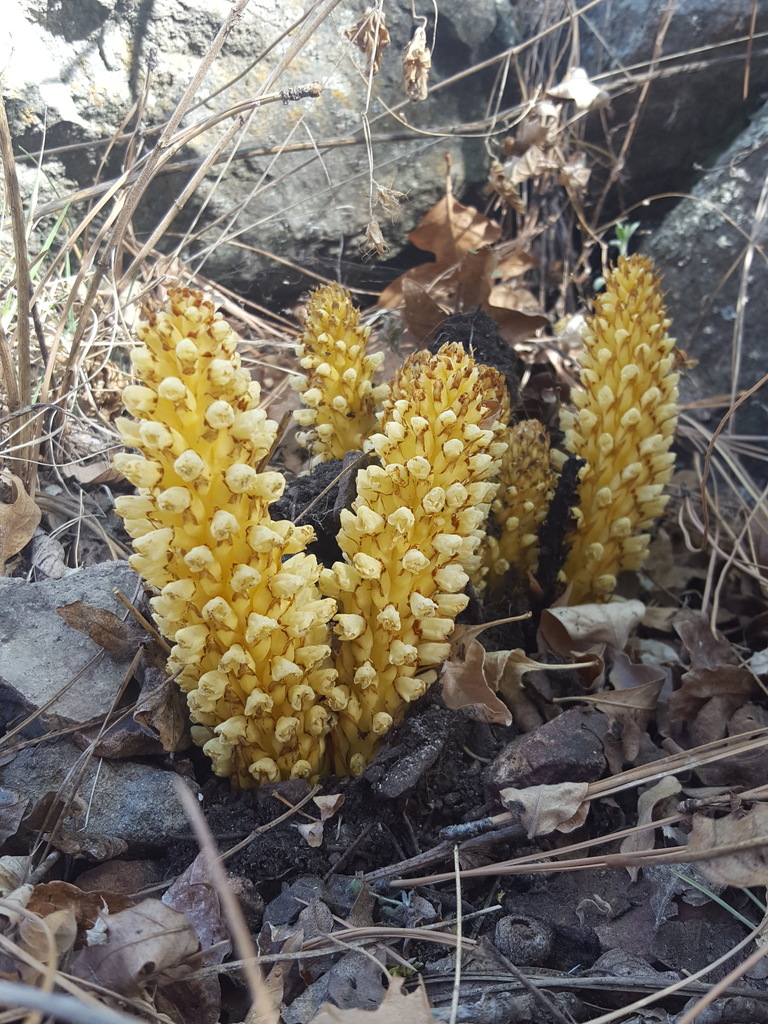
Conopholis alpina, known as Alpine Cancer-root (also Mexican cancer-root, especially for var. mexicana), is a leafless, yellow, parasitic wildflower of the oak woodlands of the Southwest and Mexico. It has no green leaves and no chlorophyll, and it cannot make its own food. Instead it attaches to the roots of oaks and draws water and nutrients from them. For most of the year it is invisible underground; in spring it pushes up clusters of thick, scaly stalks, 3 to 10 inches tall, that look strikingly like yellow pine cones or ears of corn poking out of the leaf litter.
The genus name Conopholis comes from Greek words for “cone” and “scale,” describing those cone-like stalks covered in overlapping scales. Each stalk is packed with small, two-lipped, yellow to cream flowers tucked between the scales. Alpine cancer-root belongs to the broomrape family (Orobanchaceae), which includes many root parasites, and it is the western counterpart of the eastern American Cancer-root.
This is not a garden plant. It lives only where it is connected to a healthy host oak, and it cannot be bought, transplanted or grown from nursery stock. Please never dig it up: a dug plant dies once it is separated from its host, and digging damages the oak roots it depends on. This guide covers how to identify alpine cancer-root, where and when to see it, and its fascinating relationship with the oaks of the Southwest.
Identification
Alpine cancer-root is easy to identify once you know what to look for. In the oak and pine-oak woodlands of the Southwest, few other plants are entirely yellow to tan, leafless and shaped like cones. Its relatives, the broomrapes (Orobanche and Aphyllon), have slender stems with fewer, larger, often purplish flowers.
Stalks
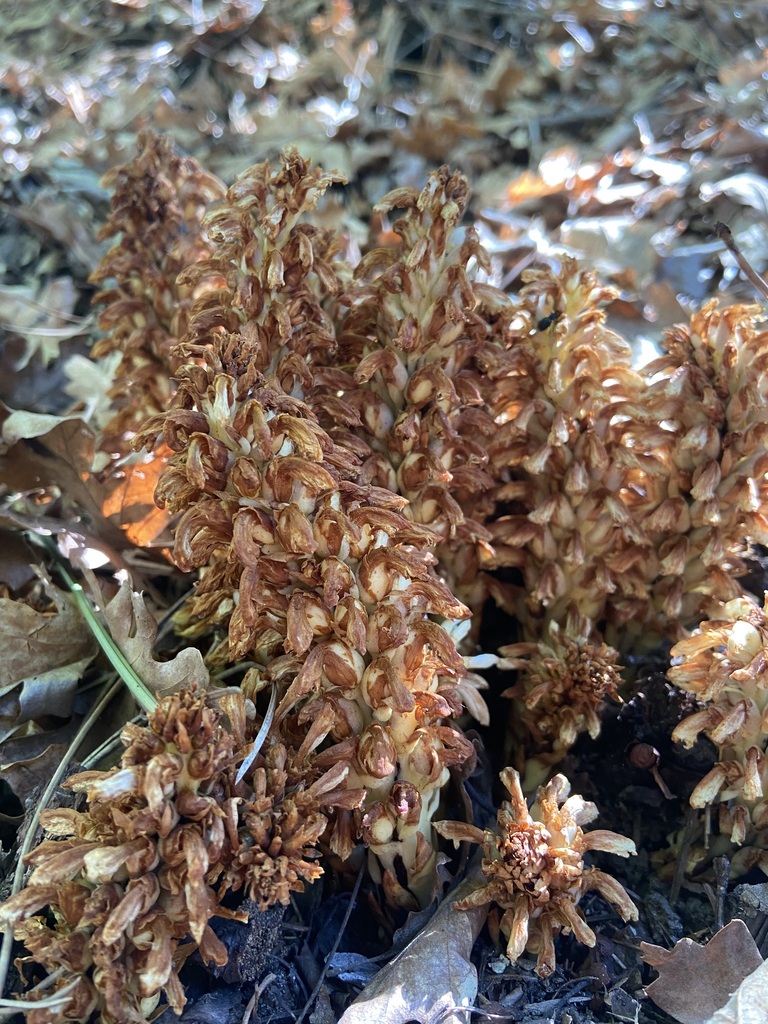
The visible part of the plant is a cluster of thick, fleshy, unbranched stalks, usually 3 to 10 inches tall and about ¾ to 1½ inches thick, rising directly from the soil near an oak. A single clump can have a few to several dozen stalks. They are bright yellow to golden or cream when fresh and become tan, brown and finally blackish as they age. Stalks are covered with overlapping, pointed scales, which are reduced leaves, so the plant has no true foliage.
Underground Parts
Below the soil, the stalks arise from a knobby, tuber-like mass that is fused to the root of a host oak. This attachment point, a type of haustorium, connects the parasite to the tree’s water- and food-conducting tissue. Individual plants can live for several years, sending up new stalks each spring from the same attachment.
Flowers
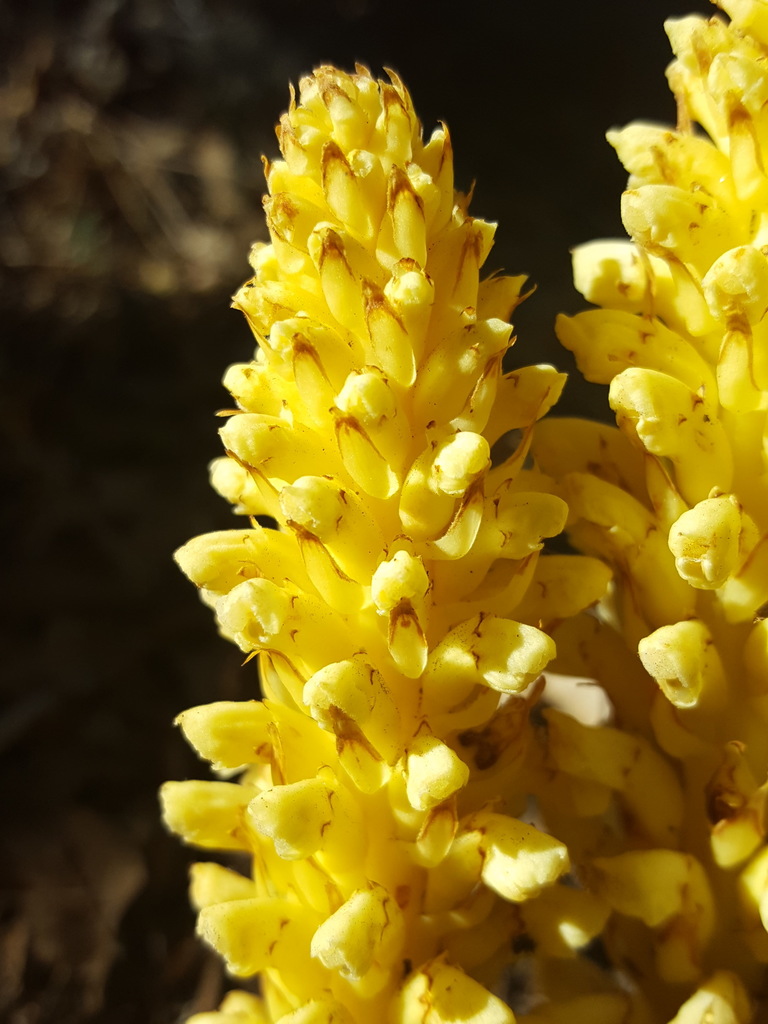
Small tubular flowers, about ⅓ to ½ inch long, are crowded along most of each stalk, one in the axil of each scale. Each flower is two-lipped, with a hooded upper lip and a three-lobed lower lip, pale yellow to cream, with the stamens extending slightly beyond the tube. Flowers open from the bottom of the stalk upward. The main bloom is in spring and early summer, mostly April to June, depending on elevation and rainfall.
Fruit & Seeds
Each flower ripens into a small, egg-shaped capsule that holds many dust-fine seeds. The aging stalks dry and darken as the capsules ripen, and they may remain standing into the following winter. Seeds that reach the soil near an oak root can germinate only when they detect chemical signals from the host root, after which the seedling attaches and begins to grow.
Quick Facts
| Scientific Name | Conopholis alpina (incl. var. mexicana; syn. C. mexicana) |
| Family | Orobanchaceae (broomrape family) |
| Plant Type | Perennial root parasite without chlorophyll; not a garden plant |
| Mature Height | 3–10 in |
| Mature Spread | Clumps of stalks up to about 12 in across |
| Growth Rate | Slow; attached to host roots for several years |
| Sun Exposure | Shade to part sun under oak canopy |
| Water Needs | Natural moisture only; depends entirely on its host oak |
| Soil Type | Undisturbed woodland soil and leaf litter over oak roots, often rocky |
| Soil pH | Slightly acidic to neutral woodland soils |
| Bloom Time | April–June (into July at higher elevations) |
| Flower Color | Yellow to cream |
| Fall Color | None; stalks turn brown to black |
| Fruit | Egg-shaped capsule with many tiny seeds |
| Deer Resistant | No; deer, javelina, bears and rodents eat the stalks |
| USDA Hardiness Zones | Not applicable (grows only on living host oaks; wild range roughly zones 6–9) |
Native Range
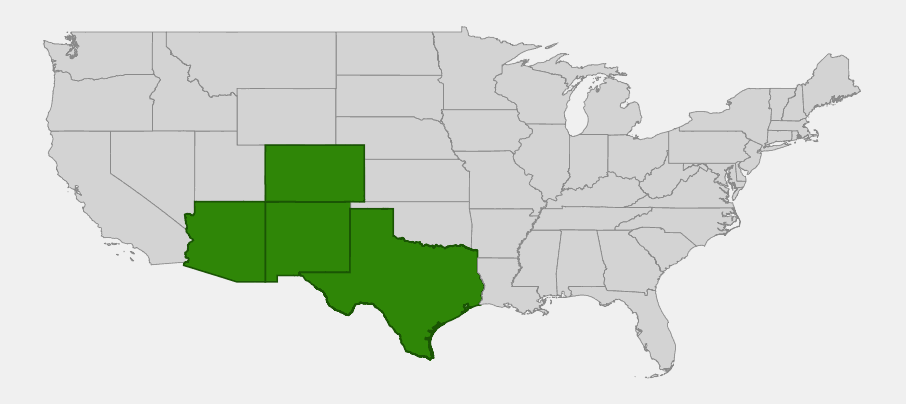
Alpine cancer-root is native to the mountains of the Southwest, Mexico and Central America. USDA PLANTS and the Lady Bird Johnson Wildflower Center record it from four U.S. states: Arizona, Colorado, New Mexico and Texas. In the United States all populations are generally referred to var. mexicana, sometimes treated as the separate species Conopholis mexicana. South of the border it ranges through the Sierra Madre of Mexico, and the typical variety extends into Central America.
In Arizona it grows mainly in the oak and pine-oak woodlands of the central mountains and the Sky Islands of the southeast, such as the Huachuca, Chiricahua and Santa Catalina Mountains. In New Mexico it is widespread in mountain oak woodlands, from the southern ranges north toward Santa Fe. It reaches southern Colorado at the northern edge of its range, and in Texas it grows mostly in the mountains of the Trans-Pecos, such as the Chisos, Davis and Guadalupe Mountains, with scattered records farther east.
It always grows near its host oaks, typically in oak woodland, pine-oak forest, chaparral with scrub oaks, and canyons, from about 4,000 to 9,000 feet. Reported hosts include Gambel oak, gray oak, Emory oak and other southwestern oaks. Where its host trees are healthy and the ground is undisturbed, it can appear in the same spots year after year.
📋 Regional plant lists featuring Alpine Cancer-root: Arizona & New Mexico · South & West Texas
Can You Grow It?
No. Alpine cancer-root cannot be grown from nursery stock, and it is not sold. It has no leaves or independent roots and lives fused to the roots of a living oak. A plant that is dug up loses its connection to the host and dies, and its seeds only germinate in contact with a suitable host root. Never dig it up or try to transplant it. The best way to “grow” it is to protect the oaks and undisturbed soil where it already lives.
Light
Light does not matter to the cancer-root itself, since it does not photosynthesize. What it needs is a healthy host oak, typically in the dappled shade or partial sun of an oak or pine-oak woodland.
Soil & Water
Leave the ground around host oaks undisturbed. Digging, trenching, grading and heavy foot or vehicle traffic damage both the oak roots and the parasite. Do not rake away leaf litter where it grows, and avoid irrigating or fertilizing the woodland floor.
Planting Tips
There is nothing to plant. If you own land with native oaks where cancer-root appears, keeping the oaks healthy is the way to keep the cancer-root. Planting and protecting young native oaks, such as Gambel, gray or Emory oak within their ranges, provides future hosts.
Pruning & Maintenance
Leave the stalks alone after flowering. The brown stalks are ripening seed, and animals that eat them may help spread it. Do not cut, pull or “tidy” them away, and keep construction and trail work outside the root zone of host oaks.
Propagation
It cannot be propagated in gardens or nurseries. Seed that falls on its own near oak roots may eventually produce new plants. Leaving seeds where they fall, and leaving plants in place, is the best thing anyone can do for it.
Where to See It
- Sky Island hikes: look under oaks in spring along trails in the Huachuca, Chiricahua and Santa Catalina Mountains of Arizona
- New Mexico oak woodlands: found under Gambel and gray oaks in mountain ranges such as the Sandia, Manzano and Organ Mountains
- Texas mountain parks: in oak woodlands of Big Bend, Davis Mountains and Guadalupe Mountains in spring
- Nature study: a clear example of a flowering plant that lives entirely without chlorophyll
- Photography: striking golden clumps among brown leaf litter from April to June
Wildlife & Ecological Value
Alpine cancer-root takes its food from oaks, but it gives back to the woodland food web through its flowers, fleshy stalks and seeds.
For Pollinators
The small yellow flowers are visited by bumble bees and other native bees, which crawl into the tubes for nectar and pollen. Cancer-roots can also self-pollinate, which helps them set seed in years when pollinators are scarce.
For Birds
Birds rarely feed on the plant directly, but turkeys and ground-foraging birds may pick at the stalks and the insects that visit them.
For Mammals
The thick, fleshy stalks are eaten by black bears, deer, javelina, squirrels and other rodents. In the eastern relative, mammals that eat the stalks are thought to help disperse the seeds, and the same is probably true here.
Ecosystem Role
As a root parasite, alpine cancer-root draws some water and nutrients from its host oak, but it seldom causes noticeable harm to a healthy, mature tree. Its presence is a sign of mature, relatively undisturbed oak woodland. It adds diversity to the forest floor and offers a spring food source for wildlife.
Cultural & Historical Uses
The Danish botanist Frederik Liebmann described Conopholis alpina in the 1840s from plants he collected in the mountains of Mexico. Plants in the southwestern United States and northern Mexico were later described as a separate species, Conopholis mexicana, and are now usually treated as C. alpina var. mexicana.
The name “cancer-root” is an old one, shared with its eastern relative and with other root parasites. It reflects historical folk use of these plants as a treatment for sores and growths, uses that have no scientific support. The plant should not be collected for any purpose.
Alpine cancer-root is not considered rare across its range, but it depends entirely on healthy oak woodlands. Large wildfires, drought-related oak die-off, development and soil disturbance can eliminate local populations. Hikers who see it are encouraged to photograph it and leave it in place, and sharing observations on platforms such as iNaturalist helps botanists track where it grows.
Frequently Asked Questions
Is alpine cancer-root a fungus?
No. It is a flowering plant in the broomrape family. It lacks chlorophyll and green leaves, so it looks like a mushroom or a pine cone, but it produces true flowers and seeds.
Does alpine cancer-root kill oak trees?
No. It takes some water and nutrients from oak roots, but healthy, mature oaks are generally not noticeably harmed.
Can I buy or transplant alpine cancer-root?
No. It is not sold, and plants dug from the wild die because they are cut off from the host oak. Please never dig it up. Enjoy it where it grows.
When is the best time to see alpine cancer-root?
Look under oaks from April to June, when the fresh yellow stalks are most visible. Older brown stalks may remain standing for months afterward.
How is it different from American cancer-root?
American Cancer-root grows in eastern North America on red and black oaks. Alpine cancer-root is its southwestern and Mexican counterpart, growing on western oaks, and it is generally similar in appearance.

Looking for a nursery that carries Alpine Cancer-root?
Browse our native plant nursery directory: Arizona · Colorado · New Mexico · Texas

