
Arctic Raspberry (Rubus arcticus)
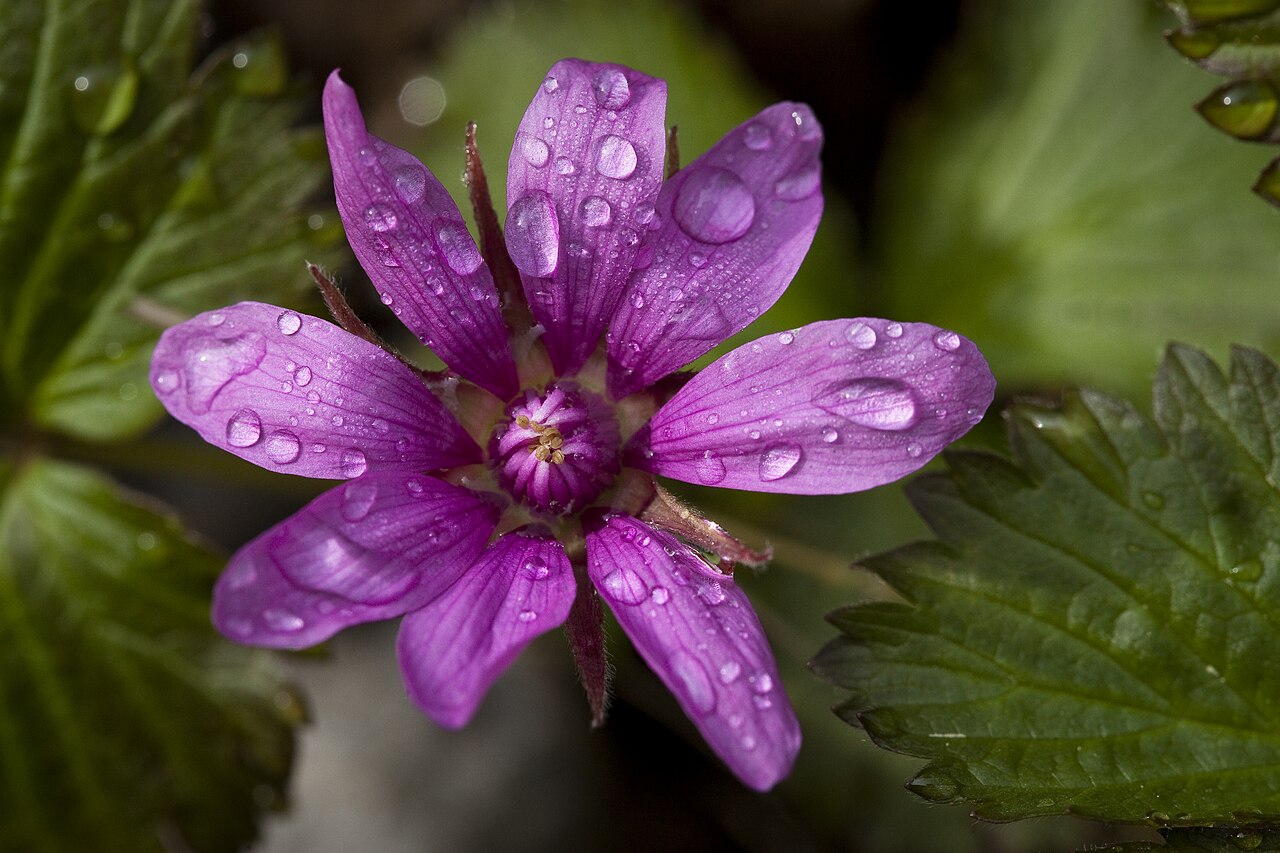
Rubus arcticus, the Arctic Raspberry, also called arctic bramble, nagoonberry and nectarberry, is a tiny, thornless relative of the raspberry. It grows only 2 to 12 inches tall from creeping underground stems and produces bright pink to magenta flowers in early summer, followed by small, dark red berries with a famously rich, sweet aroma. It belongs to the rose family (Rosaceae).
Arctic raspberry is circumboreal. It grows across Scandinavia, Finland and Russia to Mongolia, northern China and Korea, and in North America from Alaska across Canada to Labrador and Newfoundland. In the lower 48 states it reaches only a few northern and mountain areas, where it is rare. In Alaska it is a well-known wild berry, called nagoonberry from the Tlingit name neigóon.
In Finland and Sweden the berry is a delicacy used for jam and the liqueur Mesimarja, and plant breeders have crossed it with related species to create the cultivated “nectar raspberries.” This guide covers how to identify arctic raspberry, where it grows in the United States, and how to grow it as a ground cover in cool northern gardens.
Identification
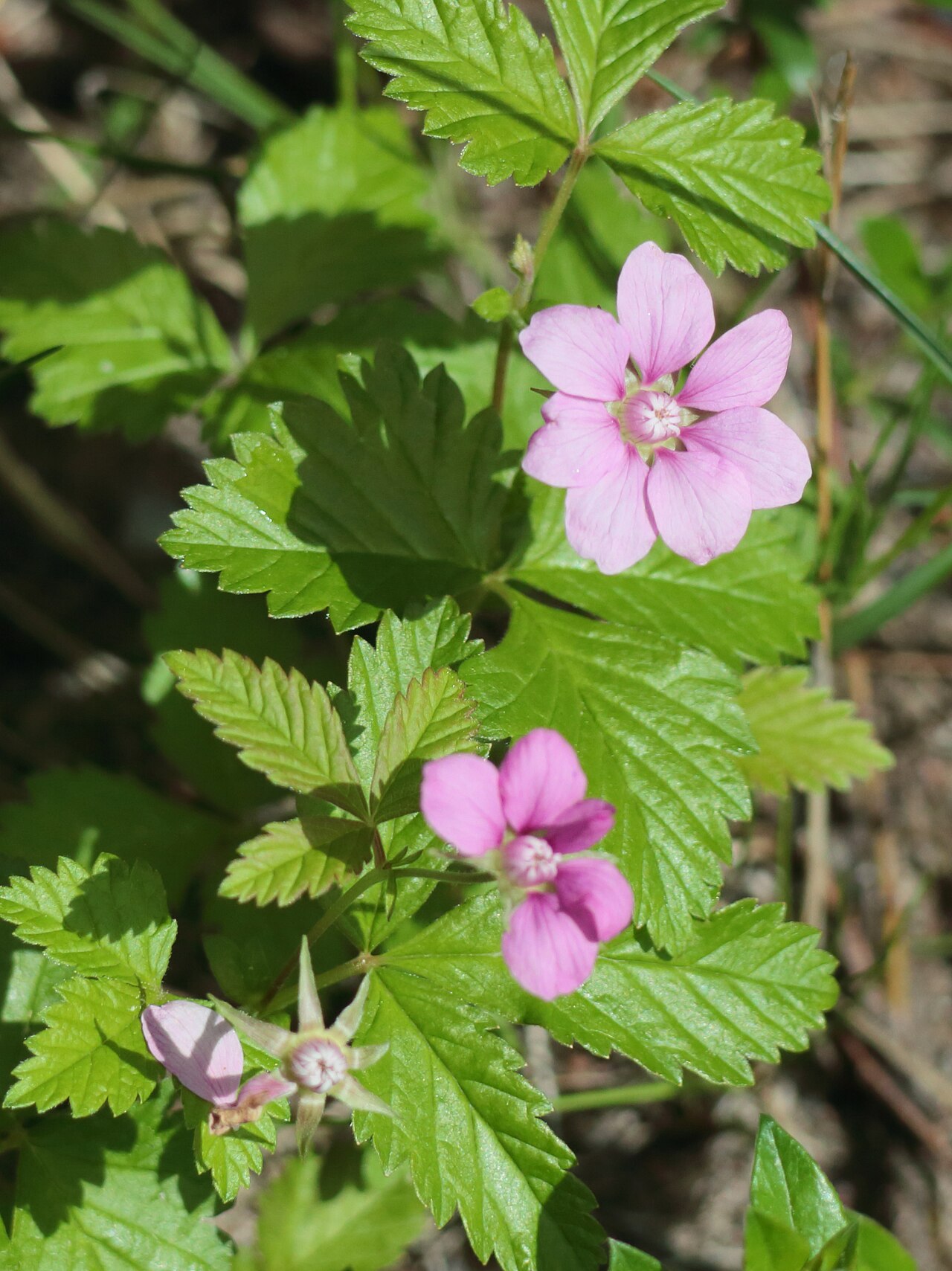
Arctic raspberry looks more like a strawberry or a small cinquefoil than a raspberry bush. It has no prickles, no woody canes, and its flowering stems die back each winter. The bright pink flowers and three-parted leaves are the best field marks.
Stems & Habit
Plants spread by slender rhizomes and form low patches. Each year they send up soft, upright stems about 2 to 6 inches tall, sometimes to about a foot, that are slightly woody only at the base. The stems are finely hairy and completely unarmed, unlike most brambles.
Leaves
Each stem carries a few alternate, long-stalked leaves, usually divided into three leaflets about ½ to 1¼ inches long, with sharply and often doubly toothed edges. The side leaflets are sometimes lobed. Leafy stipules sit at the base of each leaf stalk. In fall the leaves of some plants turn red to purple.
Flowers
Flowers are usually single at the stem tip, occasionally two or three, about ¾ to 1 inch across. They usually have five narrow, spoon-shaped petals (sometimes more) in bright pink, rose, crimson or magenta, around a cluster of 30 to 40 stamens. The narrow sepals bend back beneath the petals. Plants bloom from late May into August depending on latitude and elevation, often in a scattered way over several weeks.
Fruit
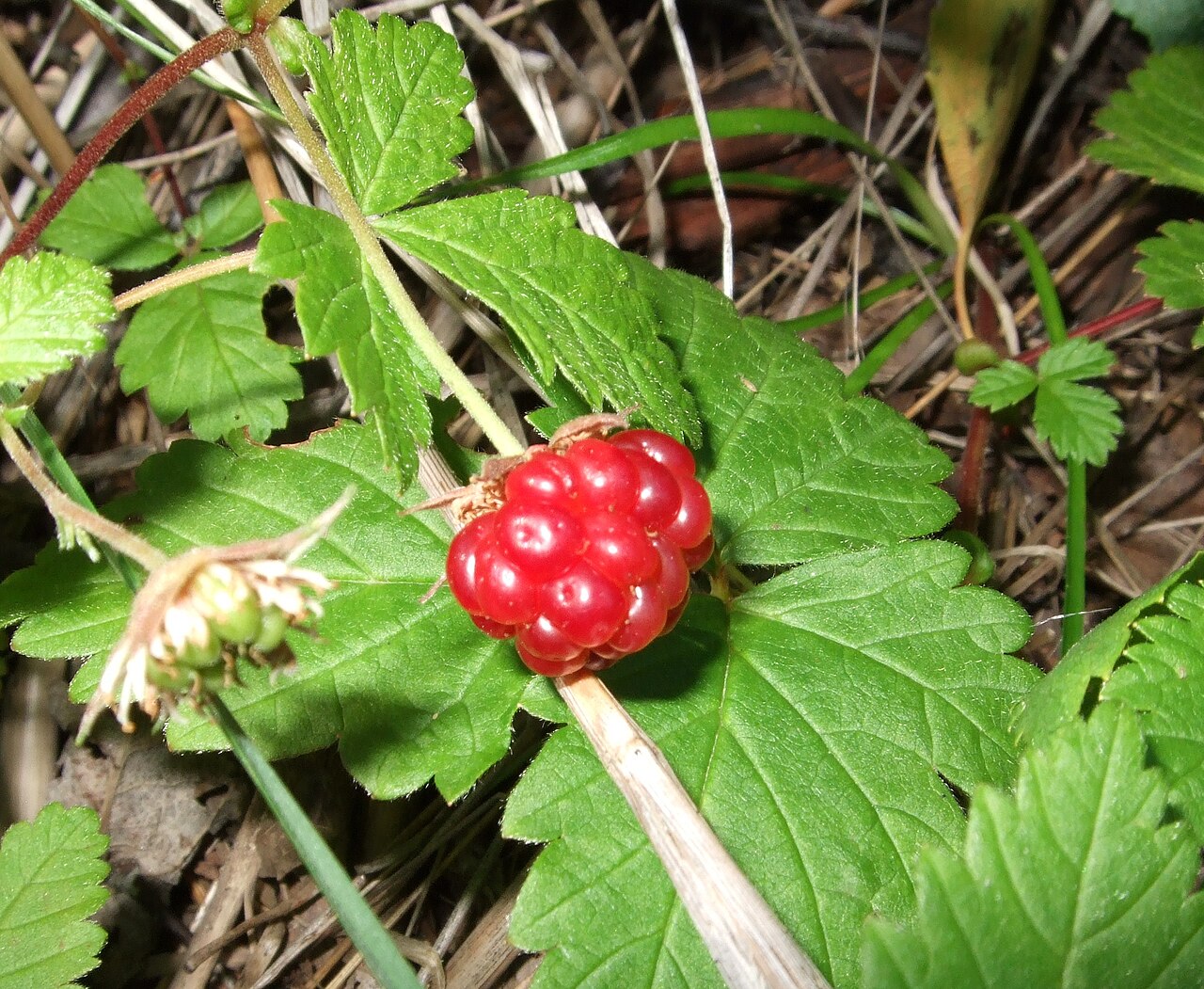
The fruit is a small aggregate of 10 to 30 drupelets, about ⅓ to ½ inch across, ripening dark red to purplish in mid to late summer. It separates from the receptacle like a raspberry. Fruit set is often light, partly because many plants need pollen from a genetically different plant to set fruit.
In Alaska and northwestern Canada, the plants known as subsp. stellatus have rounder, shallowly lobed leaves. Subsp. acaulis, the dwarf form of most of Canada and the scattered populations in the lower 48 states, is very low and has three leaflets and one flower per stem.
Quick Facts
| Scientific Name | Rubus arcticus (incl. subsp. acaulis and subsp. stellatus; syn. R. acaulis, R. stellatus) |
| Family | Rosaceae (rose family) |
| Plant Type | Low, thornless, rhizomatous subshrub with herbaceous stems |
| Mature Height | 2–12 in |
| Mature Spread | 1–3 ft as a slowly spreading patch |
| Growth Rate | Slow to moderate |
| Sun Exposure | Full sun to part shade |
| Water Needs | Moderate to high; consistently moist soil |
| Soil Type | Moist, organic loam or peaty soil; meadow, bog and streamside soils |
| Soil pH | About 5.0–7.0 |
| Bloom Time | Late May–August |
| Flower Color | Bright pink, rose, crimson or magenta |
| Fall Color | Red to purple on some plants |
| Fruit | Small dark red aggregate berry, highly aromatic |
| Deer Resistant | Moderately; thornless foliage is occasionally browsed |
| USDA Hardiness Zones | 1–6 (needs cool summers) |
Native Range
In North America, arctic raspberry is widespread from Alaska and Yukon across the boreal forest and low Arctic of Canada to Hudson Bay, Quebec, Labrador and Newfoundland, and it also occurs in Saint Pierre and Miquelon. In Alaska it is common in wet meadows, forest openings, streambanks and tundra across much of the state.
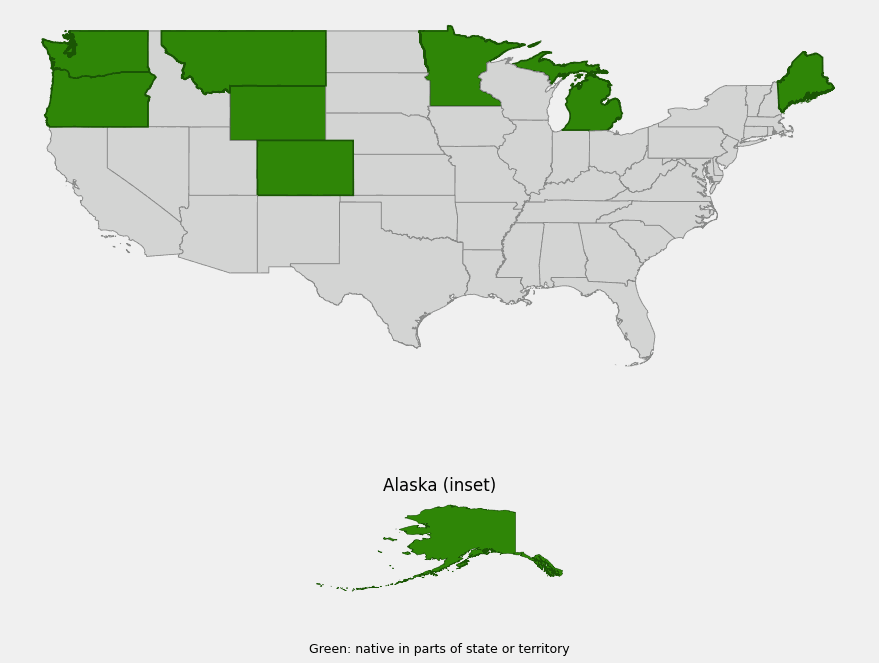
South of Canada it is a rare plant of scattered outlying populations. USDA PLANTS and the Lady Bird Johnson Wildflower Center record it from Washington, Oregon, Montana, Wyoming, Colorado, Minnesota, Michigan and Maine. Most of these records belong to the dwarf subsp. acaulis. In Washington it grows east of the Cascade crest in the north-central part of the state, and the Washington Natural Heritage Program lists it as Threatened. NatureServe ranks it as critically imperiled (S1) in Colorado, Michigan and Washington and imperiled (S2) in Montana and Wyoming.
These southern sites are mostly cold places: high-elevation wet meadows and willow thickets in the Rockies, bogs and fens near the Canadian border in Minnesota, Michigan and Maine, and moist montane meadows in the Northwest. They are probably remnants of a wider distribution during cooler periods after the last ice age. Each of them is an outlying record at the southern edge of the species’ range.
📋 Regional plant lists featuring Arctic Raspberry: Alaska · Montana & Wyoming · Idaho, Eastern Oregon & Eastern Washington · Michigan, Wisconsin & Eastern Minnesota · New Hampshire, Maine & Vermont
Growing & Care Guide
Arctic raspberry is a charming ground cover and berry plant for gardeners in cold climates, roughly USDA zones 1 to 6 with cool summers. It is grown commercially on a small scale in Finland and Sweden, and Alaskan gardeners grow nagoonberries for their fruit. In the lower 48 states, buy nursery plants and never dig plants from the rare wild populations there.
Light
Full sun gives the most flowers and fruit in cool northern climates. Where summers are warmer, give it morning sun and afternoon shade, which also helps keep the soil cool and moist.
Soil & Water
It wants consistently moist, organic, slightly acidic soil that never dries out, such as the edge of a bog garden or a cool, moist border enriched with compost. Mulch helps keep the roots cool. Wet but not waterlogged soil is ideal. Plants struggle in heat and drought and are not suited to hot-summer regions.
Planting Tips
Plant in spring, about 12 inches apart, in a bed where the rhizomes can spread into a mat. For fruit, plant at least two genetically different clones or cultivars, because most plants set little fruit with their own pollen. Finnish and Swedish selections and the hybrid nectar raspberries are sold for this purpose. Native-origin plants are best for habitat plantings.
Pruning & Maintenance
The stems die back each winter, so there are no canes to prune. Tidy away old stems in spring and pull grasses and weeds that invade the patch, because arctic raspberry competes poorly with taller plants. A light compost top-dressing in spring keeps the soil rich. Fungal leaf and fruit diseases can be a problem in humid summers, so give plants good air circulation.
Propagation
Divide established patches or take rhizome cuttings in early spring. Seed needs cold, moist stratification and germinates slowly and unevenly, so division is the usual method. Patches spread steadily in suitable conditions.
Landscape Uses
- Edible ground cover: a low, flowering mat that produces aromatic berries in cool northern gardens
- Bog and wet-meadow edges: grows with cloudberry, lingonberry and Labrador tea
- Alaska and northern native gardens: a native berry plant for food gardens and naturalistic plantings
- Rock and trough gardens: in cool, moist, organic soil in cold-climate alpine gardens
- Pollinator plantings: showy pink flowers for bumble bees in early summer
Wildlife & Ecological Value
Arctic raspberry is a small plant, but across the boreal forest and tundra its flowers and berries are part of the short summer food supply for many animals.
For Pollinators
The bright pink, open flowers are visited by bumble bees, solitary bees, flies and beetles. The Xerces Society notes it as having special value to native bees and bumble bees. Because most plants need cross-pollination to set fruit, pollinators are essential for a good berry crop.
For Birds
Grouse, thrushes and other fruit-eating birds eat the berries and spread the seeds. In Alaska and Canada its patches grow in the same wet meadows and tundra used by nesting shorebirds and songbirds.
For Mammals
Bears, small rodents and other mammals eat wild berries like these, and browsing animals occasionally nibble the leaves. People have long gathered nagoonberries in Alaska wherever they are plentiful.
Ecosystem Role
Its rhizomes let it hold and slowly spread on moist, open ground, and it often appears after disturbances such as fire, flooding or old clearings. At its southern limit in the United States it marks cold, wet habitats such as fens, high meadows and willow thickets that are vulnerable to drainage, grazing and a warming climate.
Cultural & Historical Uses
Carl Linnaeus, who grew up in Sweden, praised the arctic raspberry (Swedish åkerbär) as a great delicacy in his Flora Lapponica of 1737, and he named the species in 1753. In Finland it is called mesimarja, and since 1882 the Finnish company Lignell & Piispanen has made the liqueur Mesimarja from it. The liqueur won a gold medal at the 1900 Paris Exposition. The berry is the provincial flower of Norrbotten in northern Sweden.
In Alaska and northwestern Canada, the name nagoonberry comes from the Tlingit neigóon. Alaska Native peoples and later residents have gathered the berries in summer for eating fresh and for preserves, although they are seldom found in large quantities. Its Russian name, knyazhenika, is often explained as “the princes’ berry,” a sign of how highly it has been prized.
Because wild plants rarely produce heavy crops, Scandinavian breeders worked through the 20th century to select better-fruiting clones and crossed arctic raspberry with the related Rubus stellatus to create the “nectar raspberries” (Rubus × stellarcticus), grown on a small scale for jam and liqueur.
Frequently Asked Questions
Is arctic raspberry the same as nagoonberry?
Yes. Nagoonberry, from the Tlingit name, is the common Alaskan name for Rubus arcticus. It is also called arctic bramble and nectarberry.
Can I grow arctic raspberry in my garden?
Yes, if you have cool summers and moist, organic soil, roughly USDA zones 1 to 6. It struggles in hot, humid or dry climates. For fruit, plant two or more different clones so the flowers can cross-pollinate.
Are arctic raspberries edible?
Yes. The berries are edible and very aromatic, and they are prized for jam, desserts and liqueur in Scandinavia. In the lower 48 states the wild plants are rare, so pick fruit only from your own plants or from abundant populations in Alaska and Canada.
Does arctic raspberry have thorns?
No. Unlike most brambles it is completely thornless, with soft, herbaceous stems that die back each winter.
Where does arctic raspberry grow in the lower 48 states?
It is rare there. Outlying populations, mostly of the dwarf subsp. acaulis, are recorded from Washington, Oregon, Montana, Wyoming, Colorado, Minnesota, Michigan and Maine, in cold wet meadows, fens and mountain willow thickets.

Looking for a nursery that carries Arctic Raspberry?
Browse our native plant nursery directory: Alaska · Colorado · Maine, Michigan, Minnesota & Montana · Oregon · Washington · Wyoming

