
Ghost Orchid (Dendrophylax lindenii)
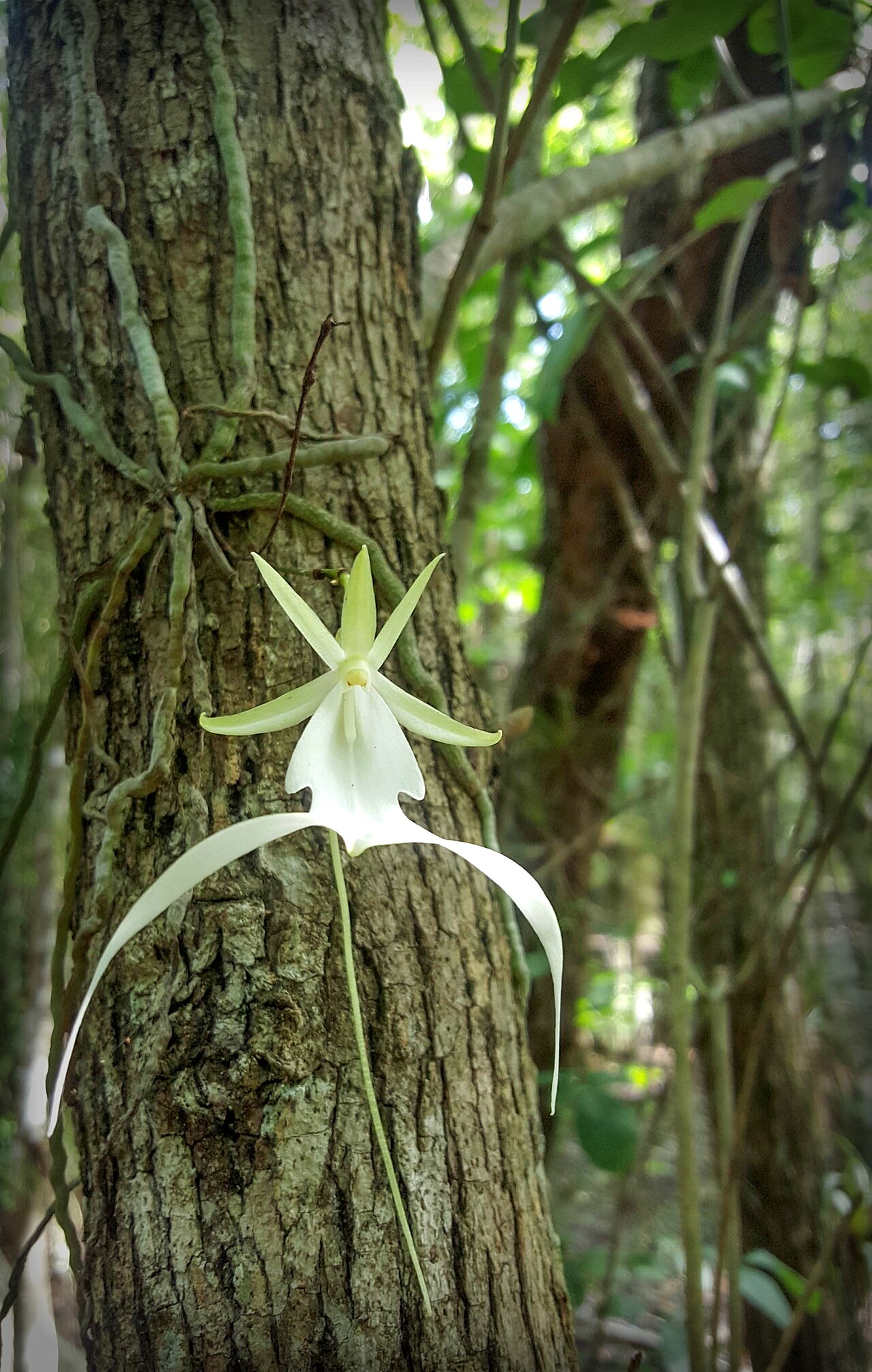
Dendrophylax lindenii, the Ghost Orchid, is a rare, leafless orchid that grows on trees in the swamps of southwest Florida and in Cuba. The whole plant is a small cluster of flattened, gray-green roots pressed against the bark. In summer, one or a few pure white flowers appear on thin stalks. Each has a broad lip that ends in two long, curling tails, so the flower looks like a white frog leaping in midair or a ghost floating in the dark swamp.
It is one of North America’s most famous wildflowers. It became widely known through Susan Orlean’s 1998 book The Orchid Thief, about the poaching of orchids in Florida’s Fakahatchee Strand, and the 2002 film Adaptation. It is listed as endangered by the state of Florida, and collecting it is illegal.
This is a page about identifying and appreciating the ghost orchid. It cannot be grown from ordinary nursery stock, and wild plants must never be removed from their trees. The best way to see one is on a guided swamp walk or at a sanctuary boardwalk in Southwest Florida in summer.
Identification
Look for a mass of flattened, gray-green roots with whitish streaks on a tree trunk in a shady South Florida swamp, and in summer, a white, frog-shaped flower with two long, twisting tails, held a few inches from the bark.
Growth Habit
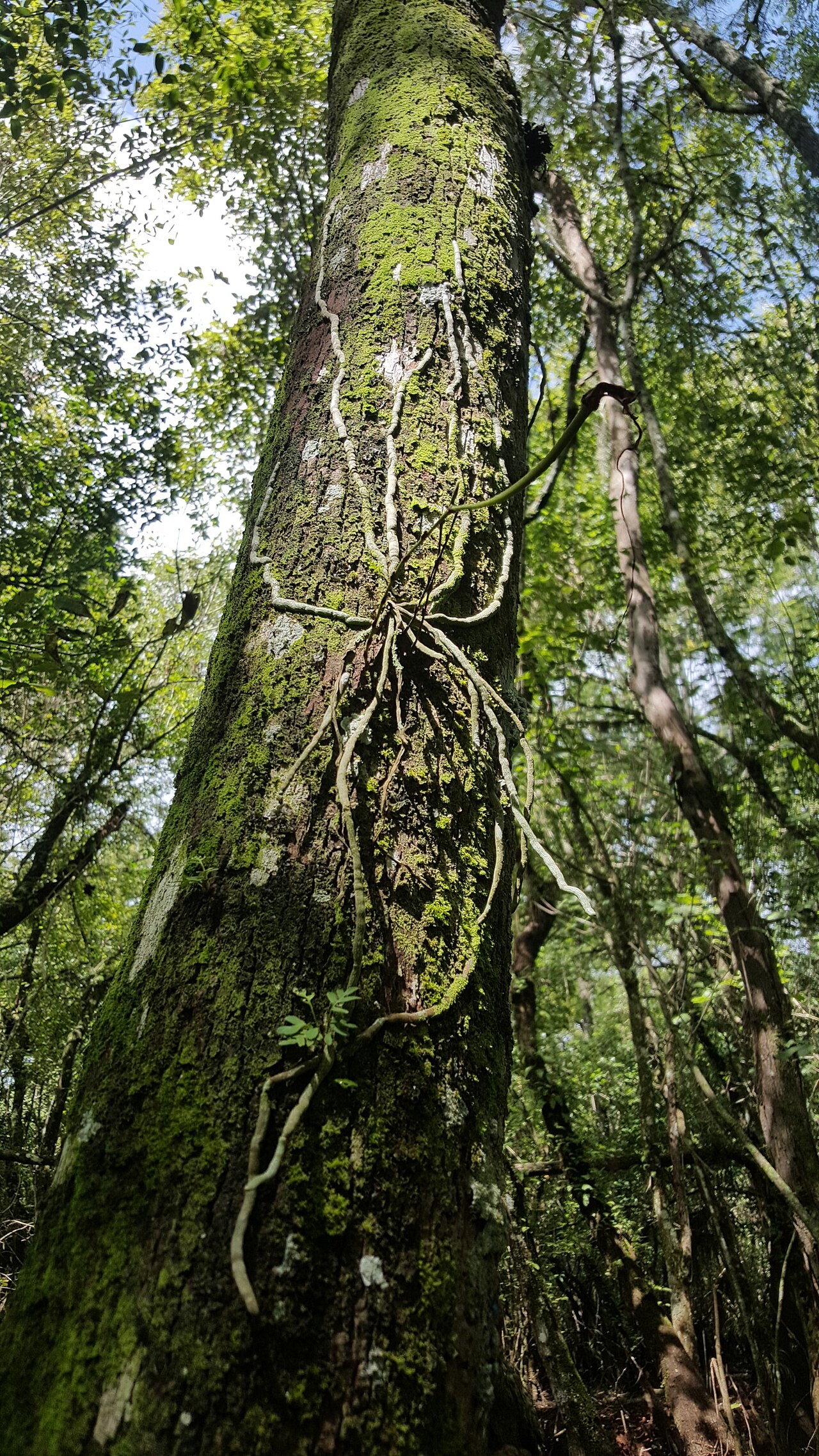
The ghost orchid has no leaves and almost no stem. The plant is a tiny central stem with a cluster of roots that spread over the bark of its host tree. The roots are green when wet because they contain chlorophyll and do the work of leaves. Plants are usually small, but old ones can have many roots spreading a foot or more. It grows on tree trunks and branches from a few feet to many feet above the water.
Roots
The roots are flattened to round, about 1/8 inch wide, gray-green to silvery, and marked with short, paired white streaks along their length. These are areas of the root’s spongy outer layer that let gases in and out. The roots cling tightly to the bark, often for several feet. Without flowers, the plant is very hard to spot.
Flowers
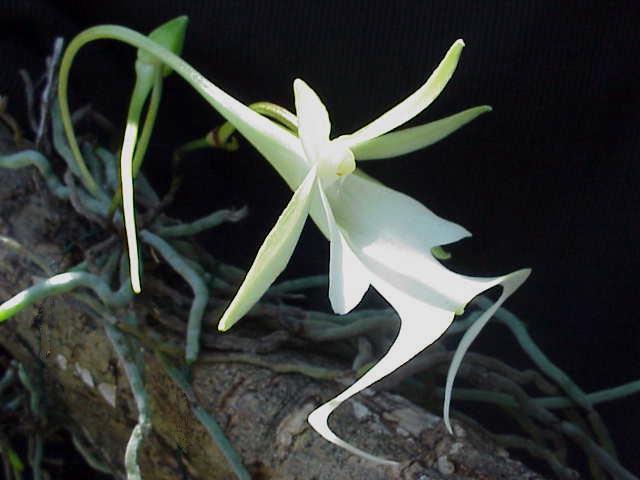
The flowers open from June to August, sometimes into September, one to several per plant, each on a thin, wiry stalk. They are white to slightly greenish, about 1 1/4 to 1 1/2 inches wide and roughly 3 to 3 1/2 inches long including the tails. The sepals and side petals are narrow and pointed. The lip is broad and white, with two long, twisting side lobes that trail downward. Behind the lip is a very long, thin nectar spur, several inches long, holding nectar at its tip. A plant can make up to about ten flowers, which open one at a time. They have a fruity, apple-like scent, strongest at night and in the early morning.
Fruit & Seeds
Pollinated flowers form a long, slender green capsule that takes months to ripen and then splits to release huge numbers of dust-like seeds. As with other orchids, each seed needs to meet a specific fungus on the bark to germinate and grow.
Look-alikes
No other Florida plant has a flower like it. Other leafless orchids in Florida, such as the jingle-bell orchid (Harrisella porrecta) and the much rarer leafless orchids of the genus Campylocentrum, have similar gray-green roots but only tiny yellowish or greenish flowers. Without flowers, ghost orchid roots can be mistaken for the roots of other epiphytes, such as the green-fly orchid, which has leaves.
Quick Facts
| Scientific Name | Dendrophylax lindenii |
| Family | Orchidaceae (orchid family) |
| Plant Type | Leafless epiphytic orchid |
| Mature Height | Root mass a few inches to 1–2 ft across |
| Mature Spread | Roots spread several inches to a few feet on bark |
| Growth Rate | Very slow |
| Sun Exposure | Shade to filtered light |
| Water Needs | Constant high humidity of swamp forests |
| Soil Type | None; grows on the bark of swamp trees |
| Soil pH | Not applicable |
| Bloom Time | June–August, sometimes into September |
| Flower Color | White |
| Fall Color | None |
| Fruit | Slender capsule with dust-like seeds |
| Deer Resistant | Not applicable; grows on trees |
| USDA Hardiness Zones | 10b–11 (in the wild) |
Native Range
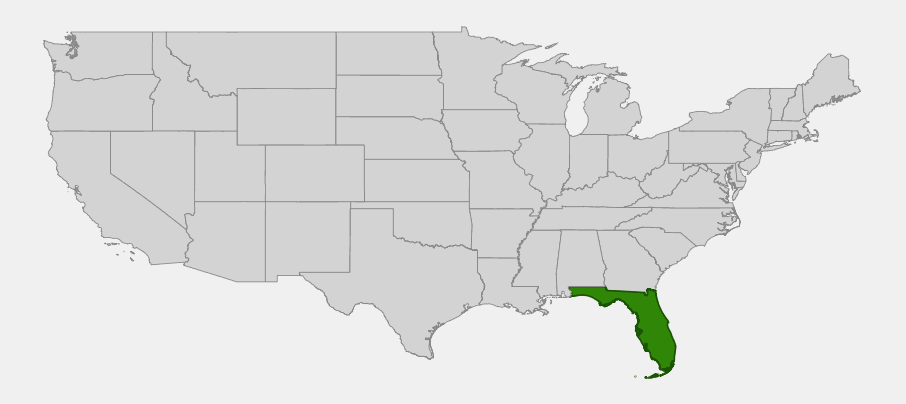
In the United States, the ghost orchid grows only in southwest Florida. USDA PLANTS records it from Collier, Hendry, Lee, Miami-Dade and Monroe counties. Most known plants are in the large cypress and hardwood swamps of the Big Cypress region, including Fakahatchee Strand Preserve State Park, the Florida Panther National Wildlife Refuge, Big Cypress National Preserve and Audubon’s Corkscrew Swamp Sanctuary. It is listed as endangered by the state of Florida, and conservation groups have petitioned the U.S. Fish and Wildlife Service to protect it under the Endangered Species Act. It is also listed in Appendix II of CITES, which regulates international trade in orchids.
Outside the United States, it grows in western Cuba. Botanists have debated whether the Florida and Cuban plants are exactly the same, but both are currently treated as one species.
It grows in deep, shady, humid swamp forests called strands and sloughs, where water stands for much of the year. It is usually found on the trunks of pop ash (Fraxinus caroliniana), pond apple and bald cypress, often low over the water. These forests stay cool and moist even in the dry season. Draining of swamps, wildfire in dry years, hurricanes and poaching are the main threats.
📋 Regional plant lists featuring Ghost Orchid: North & South Florida
Can You Grow It?
Honestly, not in an ordinary home or garden. The ghost orchid depends on specific fungi living in the bark, constant swamp humidity and a narrow climate, and it rarely survives for long outside its habitat. Wild plants are protected by Florida law and must never be removed from their trees; poached plants almost always die.
Why It Is So Hard to Grow
Like all orchids, the ghost orchid’s tiny seeds have no stored food and germinate only with the help of a partner fungus. The adult plant also lives in close association with fungi in the bark. It needs shade, nearly constant humidity, good air movement and warm temperatures all year. In a house, it dries out quickly; in a closed container, it rots.
Lab-Grown Plants
Researchers have grown ghost orchids from seed in the lab, with and without their fungal partners, and have planted lab-raised seedlings back into protected Florida swamps to help the wild population. A few specialist orchid growers also sell lab-raised (flasked) seedlings. These are the only legal and ethical source. Even expert growers find them difficult, and they are best left to people with a greenhouse and orchid experience.
If You Try a Lab-Raised Plant
Experienced growers mount the plant on a piece of bark or cork, keep it in bright shade, water or mist it daily, and give it high humidity and gentle air movement in a greenhouse, never below about 55°F. The roots should dry slightly between waterings but never stay dry for long.
Never Collect
Removing a ghost orchid from the wild is illegal in Florida without a permit, and it is illegal to take any plant from state parks, national preserves and wildlife refuges. Every plant matters to this small population. If you find one, enjoy it, photograph it from a distance, and do not share its exact location publicly, since poachers still target them.
Helping the Ghost Orchid
The best way to help is to support the parks, refuges and sanctuaries that protect the Big Cypress swamps, and the groups working on clean water and natural water flows in Southwest Florida. Healthy, wet swamps protect the ghost orchid and many other rare epiphytes.
Where to See It
- Audubon Corkscrew Swamp Sanctuary (Naples): home of a famous, much-photographed ghost orchid seen from the boardwalk in some years
- Fakahatchee Strand Preserve State Park: the heart of the Florida population; ranger-led swamp walks in season
- Florida Panther National Wildlife Refuge: supports one of the larger populations; access is limited
- Big Cypress National Preserve: vast cypress swamps with ghost orchids and other rare epiphytes
- Botanical gardens: some Florida gardens display lab-raised plants in bloom in summer
Wildlife & Ecological Value
The ghost orchid is a symbol of the wild, wet swamps of Southwest Florida, which also shelter the Florida panther and many other rare species.
For Pollinators
Its white, fragrant flowers with a very long nectar spur are classic hawkmoth flowers. For years, scientists thought only the giant sphinx moth, with a tongue long enough to reach the nectar, could pollinate it. Camera-trap studies later recorded the fig sphinx carrying its pollen packets (pollinia), the first pollinator scientifically documented, and researchers now think several other large sphinx moths in Florida may pollinate it too.
For Birds
Birds have no direct use for the ghost orchid, but the swamp forests it grows in are important nesting and feeding habitat for wading birds, owls, warblers and other birds.
For Mammals
Mammals do not feed on it. Its swamps are home to the Florida panther, black bear and other large mammals that depend on large, wild, connected habitat.
Ecosystem Role
The ghost orchid is part of a rich community of epiphytes (air plants, orchids, ferns and peperomias) in Southwest Florida’s strands. It depends on its host trees, its partner fungi and its moth pollinators. Its health is a sign of a healthy swamp with natural water levels.
Cultural & Historical Uses
The genus name Dendrophylax means tree guardian, from the Greek dendron (tree) and phylax (guard), for its habit of clinging to trees. The species is named for Jean Jules Linden, a Belgian plant explorer and orchid collector who found it in Cuba in 1844; it was discovered in Florida much later. It has also been placed in the genera Polyrrhiza and Polyradicion.
Susan Orlean’s book The Orchid Thief (1998) told the true story of a man arrested for taking ghost orchids and other plants from the Fakahatchee Strand. The book inspired the film Adaptation (2002) and made the ghost orchid famous far beyond Florida.
In 2007, a very large ghost orchid was found high on a bald cypress at Corkscrew Swamp Sanctuary. Nicknamed the “super ghost”, it has bloomed many times since, sometimes with many flowers at once, and has drawn visitors and photographers from around the world.
Frequently Asked Questions
Where can I see a ghost orchid in the wild?
In Southwest Florida in summer, mainly June to August. Audubon’s Corkscrew Swamp Sanctuary, Fakahatchee Strand Preserve State Park and Big Cypress National Preserve are the best-known places. Guided swamp walks are the safest way to find one.
Can I buy a ghost orchid?
Only lab-raised seedlings sold by specialist orchid growers are legal. Never buy or take wild plants. Ghost orchids are very difficult to grow and rarely survive outside a humid greenhouse.
Why doesn’t the ghost orchid have leaves?
Its flattened green roots do the job of leaves, making food by photosynthesis. Without leaves, it loses less water and can cling tightly to bark.
Is the ghost orchid endangered?
Yes. It is listed as endangered by the state of Florida, and only an estimated 1,500 or so plants are thought to remain in Florida. Conservation groups have asked for federal protection as well.
What pollinates the ghost orchid?
Large, long-tongued sphinx moths. The fig sphinx is the first pollinator documented by scientists, and the giant sphinx and other hawkmoths are thought to pollinate it as well.

Looking for a nursery that carries Ghost Orchid?
Browse our native plant nursery directory: Florida

