
Candelilla (Euphorbia antisyphilitica)
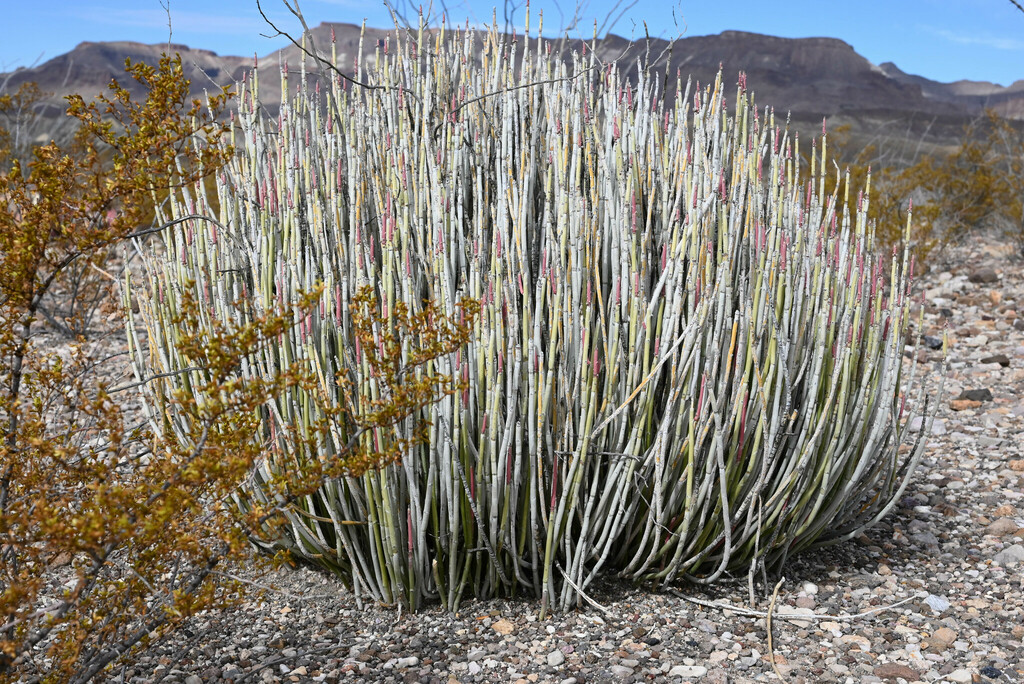
Euphorbia antisyphilitica, known as Candelilla (Spanish for “little candle”) or wax plant, is a succulent spurge of the Chihuahuan Desert. It forms dense, rounded clumps, usually 1 to 3 feet tall and often wider, of hundreds of slender, upright, pencil-thin stems that are almost leafless. A coat of wax gives the stems a soft gray-green to blue-green color and protects them from drying out in the desert heat.
That wax is the source of candelilla wax, a valuable natural wax used in lip balms, cosmetics, polishes, chewing gum and food glazes. For more than a century it has been harvested from wild plants in northern Mexico by boiling the stems, and in the early 20th century there were wax camps in the Big Bend region of Texas as well.
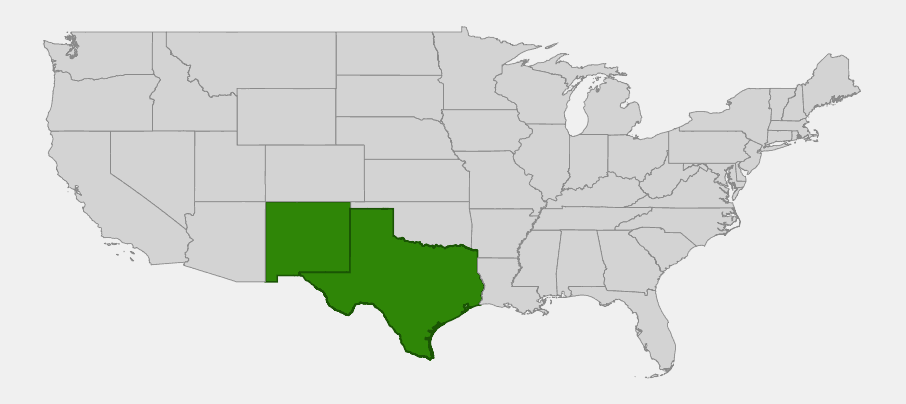
In the United States candelilla is native to the Trans-Pecos region of West Texas, especially the Big Bend, and is also listed from New Mexico. It is an excellent, almost indestructible accent plant for desert, rock and xeriscape gardens in the Southwest, and its tiny white to pink flowers appear after rain. Like all spurges it has a milky, irritating sap, so handle it with care.
Identification
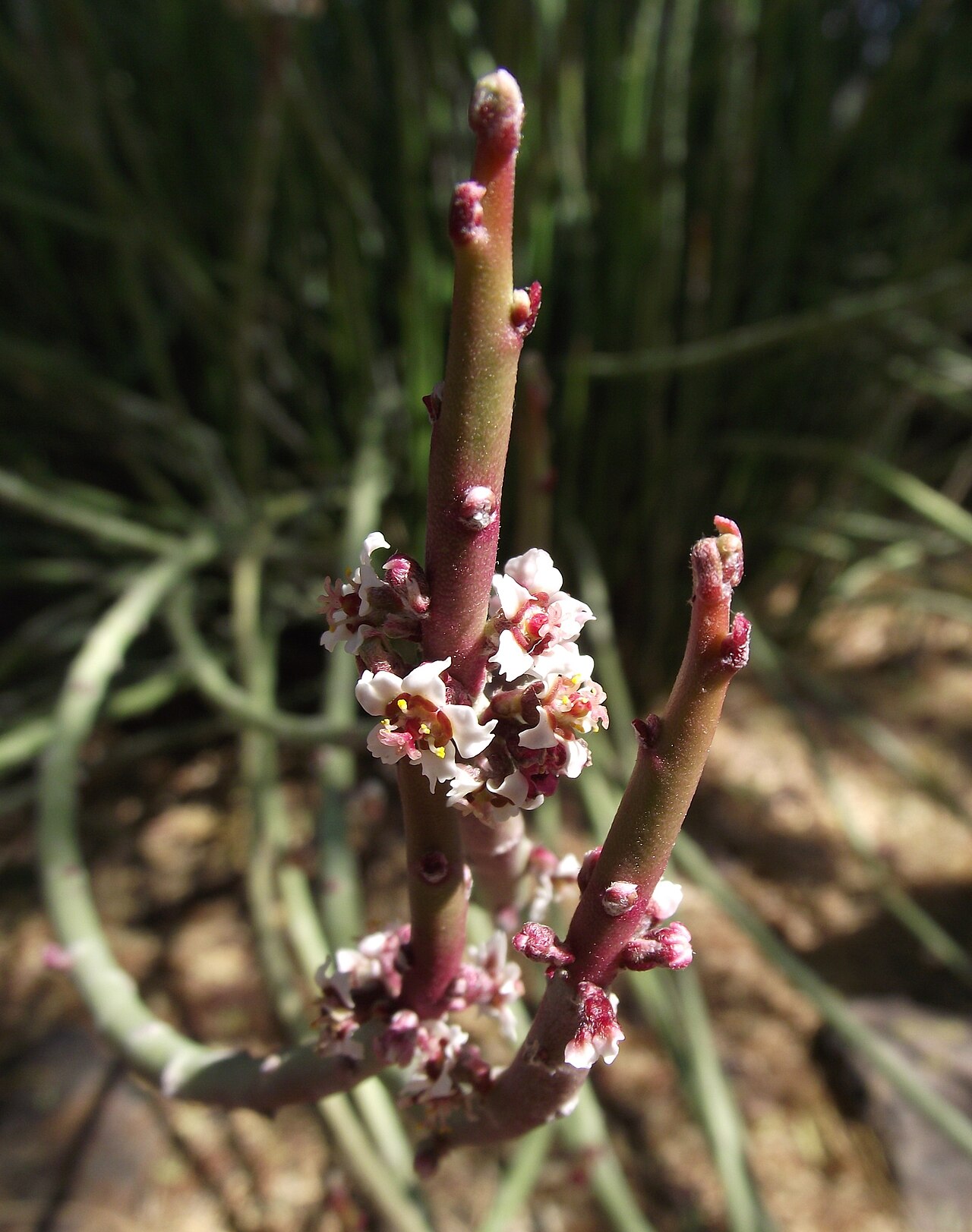
Look for a clump of many erect, round, wax-coated, gray-green stems about the thickness of a pencil, with no obvious leaves, and small pinkish-white flowers near the stem tips after rain. A broken stem oozes white latex.
Growth Habit
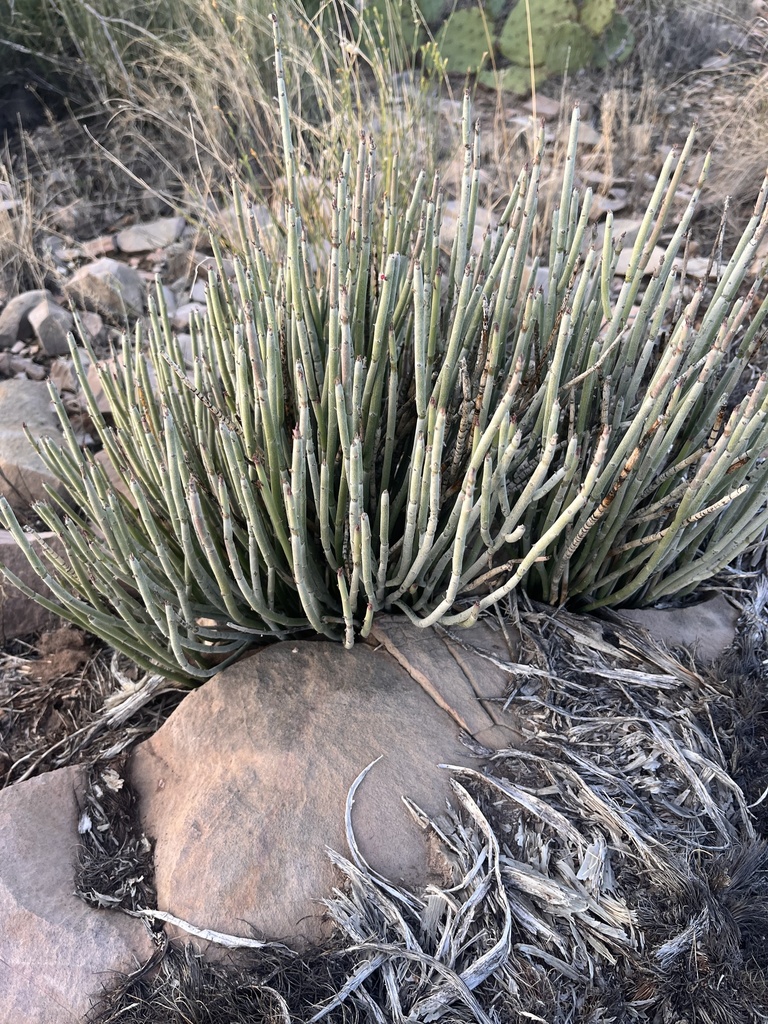
Candelilla is a perennial succulent subshrub. It grows from a woody base and spreading roots, sending up dense, upright stems that form clumps 1 to 3 feet tall and 2 to 4 feet or more across. Old clumps can become large colonies. The stems are about 1/4 inch thick, round, jointless and sparingly branched, and covered with a white to bluish wax.
Leaves
The leaves are tiny (about 1/16 inch), narrow and scale-like, and fall off soon after they form, so the plant looks leafless. The waxy green stems do the work of photosynthesis.
Flowers
Like other spurges, candelilla has a special flower structure called a cyathium: a small cup holding many tiny male flowers and a single female flower, surrounded by petal-like white to pink appendages. The cyathia are about 1/4 inch across, with red to reddish-brown glands in the center, and are borne singly or in small clusters along the upper stems. Flowering is mainly from spring through summer, especially after rains.
Fruit & Seeds
The fruit is a small, three-lobed capsule that splits open when ripe and throws out its seeds.
Look-alikes
Jointfirs such as joint-fir and clapweed (Ephedra antisyphilitica, a different plant with the same species name) also have slender green stems, but their stems are jointed, often ridged, without wax and without milky sap, and they bear small cones instead of flowers. Leatherstem is a relative in the spurge family with flexible, reddish stems and narrow leaves. Pencil cactus (Euphorbia tirucalli), a common houseplant from Africa, has branching green stems without the gray wax coat.
Quick Facts
| Scientific Name | Euphorbia antisyphilitica |
| Family | Euphorbiaceae (spurge family) |
| Plant Type | Succulent perennial subshrub |
| Mature Height | 1–3 ft |
| Mature Spread | 2–4 ft or more; forms colonies |
| Growth Rate | Slow to moderate |
| Sun Exposure | Full sun to part shade |
| Water Needs | Very low; extremely drought tolerant |
| Soil Type | Rocky, gravelly or sandy, well-drained soil; limestone and volcanic |
| Soil pH | Neutral to alkaline (about 7.0–8.5) |
| Bloom Time | Spring–summer, mainly after rain |
| Flower Color | White to pink with reddish centers |
| Fall Color | None; evergreen gray-green stems |
| Fruit | Small three-lobed capsule |
| Deer Resistant | Yes; toxic latex |
| USDA Hardiness Zones | 8–11 |
Native Range
Candelilla is a Chihuahuan Desert plant. USDA PLANTS lists it as native in Texas and New Mexico. In Texas it grows in the Trans-Pecos and along the Rio Grande, and it is common in the Big Bend region, in Brewster and Presidio counties and in Big Bend National Park, with records extending east toward the lower Pecos. Records from New Mexico are few, at the northern edge of the range.
Most of its range is in northern Mexico, in the states of Coahuila, Chihuahua, Durango, Nuevo León and Zacatecas, south into central Mexico. Coahuila and Chihuahua are the heart of the Mexican candelilla wax industry.
It grows on dry, rocky limestone hills and ridges, gravelly slopes, ledges and desert flats, usually in full sun among other desert shrubs and succulents, from about 1,000 to over 4,000 feet.
📋 Regional plant lists featuring Candelilla: South & West Texas
Growing & Care Guide
Candelilla is one of the easiest succulents for hot, dry gardens in the Southwest and a good container plant elsewhere. Buy nursery-grown plants; wild harvest of candelilla in Big Bend National Park and other protected areas is not allowed.
Light
Full sun gives the densest, grayest clumps. It tolerates part shade, where it grows greener and a bit looser. As a houseplant, give it the brightest window you have.
Soil & Water
It needs very well-drained soil: gravel, rocky limestone, decomposed granite or a cactus mix. Once established outdoors in the Chihuahuan Desert and similar climates, it needs no extra water. Occasional summer water speeds growth and flowering. Avoid wet, heavy soil, especially in winter, which causes rot. In containers, water deeply and let the soil dry out completely between waterings.
Planting Tips
Plant in spring or early summer. Use it as a vertical accent among rocks and boulders, in gravel gardens, along walls, in large pots or with agaves, yuccas and cacti. It is hardy to around 15°F to 20°F when dry; in colder areas grow it in a container and bring it in for winter.
Pruning & Maintenance
It needs almost no care. Remove dead or damaged stems at the base, and divide old clumps if they spread too far. Always wear gloves and eye protection when cutting or dividing it, because of the milky sap.
Propagation
Divide clumps in spring or summer, or take stem cuttings, let the cut ends dry and callus for several days (rinse off the latex while wearing gloves), and set them in dry, gritty soil. It can also be grown from seed.
Safety: Toxic Latex
Like other spurges, candelilla has a milky white sap (latex) that irritates the skin and can cause painful inflammation and even temporary blindness if it gets into the eyes. Wear gloves and eye protection when handling it, wash any sap off the skin right away with soap and water, and rinse eyes with plenty of water and get medical help if sap gets into them. All parts are poisonous if eaten. Keep it away from places where children and pets play. The wax extracted commercially is processed and is not the same as touching the raw plant.
Landscape Uses
- Xeriscapes: needs no water once established in the desert
- Rock gardens: a vertical, gray-green accent among boulders
- Containers: a striking pot plant, indoors or on a sunny patio
- Desert gardens: pairs with agaves, sotols, yuccas and cacti
- Low-maintenance borders: deer and rabbit resistant
Wildlife & Ecological Value
In the Chihuahuan Desert, candelilla clumps provide flowers after rain and shelter on bare, rocky ground.
For Pollinators
The small, nectar-producing cyathia are visited by bees, wasps, flies and small butterflies, especially after summer rains when the plants flower heavily.
For Birds
Ground birds such as quail may eat the seeds, and small birds and lizards shelter among the dense stems.
For Mammals
The toxic, waxy stems are rarely eaten by deer, rabbits or livestock, which is one reason candelilla thrives on grazed land.
Ecosystem Role
Dense colonies help hold rocky, eroding soils on desert slopes. Overharvesting for wax has reduced candelilla in parts of northern Mexico, where harvest is regulated, and conservation of wild stands is an ongoing concern.
Cultural & Historical Uses
The common name candelilla means “little candle” in Spanish, for the slender, upright, candle-like stems. The species name antisyphilitica comes from its old use in Mexican folk medicine to treat venereal disease. It has no proven medical use and should not be used as medicine.
Candelilla wax is made by boiling the stems in water with a little sulfuric acid; the wax floats to the top and is skimmed off and refined. It is harder than beeswax and is used in lip balms, lipsticks, polishes, crayons, candles, chewing gum and as a food glaze. In the Big Bend, a candelilla wax factory operated in the 1910s at Glenn Springs, now in Big Bend National Park; the small village was raided in 1916 during the Mexican Revolution.
In Mexico, gathering candelilla is still the livelihood of many families in the remote desert communities of Coahuila and Chihuahua, where harvesters are known as candelilleros.
Frequently Asked Questions
Is candelilla poisonous?
Yes. Its milky latex irritates skin and can seriously damage the eyes, and the plant is poisonous if eaten. Wear gloves and eye protection when handling it, and keep it away from children and pets.
What is candelilla wax used for?
Lip balms, lipsticks and other cosmetics, polishes, crayons, chewing gum and food glazes. It is a plant-based alternative to beeswax.
Is candelilla a cactus?
No. It is a succulent spurge in the family Euphorbiaceae. It has milky sap and no spines, unlike cacti.
Where does candelilla grow wild?
In the Chihuahuan Desert of West Texas, especially the Big Bend region, and northern Mexico, with a few records in New Mexico.
Can I grow candelilla as a houseplant?
Yes. Give it full sun or the brightest window, a gritty cactus mix and very little water, especially in winter.

Looking for a nursery that carries Candelilla?
Browse our native plant nursery directory: New Mexico · Texas

