
Singapore Graveyard Flower (Plumeria obtusa)
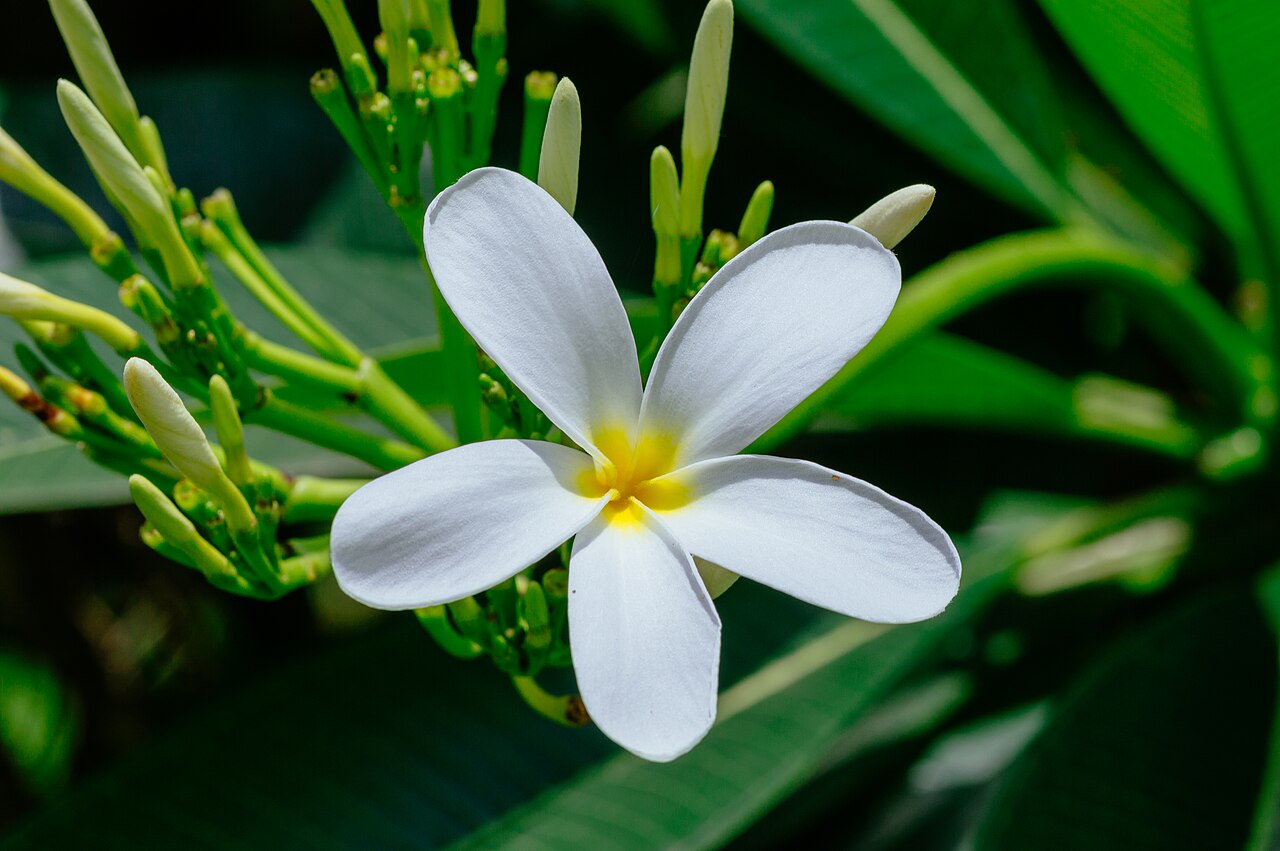
Plumeria obtusa, best known as Singapore Graveyard Flower or Singapore plumeria, is the evergreen white frangipani: a small tropical tree with thick, candelabra-like branches, glossy leaves with rounded tips, and clusters of pure white, yellow-eyed flowers that perfume the air on warm evenings. It belongs to the dogbane family (Apocynaceae), along with oleander, periwinkle and the Puerto Rican white frangipani (Plumeria alba).
Despite its common name, it is not from Singapore. Plumeria obtusa is a Caribbean and Central American native. Its wild range includes the Bahamas, the Greater Antilles and parts of southern Mexico and Central America, and within the United States, USDA PLANTS lists it as native to Puerto Rico and the U.S. Virgin Islands. It got its English name from Southeast Asia, where it has been planted in cemeteries and temple grounds for generations.
USDA PLANTS also lists it as native to Florida, but the Atlas of Florida Plants treats it as a non-native, cultivated species there, so this guide maps it in Puerto Rico only. Below you will find how to identify it, where it grows wild, how to grow it outdoors in zones 10–13 or in a container elsewhere, and what to know about its milky sap, which irritates skin and should not be eaten.
Identification
Gardeners usually meet this species beside the more common Plumeria rubra, the deciduous frangipani with pointed leaves and pink, red, yellow or white flowers. The blunt leaf tips, glossy evergreen foliage and pure white flowers of P. obtusa separate it, and so does its tendency to keep its leaves through winter in warm climates.
Growth Habit & Bark
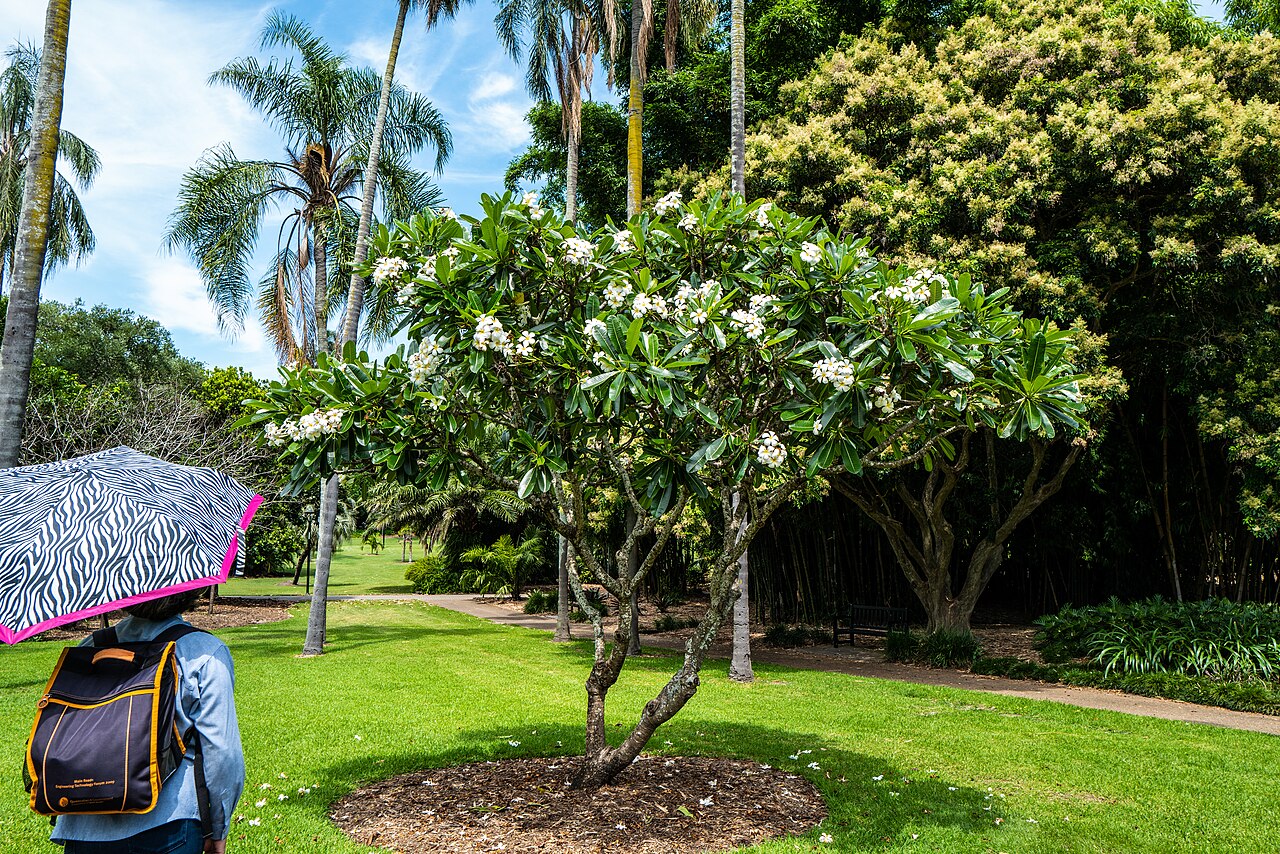
Singapore graveyard flower is a small tree or large shrub, usually 10 to 15 feet tall and about as wide, occasionally to about 25 feet. Compact “dwarf Singapore” selections stay 4 to 8 feet. The branches are thick, blunt and succulent, forking repeatedly to make a rounded, open crown. The bark is smooth and gray. Any broken twig or leaf bleeds a white, sticky latex.
Leaves
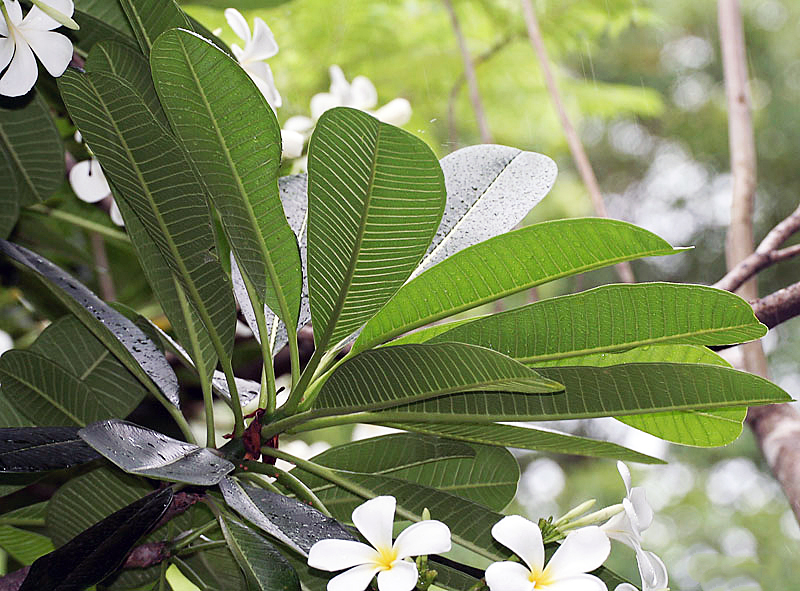
The leaves cluster near the tips of the branches. They are obovate (widest above the middle), about 4 to 8 inches long, thick, leathery, dark green and very glossy, with a rounded, blunt or slightly notched tip. Prominent side veins run almost straight to a vein along the leaf edge. In frost-free climates the leaves stay on all year, though plants shed many leaves in drought or cool weather.
Flowers
The flowers are borne in clusters at the branch tips, mainly from spring through fall, and on vigorous plants nearly year-round in the tropics. Each flower is about 2 to 3 inches across, with five thick, waxy, overlapping petals that are pure white with a yellow center. They are strongly and sweetly fragrant, especially in the evening.
Fruit & Seeds
Pollinated flowers produce paired, pod-like follicles several inches long, which ripen slowly and split to release flat seeds with a papery wing. Fruit is uncommon on garden plants, which are usually grown from cuttings.
Quick Facts
| Scientific Name | Plumeria obtusa L. |
| Family | Apocynaceae (dogbane family) |
| Plant Type | Small evergreen to semi-evergreen tree or large shrub |
| Mature Height | 10–15 ft (occasionally to about 25 ft); dwarf forms 4–8 ft |
| Mature Spread | 8–15 ft |
| Growth Rate | Slow to moderate |
| Sun Exposure | Full sun (tolerates light shade with fewer flowers) |
| Water Needs | Low to moderate; drought tolerant once established |
| Soil Type | Sandy, rocky or limestone soils; any very well-drained soil |
| Soil pH | About 6.0–8.0 (slightly acidic to alkaline) |
| Bloom Time | Spring through fall; much of the year in the tropics |
| Flower Color | White with a yellow center |
| Fall Color | None; evergreen in frost-free climates |
| Fruit | Paired pod-like follicles with winged seeds |
| Deer Resistant | Yes; the milky latex makes it unpalatable |
| USDA Hardiness Zones | 10–13 (11–13 for reliable flowering; container plant elsewhere) |
Native Range
Plumeria obtusa is native to the northern Caribbean and northern Central America: the Bahamas, the Greater Antilles, the Yucatán region of southern Mexico, Belize and Guatemala. Within U.S. jurisdictions, USDA PLANTS lists it as native in Puerto Rico and the U.S. Virgin Islands. It is a plant of warm, seasonally dry lowlands, typically on rocky or limestone ground, coastal thickets and open woodland.
USDA PLANTS also lists the species as native in Florida. The Atlas of Florida Plants, however, treats it as non-native, and the trees seen in South Florida and the Keys are generally planted. We follow the Atlas and show the species as native to Puerto Rico only; Florida gardeners can still grow it as a frost-tender ornamental.
Outside its native range it is one of the most widely planted tropical trees, grown across Southeast Asia, India, the Pacific islands (including Hawaii), Australia and the Middle East. It has naturalized in parts of Asia but is generally not considered a serious invader.
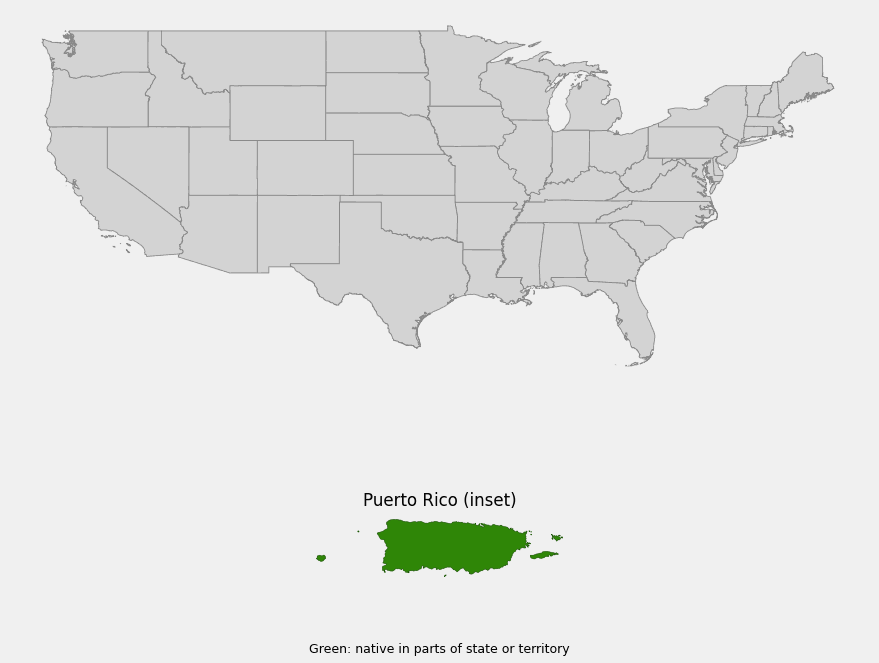
📋 Regional plant lists featuring Singapore Graveyard Flower: Puerto Rico
Growing & Care Guide
Singapore graveyard flower is a tough, low-maintenance tree in hot climates. It wants sun, heat and excellent drainage, and it suffers mostly from cold and wet roots. In zones 10–13 it grows outdoors as a specimen tree or large shrub. In colder areas it is grown in a container that spends summer outside and winter in a bright, frost-free room.
Light
Plant it in full sun: at least six hours of direct sun a day, and more is better. It tolerates light shade but flowers much less. Indoors in winter, give potted plants the sunniest window you have, or a grow light.
Soil & Water
The soil must drain fast. In the ground, sandy, rocky or limestone soils are ideal; in heavy soil, plant on a mound or raised bed. In containers use a gritty cactus or palm mix in a pot with large drainage holes. Water deeply, then let the soil dry out before watering again. Established trees in the ground tolerate long dry spells. Overwatering, especially in cool weather, causes stem and root rot. Feed during the growing season with a fertilizer relatively high in phosphorus to encourage blooms, and stop feeding in fall.
Planting Tips
Plant in warm weather. Set the root ball at the same depth it grew in the pot, and stake young trees in windy sites until they root. For containers, choose a heavy pot slightly larger than the root ball; plumerias bloom well when a little root-bound. Bring potted plants indoors before night temperatures drop below about 50°F (10°C). They tolerate brief dips toward 40°F but are damaged by frost.
Pruning & Maintenance
Prune in late winter or spring, cutting just above a branch junction. Each cut branch usually forks into two or three new shoots, which bear flowers at their tips, so light pruning makes a fuller, more floriferous tree. Wear gloves and eye protection, because the white latex irritates skin and eyes. Watch for plumeria rust (orange powdery spots on leaf undersides), scale, mealybugs, spider mites and, in the Caribbean and Florida, the large black-and-yellow-banded caterpillars of the frangipani hornworm.
Propagation
Cuttings are the standard method. Cut a branch tip 12 to 18 inches long in spring or early summer, let the cut end dry and callus for a week or two in shade, then plant it in a dry, gritty mix and water sparingly until new leaves appear. Roots usually form in four to eight weeks in warm weather. Seeds also germinate readily but take several years to flower.
Landscape Uses
- Specimen tree: a small flowering tree for patios, courtyards and entryways in zones 10–13
- Fragrance garden: near windows, seating areas and walkways where evening fragrance can be enjoyed
- Coastal and xeriscape gardens: tolerates salt wind, poor soil and drought once established
- Container plant: a patio plant in colder climates, moved indoors in winter
- Native landscapes in Puerto Rico: in dry, sunny gardens and coastal plantings
Wildlife & Ecological Value
In its native Caribbean habitat, Plumeria obtusa is a small but distinctive part of dry, sunny lowland woodland. Its flowers and leaves are linked to some of the region’s most striking insects.
For Pollinators
Plumeria flowers are famous for a trick: they smell sweet and look like nectar-rich flowers, but they produce little or no nectar. Sphinx moths, the main pollinators, visit the fragrant white flowers at dusk and at night, probe them in vain, and move on to the next flower, carrying pollen with them. Bees and butterflies also visit by day.
For Birds
The tree offers perches and nest sites in its forked branches. Birds sometimes eat the large caterpillars of the frangipani hornworm, though these warningly colored caterpillars are distasteful to many predators.
For Mammals
The toxic latex makes the foliage unpalatable to most browsing mammals.
Ecosystem Role
Plumerias are host plants for the tetrio sphinx moth (Pseudosphinx tetrio), whose black, yellow-banded and red-headed caterpillars, known as frangipani hornworms, can strip a tree of leaves in late summer. The trees recover quickly, and the caterpillars are a natural part of the plant’s ecology in its native range.
Cultural & Historical Uses
The genus Plumeria honors Charles Plumier, a 17th-century French monk and botanist who explored the Caribbean, including the Antilles. Linnaeus named Plumeria obtusa in 1753; obtusa refers to the blunt leaf tips. The name frangipani is often said to come from an Italian noble family, the Frangipani, associated with a perfume whose scent the flowers were thought to resemble.
Plumerias were carried from the Americas across the tropics early in the colonial era, and they became woven into the cultures of South and Southeast Asia and the Pacific. In Malaysia, Singapore and nearby countries, white frangipanis have long been planted in cemeteries and around temples, giving this species its English name. In Hawaii, plumeria flowers are among the most popular for lei.
In the Caribbean, white plumerias are cherished garden trees, and their flowers are used in garlands and offerings. The milky latex has been used in traditional medicine in several countries, but it is irritating and potentially toxic, and it should not be used as a home remedy.
Frequently Asked Questions
Is Plumeria obtusa poisonous?
It is considered mildly toxic. The white latex in the stems and leaves can irritate skin and eyes and may cause a rash in sensitive people, and eating plant parts can cause stomach upset, vomiting or diarrhea in people and pets. Wear gloves when pruning, keep children and pets from chewing the plant, and contact a doctor, veterinarian or Poison Control (1-800-222-1222 in the U.S.) if someone swallows it.
Is Singapore plumeria native to the United States?
Yes, in Puerto Rico and the U.S. Virgin Islands, according to USDA PLANTS. USDA also lists Florida, but the Atlas of Florida Plants treats it as non-native there. Its wider native range is the northern Caribbean, southern Mexico, Belize and Guatemala.
What is the difference between Plumeria obtusa and Plumeria rubra?
P. obtusa has glossy, dark green leaves with rounded tips, white yellow-eyed flowers, and tends to stay evergreen in warm climates. P. rubra has duller, pointed leaves, flowers in many colors, and usually drops its leaves in winter. Many garden plumerias are cultivars or hybrids of P. rubra.
Why is my plumeria not blooming?
The usual causes are too little sun, too much nitrogen fertilizer, overwatering, or a plant that is too young. Move it into full sun, switch to a bloom-promoting fertilizer, and let the soil dry between waterings. Plants grown from cuttings usually bloom within one to three years.
Can I grow Plumeria obtusa in a pot?
Yes. Use a gritty, fast-draining mix, put it outdoors in full sun in warm months, and bring it into a bright, frost-free room when nights fall below about 50°F. Water sparingly in winter. Dwarf Singapore forms are especially suited to containers.

Looking for a nursery that carries Singapore Graveyard Flower?
Our nursery directory does not yet include Puerto Rico. Browse the native plant nursery directory by state: Alabama–Arkansas · California · Colorado–Hawaii · Idaho–Kansas · Kentucky–Montana · Nebraska–Oklahoma · Oregon · Pennsylvania–Virginia · Washington · West Virginia–Wyoming

