
Northern Evening-primrose (Oenothera parviflora)
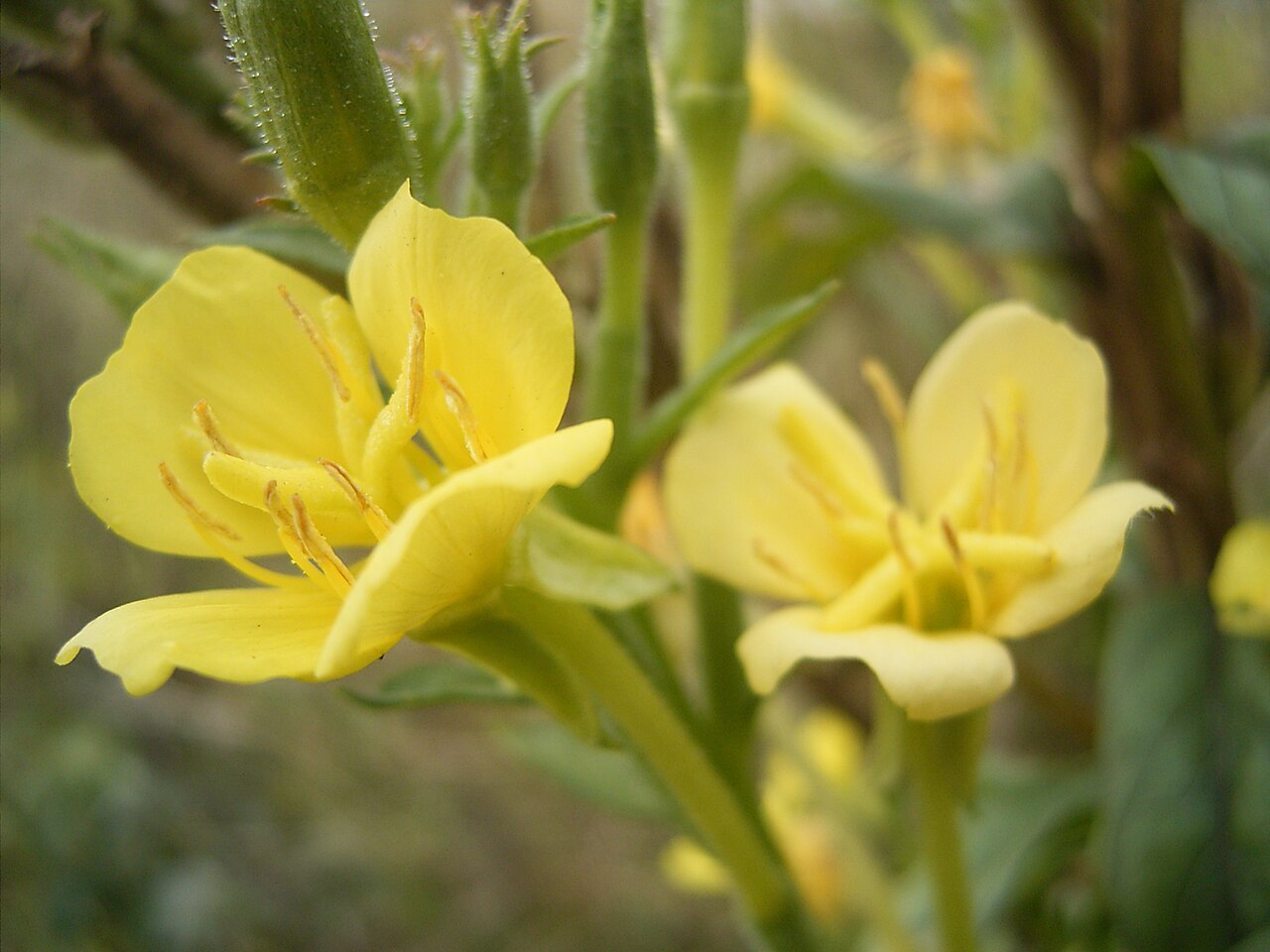
Oenothera parviflora, Northern Evening-primrose (also called small-flowered evening-primrose), is a native biennial wildflower of the Northeast, the Great Lakes region and eastern Canada. In its first year it forms a flat rosette of narrow leaves; in its second it sends up a leafy stem 1 to 4 feet tall that opens pale yellow, four-petaled flowers from midsummer into fall. Like other evening-primroses, each flower opens around dusk and lasts only until the following morning.
It is a close cousin of the familiar Common Evening Primrose (Oenothera biennis), and the two are easily confused. Northern evening-primrose has smaller flowers (the name parviflora means “small-flowered”), a flower spike whose tip usually curves or nods, and stems often dotted with red-based hairs. It grows in sunny, sandy and gravelly places: beaches and dunes, rocky shores, old fields, roadsides and railways.
Evening-primroses are a classic example of a complicated plant group. Many forms self-pollinate and breed true, and botanists have argued over how many species to recognize for more than a century. This guide explains how to identify northern evening-primrose, where it grows, how to grow it in a meadow or dune garden, and what it offers moths, bees and seed-eating birds.
Identification
Northern evening-primrose looks like a slightly smaller, more slender common evening primrose. The best features to check are flower size, the shape of the top of the flower spike, and the hairs on the stem and buds.
Rosette & Stems
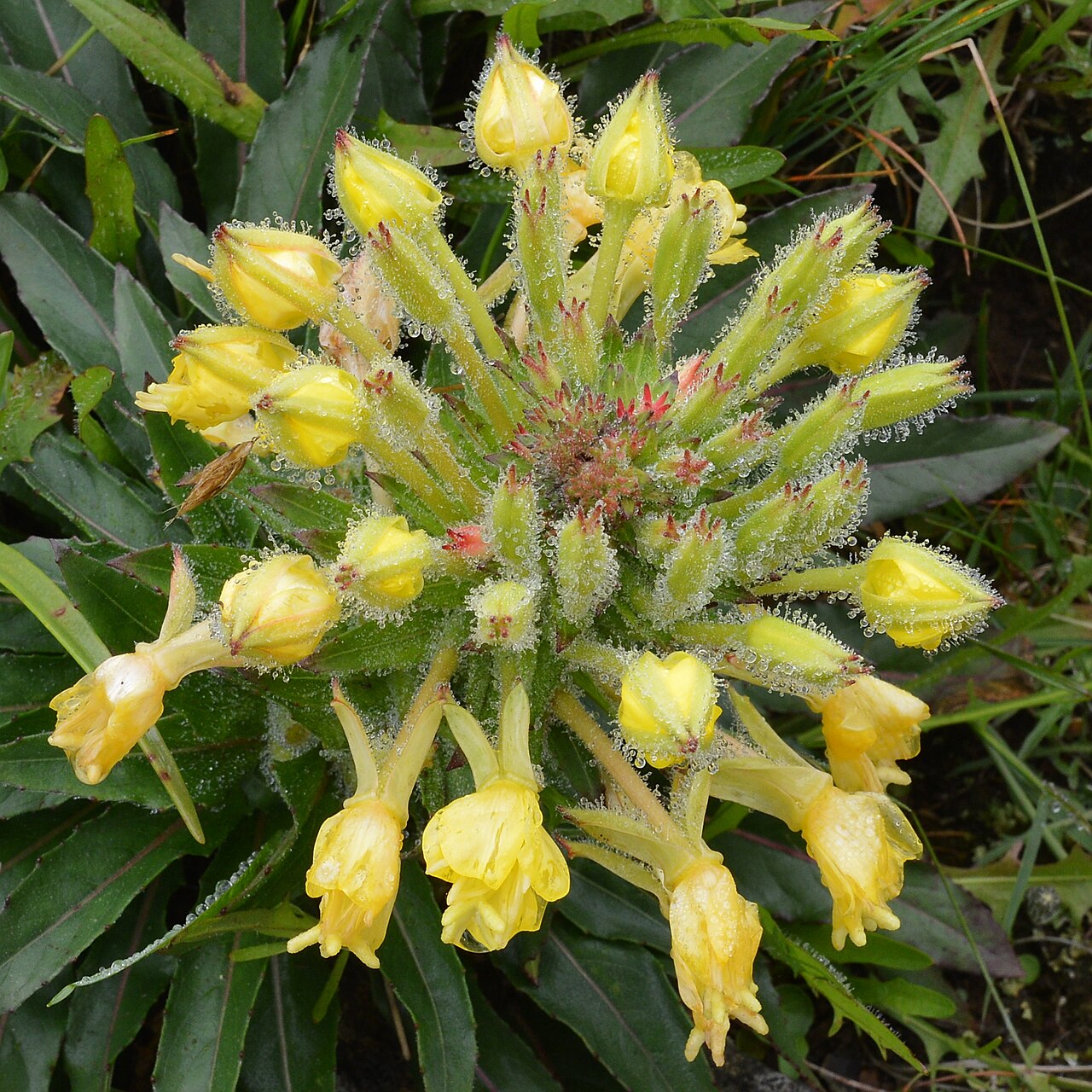
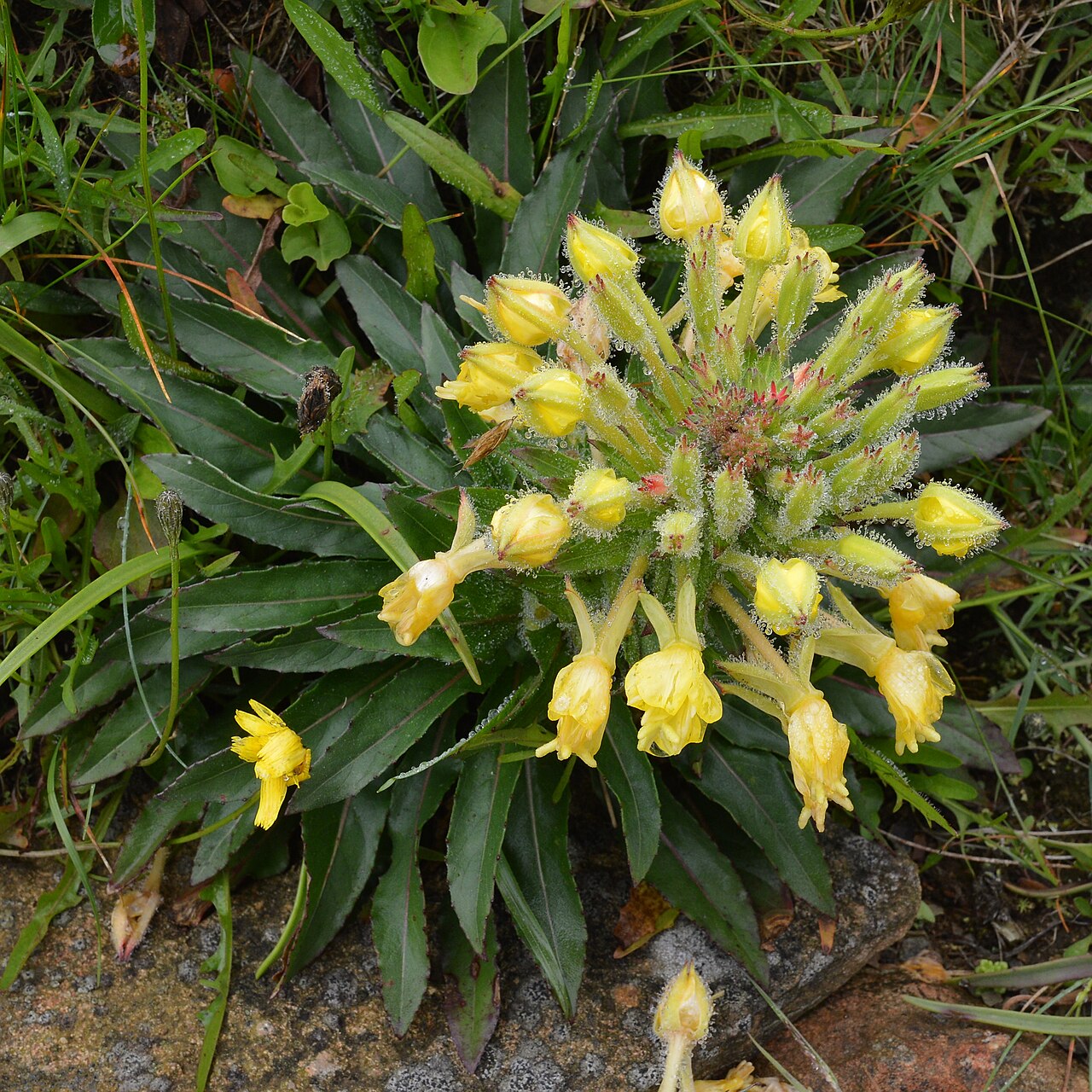
In its first year the plant is a ground-hugging rosette of narrow, lance-shaped leaves, often with a pale or reddish midrib. In its second year it bolts into a single stem or a few stems, usually 1 to 4 feet tall, which may branch near the base. The stems are green to reddish and covered with short hairs, often mixed with longer hairs that rise from small red, blister-like bumps.
Leaves
Stem leaves are alternate, narrowly lance-shaped to elliptic, about 2 to 6 inches long, with shallow, widely spaced teeth or nearly smooth edges. They are often dark green and slightly wavy.
Flowers
The flowers grow in a dense spike at the top of the stem, and in many plants the very tip of the spike curves over or nods. Each flower has four broad, pale yellow petals, roughly 1/2 to 3/4 inch long, a long floral tube, eight stamens and a cross-shaped stigma. In northern evening-primrose the stigma sits among the anthers, so the flowers usually pollinate themselves as they open. The green sepals and buds are often tinged or striped with red. Flowers open from about July to September or October.
Fruit & Seeds
The fruit is a narrow, four-sided capsule about 1 inch long, hairy and tapering toward the tip. It splits at the top in fall to release many small, angular seeds. The dry stems with their open capsules often stand through winter.
Look-alikes
Common Evening Primrose (O. biennis) has larger petals, mostly 3/4 to 1 1/4 inches long, an upright spike tip and generally fewer red-based hairs. Oakes’ evening-primrose (O. oakesiana), of sandy shores and dunes, is grayish with dense fine hairs and is treated by some botanists as part of O. parviflora. Sundrops (O. fruticosa) are perennials that bloom by day, with larger, brighter yellow flowers and club-shaped capsules.
Quick Facts
| Scientific Name | Oenothera parviflora (syn. O. muricata) |
| Family | Onagraceae (evening-primrose family) |
| Plant Type | Herbaceous biennial wildflower |
| Mature Height | 1–4 ft in flower |
| Mature Spread | 1–2 ft |
| Growth Rate | Fast |
| Sun Exposure | Full sun |
| Water Needs | Low to medium; dry to average, well-drained soil |
| Soil Type | Sandy, gravelly or rocky soils; also disturbed loam |
| Soil pH | About 5.5–7.5 |
| Bloom Time | July–September (sometimes into October) |
| Flower Color | Pale yellow |
| Fall Color | Rosette leaves often redden in fall |
| Fruit | Narrow four-sided capsule with many small seeds |
| Deer Resistant | Moderate; rosettes are sometimes browsed |
| USDA Hardiness Zones | 3–7 |
Native Range
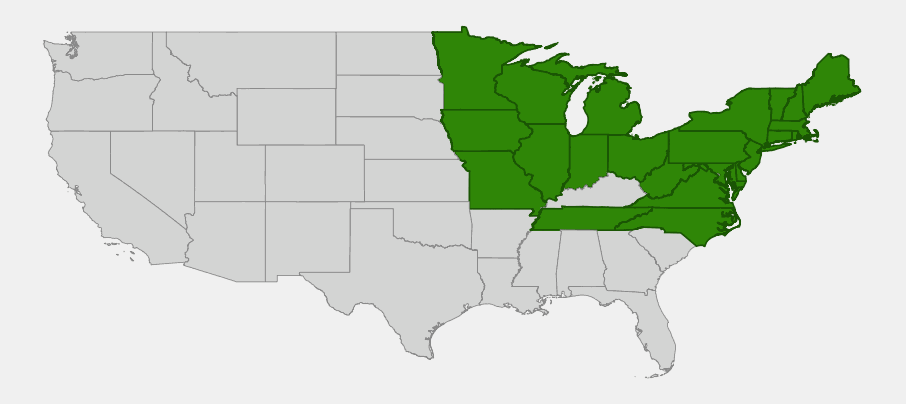
Northern evening-primrose is native to northeastern North America. USDA PLANTS and the Lady Bird Johnson Wildflower Center record it in 23 states and the District of Columbia: all of New England, New York, New Jersey, Pennsylvania, Delaware and Maryland, south through Virginia and West Virginia to North Carolina and Tennessee, and west through Ohio, Indiana, Illinois and Michigan to Wisconsin, Minnesota, Iowa and Missouri. In Canada it ranges through Ontario, Quebec and the Atlantic provinces to Newfoundland.
It is most common in the glaciated Northeast and Great Lakes region, especially on sandy coastal plains, beaches, dunes and lakeshores, and on open, gravelly ground such as road and railroad edges and old pits. It is less frequent at the southern and western edges of its range.
Northern evening-primrose has also been carried to Europe, where it has naturalized in places, which is why some of the best photographs of it come from there. In North America it is one of several native evening-primroses whose boundaries are still debated; regional floras may treat it under different names or lump it with related species.
📋 Regional plant lists featuring Northern Evening-primrose: Connecticut, Massachusetts & Rhode Island · New Hampshire, Maine & Vermont · Delaware, Southern New Jersey & Long Island · New York, Pennsylvania & Northern New Jersey · Illinois, Iowa & Missouri · Ohio & Indiana · Maryland, Virginia & West Virginia · Michigan, Wisconsin & Eastern Minnesota · North & South Carolina · Kentucky & Tennessee
Growing & Care Guide
Northern evening-primrose is easy to grow from seed in a sunny, well-drained spot. As a biennial, it blooms in its second year and then dies, but it reseeds freely, so a patch keeps itself going.
Light
Give it full sun. It tolerates a little light shade, but the plants become leggy and flower less.
Soil & Water
It prefers lean, sandy or gravelly, well-drained soil, and it handles drought, salt spray and heat once established. Rich, moist soil produces tall, floppy plants. No fertilizer is needed.
Planting Tips
Sow seed on the surface of bare or lightly disturbed soil in fall or early spring; the seeds need light and benefit from a winter outdoors. Use it in dry meadows, sandy coastal gardens, gravel gardens and along driveways, or as a pioneer plant on bare ground. Since it is biennial, sow two years in a row to get flowers every year.
Pruning & Maintenance
Leave the seed heads standing over winter for birds and for reseeding. If you want fewer volunteers, cut some stalks after flowering. Thin crowded rosettes in spring. It is short-lived and fades as perennials and grasses fill in, so lightly disturb a patch of soil now and then to keep it going.
Propagation
Seed is the only practical method. Collect ripe capsules in fall, let them dry and shake out the seeds. Sow outdoors in fall, or cold-stratify for about a month before spring sowing.
Landscape Uses
- Dry meadows and gravel gardens: tolerates poor, sandy soil and drought
- Coastal and dune plantings: grows on beaches, dunes and salt-sprayed sites in its native range
- Evening and moon gardens: pale yellow flowers open at dusk
- Bird gardens: seed heads feed goldfinches and other finches in fall and winter
- Pioneer cover on bare ground: quickly covers disturbed, sandy soil
Wildlife & Ecological Value
Northern evening-primrose supports moths at night, bees in the early morning and seed-eating birds in fall and winter.
For Pollinators
Although its flowers often pollinate themselves, they still produce nectar and pollen. Sphinx moths and other night-flying moths visit them at dusk, and bees, including bumblebees and sweat bees, gather pollen from flowers that are still open in the early morning. Evening-primroses host the caterpillars of the primrose moth (Schinia florida), which hides in the flowers by day, and of several sphinx moths and flea beetles.
For Birds
The small seeds are eaten by American goldfinches and other finches, sparrows and juncos, which pick them from the open capsules in fall and winter. The dry stalks give perches in open fields.
For Mammals
Deer and rabbits occasionally browse the rosettes. Small rodents eat fallen seeds.
Ecosystem Role
As a pioneer biennial, northern evening-primrose quickly colonizes bare sand and gravel on shores, dunes and disturbed ground, holding soil and adding organic matter until longer-lived plants take over. Its seeds can persist in the soil for years, so it often reappears after disturbance.
Cultural & Historical Uses
Linnaeus named Oenothera parviflora in 1759. Evening-primroses were among the first North American plants grown in European gardens, and some, including this one, escaped and naturalized there. Its synonym O. muricata, “rough with points,” refers to the bumpy-based hairs on the stem.
Evening-primroses played an important part in the history of genetics. In the early twentieth century, the Dutch botanist Hugo de Vries studied unusual forms of evening-primrose and used them to develop his mutation theory. Later work showed that many evening-primroses have an unusual chromosome system that keeps their genomes intact and allows them to self-pollinate and breed true. That system helps explain why the group has so many forms and why its classification has been so difficult.
Native peoples and settlers used evening-primroses as food and medicine, especially the roots of first-year rosettes and the seeds. Most of that history refers to common evening primrose, which is also the source of commercial evening primrose oil. Northern evening-primrose is mainly valued today as a tough native wildflower for sandy, sunny places.
Frequently Asked Questions
How do I tell northern evening-primrose from common evening primrose?
Look at flower size and the tip of the spike. Northern evening-primrose has smaller petals (about 1/2 to 3/4 inch), a spike tip that usually curves or nods, and stems with red-based hairs. Common evening primrose has larger petals and an upright spike tip. The two can be hard to separate, and some plants are intermediate.
Is northern evening-primrose a perennial?
No. It is a biennial. It grows as a rosette in its first year, flowers in its second and then dies after setting seed. It reseeds readily, so a patch usually persists.
When do the flowers open?
Each flower opens around dusk and closes or wilts by the next morning or midday. New flowers open every evening from midsummer into fall.
Will it grow in sandy coastal soil?
Yes. It is a natural plant of beaches, dunes and rocky shores in the Northeast and Great Lakes, and it tolerates sand, drought and salt spray.
Is it good for wildlife?
Yes. Night-flying moths and early-morning bees visit the flowers, several moth caterpillars feed on it, and goldfinches and other birds eat the seeds in fall and winter.

Looking for a nursery that carries Northern Evening-primrose?
Browse our native plant nursery directory: Connecticut & Delaware · Illinois, Indiana & Iowa · Maine, Maryland, Massachusetts, Michigan, Minnesota & Missouri · New Hampshire, New Jersey, New York, North Carolina & Ohio · Pennsylvania, Rhode Island, Tennessee, Vermont & Virginia · West Virginia & Wisconsin

