
Swedish Cornel (Cornus suecica)
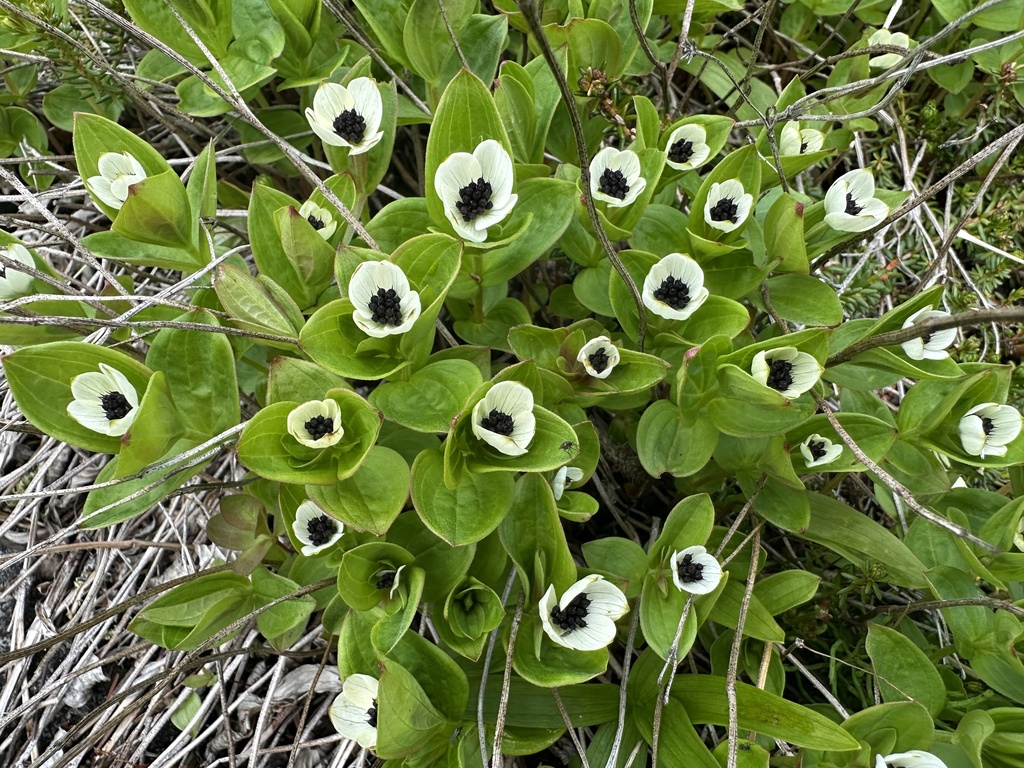
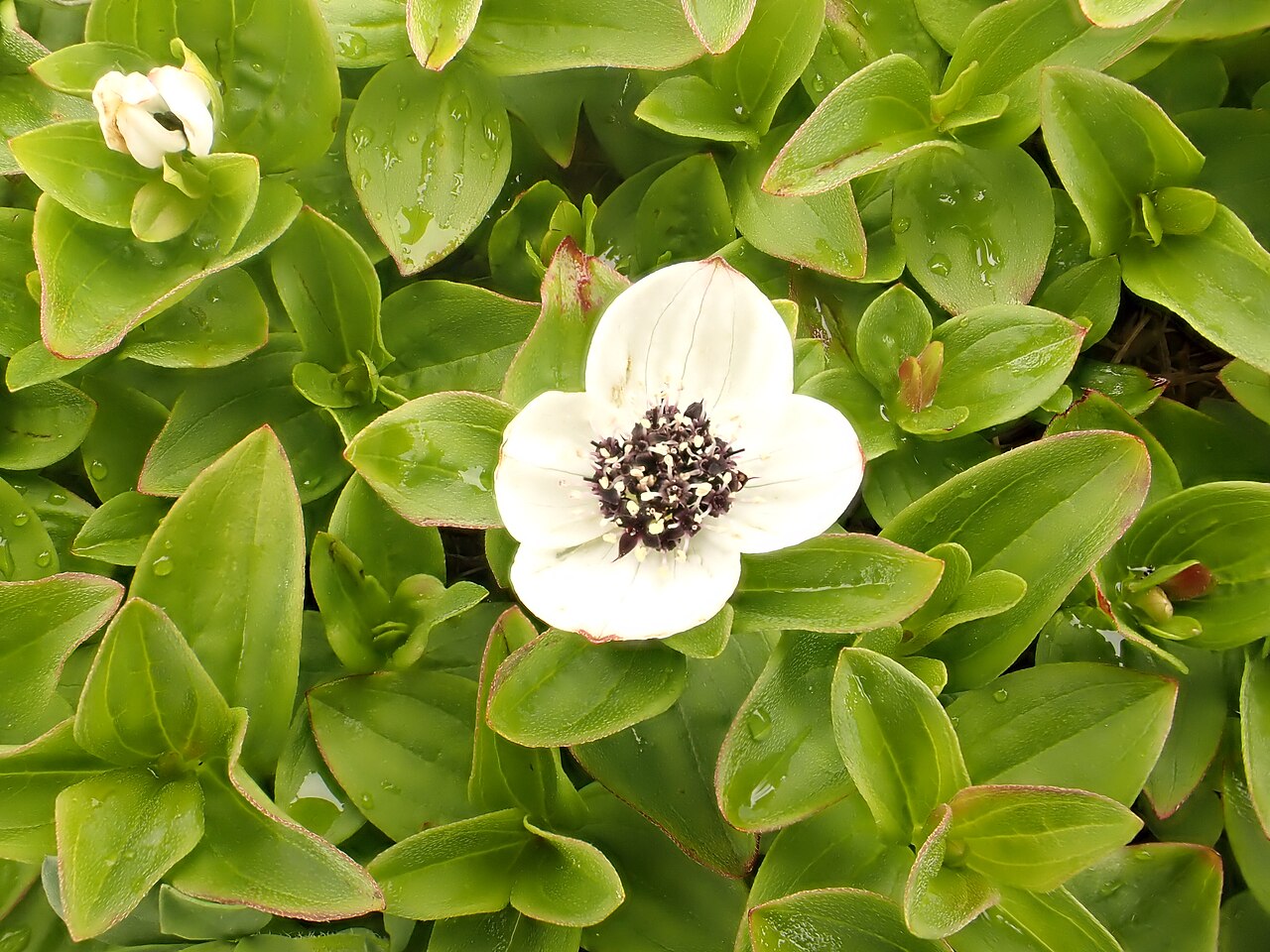
Cornus suecica, known as Swedish Cornel (also Lapland cornel, dwarf cornel or Swedish bunchberry), is a tiny, creeping dogwood of northern coasts, heaths and tundra. It grows only 2 to 10 inches tall from spreading underground stems, forming carpets of paired, prominently veined leaves. In early summer each stem is topped by what looks like a single white flower: four white bracts around a button of tiny, dark purple-black flowers.
It is a close relative of the familiar bunchberry (Cornus canadensis), and like bunchberry it produces a cluster of bright red berries in late summer. Its dark flower centers and leaves arranged in pairs up the stem, rather than in a whorl at the top, tell it apart.
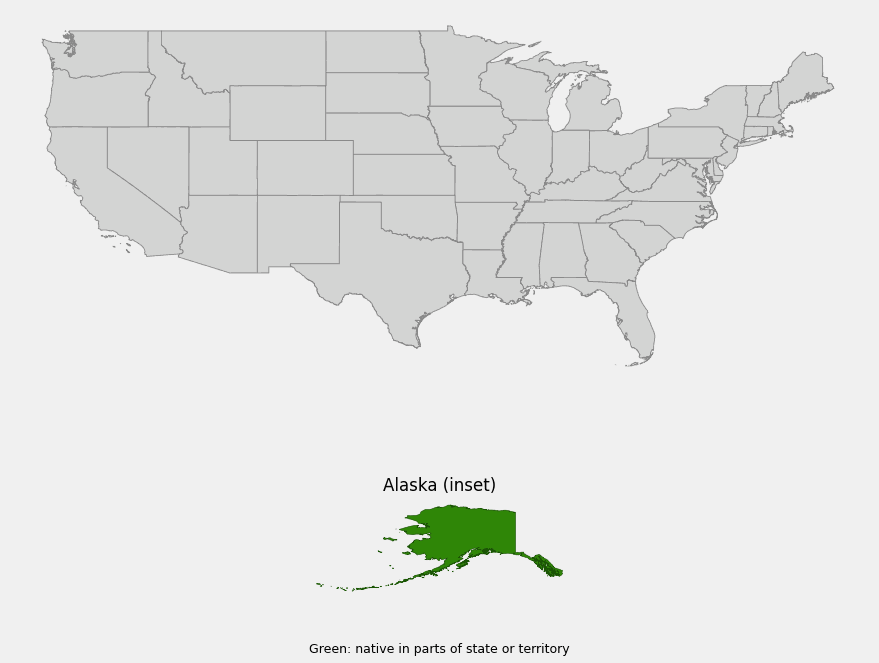
Swedish cornel is widespread in northern Europe and around the North Atlantic, and in the Pacific along the coasts of Alaska and northeast Asia. In the United States it is native only in Alaska, where it grows mostly near the coast, from Southeast Alaska and the Kenai Peninsula to Kodiak, the Aleutians and the Bering Sea coast. Where it meets bunchberry, the two hybridize.
Identification
Look for a low, carpet-forming plant with several pairs of stalkless, oval, veined leaves along each stem, a white four-bracted flower head with a dark purple-black center in June and July, and red berries in late summer.
Growth Habit
Swedish cornel is a low, herbaceous perennial (sometimes called a subshrub) that spreads by slender, branching rhizomes into large colonies. The upright stems are 2 to 10 inches tall and die back each winter. Unlike its tree and shrub relatives, it never forms woody stems above ground.
Leaves
The leaves are opposite, in three to six pairs spaced along the stem, stalkless, oval to egg-shaped, about 1/2 to 1 1/2 inches long, with the curving, parallel side veins typical of dogwoods. The top pairs are largest. In fall the leaves turn red to purple.
Flowers
The flower head sits on a short stalk at the stem tip. It is about 3/4 to 1 inch across, with four white (sometimes pink-tinged) petal-like bracts surrounding 8 to 25 tiny flowers. The flowers themselves have dark purple to blackish petals, giving the head its distinctive dark center. Bloom is in June and July.
Fruit & Seeds
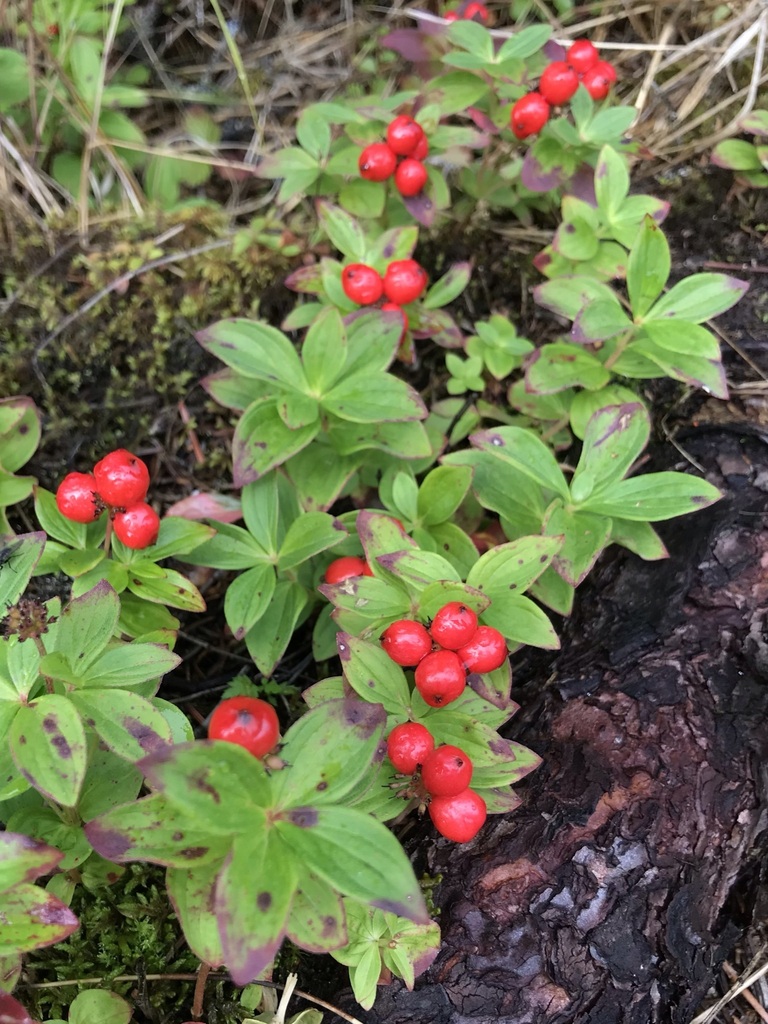
The fruits are round, bright red drupes about 1/4 inch across, clustered at the stem tip, ripening in late summer. Each contains a hard stone.
Look-alikes
Bunchberry (Cornus canadensis) has a whorl of four to six leaves at the top of the stem, small leaves or none below, and greenish-white to yellowish flowers in the center of the bracts. Western bunchberry (Cornus unalaschkensis), which arose from hybrids between the two, is intermediate, with some lower leaf pairs and flowers with purple-tipped petals. In coastal Alaska, all three grow and intergrade.
Quick Facts
| Scientific Name | Cornus suecica (syn. Chamaepericlymenum suecicum) |
| Family | Cornaceae (dogwood family) |
| Plant Type | Low, rhizomatous herbaceous perennial |
| Mature Height | 2–10 in |
| Mature Spread | Spreads by rhizomes into wide colonies |
| Growth Rate | Slow to moderate |
| Sun Exposure | Full sun to part shade |
| Water Needs | Medium to high; consistently moist soil |
| Soil Type | Moist, acidic, peaty or humus-rich soil |
| Soil pH | Acidic (about 4.5–6.0) |
| Bloom Time | June–July |
| Flower Color | White bracts with a dark purple-black center |
| Fall Color | Red to purple |
| Fruit | Clusters of bright red drupes |
| Deer Resistant | Low; browsed by deer and caribou |
| USDA Hardiness Zones | 2–6 |
Native Range
Swedish cornel has an unusual, broken range around the northern oceans. In Europe it grows from Scandinavia, Finland and northwest Russia to Britain, the Netherlands, northern Germany and Iceland, and it is also found in Greenland. In North America it grows in the Atlantic provinces of Canada (Newfoundland, Labrador, Nova Scotia, New Brunswick and Quebec) and in the Pacific Northwest, in Alaska and British Columbia, continuing across the Bering Sea into northeast Asia.
In the United States it is native only in Alaska. It is most common near the coast: in Southeast Alaska, around Cook Inlet and the Kenai Peninsula, on Kodiak Island, along the Alaska Peninsula and the Aleutians, and on the Bering Sea coast north to the Seward Peninsula region.
It grows in cool, moist, open places: coastal heath and meadows, moist tundra, bog margins, open spruce and hemlock forest, and subalpine meadows. It usually grows on acidic, peaty soils with crowberry, blueberries, cloudberry and mosses.
📋 Regional plant lists featuring Swedish Cornel: Alaska
Growing & Care Guide
Swedish cornel is a lovely groundcover for cool, moist, acidic soil in coastal Alaska and similar climates. It is rarely sold in North America; specialist nurseries in northern Europe offer it. Never dig plants from the wild.
Light
Full sun in cool coastal climates, or part shade where summers are warmer.
Soil & Water
It needs constantly moist, acidic, humus-rich or peaty soil, like that of a heath or bog edge. It does not tolerate drought, hot summers or alkaline soil, and it usually fails in warm-summer gardens.
Planting Tips
Plant rhizome divisions or pot-grown plants in spring, 6 to 12 inches apart, among heathers, crowberry and low blueberries, or in a peat or woodland garden. Mulch with leaf litter or pine needles to keep the soil cool and moist.
Pruning & Maintenance
No pruning is needed. Keep the soil moist and weed carefully by hand while the colony fills in.
Propagation
Divide rhizomes in early spring. Seed must be cleaned from the berries and sown outdoors in fall; it needs cold, moist stratification and may take more than a year to germinate.
Landscape Uses
- Groundcover: a low carpet for cool, moist, acidic soil
- Heath and bog gardens: mixes with crowberry, heathers and blueberries
- Northern native gardens: very cold hardy for coastal Alaska
- Woodland edges: flowers and red berries under open conifers
Wildlife & Ecological Value
Across the northern coasts, Swedish cornel provides flowers in early summer and berries in fall.
For Pollinators
The tiny flowers are visited by flies and small bees. Like bunchberry, the flowers may open explosively, flinging pollen onto visiting insects.
For Birds
Grouse, ptarmigan and other birds eat the red berries, which helps spread the seeds.
For Mammals
Deer, caribou and reindeer browse the plants, and bears and small mammals may eat the berries.
Ecosystem Role
Its rhizome mats help hold peaty soils in coastal heath and tundra, and it is a common part of the low plant cover in many northern ecosystems.
Cultural & Historical Uses
The species name suecica means “Swedish,” and Linnaeus described the plant from Sweden. In Swedish it is called hönsbär (“hen berry”), and in Norwegian skrubbær.
The berries are edible but mealy and almost tasteless. In parts of Scandinavia and Scotland they were traditionally said to increase the appetite, which gave the plant the Gaelic name lus-a-chraois, “plant of gluttony.”
Western bunchberry (Cornus unalaschkensis) of the Pacific Northwest is thought to have originated from hybrids between Swedish cornel and bunchberry, a well-known example of how new plant species can arise through hybridization.
Frequently Asked Questions
How do I tell Swedish cornel from bunchberry?
Swedish cornel has several pairs of leaves along the stem and dark purple-black flowers in the center of the white bracts. Bunchberry has a whorl of leaves at the top of the stem and greenish-white flowers.
Are Swedish cornel berries edible?
They are edible but mealy and nearly tasteless, and are rarely eaten.
Where does Swedish cornel grow in the United States?
Only in Alaska, mostly near the coast, from Southeast Alaska to the Aleutians and the Bering Sea coast.
When does Swedish cornel bloom?
In June and July, with red berries ripening in late summer.
Is Swedish cornel a dogwood?
Yes. It is a tiny, herbaceous member of the dogwood genus Cornus, closely related to bunchberry.

Looking for a nursery that carries Swedish Cornel?
Browse our native plant nursery directory: Alaska

