
Yellow Avens (Geum aleppicum)
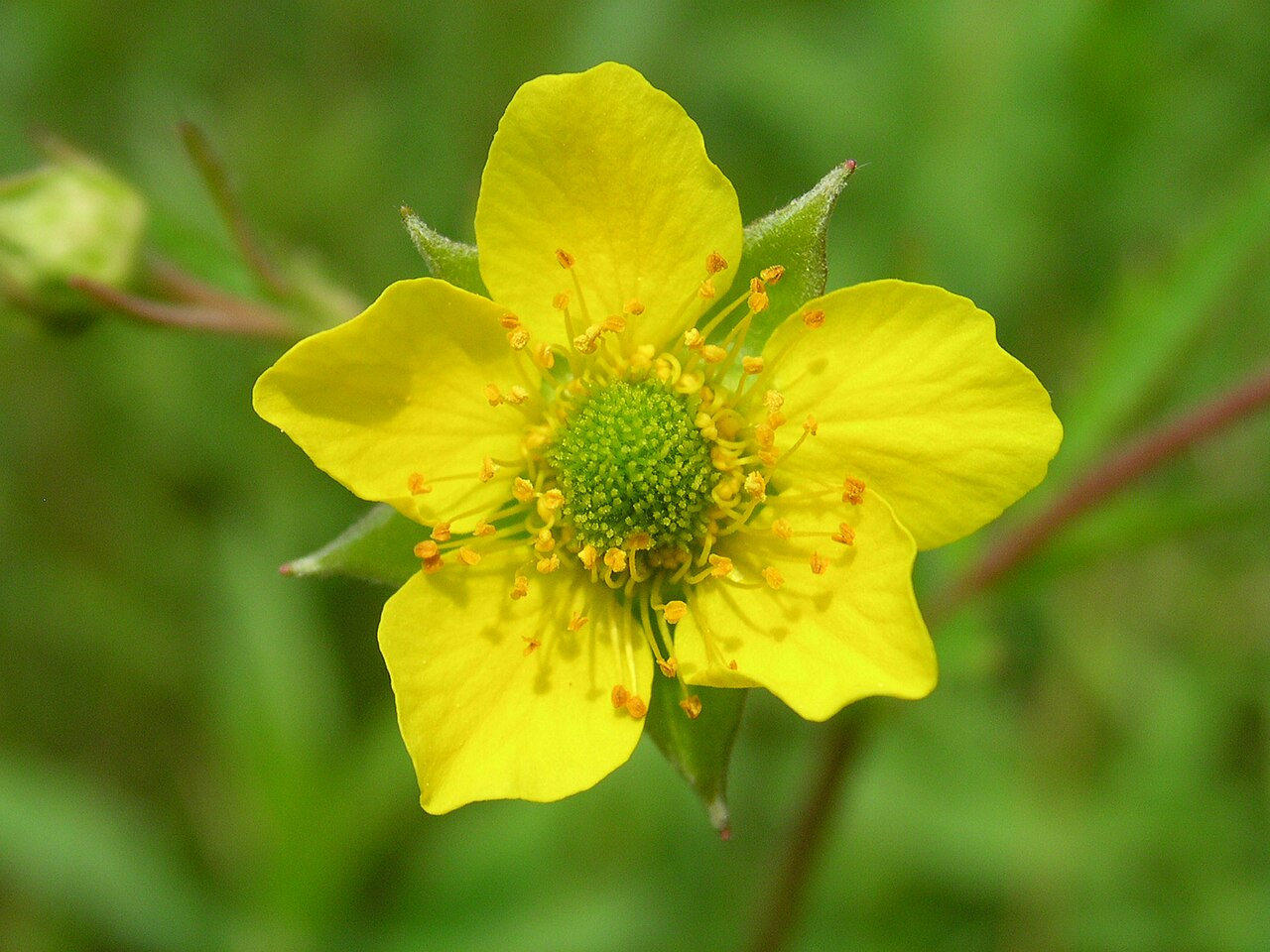
Geum aleppicum, known as Yellow Avens or Aleppo avens, is a hairy, upright perennial wildflower of moist meadows, thickets, stream banks and woodland edges across the northern United States, Canada and much of Eurasia. It grows 1 to 3 feet tall, with large, deeply divided basal leaves, and from early to late summer it carries bright yellow, five-petaled flowers about ¾ inch wide. It belongs to the rose family (Rosaceae).
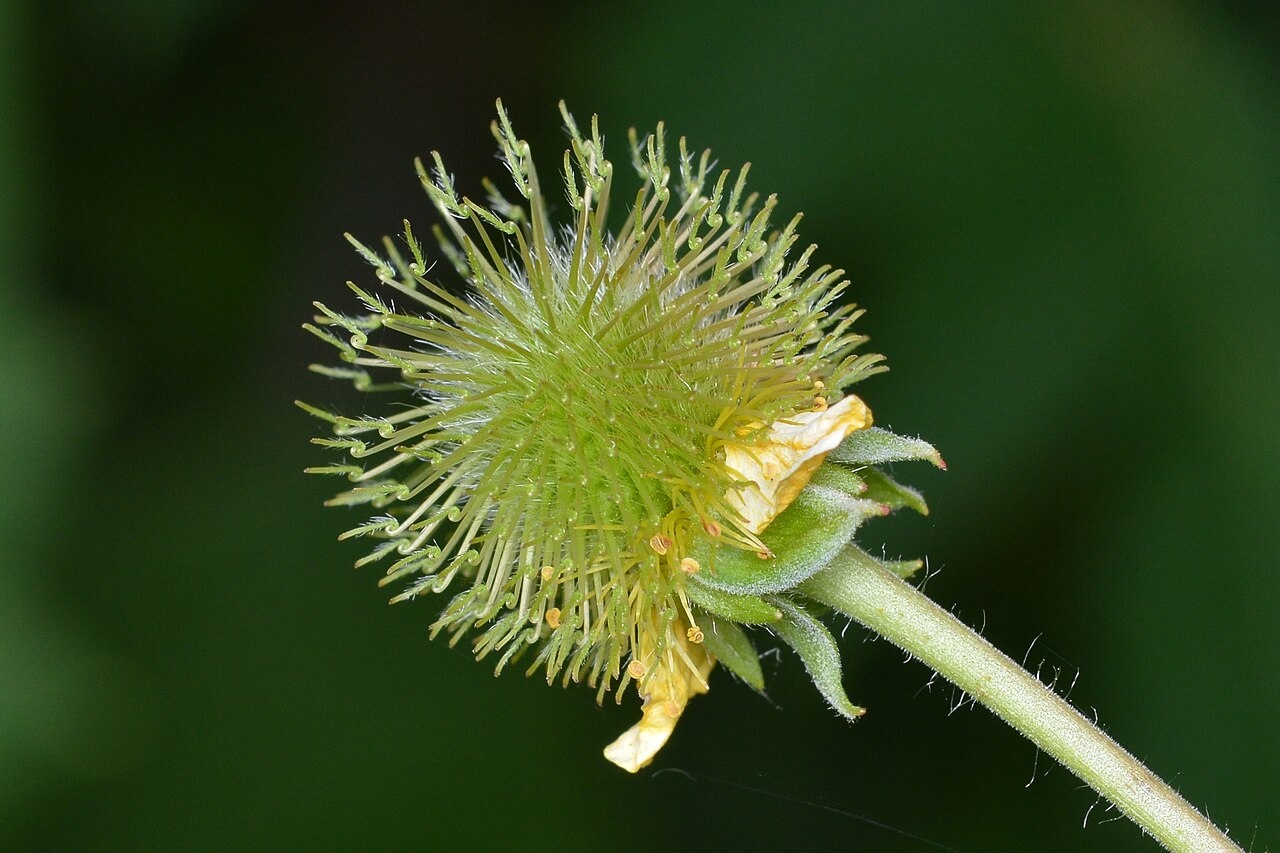
After the petals drop, each flower becomes a round, bristly seed head. Every seed ends in a tiny hook, and the heads cling to fur, socks and dog coats, which is how yellow avens travels. It is a close relative of Large-leaved Avens, White Avens and Prairie Smoke, and of the garden geums sold in nurseries.
Yellow avens is not a showy border plant, but it is an easy, adaptable native for wet meadows, rain gardens and naturalistic plantings, where its cheerful flowers draw small bees and flies through midsummer. This guide covers how to identify it, where it grows, how to grow it, and its place in northern meadows and thickets.
Identification
Several yellow-flowered avens grow in North America, and they can be tricky to tell apart. For yellow avens, look at the shape of the basal leaves, the hairiness of the plant and the details of the seed head.
Stems & Growth Habit
Plants grow from a short, thick rootstock and form a clump of basal leaves. Flowering stems rise 1 to 3 feet tall, branch near the top, and are covered with spreading, bristly hairs.
Leaves
Basal leaves are long-stalked and pinnately divided into 5 to 9 leaflets, with a terminal leaflet that is larger than the side ones and often 3-lobed, and smaller leaflets mixed in between the larger ones. Unlike large-leaved avens, the terminal leaflet is wedge-shaped at the base and deeply lobed rather than round and heart-shaped. Stem leaves are smaller and usually divided into three toothed, often lobed leaflets. All the leaves are hairy.
Flowers
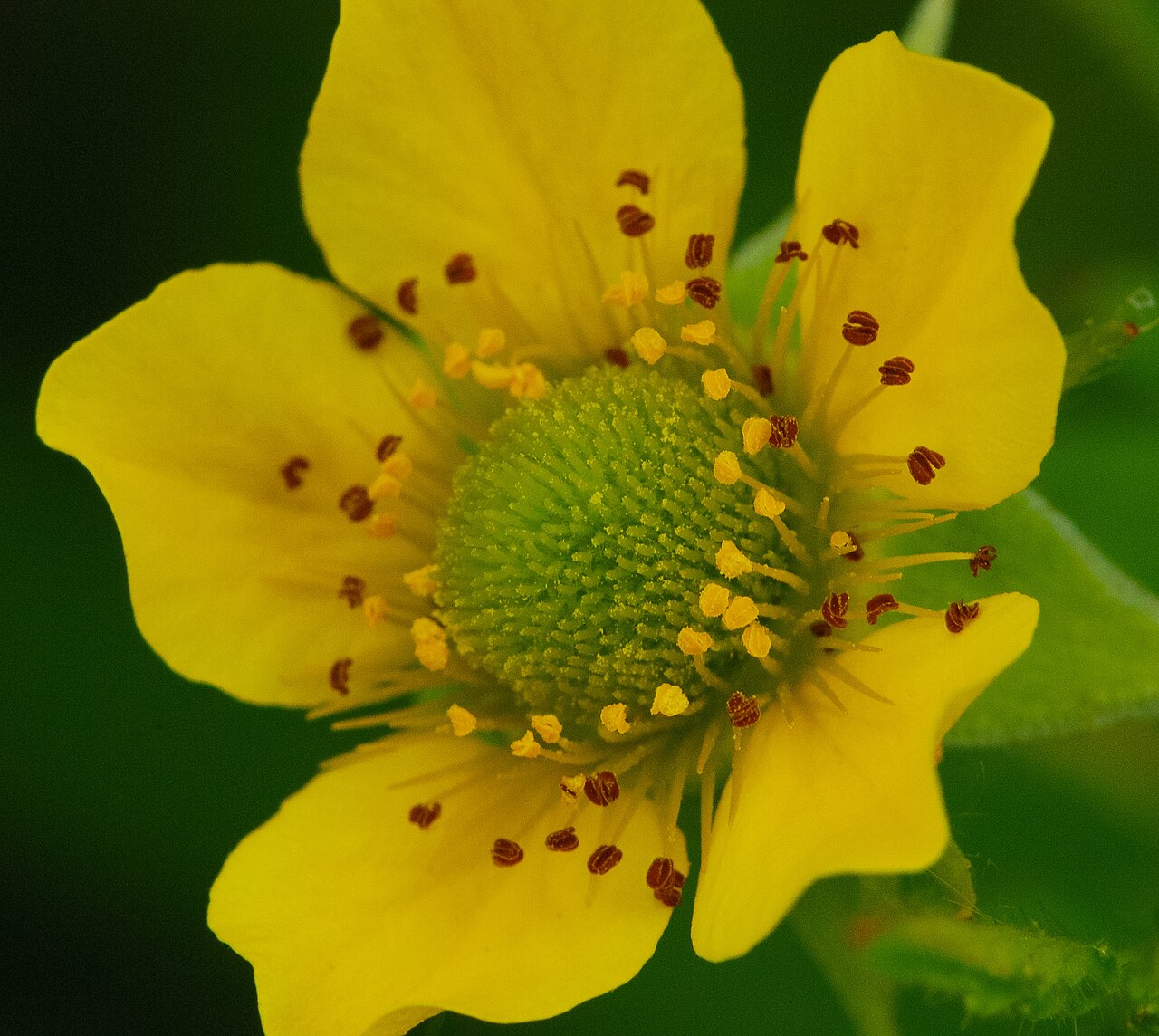
Flowers appear from June into August, a few at a time at the branch tips. Each is about ½ to ¾ inch across, with five rounded, bright yellow petals that are a little longer than the green, pointed sepals, which bend backward as the flower opens. The center holds many yellow stamens around a green dome of pistils.
Fruit & Seeds
The fruiting head is round to egg-shaped, about ½ to ¾ inch across, and made of many small, hairy achenes. Each achene carries a jointed style; the upper section falls away, leaving a sharp hook. The base the seeds sit on (the receptacle) is covered with short hairs, which helps separate it from large-leaved avens. The heads turn brown and bristly in late summer and fall.
Quick Facts
| Scientific Name | Geum aleppicum (syn. G. strictum) |
| Family | Rosaceae (rose family) |
| Plant Type | Herbaceous perennial wildflower |
| Mature Height | 1–3 ft |
| Mature Spread | 1–2 ft |
| Growth Rate | Moderate |
| Sun Exposure | Full sun to part shade |
| Water Needs | Medium to wet; tolerates brief dry spells |
| Soil Type | Loam, clay loam or silty soil; moist, fertile |
| Soil pH | About 5.5–7.5 |
| Bloom Time | June–August |
| Flower Color | Bright yellow |
| Fall Color | Basal leaves may redden; foliage partly evergreen |
| Fruit | Round, bristly head of hooked achenes |
| Deer Resistant | Moderate; occasionally browsed |
| USDA Hardiness Zones | 2–7 |
Native Range
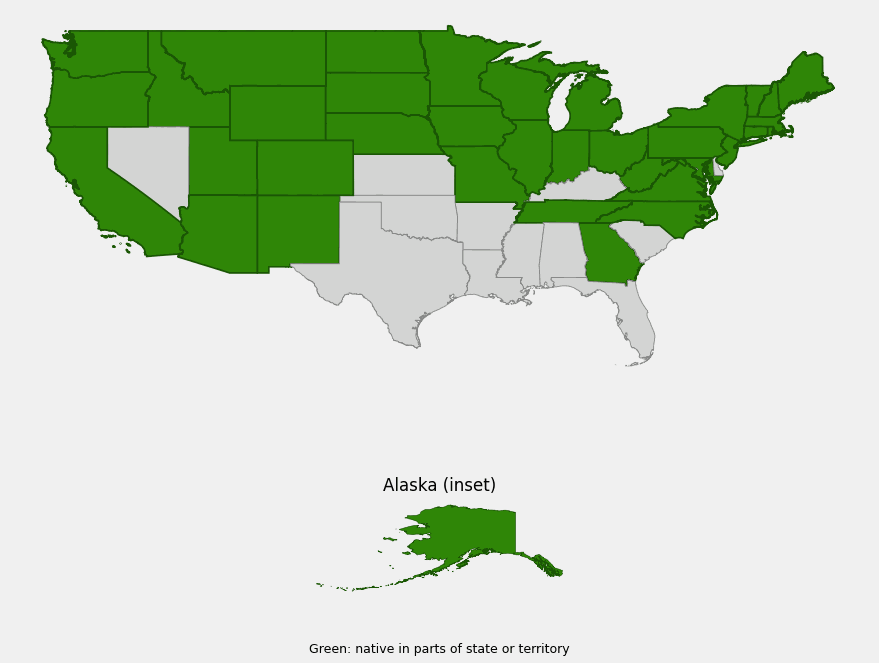
Yellow avens is one of the most widespread avens in the world, native across northern North America and much of temperate Europe and Asia, from Scandinavia and the Caucasus to Siberia, China, Korea and Japan. In North America it ranges from Alaska and Yukon across Canada to Newfoundland and Nova Scotia, and south in the United States to the northern tier, the Rockies and the Northeast.
USDA PLANTS records it as native in Alaska, Washington, Oregon, California, Idaho, Montana, Wyoming, Colorado, Utah, Arizona, New Mexico, North Dakota, South Dakota, Nebraska, Minnesota, Iowa, Missouri, Wisconsin, Illinois, Michigan, Indiana, Ohio, Pennsylvania, New York, New Jersey, the New England states, Maryland, West Virginia and Virginia. It also reaches south along the Appalachians, with outlying records in Tennessee, North Carolina and Georgia.
It is most common in the Upper Midwest, the Great Lakes region, the Northeast and the northern Rockies, where it grows in wet meadows, thickets, stream banks, floodplain woods, lakeshores and roadside ditches. In the Southwest it is confined to moist mountain meadows and canyons at higher elevations. North American plants are sometimes separated as var. strictum.
📋 Regional plant lists featuring Yellow Avens: Alaska · Western Oregon & Western Washington · Idaho, Eastern Oregon & Eastern Washington · California & Nevada · Arizona & New Mexico · Utah & Western Colorado · Montana & Wyoming · North Dakota, South Dakota & Western Minnesota · Nebraska, Kansas & Eastern Colorado · Illinois, Iowa & Missouri · Michigan, Wisconsin & Eastern Minnesota · Ohio & Indiana · Kentucky & Tennessee · Maryland, Virginia & West Virginia · North & South Carolina · Alabama, Georgia & Mississippi · New York, Pennsylvania & Northern New Jersey · Delaware, Southern New Jersey & Long Island · Connecticut, Massachusetts & Rhode Island · New Hampshire, Maine & Vermont
Growing & Care Guide
Yellow avens is an easy native perennial for moist, sunny to partly shaded spots. It is rarely sold by mainstream nurseries but is offered by native plant nurseries and seed suppliers in the North, and it establishes readily from seed.
Light
Grow it in full sun to part shade. It flowers best with at least half a day of sun, but it tolerates the dappled light of woodland edges and thickets.
Soil & Water
It prefers moist, fertile loam or clay loam and handles seasonally wet soils well. Once established it tolerates average garden soil and short dry spells, though it may go partly dormant in a hot, dry summer. It is not fussy about pH.
Planting Tips
Plant nursery plants in spring or fall, 12 to 18 inches apart. It is well suited to rain gardens, wet meadow plantings, pond edges and the shady side of a native border. Combine it with taller late-summer bloomers such as asters, goldenrods and joe-pye weeds, which take over as yellow avens finishes.
Pruning & Maintenance
It needs little care. Cut back the flowering stems after the seed heads ripen if you want to limit self-seeding or avoid burs on pets and clothing; leave the basal leaves, which stay green late into fall. Clumps live for several years and can be divided when crowded.
Propagation
Sow fresh seed in fall outdoors, or give it about 60 days of cold, moist stratification before sowing in spring. Seed germinates well and plants often bloom in their second year. Mature clumps can be divided in early spring or fall.
Landscape Uses
- Rain gardens: in the wetter zones of rain gardens and bioswales
- Wet meadow plantings: with sedges, asters, goldenrods and joe-pye weeds
- Woodland edges: for the transition between lawn and shrubs or woods
- Streambank and pond-edge restoration: a fast-establishing native for moist banks
- Pollinator gardens: an early- to midsummer source of pollen and nectar for small bees and flies
Wildlife & Ecological Value
Yellow avens is a modest but dependable part of northern meadows and thickets, flowering through the gap between spring wildflowers and late-summer goldenrods.
For Pollinators
The open, bowl-shaped flowers offer easy access to pollen and nectar for small bees, including sweat bees and small carpenter bees, as well as syrphid flies and other flies.
For Birds
Birds eat a few of the seeds, and the dense clumps give cover to ground-nesting birds in wet meadows and thickets.
For Mammals
Deer and rabbits browse it occasionally. Its hooked seeds are carried on the fur of deer, foxes, raccoons and other mammals, which spreads the plant to new sites.
Ecosystem Role
Yellow avens is an early colonizer of moist disturbed ground, such as stream banks after floods, logged areas and old fields, and it helps hold soil until longer-lived plants take over. Its hitchhiking seeds are a classic example of seed dispersal by animals.
Cultural & Historical Uses
The Austrian-Dutch botanist Nikolaus Joseph von Jacquin described Geum aleppicum in the 1770s. The name refers to Aleppo in Syria, the origin of the plants he studied. North American plants were long called Geum strictum, the name used in many older field guides, before botanists concluded that they belong to the same species as the Eurasian plants.
“Avens” is an old English name for Geum species, and the genus name comes from the Greek geuo, “to taste,” a reference to the aromatic roots of some species, such as the clove-scented herb bennet of Europe. The roots of avens are rich in tannins, and in many cultures, including among Indigenous peoples of North America, the roots of avens species were used in traditional medicine.
In China, yellow avens is a traditional medicinal herb. In North America it is mostly a quiet roadside and meadow wildflower, best known to hikers and dog owners for the bristly seed heads that end up clinging to their clothing.
Frequently Asked Questions
How do I tell yellow avens from large-leaved avens?
Look at the terminal leaflet of the basal leaves. Large-leaved avens has a very large, round, heart-shaped terminal leaflet. Yellow avens has a smaller, wedge-based terminal leaflet that is deeply lobed. The seed head receptacle of yellow avens is also covered with short hairs, while that of large-leaved avens is nearly hairless.
Why is it called Aleppo avens?
The species was first described in the 18th century from plants that came from the region of Aleppo, Syria. The species ranges across Europe and Asia as well as North America, so the name reflects where it was first studied rather than where it is most common.
Is yellow avens a good garden plant?
It is a good choice for rain gardens, wet meadows and naturalistic plantings, where its yellow flowers and long season of green leaves are useful. It is less suitable for formal borders, because it self-seeds and its burs cling to pets and clothing.
Is yellow avens the same as garden geum?
No. Garden geums sold in nurseries are mostly hybrids of European and Asian species with larger, brighter flowers. Yellow avens is a wild native species with smaller flowers.
Does yellow avens spread aggressively?
Not usually. It spreads mainly by seed, and seedlings are easy to pull. Cutting off seed heads before they ripen limits spreading.

Looking for a nursery that carries Yellow Avens?
Browse our native plant nursery directory: Alaska & Arizona · California · Colorado, Connecticut & Georgia · Idaho, Illinois, Indiana & Iowa · Maine, Maryland, Massachusetts, Michigan, Minnesota, Missouri & Montana · Nebraska, New Hampshire, New Jersey, New Mexico, New York, North Carolina, North Dakota & Ohio · Oregon · Pennsylvania, Rhode Island, South Dakota, Tennessee, Utah, Vermont & Virginia · Washington · West Virginia, Wisconsin & Wyoming

