
Sierra Nevada Sky Pilot (Polemonium eximium)
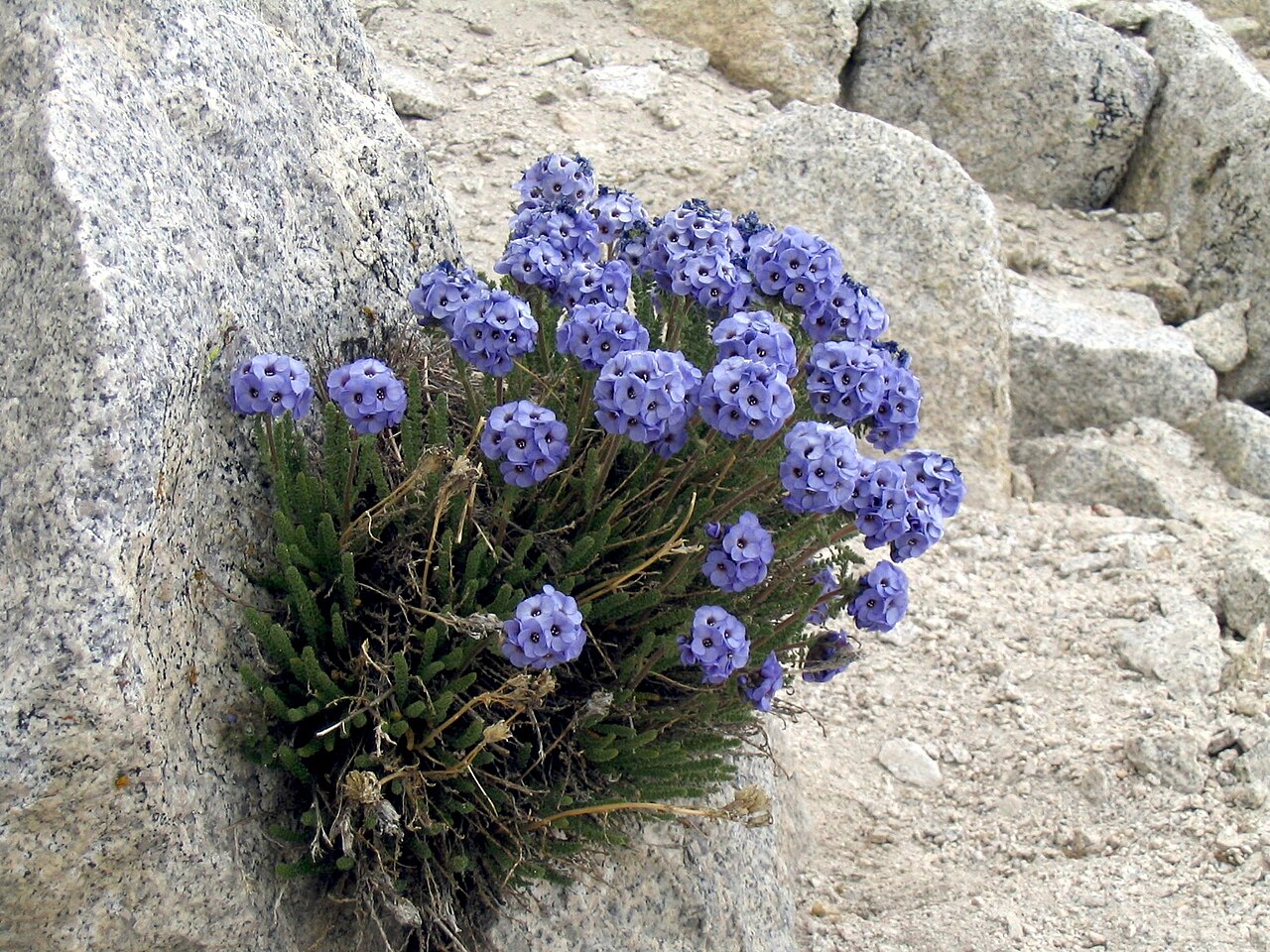
Polemonium eximium, known as Sierra Nevada Sky Pilot, skypilot or honey sweet, is a small, clump-forming perennial wildflower that grows only on the highest peaks and passes of the Sierra Nevada in California. It forms dense tufts of finely divided, sticky leaves topped in midsummer by tight, rounded heads of sky-blue to violet flowers. It belongs to the phlox family (Polemoniaceae), alongside the Jacob’s ladders.
Few plants live as high as this one. It grows on granite talus, rock crevices and summit ridges from roughly 10,000 to over 14,000 feet, and it is famous among hikers and climbers as one of the flowers found near the top of Mount Whitney, the highest point in the lower 48 states. The species name eximium means “excellent” or “distinguished.”
Its close relative, the Sky Pilot (Polemonium viscosum), grows on high peaks of the Rocky Mountains and Great Basin. This guide covers how to identify Sierra Nevada sky pilot, where to see it, whether it can be grown, and its role in the alpine ecosystem.
Identification
Sierra Nevada sky pilot is unmistakable in its habitat: a low, dense mound of bottlebrush-like leaves crowned with ball-shaped clusters of blue flowers, growing among rocks at very high elevation.
Growth Habit
A long-lived, taprooted perennial forming compact clumps 4 to 16 inches tall from a branched, woody base that is covered with the persistent bases of old leaves. A large plant may carry dozens of flowering stems.
Leaves
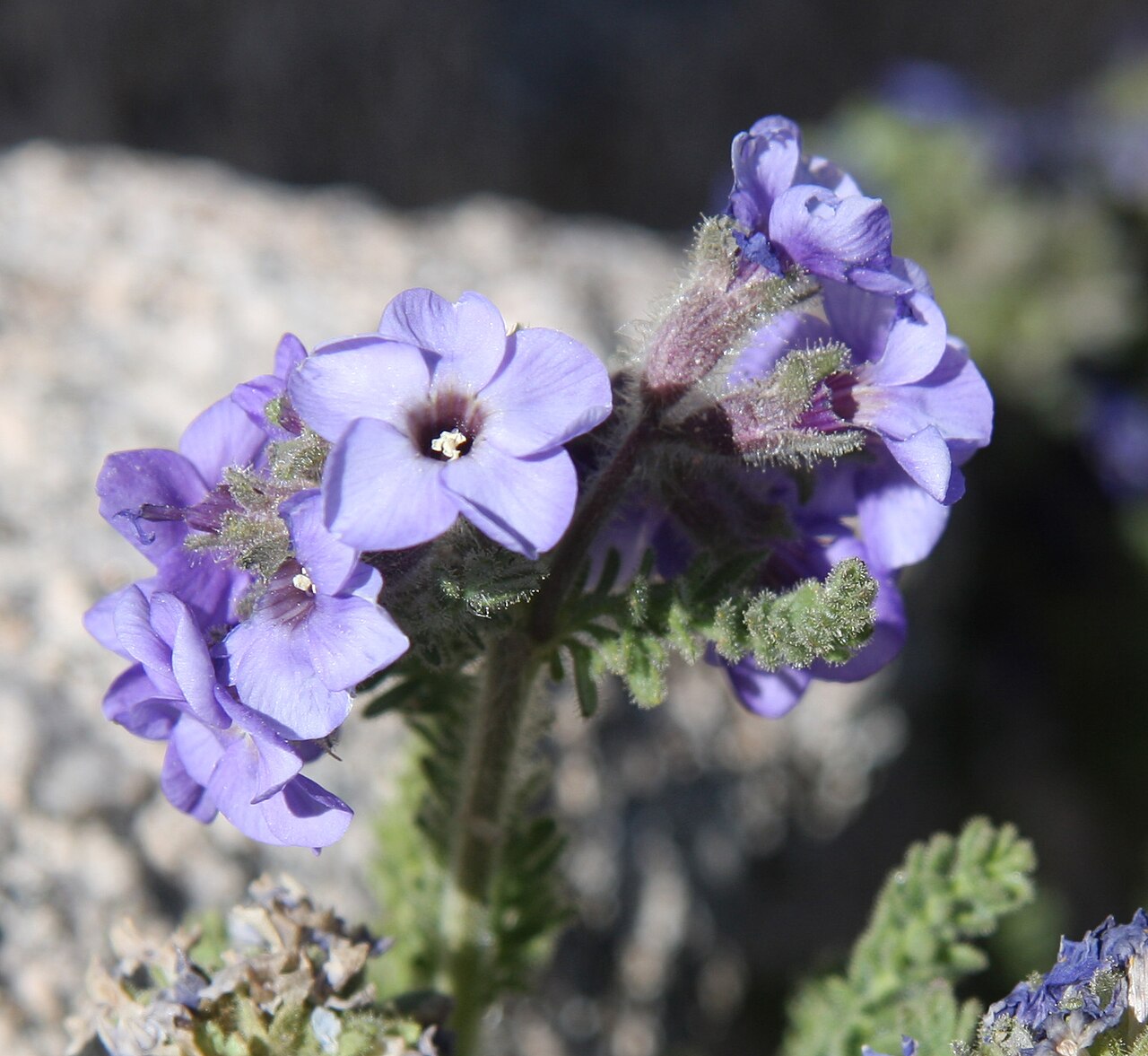
The leaves are mostly basal, 2 to 6 inches long, and pinnately divided into many tiny, crowded leaflets, each of which is itself split into 2 to 5 small lobes. The leaflets are so crowded and lobed that each leaf looks like a narrow, cylindrical bottlebrush. The foliage is covered with sticky glandular hairs and has a strong, musky or skunky smell when brushed.
Flowers
Flowers bloom from July to August, soon after snowmelt, in dense, round heads at the tips of the stems. Each flower is a short funnel about ½ inch long and wide, with five rounded, sky-blue to blue-violet lobes (rarely white), a pale throat, and stamens with bright orange-yellow pollen. In contrast to the leaves, the flowers have a sweet scent.
Fruit & Look-alikes
The fruit is a small three-chambered capsule held inside the persistent calyx, containing a few seeds. In the Rocky Mountains and Great Basin, the similar Sky Pilot (P. viscosum) has leaflets that are mostly undivided or only partly lobed and longer, more tubular flowers, and it grows mainly in the Rocky Mountains and Great Basin. Lower-elevation Jacob’s ladders, such as California Jacob’s Ladder, have flat, ladder-like leaves with larger, separate leaflets.
Quick Facts
| Scientific Name | Polemonium eximium |
| Family | Polemoniaceae (phlox family) |
| Plant Type | Herbaceous perennial with a woody, taprooted base |
| Mature Height | 4–16 in |
| Mature Spread | 4–12 in |
| Growth Rate | Very slow |
| Sun Exposure | Full sun |
| Water Needs | Moist from snowmelt in early summer, then dry; perfect drainage |
| Soil Type | Granite gravel, talus and rock crevices |
| Soil pH | Acidic to neutral |
| Bloom Time | July–August |
| Flower Color | Sky blue to blue-violet, rarely white |
| Fall Color | None |
| Fruit | Small capsule with a few seeds |
| Deer Resistant | Yes in practice; sticky, strong-smelling foliage, though marmots and pikas nibble flowers |
| USDA Hardiness Zones | About 3–6 in specialist alpine culture; rarely grown |
Native Range
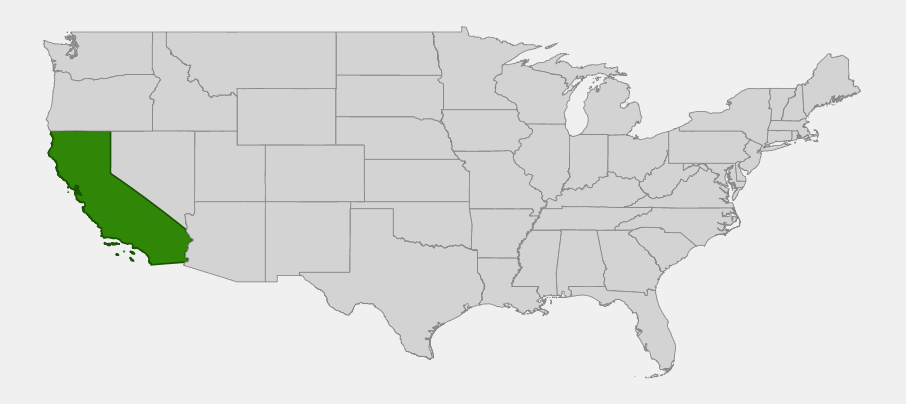
Sierra Nevada sky pilot is a California endemic. USDA PLANTS lists it only for California, where it grows in the high Sierra Nevada, mainly from the Yosemite region south through the John Muir Wilderness, Kings Canyon and Sequoia National Parks to the Mount Whitney area, on both the western and eastern sides of the crest.
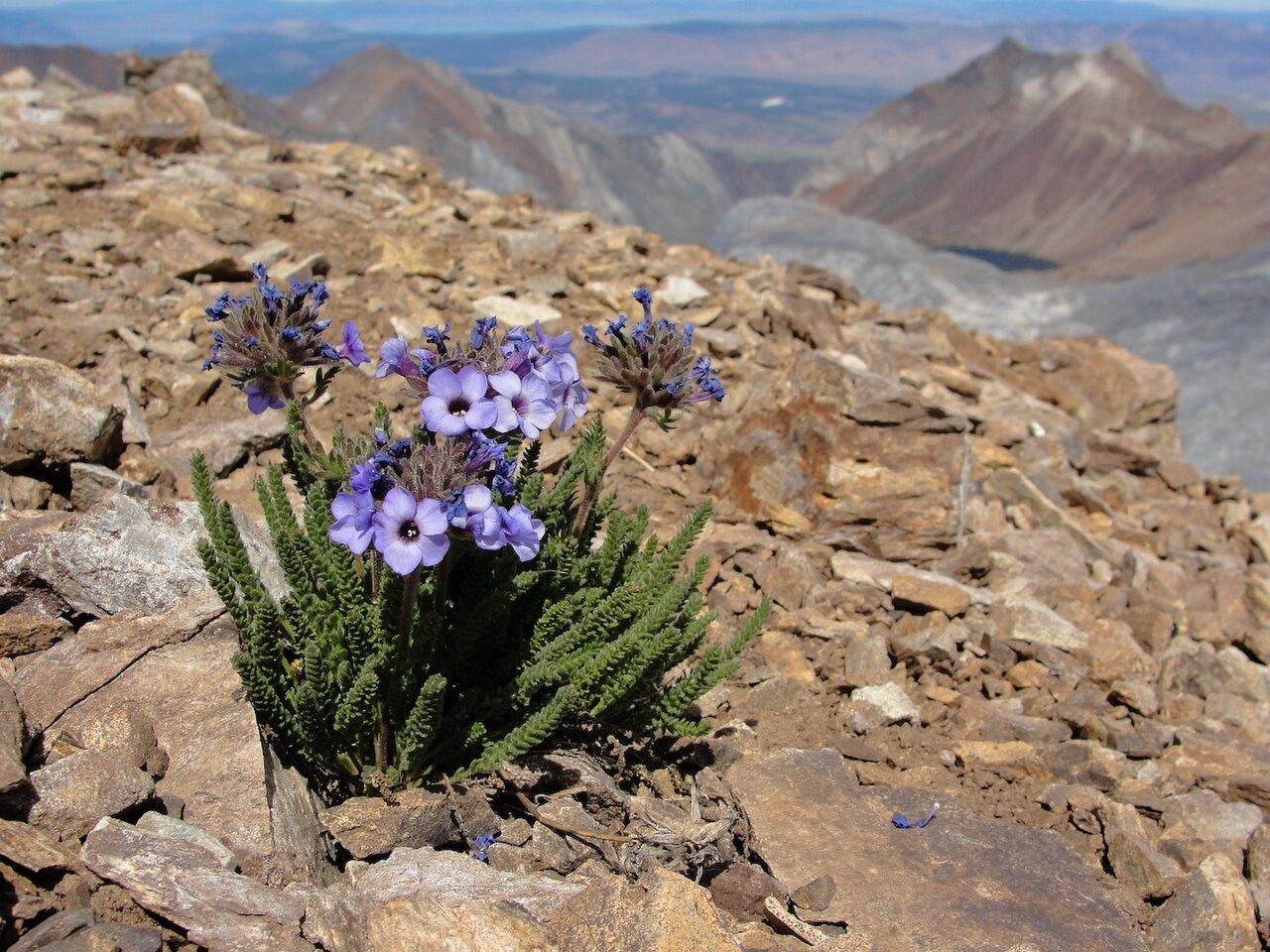
It lives at the upper limit of plant life in the range, usually above about 10,000 feet and up to the summit areas of the highest peaks above 14,000 feet. Its habitat is open, rocky, wind-blown ground: granite talus and boulder fields, rock crevices, ridges, passes and summit plateaus, often on sites that receive meltwater early in the summer and dry out later.
Because nearly all of its range lies in national parks and wilderness areas, most populations are well protected, and collecting plants or seed in national parks is prohibited. The best way to see it is on a summer hike to a high Sierra pass such as Forester Pass or along the upper Mount Whitney Trail, where it blooms in July and August.
📋 Regional plant lists featuring Sierra Nevada Sky Pilot: California & Nevada
Growing & Care Guide
Sierra Nevada sky pilot is a true high-alpine plant, and it is almost never grown successfully outside its mountain home. It needs intense light, cold winters under snow, cool nights, and gritty soil that is wet at snowmelt but never soggy afterward. Plants and seed are rarely offered, and collecting from the wild is not allowed in the national parks where most of it grows. For a garden, choose a lower-elevation relative such as California Jacob’s Ladder or Tall Jacob’s Ladder.
Light
Full sun with high light intensity is essential. In lowland gardens the combination of warm nights and weaker light causes plants to stretch, rot or decline.
Soil & Water
Specialist growers use a very lean, fast-draining mix of granite grit or pumice with little organic matter, in a deep pot, trough or crevice garden. Water freely in spring and early summer, then keep it on the dry side, and keep the crown dry in winter. Wet, warm conditions around the crown are the main cause of loss.
Planting Tips
If you obtain legally sourced, nursery-grown seedlings, plant them in a raised crevice bed or alpine house where summers are cool, at high elevation in the West or in cold northern climates. Set the crown slightly above the surrounding grit and wedge rocks around it to protect the deep taproot, which resents disturbance.
Pruning & Maintenance
Remove spent flower stems if you do not want seed. Do not fertilize. Clumps grow very slowly and should not be divided.
Propagation
It is grown from seed, which germinates best after a period of cold, moist stratification over winter. Seedlings grow slowly and take several years to flower. Seed from wild plants in national parks and wilderness should never be collected without a permit; use seed from specialist alpine seed exchanges or nurseries.
Landscape Uses
- Where to see it: summer hikes to high Sierra passes and summits such as Forester Pass and the upper Mount Whitney Trail
- Alpine house and crevice gardens: for experienced alpine-plant growers only
- Wildflower photography: a signature flower of the High Sierra
- Nature study: an example of plant adaptation to extreme cold, wind and short seasons
Wildlife & Ecological Value
At the edge of plant life, Sierra Nevada sky pilot is a key nectar source in the brief alpine summer and part of a small community of cushion and mat plants that hold the thin soil of the high peaks.
For Pollinators
The sweet-scented blue flowers attract bumblebees, which are among the few large pollinators active at these elevations, as well as flies and butterflies that ride the summer winds up to the peaks.
For Birds
Seed-eating birds of the high country, such as gray-crowned rosy-finches, forage among the rocks and alpine plants where sky pilot grows, picking seeds and insects from the vegetation.
For Mammals
Yellow-bellied marmots and American pikas eat alpine plants, and flowers nibbled by marmots are a common sight on Sierra passes. The sticky, strong-smelling leaves are thought to discourage some grazing.
Ecosystem Role
Its deep taproot and dense clumps help stabilize talus and trap fine soil and organic matter among the rocks, creating small pockets where other alpine plants can grow. As one of the few showy flowers at the highest elevations, it supports the insects that in turn feed alpine birds.
Cultural & Historical Uses
Edward Lee Greene, a pioneering California botanist, described Polemonium eximium in 1892. The genus name Polemonium comes from the ancient Greek name of a medicinal plant, sometimes linked to the Greek word for war, polemos. The common name “sky pilot” is often explained as a reference to its habit of growing on the highest summits, closest to the sky.
The name “honey sweet” refers to the flowers’ sweet scent, which contrasts with the musky smell of the sticky foliage. Climbers have long noted the plant as a reward near the top of Mount Whitney and other fourteeners in the Sierra.
Alpine plants like sky pilot are watched by scientists as indicators of climate change, because warming can push their habitat upslope until there is no higher ground left. Staying on established trails and not picking flowers helps protect these slow-growing populations.
Frequently Asked Questions
Where does Sierra Nevada sky pilot grow?
Only in California, in the high Sierra Nevada, usually above about 10,000 feet on granite talus, ridges, passes and summits. It grows near the top of Mount Whitney and on many other high peaks.
How is it different from the Rocky Mountain sky pilot?
Polemonium viscosum grows mainly on high peaks of the Rocky Mountains and Great Basin. Sierra Nevada sky pilot has leaflets that are each divided into several small lobes, giving its leaves a fuller bottlebrush look, and somewhat shorter, more open flowers.
Why does sky pilot smell bad?
The leaves are covered with sticky glandular hairs that give off a musky, skunky odor when touched. The flowers themselves smell sweet.
Can I grow Sierra Nevada sky pilot?
Only with great difficulty. It needs high-alpine conditions, and plants are rarely available. Never collect plants or seeds from the wild. Lower-elevation Jacob’s ladders are much better garden plants.
When does it bloom?
In July and August, shortly after the snow melts at high elevations. Peak bloom varies from year to year with the snowpack.

Looking for a nursery that carries Sierra Nevada Sky Pilot?
Browse our native plant nursery directory: California

