
Blind Pricklypear (Opuntia rufida)
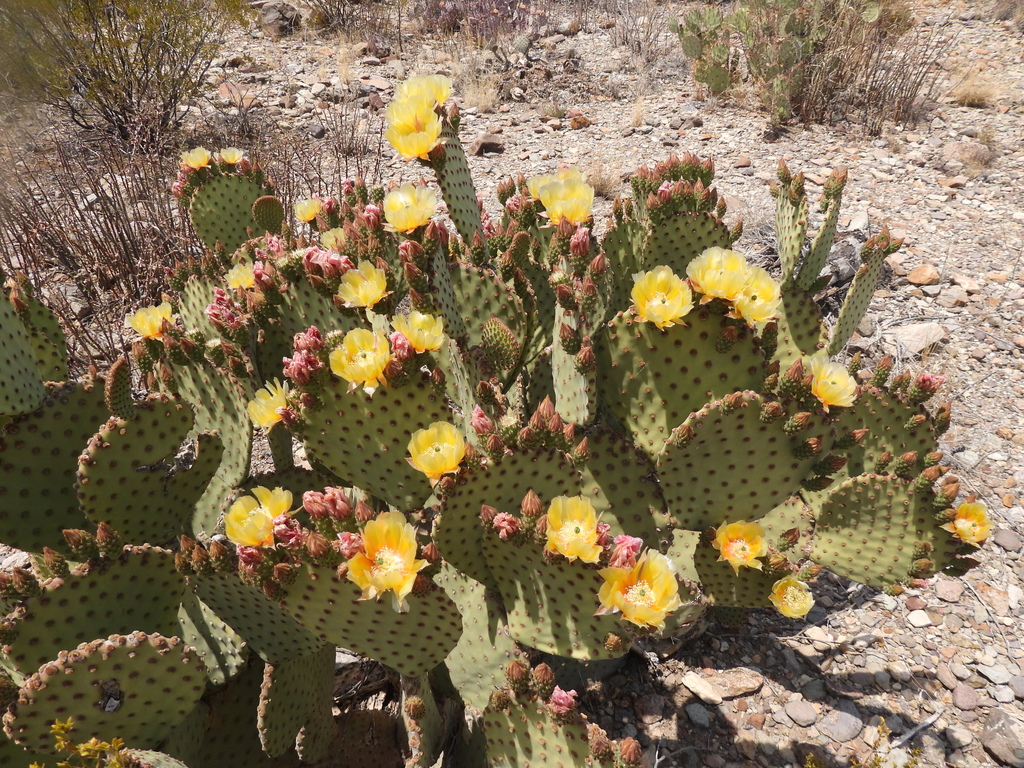
Opuntia rufida, known as Blind Pricklypear or blind prickly pear, is a shrubby prickly pear cactus of the Chihuahuan Desert. It forms rounded clumps of nearly circular, velvety gray-green pads with no true spines at all. Instead, each pad is evenly dotted with tufts of reddish-brown glochids, tiny barbed bristles that give the plant a polka-dot look. In spring it bears yellow flowers that age to orange and red, followed by small red fruits.
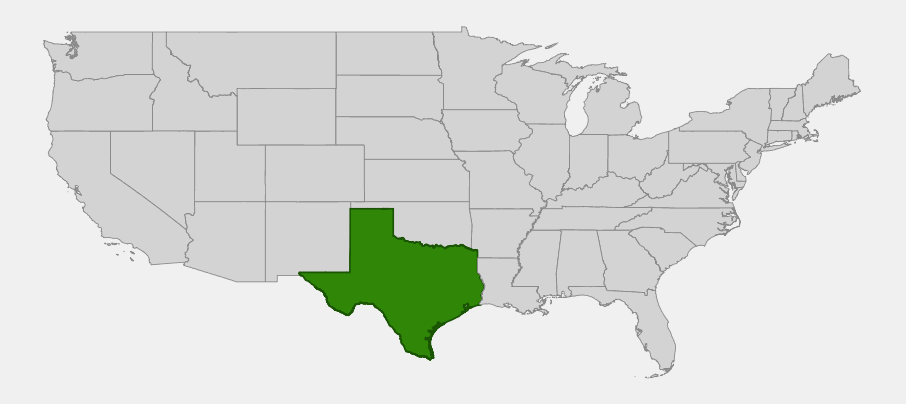
In the United States it grows only in far West Texas, mainly in the Big Bend region along the Rio Grande, and it ranges south into the Mexican states of Chihuahua, Coahuila, Durango and Nuevo León. It grows on rocky limestone and volcanic slopes, canyon walls and desert hills. Some botanists treat it as a subspecies of the Mexican bunny ears cactus, Opuntia microdasys.
Its spineless pads look harmless, but they are not. Safety note: the glochids come off at the lightest touch, lodge in skin and are very hard to remove. The common name comes from the old belief that the windblown bristles could blind livestock. This guide covers how to identify it, where it grows, how to grow it safely in a dry garden, and its value to desert wildlife.
Identification
Look for a gray-green prickly pear with round, softly velvety pads that have no spines, only neat rows of reddish-brown dots of glochids, growing among rocks in the Chihuahuan Desert.
Growth Habit
Blind pricklypear is a branching, shrubby cactus, usually 2 to 4 feet tall and sometimes up to about 5 feet, often wider than tall. Older plants may develop a short, woody trunk. The pads (cladodes) are joined end to end and branch freely, forming dense mounds.
Pads
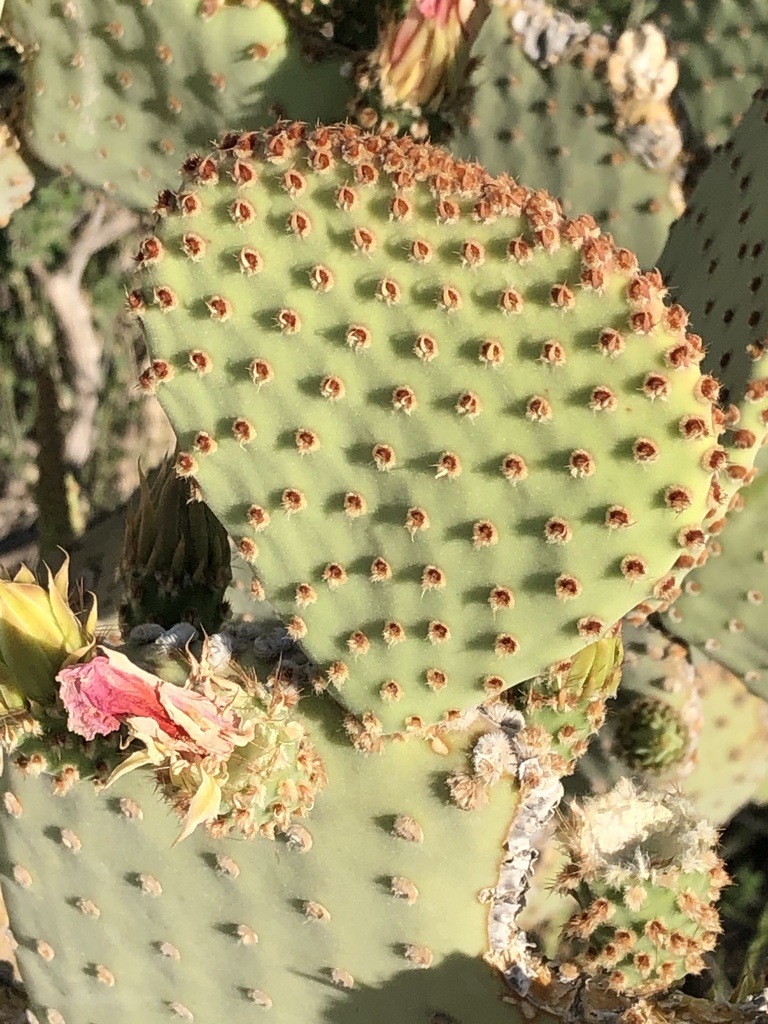
The pads are nearly round to broadly egg-shaped, usually about 4 to 8 inches across, and fairly thick. They are dull gray-green and finely velvety to the touch, without a waxy shine. Some plants turn purplish under drought or cold stress.
Glochids (No Spines)
Mature pads have no true spines. The areoles are evenly spaced, close together and packed with short reddish-brown to rusty glochids, which is where the species name rufida (reddish) comes from. Glochids are hair-fine, barbed bristles that break off and stick in skin and clothing.
Flowers & Fruit
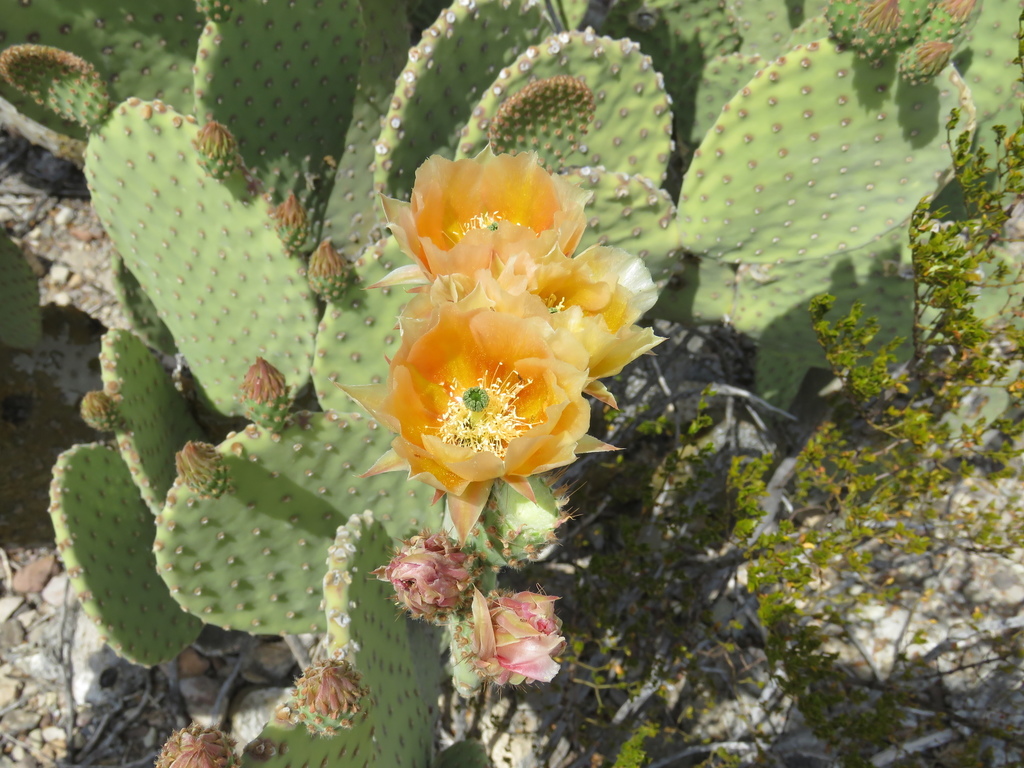
It blooms mainly in spring, from about March to May, with scattered flowers later in summer. The cup-shaped flowers are about 2 to 3 inches across, opening bright yellow and aging to orange or red, so one plant often shows the full range of colors at once. The fruits are fleshy, egg-shaped and red, about 1 inch long, and carry glochids too.
Look-alikes
Bunny ears (Opuntia microdasys), a popular Mexican houseplant, is closely related but has smaller pads and yellow to white glochids. Purple Prickly Pear (Opuntia macrocentra), which grows nearby, has purplish pads and long black spines from the upper areoles. Engelmann’s Prickly Pear and Texas Prickly Pear have larger, greener pads with stout yellow spines. The western Beavertail Cactus is also spineless and velvety but has magenta flowers and grows in the Mojave and Sonoran deserts, not Texas.
Quick Facts
| Scientific Name | Opuntia rufida Engelm. |
| Family | Cactaceae (cactus family) |
| Plant Type | Shrubby, spineless prickly pear cactus |
| Mature Height | 2–5 ft |
| Mature Spread | 3–6 ft |
| Growth Rate | Slow to moderate |
| Sun Exposure | Full sun to light shade |
| Water Needs | Very low; dry, fast-draining soil |
| Soil Type | Rocky, gravelly limestone or volcanic soil |
| Soil pH | Neutral to alkaline |
| Bloom Time | March–May, scattered into summer |
| Flower Color | Yellow aging to orange and red |
| Fall Color | Evergreen; pads may blush purple in cold or drought |
| Fruit | Red, fleshy, egg-shaped, about 1 in |
| Deer Resistant | Mostly; javelinas and rodents may eat pads and fruit |
| USDA Hardiness Zones | 8–11 |
Native Range
Blind pricklypear is native to the Chihuahuan Desert. USDA PLANTS lists it only from Texas, where it grows in the Trans-Pecos, mainly in the Big Bend region of Brewster and Presidio counties along the Rio Grande. It is a familiar plant in Big Bend National Park and Big Bend Ranch State Park.
Its range continues south into northern Mexico, through Chihuahua, Coahuila, Durango and Nuevo León, and it is more widespread there than in Texas. In the United States it is at the northern edge of its range.
It grows on rocky desert slopes, limestone hills, canyon walls and ledges, volcanic outcrops and gravelly flats, often among lechuguilla, candelilla and creosote bush. It favors hot, low to middle elevations, roughly 1,800 to 4,000 feet, and is often found on cliffs and boulder slopes where it is sheltered from hard frost.
📋 Regional plant lists featuring Blind Pricklypear: South & West Texas
Growing & Care Guide
Blind pricklypear is a striking, low-water accent plant for desert and rock gardens in hot, dry climates. Buy nursery-grown plants or start them from cuttings of cultivated plants; never take pads or plants from parks or wild land. Glochid safety: always handle it with thick leather gloves and tongs, or wrap pads in folded newspaper or carpet. Glochids float in the air when plants are moved, so wear eye protection and long sleeves. Remove glochids from skin with adhesive tape or a thin layer of white glue peeled off once dry. Plant it well away from paths, play areas and places pets roam.
Light
Full sun gives the most compact growth and best flowering. It tolerates light afternoon shade, especially in the hottest low deserts.
Soil & Water
It needs very fast-draining, gravelly or rocky soil; heavy, wet soil causes rot. Once established it lives on rainfall in desert climates. In very hot, dry summers an occasional deep watering keeps the pads plump. Keep it dry in winter. It is less cold-hardy than many prickly pears and can be damaged by hard freezes, so in marginal areas plant it against a south-facing wall or among boulders, and in cold climates grow it in a pot moved indoors for winter.
Planting Tips
Plant in spring or early summer in a raised bed, berm or slope where water drains away quickly. Set it at the same depth it grew in the pot, and wait a week before the first watering so any broken roots can heal. In containers, use a gritty cactus mix in a pot with a drainage hole.
Pruning & Maintenance
Little care is needed. Remove damaged or crowded pads with long tongs and a knife at the joint, wearing gloves and eye protection. Do not fertilize heavily; lean soil keeps it compact. Watch for cochineal scale (white cottony patches), which can be sprayed off with a strong jet of water.
Propagation
Propagate from single pads cut from cultivated plants. Let the cut end dry and callus for one to two weeks, then set it upright, about one-third deep, in dry gritty soil, and water lightly once roots form. It can also be grown from seed, but seedlings are slow.
Landscape Uses
- Desert and xeriscape gardens: a spineless-looking sculptural accent for very low water use
- Rock gardens and slopes: looks natural among boulders and gravel, where drainage is fast
- Containers and patios: a compact cactus for pots in hot, sunny spots (keep away from walkways)
- Pollinator gardens: spring flowers are visited by native cactus bees and other bees
- Chihuahuan Desert restoration: a native cactus for rocky Trans-Pecos landscapes
Wildlife & Ecological Value
Blind pricklypear is part of the rich cactus community of the Chihuahuan Desert, offering flowers, fruit and shelter in a harsh landscape.
For Pollinators
The large spring flowers are an important pollen and nectar source for native bees, especially specialist cactus bees (Diadasia and Lithurgopsis) and bumble bees, as well as beetles. The Xerces Society rates blind pricklypear as having special value to native bees.
For Birds
Birds such as cactus wrens, curve-billed thrashers and doves eat the ripe fruit and seeds, and small birds shelter among the dense pads.
For Mammals
Javelinas, packrats, ground squirrels, rabbits and coyotes eat the fruit, and javelinas and packrats also eat the pads, getting moisture from them in dry seasons.
Ecosystem Role
Animals that eat the fruit spread the seeds, and pads that break off can root where they land. Dense clumps shelter lizards, small mammals and nesting birds, and the plants help hold soil on steep, rocky slopes.
Cultural & Historical Uses
George Engelmann, the German-American physician and botanist who described many cacti of the American Southwest, named Opuntia rufida in 1856. The name rufida refers to its reddish glochids.
The common name “blind pricklypear” comes from the belief that its glochids, carried by wind or brushed off by grazing animals, could get into the eyes of cattle and other livestock and blind them. Whether or not that happened often, the bristles are a real hazard, and ranchers and hikers have long treated the plant with respect.
Its cousin, bunny ears (Opuntia microdasys), is one of the most widely sold houseplant cacti in the world. Blind pricklypear is its larger, red-glochid relative and is sometimes sold under the name Opuntia microdasys var. rufida.
Frequently Asked Questions
Does blind pricklypear have spines?
No true spines, but it is far from harmless. Each pad is covered in tufts of tiny barbed bristles called glochids that detach at a touch and stick in skin. Always handle it with thick gloves and tongs.
Why is it called blind pricklypear?
The name comes from the old belief that its glochids, carried by the wind or brushed off by animals, could get into the eyes of livestock and blind them.
How do I remove glochids from my skin?
Press adhesive tape onto the area and pull it off, or spread a thin layer of white school glue, let it dry and peel it away. Repeat as needed, then wash the skin. See a doctor if glochids get into your eyes.
Where does blind pricklypear grow?
In the Chihuahuan Desert. In the United States it grows only in far West Texas, mainly the Big Bend region, and it ranges south into northern Mexico.
Is blind pricklypear cold-hardy?
Only moderately. It does best in USDA zones 8 to 11 and can be damaged by hard freezes. In colder areas grow it in a pot and bring it indoors or into a bright garage for winter.

Looking for a nursery that carries Blind Pricklypear?
Browse our native plant nursery directory: Texas

