
Missouri Ironweed (Vernonia missurica)
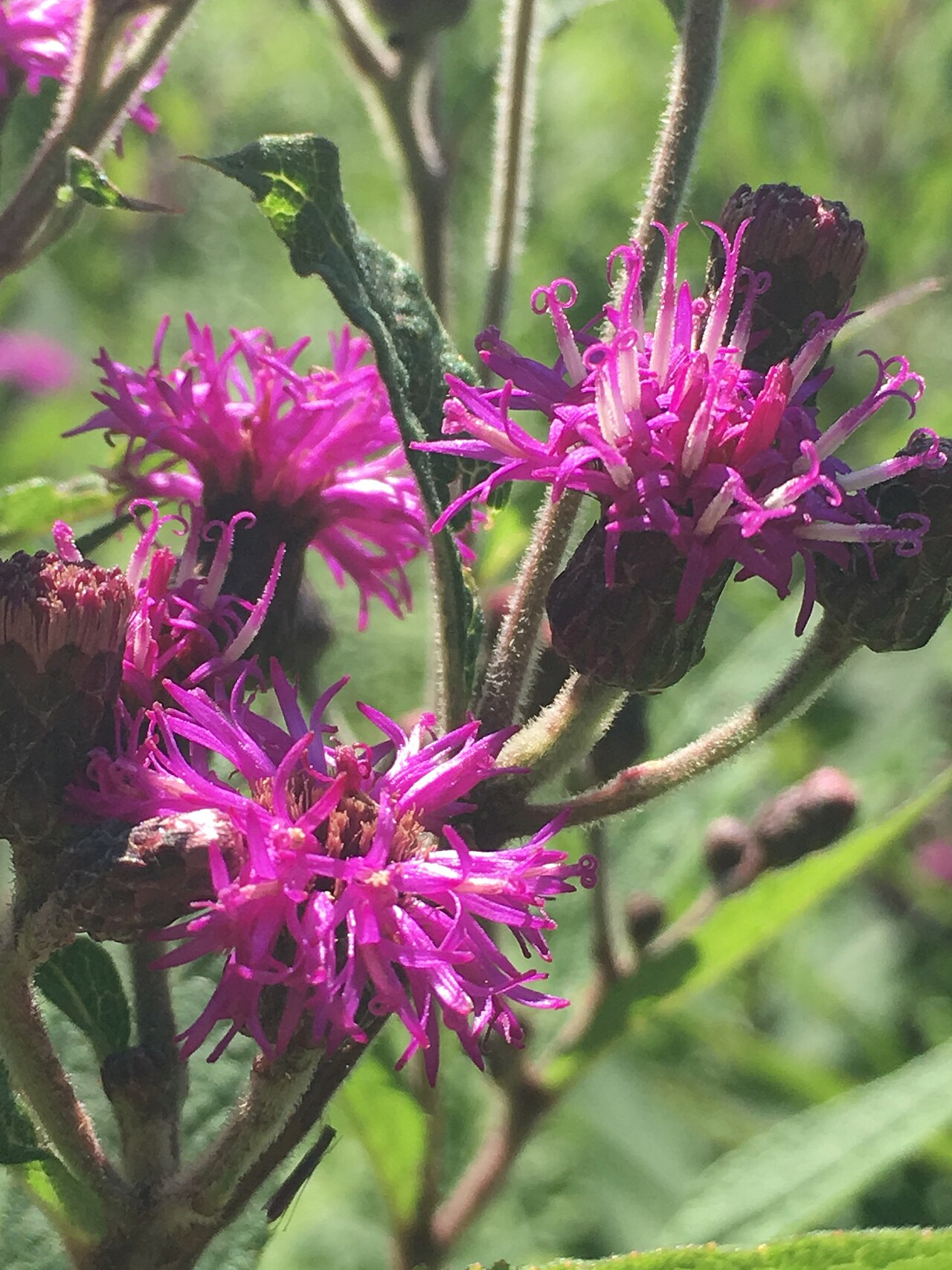
Vernonia missurica, the Missouri Ironweed, is a tall, late-summer wildflower of the prairies, pastures and moist meadows of the central and southern United States. From the Great Lakes states south to the Gulf Coast and west to Kansas, Oklahoma and Texas, its stout stems rise 3 to 5 feet and end in broad, loose clusters of fluffy, intensely magenta-purple flower heads from July into September.
It is one of several ironweeds native to the eastern half of the country, and the hardest-wearing of them in many ways. The leaves are bitter, so cattle, deer and rabbits leave it alone; that is why ironweed often stands tall in grazed pastures when everything around it has been eaten. The name “ironweed” refers to its tough, rigid stems, which stay upright through winter, and possibly to the rusty color of the seed heads in fall.
For gardeners, Missouri ironweed is a long-lived, easy prairie perennial that feeds butterflies and native bees at the end of summer, tolerates heat, clay and periodic drought, and pairs naturally with goldenrods, asters and native grasses. This guide covers how to identify it among the other ironweeds, where it grows, how to grow it and what it does for wildlife.
Identification
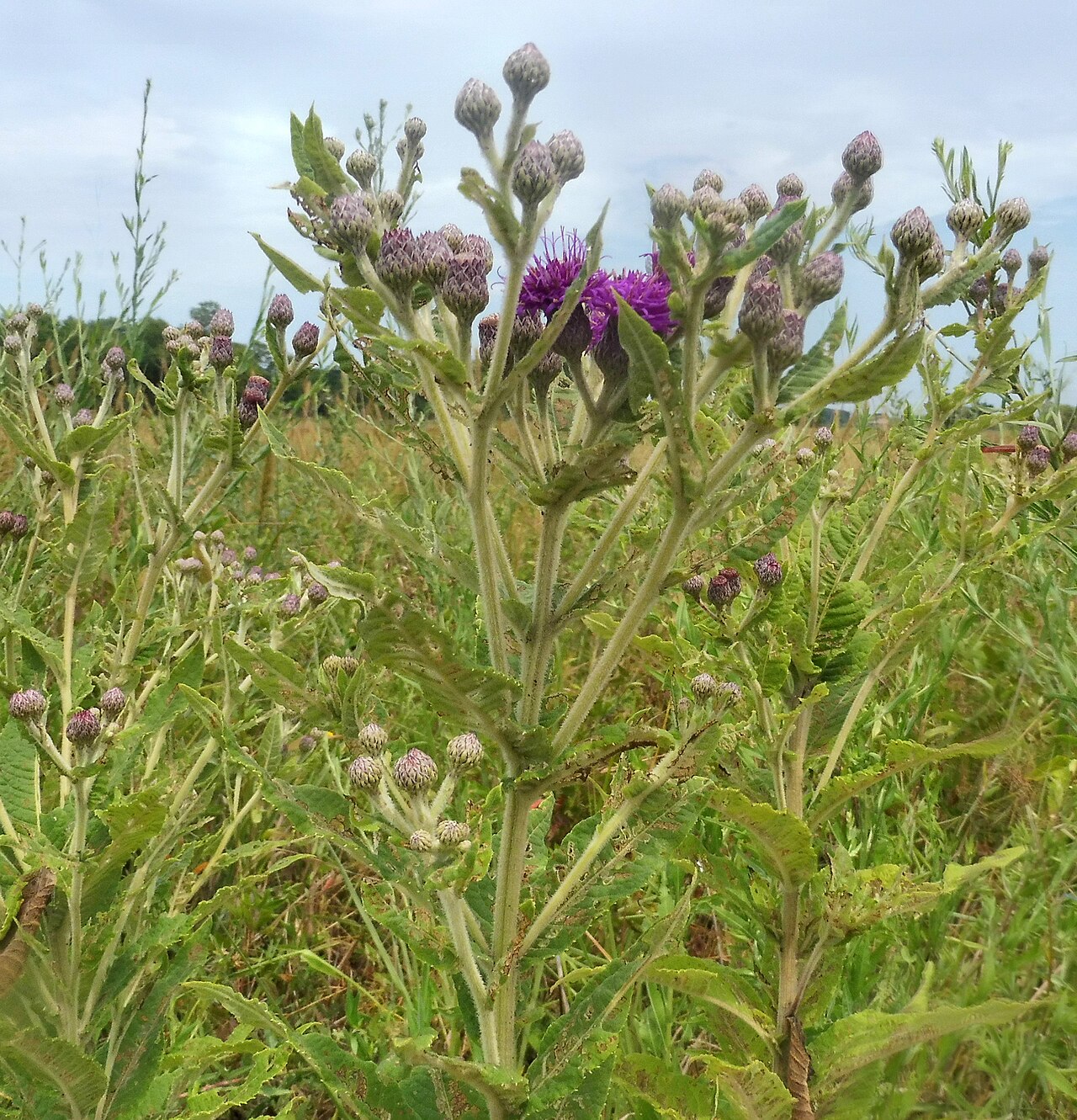
Missouri ironweed is a coarse, clump-forming perennial with leafy, unbranched stems that branch only in the flower cluster at the top. Ironweeds hybridize readily where they grow together, so intermediate plants are common; look at several features rather than just one.
Stems & Leaves
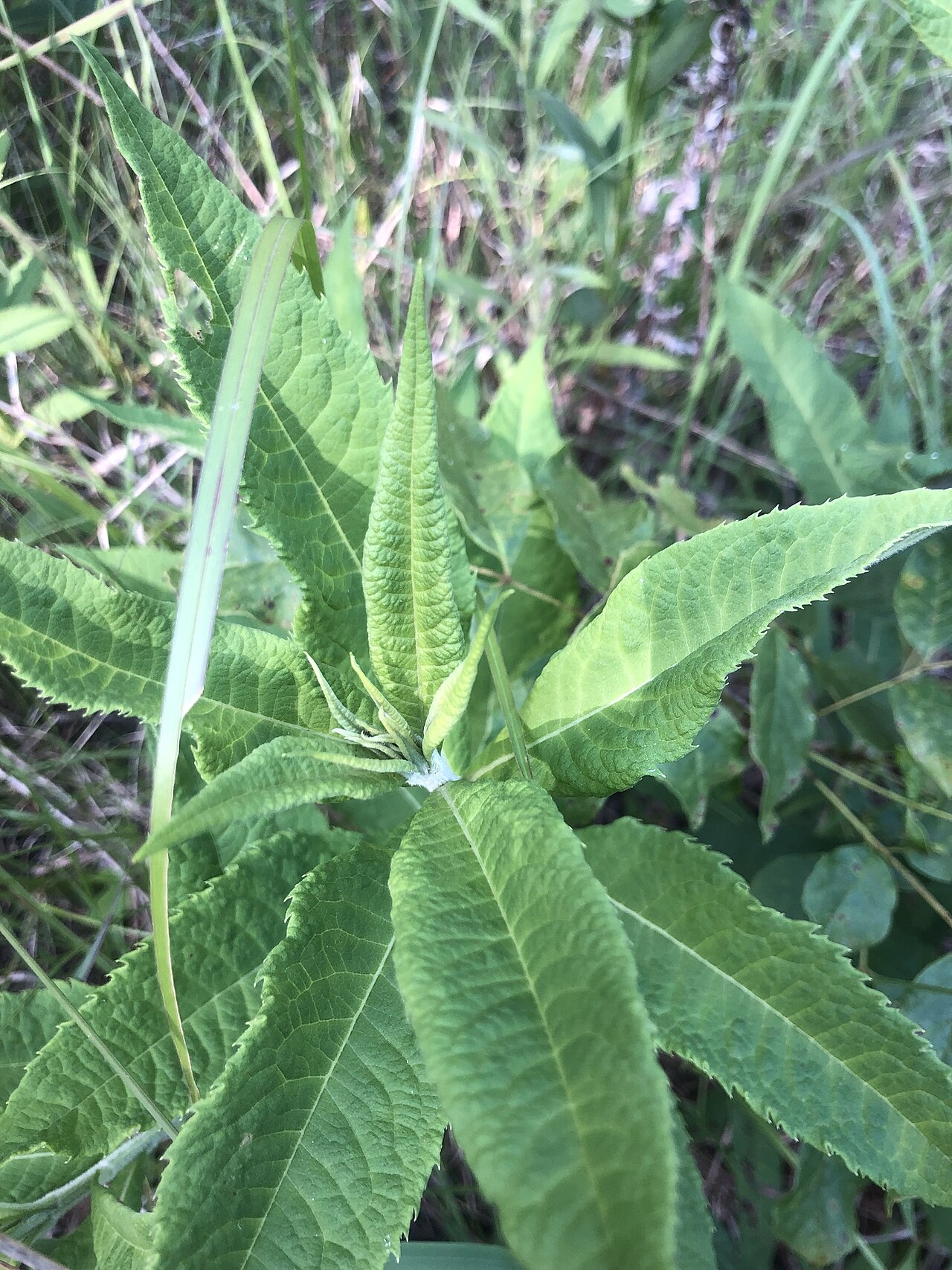
Stems are stout, 3 to 5 feet tall (occasionally taller), green to purplish and covered with short, soft hairs. The leaves are alternate, lance-shaped to narrowly elliptic, typically 4 to 6 inches long and about 1 inch wide, with small, sharp teeth along the edges. The upper surface is rough to the touch, and the underside is densely covered with soft, woolly hairs, which is one of the best field marks for this species.
Flowers
From July to September, each stem ends in a broad, branched, somewhat flat-topped cluster of many flower heads. Each head is about ¾ inch across and contains only disk florets, no rays: usually about 30 to 60 florets per head, more than most other ironweeds, which gives the heads a full, fluffy look. The florets are vivid magenta to reddish purple. The bracts (phyllaries) around each head are overlapping, purplish-brown, pressed close to the head and often fringed with fine hairs, without long thread-like tips.
Fruit & Seed Heads
The seeds (cypselae) are small, ribbed and tipped with a double row of tawny to purplish bristles. In fall the seed heads turn a rusty tan and fluffy, and the dead stems often stay upright well into winter.
Look-alikes
Giant Ironweed (V. gigantea) has fewer florets per head (roughly 13 to 30) and leaves that are smooth or only thinly hairy beneath. Prairie Ironweed (V. fasciculata) has tighter, flat-topped clusters and nearly hairless leaves with tiny pits underneath. Western Ironweed (V. baldwinii) has phyllaries with spreading or curled-back tips. New York Ironweed of the East Coast has phyllaries ending in long, hair-like tips. Joe-pye weeds have pinkish, more domed clusters and whorled leaves.
Quick Facts
| Scientific Name | Vernonia missurica Raf. |
| Family | Asteraceae (aster family) |
| Plant Type | Herbaceous perennial wildflower |
| Mature Height | 3–5 ft (occasionally to 6 ft) |
| Mature Spread | 2–3 ft |
| Growth Rate | Moderate to fast |
| Sun Exposure | Full sun to light shade |
| Water Needs | Medium to moist; tolerates dry spells once established |
| Soil Type | Loam, clay loam, silty or sandy soils |
| Soil pH | About 5.5–7.5 |
| Bloom Time | July–September |
| Flower Color | Magenta to reddish purple |
| Fall Color | Rusty tan seed heads; stems stand through winter |
| Fruit | Small ribbed seeds with tawny bristles |
| Deer Resistant | Yes; bitter leaves are rarely browsed |
| USDA Hardiness Zones | 4–9 |
Native Range
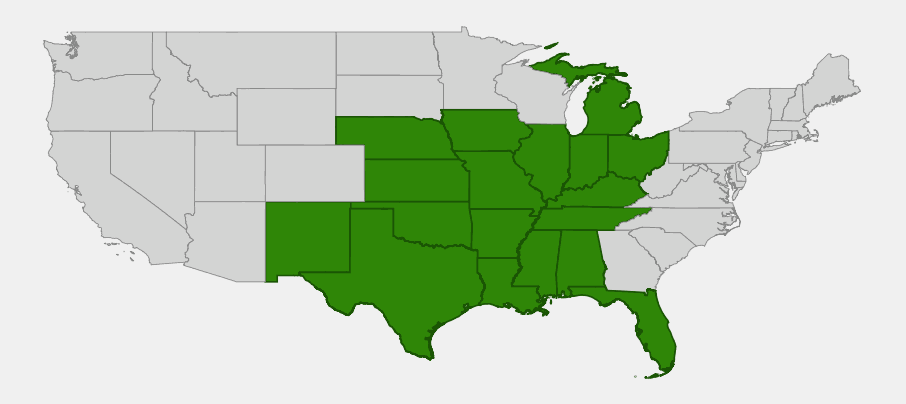
Missouri ironweed grows across the interior of the eastern and central United States. USDA PLANTS lists it as native from Michigan, Ohio, Indiana and Illinois south through Kentucky, Tennessee, Alabama and Mississippi to the Florida Panhandle and Louisiana, and west through Iowa, Missouri, Nebraska, Kansas, Oklahoma and Texas to an outlying record in New Mexico. It also reaches southwestern Ontario. Its heartland is the tallgrass prairie region and the Mississippi Valley, especially Missouri, Arkansas, Illinois and eastern Kansas and Oklahoma.
USDA also has a record from Massachusetts, but the Native Plant Trust’s Go Botany describes that as a collection from a human-disturbed site well outside its native prairie range, so it is not shown on our map. In Texas it grows mainly in the eastern and north-central parts of the state.
Its habitats are open and sunny: mesic and wet-mesic prairies, moist meadows, pastures, old fields, the edges of marshes and streams, open woods and roadsides. It does well in disturbed ground and grazed pastures because livestock avoid it, and it often marks the low, moister spots in a prairie.
📋 Regional plant lists featuring Missouri Ironweed: Ohio & Indiana · Michigan, Wisconsin & Eastern Minnesota · Kentucky & Tennessee · Nebraska, Kansas & Eastern Colorado · Illinois, Iowa & Missouri · Alabama, Georgia & Mississippi · North & South Florida · Arkansas, Louisiana, Eastern Oklahoma & Eastern Texas · Arizona & New Mexico
Growing & Care Guide
Missouri ironweed is one of the easiest prairie perennials to grow. Native plant nurseries in the Midwest and South sell plants and seed, and once established it needs almost no care. It is a big, upright plant, so give it room at the back of a border or in a meadow.
Light
Full sun gives the strongest stems and the most flowers. It tolerates light shade, but plants in shade grow taller, flop more and bloom less.
Soil & Water
It grows in most garden soils, including heavy clay, and prefers medium to moist conditions. It is at home in rain gardens and low spots that dry out in summer. Established plants have deep, fibrous roots and survive dry spells, though they look best with steady moisture. Rich soil and extra fertilizer make the stems taller and weaker.
Planting Tips
Plant in spring or fall, spacing plants 2 to 3 feet apart. Put it behind shorter plants such as asters, black-eyed Susans and little bluestem, or among tall prairie grasses that help hold it upright. It self-seeds modestly in open, bare soil.
Pruning & Maintenance
To get shorter, bushier plants that flop less, cut the stems back by about half in late May or early June (the “Chelsea chop”); flowering will be a little later. Leave the seed heads standing through winter for birds and for the hollow stems that shelter overwintering insects, then cut the old stems down in late winter or early spring. Divide large clumps every few years if needed; the crowns are tough, so use a sharp spade.
Propagation
Seed is easiest. Sow it outdoors in fall, or give it 30 to 60 days of cold, moist stratification before sowing in spring; seedlings usually bloom in their second or third year. Because ironweeds hybridize freely, seed collected near other ironweed species may produce intermediate plants. Established clumps can also be divided in early spring.
Landscape Uses
- Prairie and meadow plantings: late-summer purple among goldenrods and grasses
- Pollinator and butterfly gardens: a top nectar plant for late-season butterflies and bees
- Rain gardens and swales: handles wet spells and summer dry-down
- Deer- and rabbit-prone yards: bitter foliage that browsers avoid
- Back of the border: tall, upright accent for large perennial beds
Wildlife & Ecological Value
Missouri ironweed blooms when many spring and early-summer wildflowers have finished, making it an important nectar source in the late-summer prairie.
For Pollinators
The flowers attract a steady stream of butterflies, including swallowtails, monarchs, fritillaries, skippers and painted ladies, along with bumble bees and other long-tongued bees. The Xerces Society notes ironweed as having special value to native bees. The leaves are eaten by caterpillars of several moths, and the stems host stem-boring insects.
For Birds
Small birds such as finches and sparrows pick at the seed heads in fall and winter, and the standing stems give cover in winter. The prairies and meadows where it grows support grassland birds such as dickcissels and meadowlarks.
For Mammals
Its bitter leaves make it one of the plants least eaten by deer, rabbits and cattle. In pastures this makes it an “increaser”: as grazers eat the grasses around it, ironweed spreads. Small mammals use the dense stands for cover.
Ecosystem Role
As a long-lived prairie perennial with deep roots, it helps hold soil along streams and in moist swales, and its late bloom supports pollinators preparing for migration or winter. Ironweeds hybridize readily, and botanists use Missouri ironweed and its relatives to study how hybrid swarms form where species ranges meet.
Cultural & Historical Uses
Constantine Rafinesque described Vernonia missurica in 1836; the species name means “of Missouri.” The genus Vernonia honors William Vernon, an English naturalist who collected plants in Maryland around 1698.
According to the Native Plant Trust’s Go Botany, the Kiowa used Missouri ironweed to weave rugs, mats and mattresses, made a purple dye from the flowers, used it as a wash for dandruff and chewed the flowers as a sweet. Other ironweeds were used in folk medicine, but no part of the plant should be eaten or used medicinally without expert guidance.
Farmers have long known ironweed as a pasture weed that cattle will not touch, which explains both its name and its tough reputation. Today it is valued in prairie restorations and gardens as one of the showiest late-summer natives.
Frequently Asked Questions
How do I tell Missouri ironweed from other ironweeds?
Check the leaf undersides and count the florets. Missouri ironweed has leaves densely woolly-hairy beneath and heads with about 30 to 60 florets. Giant ironweed has fewer florets and smoother leaves, prairie ironweed has hairless pitted leaves and tight clusters, and western ironweed has phyllaries with spreading tips. Hybrids are common.
Is Missouri ironweed invasive?
No. It is a native perennial that spreads mostly by seed and slowly enlarging clumps. It can increase in heavily grazed pastures because livestock avoid it, but in gardens it is easy to manage by removing unwanted seedlings.
Does Missouri ironweed attract butterflies?
Yes. It is one of the best late-summer butterfly plants, visited by swallowtails, monarchs, fritillaries, skippers and many bees.
How tall does Missouri ironweed get?
Usually 3 to 5 feet, sometimes to 6 feet in rich, moist soil. Cutting the stems back by half in early June gives shorter, sturdier plants.
Will deer eat ironweed?
Rarely. The leaves are bitter, and deer, rabbits and cattle usually avoid it, which makes it a good choice for yards with heavy browsing.

Looking for a nursery that carries Missouri Ironweed?
Browse our native plant nursery directory: Alabama & Arkansas · Florida · Illinois, Indiana, Iowa & Kansas · Kentucky, Louisiana, Michigan, Mississippi & Missouri · Nebraska, New Mexico, Ohio & Oklahoma · Tennessee & Texas

