
Beach False Foxglove (Agalinis fasciculata)
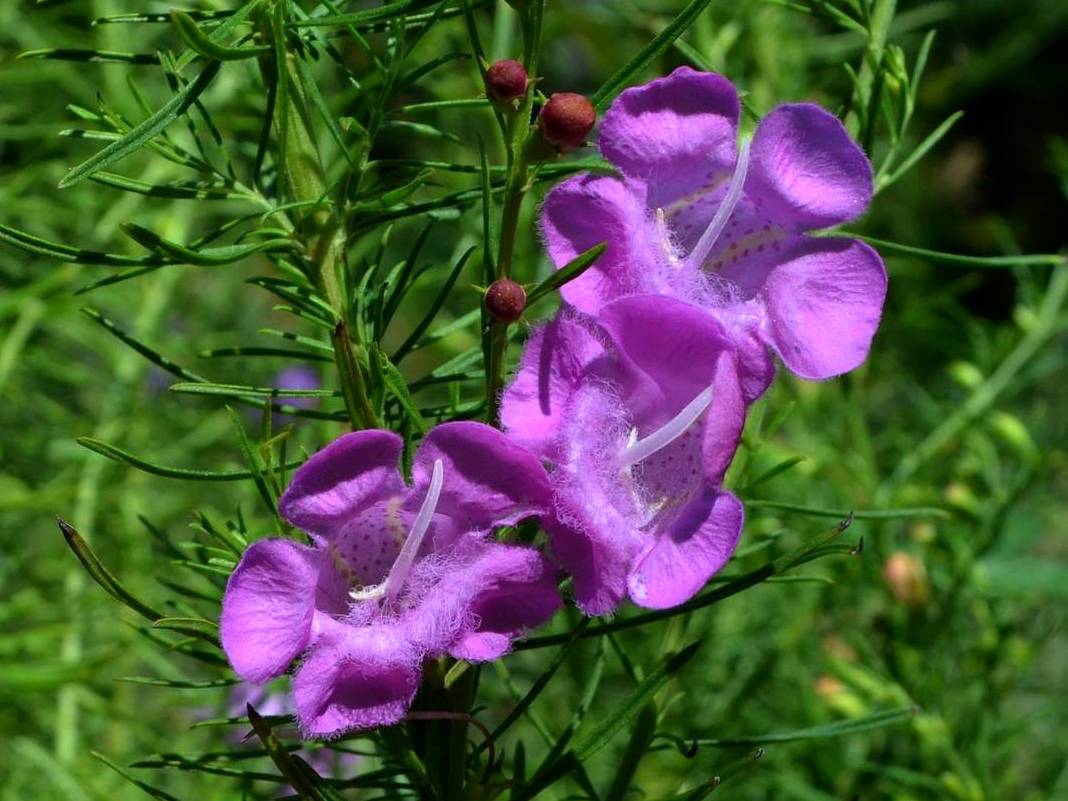
Agalinis fasciculata, known as Beach False Foxglove or fascicled false foxglove, is a wiry, much-branched annual wildflower of the eastern and south-central United States. From late summer into fall it is covered with rose-pink to purple, bell-shaped flowers about an inch across, each one speckled inside with dark purple dots and marked with two yellow lines. It belongs to the broomrape family (Orobanchaceae), the family that now holds most of the root-parasitic wildflowers formerly placed in the figwort family.
Despite the common name, this is not a beach specialist. It does grow on coastal dunes and the sandy edges of salt marshes, but it is equally at home in pine flatwoods, sandhills, old fields, prairies and roadsides from New York and Illinois south to Florida and Texas. The species name fasciculata means “bundled” and refers to the tufts of short leaves that crowd the leaf axils, making the stems look bushier than they are.
Like all Agalinis, beach false foxglove is a hemiparasite. It has green leaves and makes its own sugars, but its roots attach to the roots of nearby grasses and other plants and take water and minerals from them. That makes it a plant for meadows and wild gardens rather than tidy borders, and it explains why it is rarely sold in pots. It is also one of the most important larval host plants for the common buckeye butterfly in the Southeast.
Identification
There are about 20 Agalinis species in the eastern United States, and several of them look alike. Beach false foxglove is one of the larger and coarser ones, and its rough stems and bundled leaves are the most useful field marks.
Stems & Habit
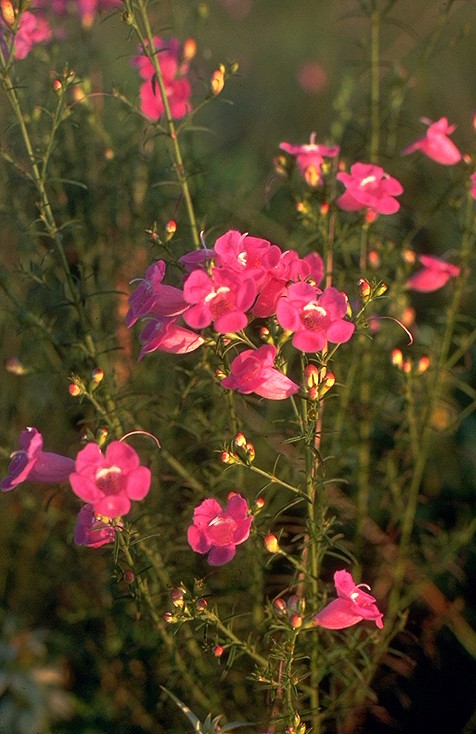
Plants usually stand 1 to 4 feet tall, occasionally taller in rich, open ground. The single main stem branches repeatedly into a broad, airy, broom-like shape. Stems are stiff, often reddish or purplish, and rough to the touch because of short, stiff hairs. This roughness (scabrous texture) helps separate it from the smooth-stemmed purple false foxglove, A. purpurea.
Leaves
The main leaves are opposite, very narrow and almost needle-like, about ½ to 1½ inches long and less than ⅛ inch wide. They are rough on the upper surface. In the axils of most leaves sit clusters of shorter leaves on undeveloped side shoots, and these bundles are what the name fasciculata describes. Plants often blacken when they dry or are pressed, a common trait of the genus.
Flowers
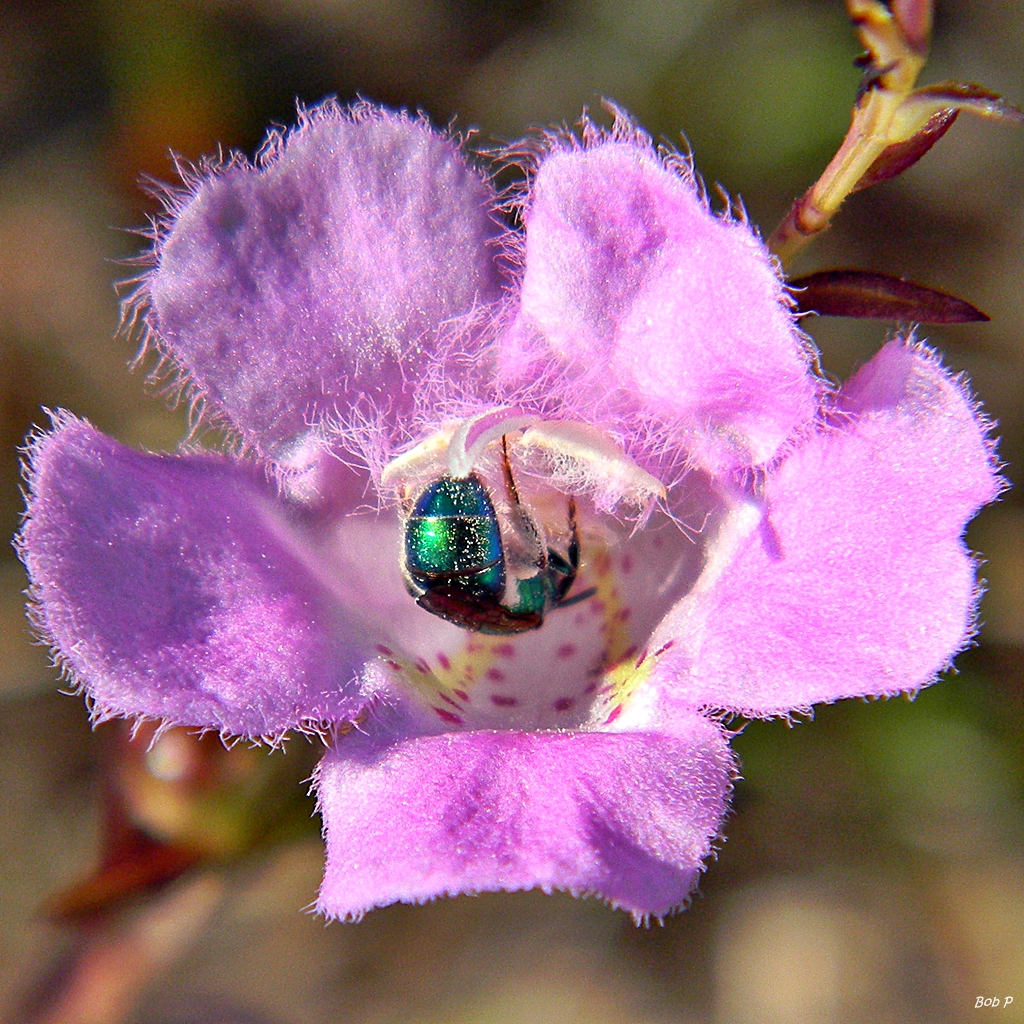
The flowers are borne singly on short stalks (usually shorter than the calyx or only a little longer) in the upper leaf axils, forming loose, leafy racemes along the branches. Each corolla is a short, broad, slightly two-lipped bell about ¾ to 1¼ inches long, rose-pink to lavender-purple, finely hairy on the outside, with five spreading, rounded lobes. Inside, the throat is paler, with two yellow lines and many dark purple spots. Four hairy stamens and the style sit against the upper side of the throat.
Each flower lasts only a day, and fresh flowers open each morning. In Florida plants can bloom from late spring through fall. Farther north, flowering is mainly August through October.
Fruit & Seeds
The fruit is a small, round capsule about ¼ inch across that splits open at the top in fall. It releases many tiny, dark seeds that fall close to the parent plant or are carried short distances by wind and water. As an annual, the plant lives only one season and depends on this seed to return the following year.
Quick Facts
| Scientific Name | Agalinis fasciculata (syn. Gerardia fasciculata) |
| Family | Orobanchaceae (broomrape family; formerly placed in Scrophulariaceae) |
| Plant Type | Annual wildflower; hemiparasitic on the roots of other plants |
| Mature Height | 1–4 ft (occasionally taller) |
| Mature Spread | 1–2 ft; broad and much-branched |
| Growth Rate | Fast (completes its life cycle in one season) |
| Sun Exposure | Full sun |
| Water Needs | Low to moderate; tolerates dry sand and seasonally moist ground |
| Soil Type | Sandy, loamy or gravelly soils; tolerates poor, disturbed ground |
| Soil pH | About 5.0–7.5 |
| Bloom Time | August–October in most of the range; late spring to fall in Florida |
| Flower Color | Rose-pink to lavender-purple with purple spots and yellow lines inside |
| Fall Color | Stems and leaves often turn purplish to blackish as plants age |
| Fruit | Small round capsule with many tiny seeds |
| Deer Resistant | Moderate; not a favored deer browse |
| USDA Hardiness Zones | Annual; native range spans roughly zones 6–10 |
Native Range
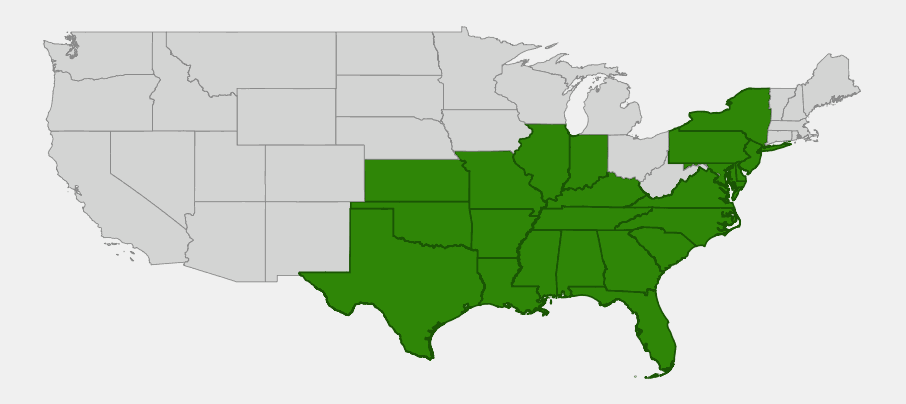
USDA PLANTS and the Lady Bird Johnson Wildflower Center record beach false foxglove from 22 states: along the Atlantic Coastal Plain from New York, New Jersey, Delaware and Maryland south through Virginia, the Carolinas and Georgia to Florida, west along the Gulf Coast to Texas, and up the Mississippi Valley into Tennessee, Kentucky, Missouri, Arkansas, Oklahoma, Kansas, Illinois and Indiana. Pennsylvania is also listed. USDA also lists it as native in Puerto Rico.
It is most common on the Coastal Plain of the Southeast, where it can be one of the most conspicuous late-summer wildflowers along sandy roadsides and in pine flatwoods. In Florida it is found across most of the state, from the Panhandle well down the peninsula. At the northern and western edges of its range it is local and less frequent.
Habitats vary widely: coastal dunes and swales, edges of salt and brackish marshes, pine flatwoods and savannas, sandhills, prairies, old fields, pastures, railroad and road shoulders, and other open, frequently disturbed ground. The common thread is full sun and a community of grasses and other herbs whose roots it can tap.
📋 Regional plant lists featuring Beach False Foxglove: North & South Florida · Alabama, Georgia & Mississippi · North & South Carolina · Maryland, Virginia & West Virginia · Kentucky & Tennessee · Arkansas, Louisiana, Eastern Oklahoma & Eastern Texas · Illinois, Iowa & Missouri · Ohio & Indiana · Nebraska, Kansas & Eastern Colorado · New York, Pennsylvania & Northern New Jersey · Delaware, Southern New Jersey & Long Island
Growing & Care Guide
Beach false foxglove is easy to grow from seed but almost never available as a nursery plant, and for good reason: as a hemiparasite it needs living host roots nearby and does poorly alone in a pot. The practical way to grow it is to sow seed directly into a sunny meadow, prairie planting or grassy wild area where it can find hosts and reseed itself each year.
Light
Give it full sun. Plants in shade grow thin and flower poorly, and in the wild it disappears once shrubs and trees close in.
Soil & Water
Average to poor, well-drained soil is best: sandy or gravelly ground in the Southeast, loam in the Midwest. It tolerates drought once growing and also accepts sites that stay damp for part of the year. Rich, heavily fertilized soil favors lush competitors and is unnecessary. Do not water a meadow just for this plant.
Planting Tips
Collect or buy seed (a few native seed suppliers carry Agalinis species) and scatter it in fall or late winter on the surface of bare patches within an established planting of native grasses such as bluestems, wiregrass or other bunchgrasses. The seed is dust-fine and needs light and cold-moist conditions to germinate well, so press it onto the soil rather than burying it. Seedlings appear in spring and attach to host roots as they grow. Plants grown alone in pots or sterile beds rarely thrive.
Pruning & Maintenance
No pruning is needed. Leave the plants standing until the capsules have opened in late fall so seed can drop. A light mowing or burn in late winter, as in the native pine savannas and prairies, keeps the planting open and creates the bare patches that seedlings need. Avoid heavy mulch, which buries the tiny seed.
Propagation
Propagation is by seed only. Collect ripe capsules in fall when they turn brown and begin to split, dry them in a paper bag, and sow the seed within a few months. Because individual plants live only one season, a population persists only if it is allowed to reseed.
Landscape Uses
- Meadows and prairie plantings: a late-season splash of pink among grasses after most summer flowers have faded
- Butterfly gardens: as a larval host for the common buckeye in a sunny, grassy corner
- Coastal and dune restoration: on stabilized back dunes and sandy swales within its native range
- Pine flatwoods and sandhill restoration: in fire-managed longleaf pine communities
- Roadside and right-of-way plantings: tolerates poor, disturbed sandy soils and periodic mowing
Wildlife & Ecological Value
Beach false foxglove is a short-lived, rather scraggly plant, but in late summer it supports a surprising amount of insect life, and its root parasitism even plays a small role in shaping the plant community around it.
For Pollinators
The flowers are visited mainly by bees. Bumblebees and other medium-sized bees push into the open bell, where the hairy anthers dust their backs with pollen, and smaller sweat bees and leafcutter bees collect pollen and nectar. The purple spots and yellow lines inside the throat act as nectar guides. Butterflies and skippers visit occasionally.
For Birds
The tiny seeds have little food value for most birds, but the plants grow in open, grassy habitats used by ground-nesting and seed-eating birds such as Bachman’s sparrow, eastern meadowlark and northern bobwhite, and the insects they host are food for those birds’ chicks.
For Mammals
The rough, bitter foliage is not a preferred browse for deer or rabbits. Like other hemiparasitic Orobanchaceae, it contains iridoid glycosides, compounds that deter many herbivores.
Ecosystem Role
Agalinis species are major larval host plants for the common buckeye (Junonia coenia), whose caterpillars feed on the leaves and store the plant’s iridoid glycosides, making them distasteful to predators. Beach false foxglove is also a host for several small moths. As a root parasite it draws resources from grasses and other dominant plants, which can slightly weaken them and leave room for other wildflowers, one reason hemiparasites are often associated with diverse grasslands.
Cultural & Historical Uses
For most of the nineteenth and twentieth centuries, American false foxgloves were placed in the genus Gerardia, named for the English herbalist John Gerard, and this species was Gerardia fasciculata. Older field guides and many state floras still use that name. The name Agalinis was published by Constantine Rafinesque in 1837 and was adopted widely after botanists revised the group in the late twentieth century.
The common name “false foxglove” refers to the resemblance between the flowers of Agalinis and those of the European foxglove (Digitalis), which also has spotted, bell-shaped flowers. The two are not closely related, and Agalinis does not contain the heart-active compounds that make Digitalis dangerous. There is little documented Native American use of beach false foxglove itself.
The move of Agalinis from the figwort family to the broomrape family (Orobanchaceae) came from DNA studies in the 1990s and 2000s. They showed that the green hemiparasites such as false foxgloves, paintbrushes and lousewort are close relatives of the leafless, fully parasitic broomrapes, and that root parasitism evolved within that single lineage.
Frequently Asked Questions
Does beach false foxglove only grow at the beach?
No. The name is misleading. It grows on coastal dunes and marsh edges, but also in pine flatwoods, sandhills, prairies, old fields and roadsides well inland, from the Gulf Coast north to Illinois and New York.
Is it a parasite? Will it hurt my lawn or garden plants?
It is a hemiparasite: it photosynthesizes but taps the roots of nearby plants, mostly grasses, for water and minerals. In a meadow this causes little harm and can even make room for other wildflowers. It does not spread aggressively into lawns or kill garden plants, and as an annual it disappears if not allowed to reseed.
Why can’t I find it at nurseries?
Because it needs host roots, it grows poorly in pots and is very rarely sold as a plant. Seed is occasionally offered by native seed companies. Sowing seed among established native grasses is the most reliable way to grow it.
Is beach false foxglove a host plant for butterflies?
Yes. Agalinis species are among the main larval host plants of the common buckeye. The caterpillars feed on the narrow leaves in summer and fall.
How is it different from purple false foxglove?
Beach false foxglove has rough, sandpapery stems and leaves with conspicuous bundles of small leaves in the leaf axils. Purple false foxglove (Agalinis purpurea) has smoother stems, usually lacks the leaf bundles, and tends to grow in moister places. Flower size and color overlap, so check the stems and leaves.

Looking for a nursery that carries Beach False Foxglove?
Browse our native plant nursery directory: Alabama & Arkansas · Delaware, Florida & Georgia · Illinois, Indiana & Kansas · Kentucky, Louisiana, Maryland, Mississippi & Missouri · New Jersey, New York, North Carolina & Oklahoma · Pennsylvania, South Carolina, Tennessee, Texas & Virginia