
Giant Bulrush (Schoenoplectus californicus)
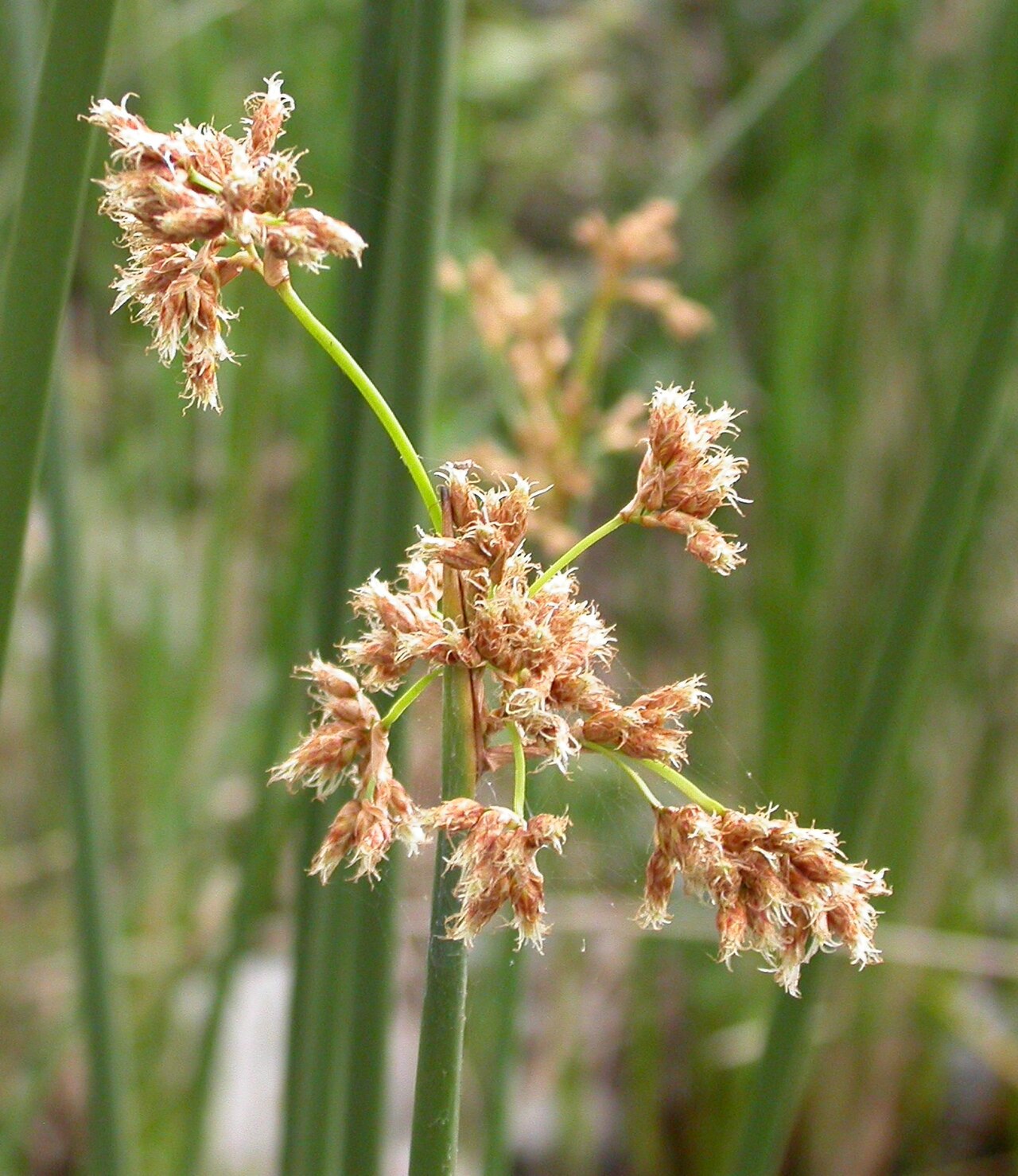
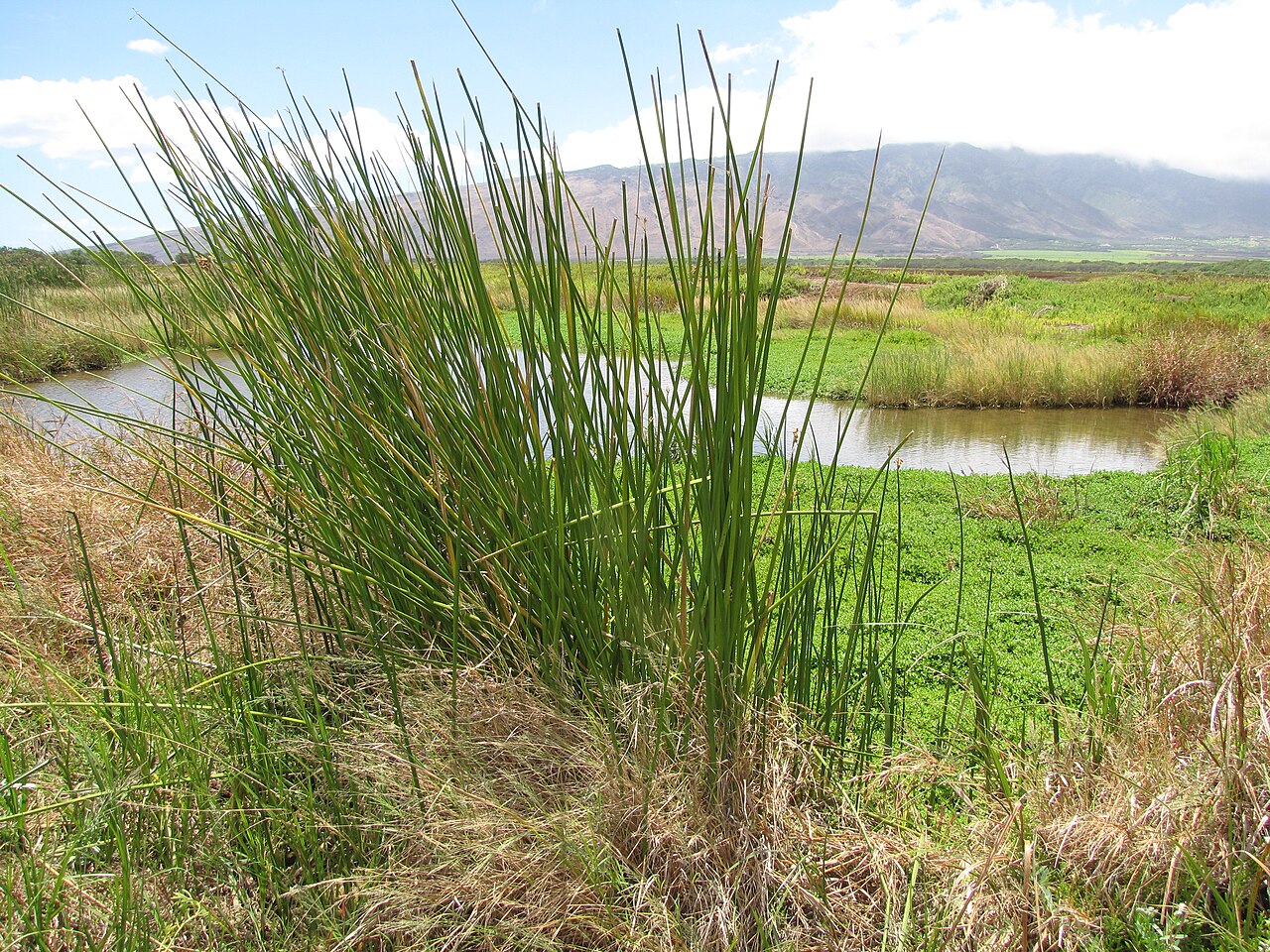
Schoenoplectus californicus, known as Giant Bulrush, California bulrush or southern bulrush, is one of the tallest native sedges in North America. Its smooth, dark green, nearly leafless stems grow 6 to 12 feet tall, occasionally more, from thick, creeping rhizomes in shallow water, and they form dense stands along the edges of lakes, ponds, rivers, marshes and brackish lagoons. From spring through summer, loose clusters of fuzzy, reddish-brown spikelets hang from near the tips of the stems. It belongs to the sedge family (Cyperaceae).
Older books and many nurseries list it as Scirpus californicus, its former name before the large-stemmed bulrushes were moved to the genus Schoenoplectus. It is sometimes called tule, though that name more often refers to its close relative hardstem bulrush (Schoenoplectus acutus). Its range is unusually wide: it grows across the southern United States from South Carolina and Florida to California, south through Mexico and Central America, and through much of South America, including the totora reed beds of Lake Titicaca.
For gardeners and land managers, giant bulrush is a workhorse wetland plant. Its dense roots and stems hold shorelines against waves, filter runoff, and give cover to fish, wading birds and waterfowl. This guide explains how to identify it, where it grows, how to plant it in ponds and stormwater wetlands, and its value to wildlife.
Identification
Giant bulrush is easy to recognize by its sheer size and its stems, which look like giant, dark green knitting needles with tufts of brown spikelets near the top. Its close relatives, hardstem and softstem bulrush, have round stems and grow mainly farther north.
Stems
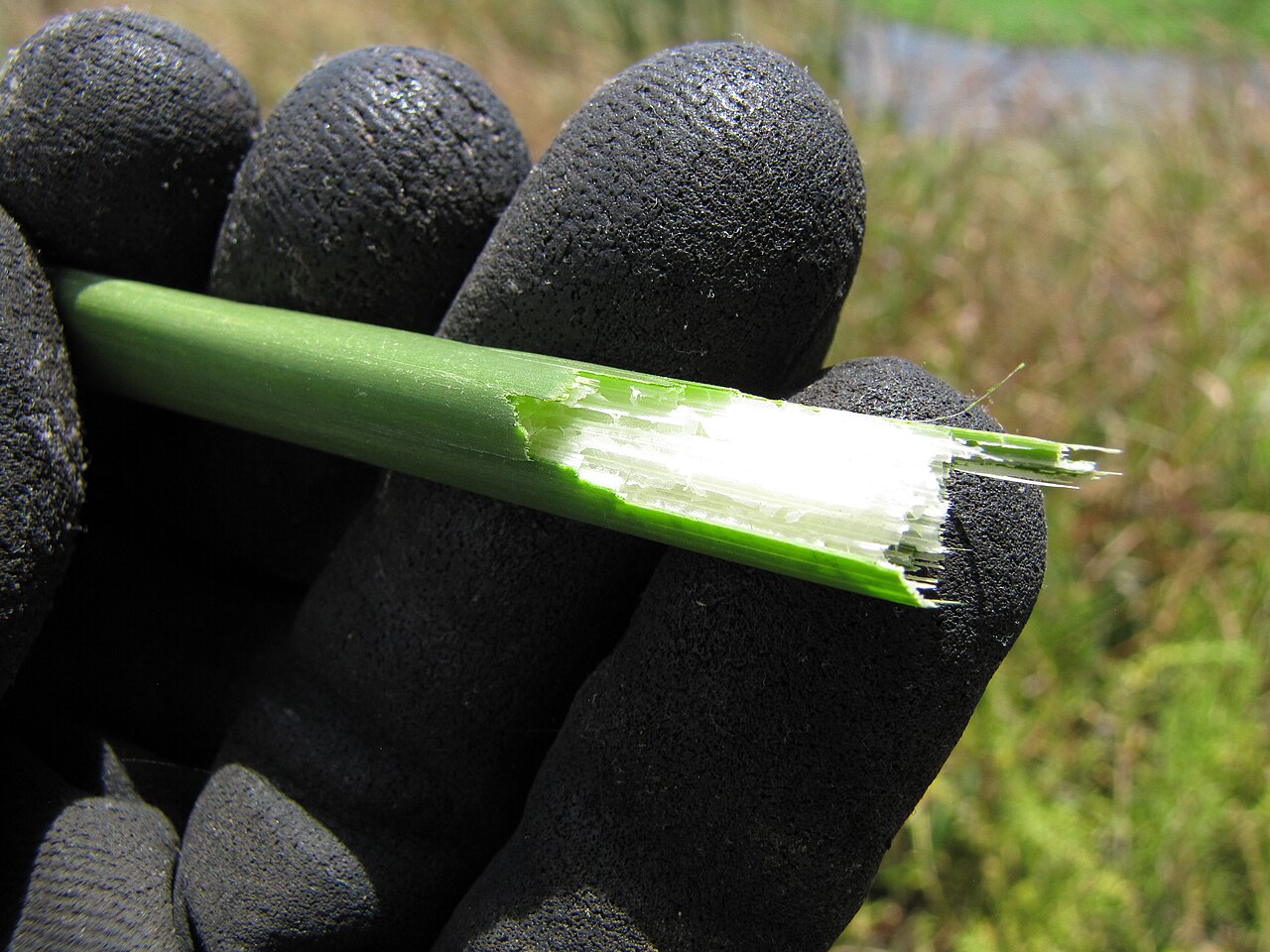
The stems (culms) are usually 6 to 12 feet tall and about ½ to 1 inch thick at the base, tapering toward the top. They are round near the base but become bluntly three-sided toward the tip, a useful feature for telling this species from hardstem and softstem bulrushes, whose stems stay round. Inside, the stems are filled with soft, white, spongy pith with many air spaces. This tissue carries oxygen down to the roots in airless mud and makes the stems light enough to float when cut.
Leaves
Giant bulrush has almost no leaves. What leaves there are have been reduced to brownish sheaths around the base of each stem, sometimes with a short blade. The tall green stems do nearly all of the photosynthesis.
Flowers
The flower cluster appears to come out of the side of the stem just below the tip, because a short, stiff bract continues upward beyond it like an extension of the stem. The cluster is a loose, branched, often drooping arrangement of many small, egg-shaped spikelets about ¼ to ½ inch long. Each spikelet is made of overlapping reddish-brown scales, and the protruding stamens and feathery stigmas give the clusters a fuzzy, tassel-like look. The Lady Bird Johnson Wildflower Center lists flowering from April through August. Plants in frost-free areas may flower almost year-round.
Fruit & Seeds
Each flower produces a small, smooth, gray-brown to dark brown achene, roughly lens-shaped, with a few bristles at the base. The seeds ripen in summer and fall and drop into the water or onto mud. Ducks and other birds eat them.
Similar Species
Chairmaker’s bulrush (Schoenoplectus americanus) is much shorter and has sharply three-sided stems. Hardstem bulrush (S. acutus) and softstem bulrush (S. tabernaemontani) have round stems from base to tip. Cattails have flat leaves and brown, sausage-shaped seed heads.
Quick Facts
| Scientific Name | Schoenoplectus californicus (C.A. Mey.) Palla (syn. Scirpus californicus) |
| Family | Cyperaceae (sedge family) |
| Plant Type | Emergent aquatic perennial (sedge) from rhizomes |
| Mature Height | 6–12 ft (occasionally taller) |
| Mature Spread | Spreads indefinitely by rhizomes to form large colonies |
| Growth Rate | Fast |
| Sun Exposure | Full sun |
| Water Needs | Very high; wet mud to standing water up to about 3 ft deep |
| Soil Type | Mucky, silty, sandy or clay soils in fresh to brackish water |
| Soil pH | Wide range, about 5.5–8.5; tolerates lime |
| Bloom Time | April–August (longer in frost-free areas) |
| Flower Color | Reddish-brown spikelets |
| Fall Color | Stems stay green in mild climates; may brown after frost |
| Fruit | Small, smooth brown achenes |
| Deer Resistant | Yes (rated high by the Lady Bird Johnson Wildflower Center) |
| USDA Hardiness Zones | 7–11 |
Native Range
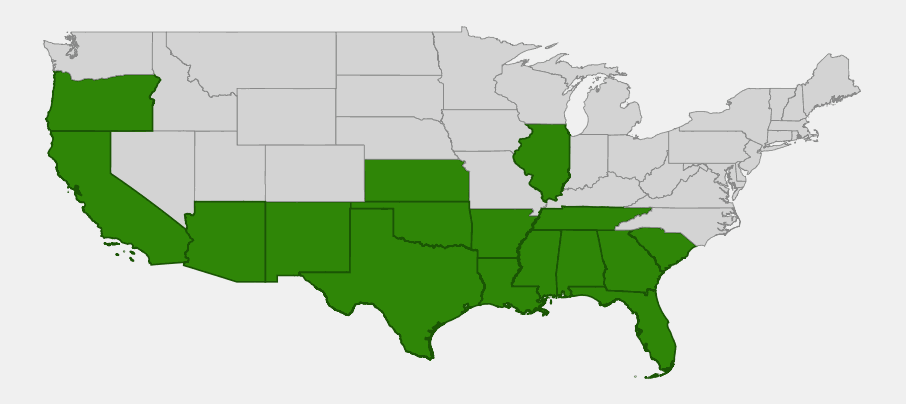
Giant bulrush has a huge range across the warmer parts of the Americas. In the United States, USDA PLANTS and the Lady Bird Johnson Wildflower Center record it as native in South Carolina, Georgia, Florida, Alabama, Mississippi, Tennessee, Louisiana, Arkansas, Oklahoma, Texas, Kansas, Illinois, New Mexico, Arizona, California and Oregon. It also grows in Hawaii, where it is considered introduced. Beyond the United States it extends through Mexico, Central America, the Caribbean and South America to Chile and Argentina, and to Easter Island.
It is most abundant along the Gulf and southern Atlantic coasts and in California. In Florida it grows throughout the state in lakes, rivers, marshes and coastal lagoons, and it is common around large lakes such as Lake Okeechobee. In Louisiana and coastal Texas it forms extensive stands in fresh and slightly brackish marshes, and in California it is a dominant plant of the Central Valley, the Sacramento-San Joaquin Delta and coastal marshes. Records from the interior, such as Illinois, Kansas and Tennessee, are scattered.
Giant bulrush grows in water from a few inches to about 3 feet deep and tolerates moderately brackish water, so it often marks the transition between freshwater and salt marsh. It spreads mainly by rhizomes and can form solid stands covering many acres. Those stands slow waves and currents, trap sediment and build up the shoreline over time.
📋 Regional plant lists featuring Giant Bulrush: North & South Florida · Alabama, Georgia & Mississippi · North & South Carolina · Kentucky & Tennessee · Arkansas, Louisiana, Eastern Oklahoma & Eastern Texas · South & West Texas · Illinois, Iowa & Missouri · Nebraska, Kansas & Eastern Colorado · Arizona & New Mexico · California & Nevada
Growing & Care Guide
Giant bulrush is easy to grow wherever you have shallow water and full sun, and it is sold by aquatic and native plant nurseries for ponds, lakeshores and stormwater wetlands. It is a large, aggressive spreader, so plan for its size. It is best suited to big ponds, lake edges and restoration sites, not small water gardens unless it is kept in a container.
Light
Full sun. It tolerates light shade for part of the day, but stands become thin and weak in shade.
Soil & Water
It grows in almost any wet soil, from muck to sand and clay, and tolerates a wide pH range and moderately brackish water. Plant it in saturated soil or in water up to about 1 to 2 feet deep. Established stands can tolerate deeper water and seasonal flooding. It does not tolerate drying out for long periods.
Planting Tips
Plant rhizome divisions or potted plants in spring or early summer, spacing them 2 to 3 feet apart. They will fill in within one or two seasons. In a water garden, grow it in a large, sturdy container without drainage holes, set on the bottom of the pond, to keep the rhizomes from spreading through the whole pond. Where waves or wildlife may uproot new plants, protect plantings with temporary fencing or stake them in place.
Pruning & Maintenance
Little maintenance is needed. In cooler areas, you can cut the stems back after they brown in winter to tidy the planting, or leave them for wildlife cover. In ponds, divide or thin container plants every few years. Pull rhizomes that escape into areas where you do not want them.
Propagation
Propagate it by dividing rhizomes in spring, which is the easiest and most reliable method. Seed is slower. The Lady Bird Johnson Wildflower Center notes that fresh, undried seed stored in water in a refrigerator for about six months, then germinated in water at 86–90°F under strong light, gives good results.
Landscape Uses
- Shoreline stabilization: dense roots and stems buffer waves and hold soil on lake and pond edges
- Stormwater and treatment wetlands: widely used to filter runoff and take up nutrients
- Wetland restoration: in freshwater and brackish marshes within its native range
- Large ponds: a bold vertical accent; contain it in pots for small ponds
- Wildlife habitat: cover and nesting sites for marsh birds and shelter for fish
Wildlife & Ecological Value
Giant bulrush stands are among the most productive wildlife habitats in southern wetlands. The Lady Bird Johnson Wildflower Center notes that they buffer wind and wave action, allowing other aquatic plants to grow where they otherwise could not.
For Pollinators
Like other sedges, giant bulrush is wind-pollinated and offers little to bees or butterflies. Its stems do give perching sites to dragonflies and damselflies, whose nymphs live in the water around the stems.
For Birds
The seeds are eaten by ducks and other waterfowl, rails and some songbirds. The tall, dense stands give nesting cover to red-winged blackbirds, marsh wrens, least bitterns and rails, and shelter for herons and egrets hunting along the edges. In California, tricolored blackbirds and other marsh birds nest in bulrush stands.
For Mammals
Muskrats eat the rhizomes and use the stems in their lodges, and nutria feed on it where they occur. Deer seldom browse it.
Ecosystem Role
The underwater stems provide shelter and spawning habitat for fish, such as largemouth bass and sunfish, and a surface for algae and invertebrates that feed them. The dense rhizome mats stabilize sediment, reduce shoreline erosion and take up nutrients from the water, which is why giant bulrush is a common choice for treatment wetlands and lake restoration.
Cultural & Historical Uses
Giant bulrush and its close relatives have been important to people wherever they grow. In California, Native American peoples used bulrush stems, known as tule, to build boats, houses, mats and baskets, and the name tule comes from the Nahuatl word tollin for these plants. The spongy stems float well, which made them ideal for rafts and canoe-like reed boats.
In South America the same species, under the name totora (Schoenoplectus californicus subsp. tatora), is famous for the floating islands that the Uru people build from layers of reeds on Lake Titicaca, and for the caballitos de totora, small reed boats that fishermen on the coast of Peru have used for over 3,000 years. Totora also grows on Easter Island, where it was used for thatch and reed boats.
Today giant bulrush is valued in the United States mainly for its ecological work. Wetland designers plant it in stormwater ponds, treatment wetlands and shoreline restoration projects, and Florida lake managers use it to restore marsh edges and reduce erosion.
Frequently Asked Questions
Is giant bulrush the same as Scirpus californicus?
Yes. Scirpus californicus is an older name for the same plant. Botanists moved the large bulrushes to the genus Schoenoplectus, but many nurseries and older references still use Scirpus.
Will giant bulrush take over my pond?
It can. It spreads quickly by rhizomes in shallow water and can cover a large area. In small ponds, grow it in a large container set on the bottom of the pond. In big ponds and lakes, plant it only where you want a broad marsh edge.
How deep can giant bulrush grow?
It grows best in saturated soil to about 1 to 2 feet of water, and established stands tolerate water up to about 3 feet deep and seasonal flooding.
Is giant bulrush good for wildlife?
Yes. The seeds feed ducks and other birds, the dense stands give nesting cover to marsh birds, and the underwater stems shelter fish and the insects they eat.
Can it grow in salty water?
It tolerates fresh to moderately brackish water and often grows where rivers meet coastal marshes. It is not suited to full-strength seawater.

Looking for a nursery that carries Giant Bulrush?
Browse our native plant nursery directory: Alabama, Arizona & Arkansas · California · Florida & Georgia · Illinois & Kansas · Louisiana & Mississippi · New Mexico & Oklahoma · Oregon · South Carolina, Tennessee & Texas