Colorado Four O’Clock (Mirabilis multiflora)
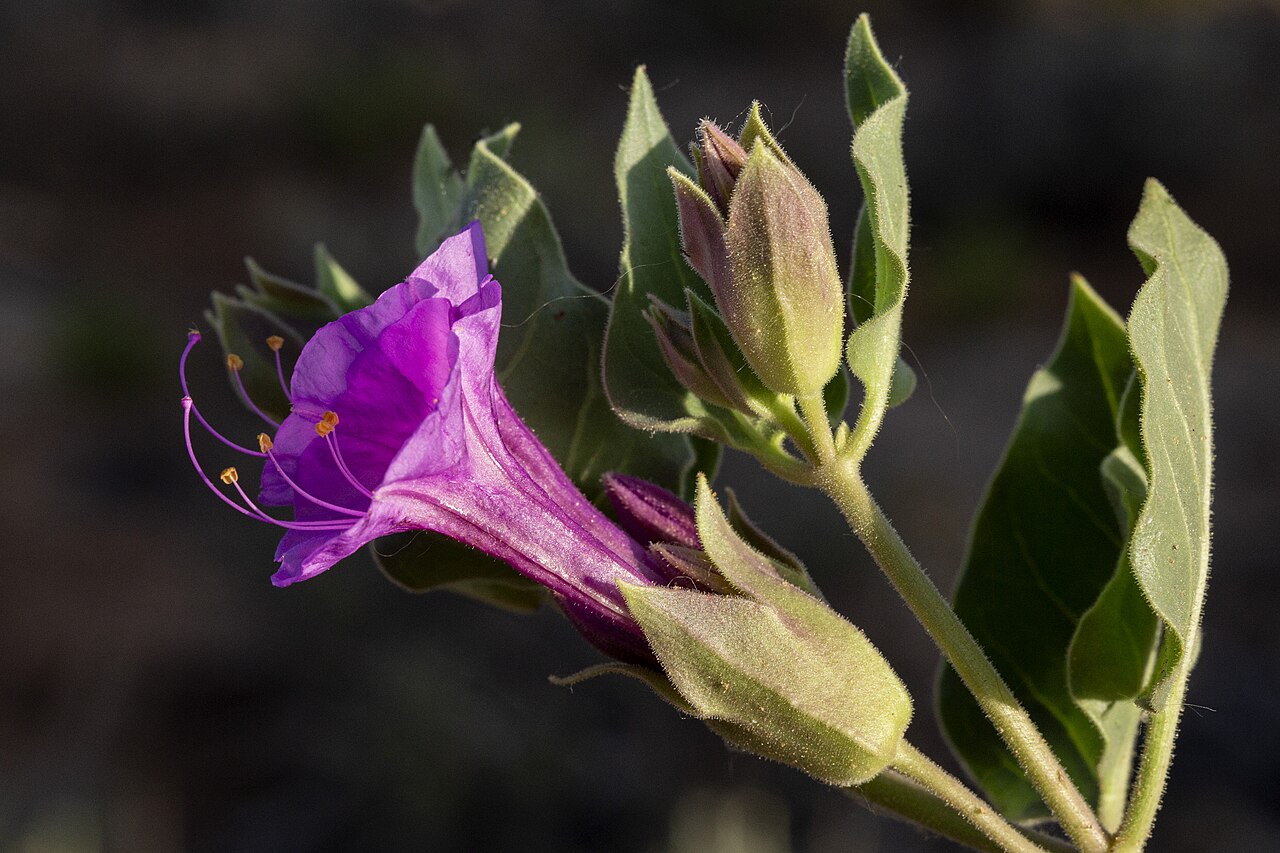
Colorado four o’clock makes an expansive mound of fleshy green foliage that opens into magenta flowers as the day cools. It is a southwestern perennial for a generous space, not a tiny edging plant. A modest spring shoot can become a broad summer presence, then disappear above ground after the growing season. The persistent storage root, rather than the winter silhouette, is the plant's enduring structure.
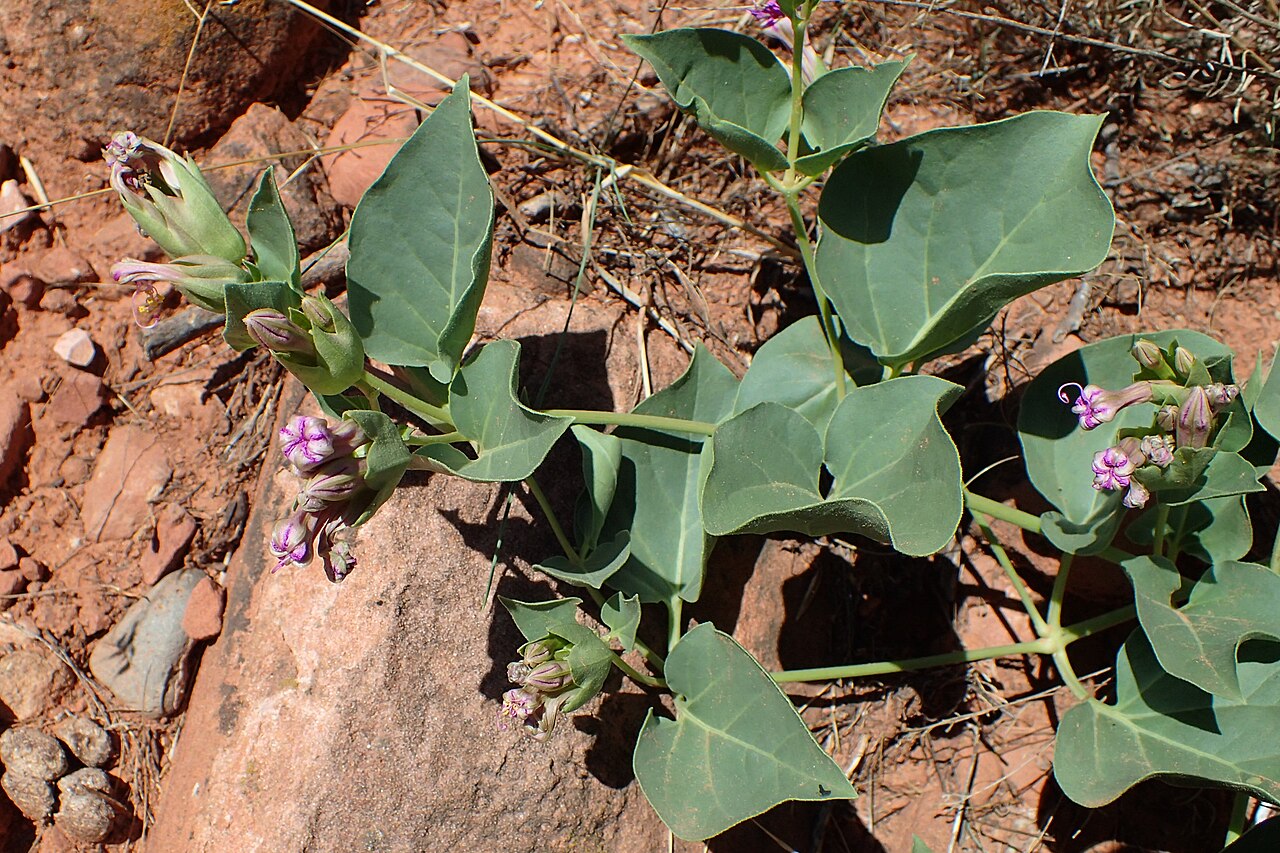
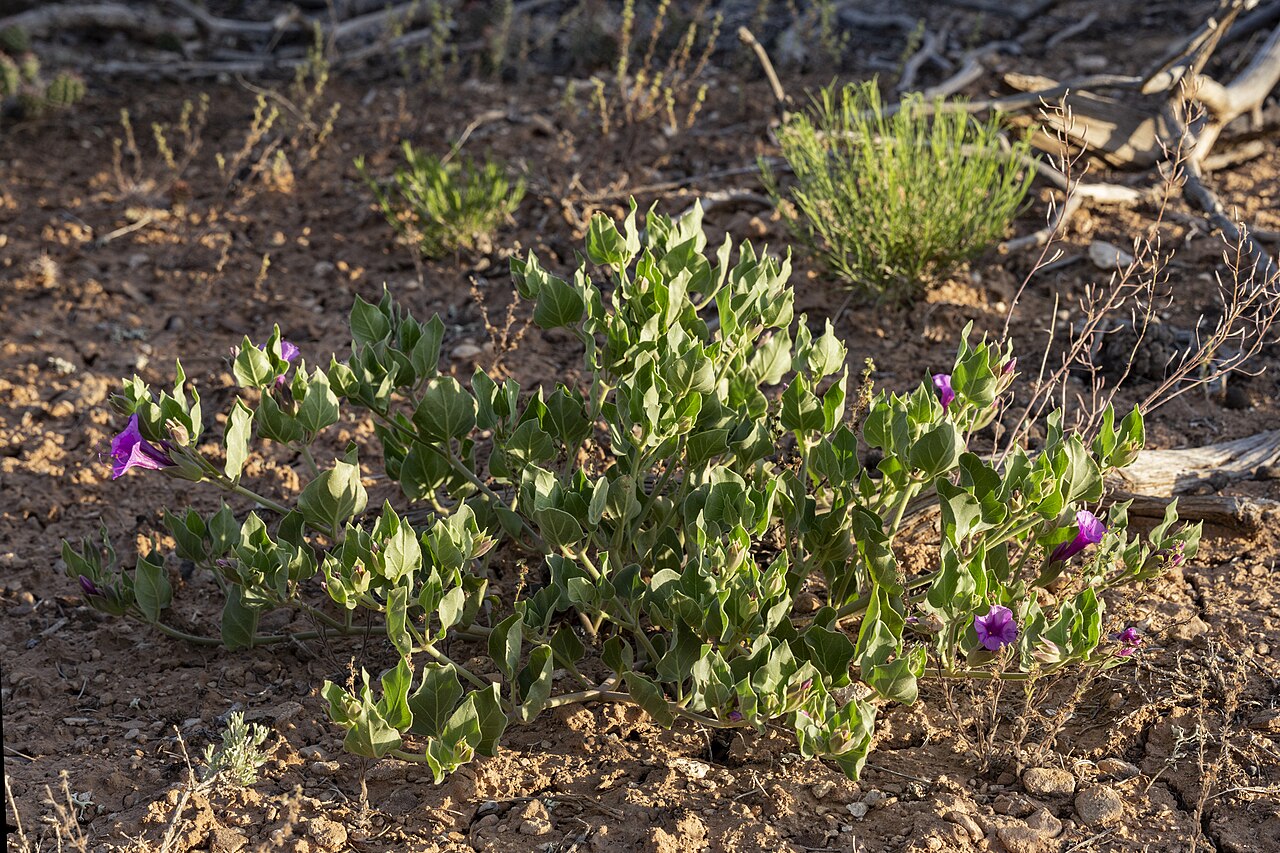
Mirabilis multiflora is also called desert four o’clock or showy four o’clock. The regional table previously misspelled the species as multipflora; the corrected name is multiflora. It is distinct from the familiar garden four o’clock, Mirabilis jalapa, and from other western Mirabilis species. The photographs here show plants from Utah and Colorado, including their low, spreading habit and the leafy cups surrounding the flowers.
For a Utah or western Colorado dry garden, the main design decision is room. Its roughly two-foot height can sound modest until you account for a mound several feet across. Give it a place where broad growth is useful: around the open spaces between shrubs, on a sunny bank, or in a large water-wise bed. Avoid squeezing it between fragile low flowers that will eventually disappear beneath its branches.
Identification
Stems and seasonal habit
Branches spread outward from the crown and may run along the ground before lifting their tips. The stems are herbaceous, not a permanent woody framework. After cold weather the top growth dies back, leaving the underground root to support the following season. Mark the crown discreetly while it is visible so winter or early-spring garden work does not accidentally disturb a plant that appears to be absent.
Leaves
Leaves occur in opposite pairs and have broad oval to rounded blades, often with a substantial, somewhat fleshy feel. The foliage provides much of the plant's visual mass even when individual flowers close. New growth may show reddish tones. Several western four o’clocks share similar leaves, so examine the whole plant and its flower-bearing structures rather than using a detached leaf as your only identification evidence.
Flowers
The showy pink-purple funnel is formed by petal-like sepals rather than a conventional separate corolla. Green bracts surround groups of flowers and remain visible as blossoms fade. Flowers tend to open later in the day and can remain open into the morning, although temperature and light affect the display. The familiar name is a useful clue to timing, not a promise that every bud opens at exactly four o’clock.
Fruits and roots
The dry fruits are enclosed by persistent floral structures. The plant also develops a large storage root that helps it return after winter and endure dry intervals. Do not expose or cut that root merely to confirm identity. A planted specimen is best understood by following its annual cycle from spring emergence to summer growth and autumn dieback, while retaining a nursery label with the full scientific name.
Quick Facts
| Scientific Name | Mirabilis multiflora; corrected from legacy typo multipflora |
| Family | Nyctaginaceae |
| Plant Type | Long-lived herbaceous perennial with a storage root |
| Mature Height | Commonly about 1–3 feet; the regional table lists 24 inches |
| Mature Spread | Often several feet; vigorous garden plants can reach 5–10 feet across |
| Growth Rate | Rapid seasonal top growth after emergence |
| Sun Exposure | Full sun to light partial shade |
| Water Needs | Low once established; avoid frequent saturation |
| Soil Type | Well-drained mineral soils; tolerates varied textures when not waterlogged |
| Soil pH | Tolerates alkaline conditions |
| Bloom Time | Late spring through summer; may continue into fall with suitable weather |
| Flower Color | Magenta to pink-purple |
| Fall Color | Seasonal dieback rather than ornamental fall foliage |
| Fruit | Dry one-seeded fruits associated with persistent floral structures |
| Deer Resistant | Not guaranteed; local browsing varies |
| USDA Hardiness Zones | Use locally proven provenance and winter drainage rather than a universal zone claim |
Native Range
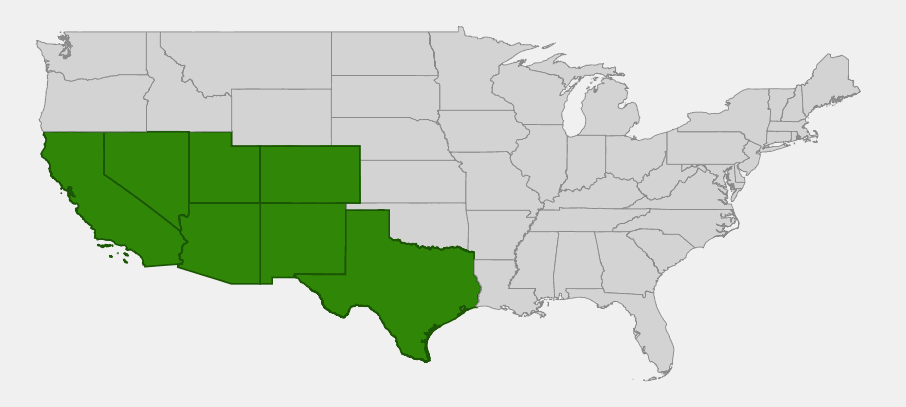
Kew recognizes Mirabilis multiflora as native in Arizona, California, Colorado, Nevada, New Mexico, Texas and Utah, extending into northern Mexico. The species includes several accepted varieties, whose individual ranges are narrower than the species-wide map. A Utah or Colorado plant should therefore not be assumed to represent every form occurring across the Southwest.
Dry shrublands and pinyon-juniper landscapes are characteristic settings. At Arches National Park, the National Park Service documents it in desert shrub and pinyon-juniper communities. Those examples help explain its preference for open light and its ability to endure seasonal dryness, but they do not mean that every exposed rock garden provides enough rooting volume for a mature plant.
Elevation, rainfall and winter conditions vary greatly across the mapped states. Buy plants with a known regional history where possible, especially near the colder edge of cultivation. The map marks state-level nativity, not a claim that this species occurs in every county or that it will grow in every soil within those borders. For a restoration project, local botanical records and source-population suitability take priority over a broad garden recommendation.
📋 Regional plant list: Utah and Western Colorado
Growing & Care Guide
Light
Full sun produces a broad, conspicuous display, while light shade from an open shrub or small tree can also be suitable. Dense shade is a different environment. Consider the path of sunlight after nearby shrubs mature, not just the conditions on planting day. The spreading branches need an open margin where they will not be stepped on each time someone reaches another plant.
Soil and water
This is a water-wise plant after establishment, but a newly planted root ball still needs attention. Water deeply enough to reach its young roots and then allow the soil to move away from saturation. Avoid attaching it to the same frequent watering schedule as a vegetable bed. A well-drained site is more important than making every planting hole uniformly sandy; abrupt texture changes can create water problems of their own.
Planting tips
Plant a small, healthy nursery specimen in spring where cold winters make root establishment important. Choose the final position carefully because a mature storage root is not something to move casually. Keep the crown at its original depth and leave room for the projected mound, not just the pot. A temporary marker helps protect late-emerging shoots from being mistaken for weeds or overlooked during spring cleanup.
Pruning and maintenance
Remove dead top growth when it is clearly dead and access is convenient, protecting new shoots at the crown. Occasional selective trimming can keep a branch off a path, but repeated hard shearing defeats the plant's natural form. If pruning is constantly required to preserve neighboring plants, the site is too small. Move the neighbors or reconsider the layout rather than treating the perennial as a clipped hedge.
Propagation
Seed is a practical route, and the western landscape guide reports that cold stratification is not required. Use a small labeled sowing trial and follow supplier instructions for the seed lot. Pot seedlings on promptly enough that their developing roots are not held for a long period in cramped containers. Avoid unnecessary disturbance of the root when transplanting. Garden-grown seed is preferable to removing material from wild populations.
Seasonal planning
Its empty winter space and late spring emergence deserve deliberate design. Use a marker or a nearby durable feature to show where the crown belongs, and do not fill the apparent gap with another large perennial. In summer, check that expanding foliage is not burying irrigation emitters or small plants. At the end of the season, observe how far the mound actually spread and use that measurement in future planting decisions.
Landscape Uses
- Broad summer color in a large xeric bed.
- A soft-textured mound between established dryland shrubs.
- A sunny bank with ample undisturbed rooting space.
- An evening-viewed garden near a seating area but clear of walking routes.
- A regional native planting where seasonal winter dormancy is acceptable.
Wildlife & Ecological Value
For pollinators
The National Park Service identifies hawkmoths among the pollinators. Evening observation can therefore reveal activity missed during a midday garden visit. Avoid bright lighting directly on the plant if the aim is to observe natural nocturnal behavior. Include other species with different flower forms and bloom seasons so the garden supports a wider range of insects than a single spectacular mound can.
For birds
The plant adds seasonal structure and the insects associated with living foliage, but this guide does not promise a specific bird-seed benefit unsupported by a species-level source. A bird-friendly planting should also include appropriate shrubs, grasses and shelter. Leave some natural seasonal structure where it does not interfere with access, while recognizing that the top growth will eventually die back.
For mammals
Dense summer growth can provide cover for small animals. That is an ecological feature, but it may matter near structures or highly managed beds where rodents are already a concern. Inspect the area rather than assuming every sheltered animal is causing damage. No plant should be marketed as universally deer-proof on the basis of a few gardens; protect young specimens if local browsing pressure warrants it.
Water-wise landscape role
Its large seasonal canopy is supported by a persistent underground root rather than by continuous heavy irrigation. That makes it useful where an appropriate dryland perennial can replace a thirsty bedding display. Savings depend on actually changing the watering regime. Planting a drought-adapted species while retaining a daily lawn schedule misses both the horticultural and water-conservation point.
Cultural & Historical Uses
The names Mirabilis and multiflora refer to the plant's striking appearance and abundant flowers. Its common names emphasize either geography or its afternoon flowering behavior. Keeping the correct spelling in a plant record matters because a small typographic error can make nursery searches and botanical references unnecessarily difficult.
Utah State University summarizes documented Indigenous dye and medicinal traditions associated with Colorado four o’clock. Such accounts should be understood in their cultural context, not transferred into home-remedy instructions. This guide supplies no preparation or dosage advice and does not infer edibility from the fact that related plants have appeared in historical accounts.
In modern dryland design, its greatest contribution may be scale: it offers a substantial flowering mass without behaving like a small tree or evergreen shrub. Understanding both the broad summer mound and the dormant winter root makes it easier to use honestly. A photograph taken at peak flowering should be balanced with an explanation of what the garden looks like when the plant is resting.
Frequently Asked Questions
Is this the ordinary garden four o’clock?
No. The southwestern native here is Mirabilis multiflora, not Mirabilis jalapa. Buy by the full scientific name, especially when selecting plants for a native-only project.
Why has it not emerged with my other perennials?
It can emerge relatively late. Check the marked crown gently and avoid digging it up immediately. Winter damage is possible, but delayed emergence alone is not proof that the root has died.
How much space should I allow?
Expect a mound several feet across, with particularly vigorous garden plants potentially reaching five to ten feet in spread. The roughly two-foot height does not describe its horizontal footprint.
Do the flowers open at exactly four?
No. Afternoon and evening opening is a tendency influenced by conditions, not a clock setting. Weather and light can change the timing and how long flowers remain open.
Can it share daily irrigation with bedding plants?
That is usually a poor arrangement. Establishment watering is needed, but established plants should not be kept frequently saturated. Separate irrigation zones make it easier to meet each plant's needs.
Sources & Further Reading
- Kew POWO: Mirabilis multiflora accepted taxonomy and distribution
- National Park Service: showy four o’clock at Arches
- Western Native Plants: desert four o’clock in the landscape
- Utah State University: four o’clock genus and cultural history
- USDA PLANTS: MIMU
Find Native Plants
Ask growers about nursery propagation and regional provenance. Browse our Utah native plant nurseries, Colorado native plant nurseries directory for suppliers.