Dune Sunflower (Helianthus anomalus)
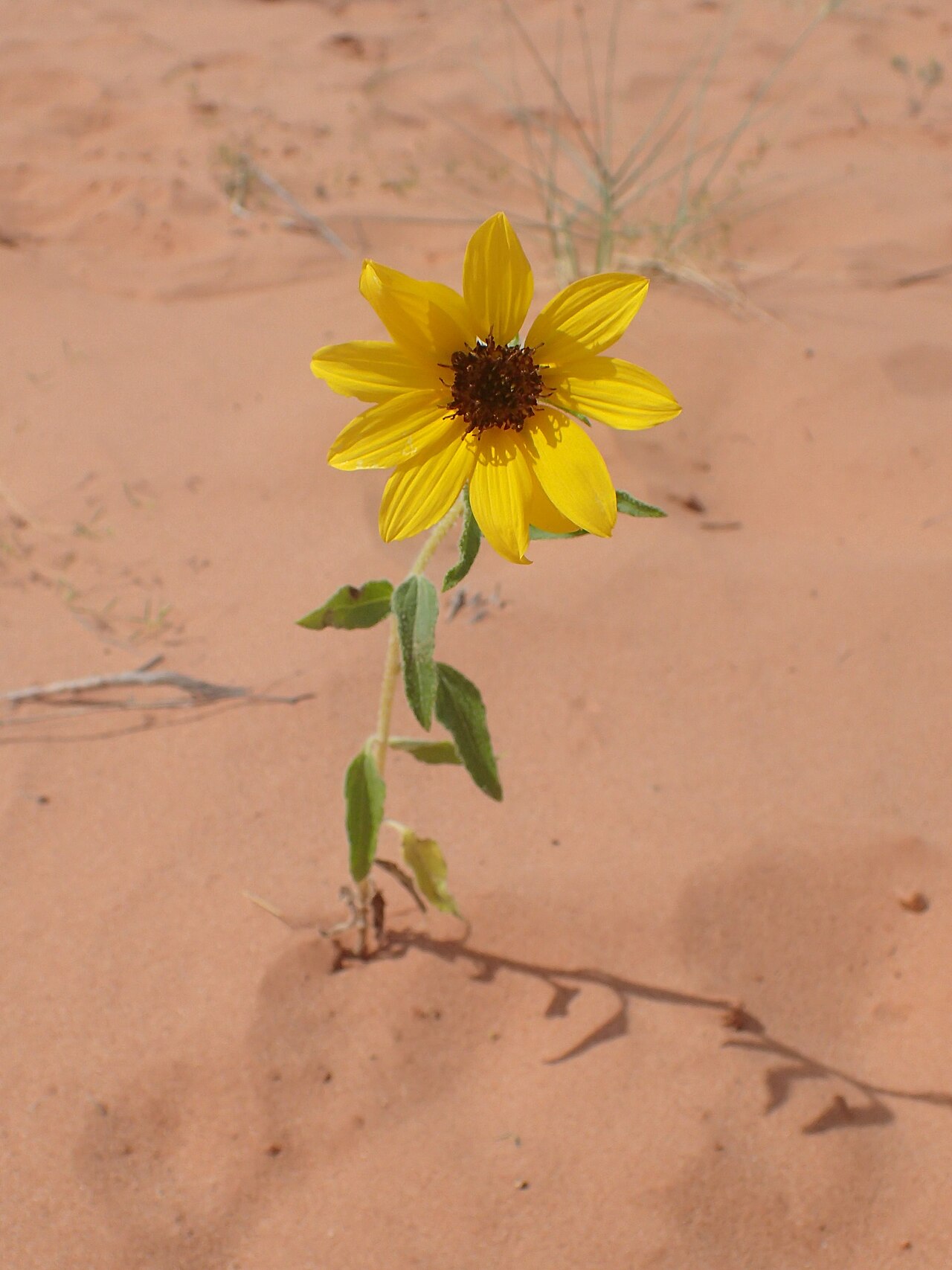
Dune sunflower is a small native sunflower with an unusually specialized home: desert sand dunes in Utah and northern Arizona. Yellow rays surround dark reddish disk flowers, while broad, relatively thick leaves rise above open sand. This is not a six-foot prairie perennial or a miniature version of a standard seed-crop sunflower. Its ecology is tied to a particular combination of loose substrate, open light, and moisture below a dry-looking surface.
The botanical name Helianthus anomalus is the most reliable way to find information about it. Anomalous sunflower and sand sunflower are other common names. The legacy regional table called it Western Sunflower, a name often applied to a different species, Helianthus occidentalis. Here the page and corrected table use Dune Sunflower together with the scientific name. Other plants also share dune-related common names, so the Latin name remains essential.
For most readers this is first an identification and conservation plant, not an automatic shopping-list recommendation. A suitable native garden is more than a state on a map: ordinary clay beds, irrigated lawn edges, and cool Colorado mountain gardens do not reproduce its habitat. Grow it only from responsibly supplied, correctly identified propagated material, and keep its narrow ecological requirements in mind when considering a trial.
Identification
Stems and annual habit
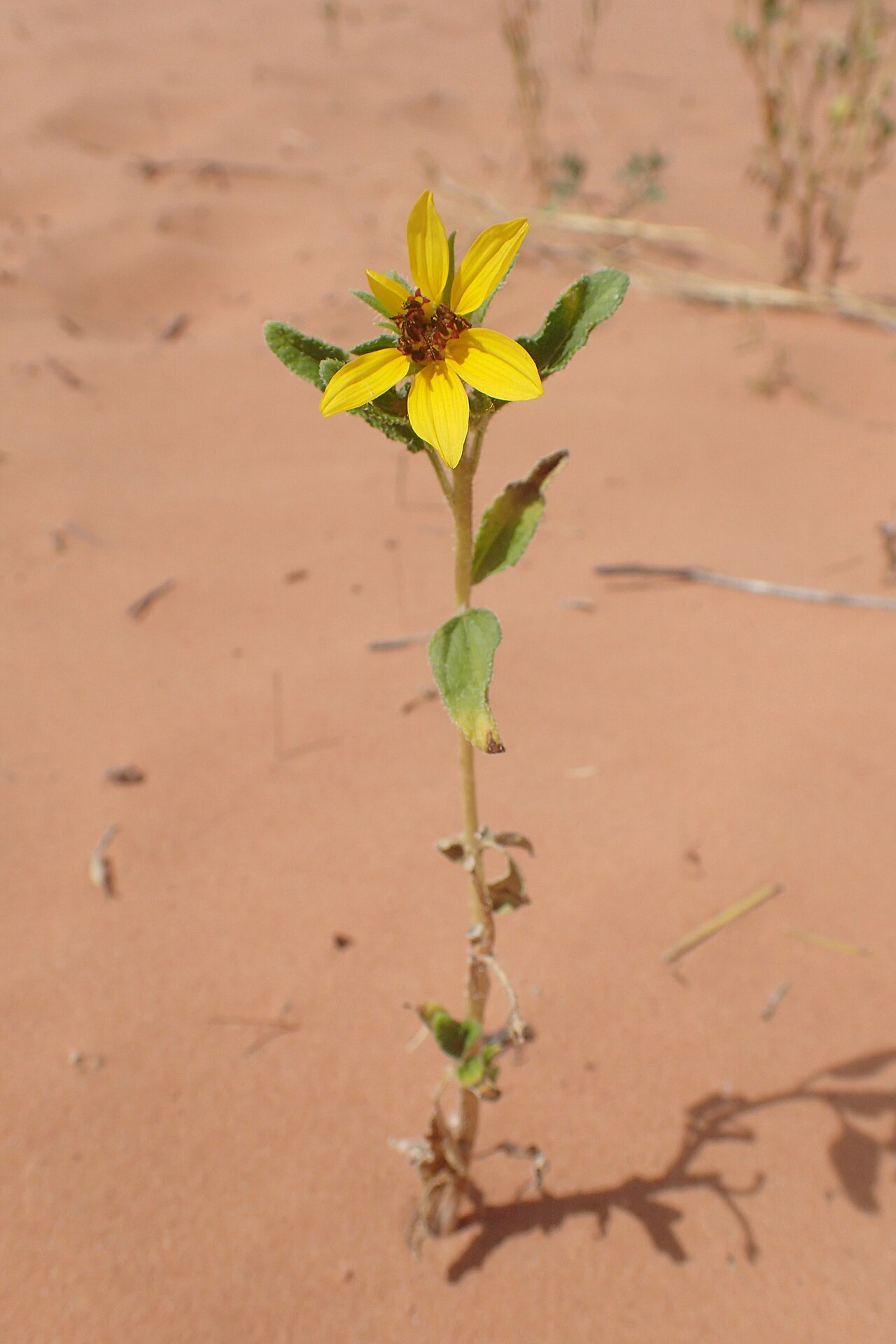
Flora of North America describes an annual roughly 25–60 centimeters tall, approximately 10–24 inches, with upright stems carrying sparse coarse hairs. That published range is quite different from the old regional table's 72-inch listing. An individual completes its life cycle from seed rather than persisting as a spreading perennial root system. The amount of branching can vary, so use reproductive characters as well as overall silhouette.
Leaves
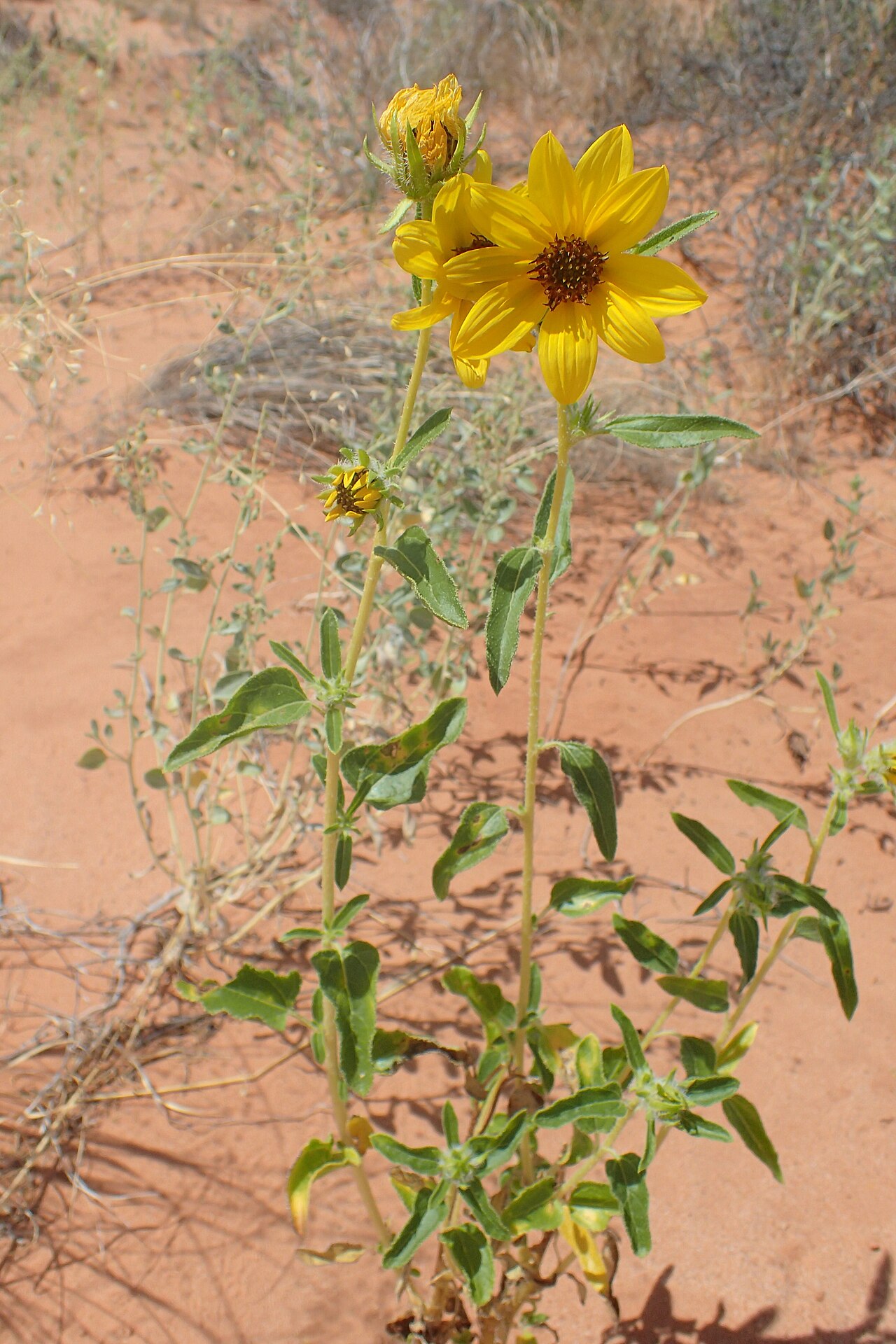
Leaves are mostly alternate along the stem and range from broadly oval toward lance-oval. The blades have largely unbroken margins rather than dramatic teeth, and they sit on visible stalks. Their substantial texture is relevant to the plant's dune adaptation, but touching one leaf is not a sufficient identification test. Examine several mature leaves and photograph both surfaces when documenting an uncertain wild plant.
Flower heads
A sunflower head contains many small flowers. The showy yellow rays frame a central disk whose individual flowers mature in sequence. In this species the pointed green bracts below the head can extend noticeably beyond the disk. For a defensible identification, record the side and back of the head as well as the familiar frontal view. A photograph of yellow petals alone cannot separate the many western Helianthus species.
Fruits and lookalikes
Each fertile disk flower can produce a dry, one-seeded fruit commonly called an achene or sunflower seed. Do not identify a seed lot solely by size. Common sunflower, prairie sunflower and desert sunflower can occur in the broader region, yet they are not substitutes for H. anomalus. A nursery label should identify the species and source population. Where the identification is uncertain, retain the plant as an observation rather than assigning a confident species name.
Quick Facts
| Scientific Name | Helianthus anomalus |
| Family | Asteraceae |
| Plant Type | Annual herb; desert sand-dune specialist |
| Mature Height | About 10–24 inches (25–60 cm) in Flora of North America |
| Mature Spread | Variable annual branching; not a spreading perennial colony |
| Growth Rate | Seasonal annual growth; not a rapid giant sunflower |
| Sun Exposure | Open, full sun |
| Water Needs | Dune-adapted; access to subsurface moisture matters |
| Soil Type | Loose, coarse sand; low-fertility dune substrate |
| Soil pH | No defensible narrow garden target established here |
| Bloom Time | Season varies with site; spring through fall reported by FNA |
| Flower Color | Yellow rays with darker reddish disk florets |
| Fall Color | Annual foliage dries after the season |
| Fruit | Dry one-seeded fruits in mature heads |
| Deer Resistant | Not established; do not assume browsing immunity |
| USDA Hardiness Zones | Annual specialist; a zone number alone does not predict suitability |
Native Range
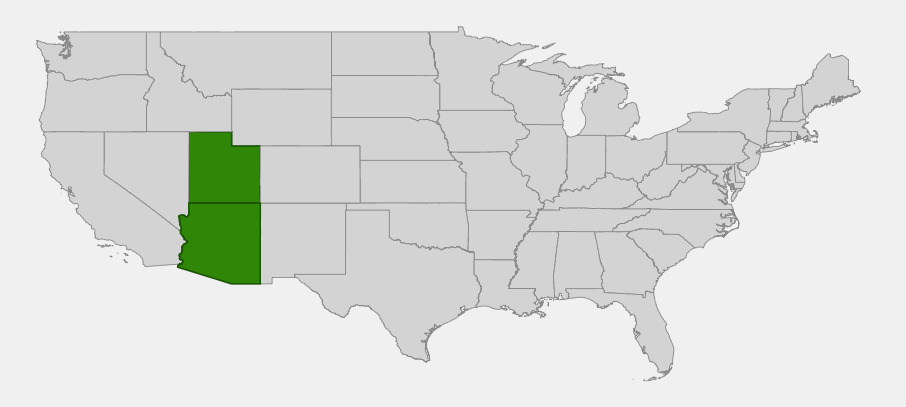
The native range is restricted to Arizona and Utah under both Kew and Flora of North America. Colorado is not included. Its presence on a combined Utah and western Colorado list therefore reflects the Utah portion of that region, not native status in both states. The two-state map is deliberately conservative and should not be interpreted as continuous occupancy across either state.
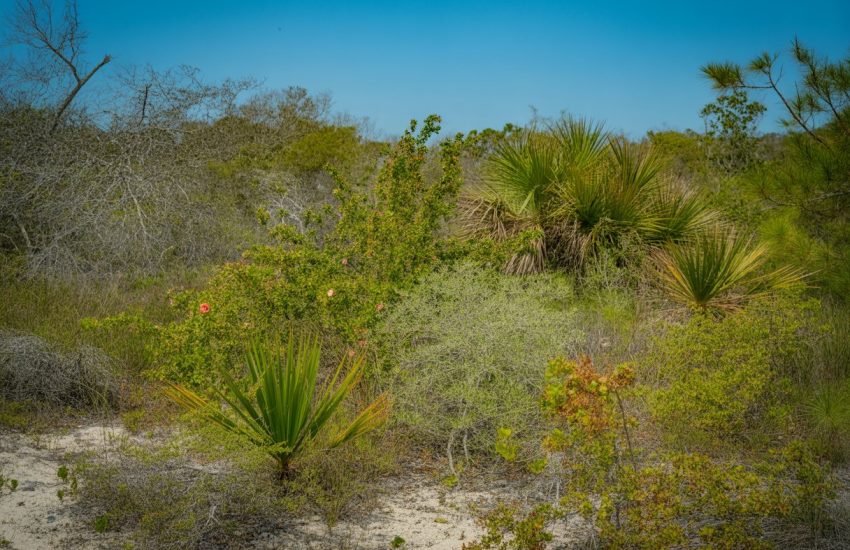
The species grows in dune systems with moving or partly stabilized sand. Research comparing it with related sunflowers shows why the phrase desert plant can be misleading: coarse dune soils may retain usable water below the surface even while the surface appears exceptionally dry. This is a different environment from nearby stabilized desert ground. Moving the plant into a generic dry garden can remove the very conditions to which it is adapted.
Use local floristic records and land-manager guidance when interpreting an observation. The photographed Utah plants illustrate a dune setting, but a photograph is not permission to collect seed or disturb habitat. Existing populations can be affected by recreation and altered vegetation as well as by weather. Observation from established access routes is preferable to walking through vegetation and fragile soil solely for a closer photograph.
📋 Regional plant list: Utah and Western Colorado
Growing & Care Guide
Light and placement
Treat an open, sunny position as a prerequisite, not as a complete recipe. A nursery trial should have room for unobstructed light and access for inspection without repeated disturbance around the roots. Avoid crowding it among vigorous groundcovers. Their shade and roots would change the low-competition conditions suggested by its natural habitat. This recommendation follows habitat logic; it is not a claim of a standardized home-garden trial.
Soil and water
Do not replace a coarse, low-fertility substrate with a heavily amended flower-bed mix and expect identical behavior. Likewise, do not deliberately withhold all water because the plant is a desert native. Research on its water relations concerns the entire dune soil profile, not just surface dryness. In any propagated trial, monitor moisture below the top layer and record irrigation and survival. Avoid standing water and prevent loose media from drying unpredictably in small containers.
Planting tips
A responsibly grown seed lot with documented identity is the starting point. Ask the supplier whether it is H. anomalus rather than another plant sold as dune sunflower, and request their germination and handling information. Plant only a small trial initially. Label the source and date, keep different lots separate, and photograph seedlings through flowering. Do not dig up established wild plants: transplanting disrupts their root environment and removes individuals from a specialized population.
Maintenance
This annual does not require perennial division or shrub pruning. Remove competing weeds carefully without repeatedly loosening the soil around its roots. If a trial produces seed, retain enough mature heads for documented propagation rather than removing every fading flower for appearance. Let the plant's actual performance determine whether the site is appropriate. Repeated failure is a reason to reconsider the substrate and species choice, not to apply progressively more fertilizer.
Propagation and records
No broadly validated home-garden germination schedule is asserted here. Published ecological experiments demonstrate that researchers can grow this species, but experimental protocols and seed-bank procedures should not be reduced to an invented universal recipe. Follow instructions specific to the supplied seed lot. Keep a record of germination percentage, emergence dates, flowering and seed maturation so future decisions are based on the actual material rather than on advice for common sunflower.
Choosing a garden alternative
If your goal is simply yellow flowers for pollinators in an ordinary native garden, a locally appropriate, commercially propagated species with established cultivation guidance is often a better choice. Do not substitute an unrelated western sunflower while keeping this name on the label. A truthful label and a plant suited to the soil are more valuable than forcing a rare habitat specialist into a display where it cannot complete its life cycle.
Landscape Uses
- Botanical education about specialized dune habitats.
- Documented conservation or research propagation using permitted material.
- Small, labeled trials where substrate and provenance can be managed.
- Interpretive comparisons of related sunflower species without moving wild plants.
Wildlife & Ecological Value
For pollinators
The flower heads provide the floral structures typical of a sunflower, with individual disk flowers opening through time. Observe visitors directly rather than promising a particular specialist bee relationship unsupported by the sources used here. In a conservation planting, insecticide avoidance and protection of the surrounding habitat are more important than maximizing the cosmetic size of each head.
For birds
Mature heads contain seeds, but the old table's general bird-seed comment should not be mistaken for a species-specific feeding study. Leave some heads where doing so is compatible with a documented propagation plan. Do not use wild populations as a seed source for bird feeders. Their ecological value is tied to successful reproduction in their own habitat, not to the volume of seed they can supply elsewhere.
For mammals
Specific claims of deer resistance, livestock value or mammal feeding preference are not established in this guide. Small plants can be damaged by trampling regardless of whether animals eat them. Where a nursery trial needs protection, use a physical barrier that does not shade the plant or trap wildlife. Avoid turning uncertainty into a marketing claim such as completely pest-proof.
Evolution and ecosystem role
H. anomalus is a well-studied example of a natural species of hybrid origin, associated with ancestry from H. annuus and H. petiolaris. That does not make it a recent garden hybrid or an introduced ornamental. Its established lineage occupies an ecological setting different from those of its parents. Protecting a native species can therefore mean protecting the particular physical habitat that allowed its distinctive evolutionary history to persist.
Cultural & Historical Uses
The epithet anomalus reflects the plant's unusual place among sunflowers. Modern genetic and ecological research has made it an important system for studying how hybridization and habitat specialization can contribute to species formation. Natural hybrid ancestry is not the same as accidental misidentification: researchers recognize a distinct species with its own distribution and ecological characteristics.
Agricultural researchers have investigated desert sunflower relatives as potential sources of useful traits for cultivated sunflower. Such work depends on documented germplasm and controlled study. It does not establish that a wild species is an edible crop, an easy garden annual, or a guaranteed source of drought-proof genes in every cross. The value lies in careful research, not in extrapolating a product claim from a desert photograph.
No specific traditional food or medicinal use is claimed here. Accounts for common sunflower or other desert plants cannot safely be transferred to this species. For gardeners and visitors, the most responsible cultural role may be interpretation: learning to notice a small specialist plant, distinguish it from more familiar relatives, and understand why an apparently empty dune can be a highly particular living environment.
Frequently Asked Questions
Is this the western sunflower sold by prairie nurseries?
Not necessarily. Western sunflower commonly means Helianthus occidentalis, a different species. Ask for Helianthus anomalus specifically and verify the supplier's identification. Common names alone are unreliable.
Is it native to Colorado?
The botanical treatments used here list Arizona and Utah, not Colorado. The combined Utah and western Colorado regional list should not be read as establishing Colorado nativity for every entry.
Why is the plant shorter than the old table suggested?
The earlier 72-inch figure did not match the FNA description of roughly 25–60 cm. The corrected row follows that botanical treatment. Size still varies with conditions, but this is not presented as a standard six-foot sunflower.
Can I collect seed from a national park?
Do not collect plants or seed without the relevant explicit authorization. Use responsibly propagated material for cultivation and observe wild plants in place. The photographs on this page do not imply collection permission.
Does desert-adapted mean no water?
No. Dune adaptation includes relationships with subsurface water, soil texture and competition. A dry surface can conceal a different moisture environment below. Garden care should reflect that complexity rather than treating all desert plants identically.
Sources & Further Reading
- Flora of North America: Helianthus anomalus morphology and distribution
- Kew POWO: Helianthus anomalus
- Research: genetic diversity and ecological divergence in H. anomalus
- Research: contrasting drought tolerance strategies in desert annuals
- USDA ARS: exploration for wild desert Helianthus germplasm
- USDA PLANTS: HEAN4
Find Native Plants
Ask growers about nursery propagation and regional provenance. Browse our Utah native plant nurseries, Colorado native plant nurseries directory for suppliers.