Rocky Mountain Beeplant (Cleomella serrulata)
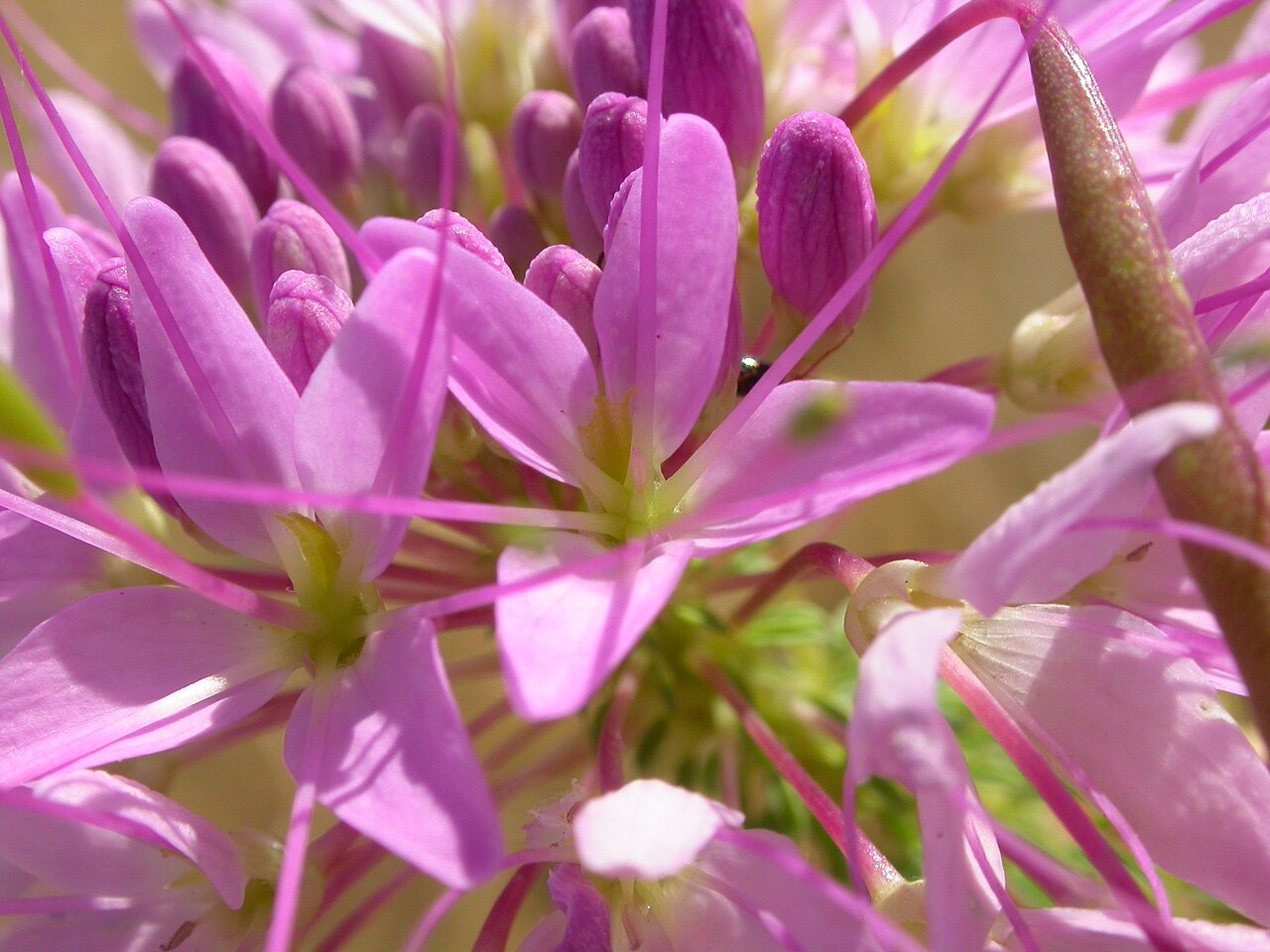
Rocky Mountain beeplant turns a patch of open ground into a cloud of pink flowers, long stamens, and busy insects. Its upright stems carry new blossoms above dangling seed pods, so a single plant shows several stages of development at once. In a Utah native garden it is especially useful while slower perennial plants are still small: this is an annual that can provide flowers during its first growing season, not a permanent clump that returns from the same root.
The accepted name used here is Cleomella serrulata. Gardeners will also encounter Cleome serrulata and Peritoma serrulata; Kew treats those names as synonyms of the same species. The pink native beeplant should not be confused with yellow beeplant or ornamental spider flowers sold simply as cleome. A seed packet with the full botanical name and collection provenance is more useful than a photograph of a vaguely similar pink flower.
Beeplant suits a sunny, informal planting where seedlings are welcome and some bare soil remains available. It is less suitable for a tightly packed, heavily mulched border expected to look identical each year. Its abundance changes with weather, soil disturbance, and competition. Use it as a moving seasonal layer among longer-lived natives, and allow its future seed supply some room rather than interpreting every volunteer as a weed.
Identification
Stems and overall habit
Plants grow upright with one main stem or several branches. The USDA NRCS guide describes vigorous plants commonly reaching three to six feet, although dry sites may produce much smaller individuals. The regional list's three-foot height is a useful middle-sized example, not a fixed maximum. Soft annual stems, rapid flowering, and death after seed production distinguish its life cycle from that of a woody shrub or persistent herbaceous crown.
Leaves
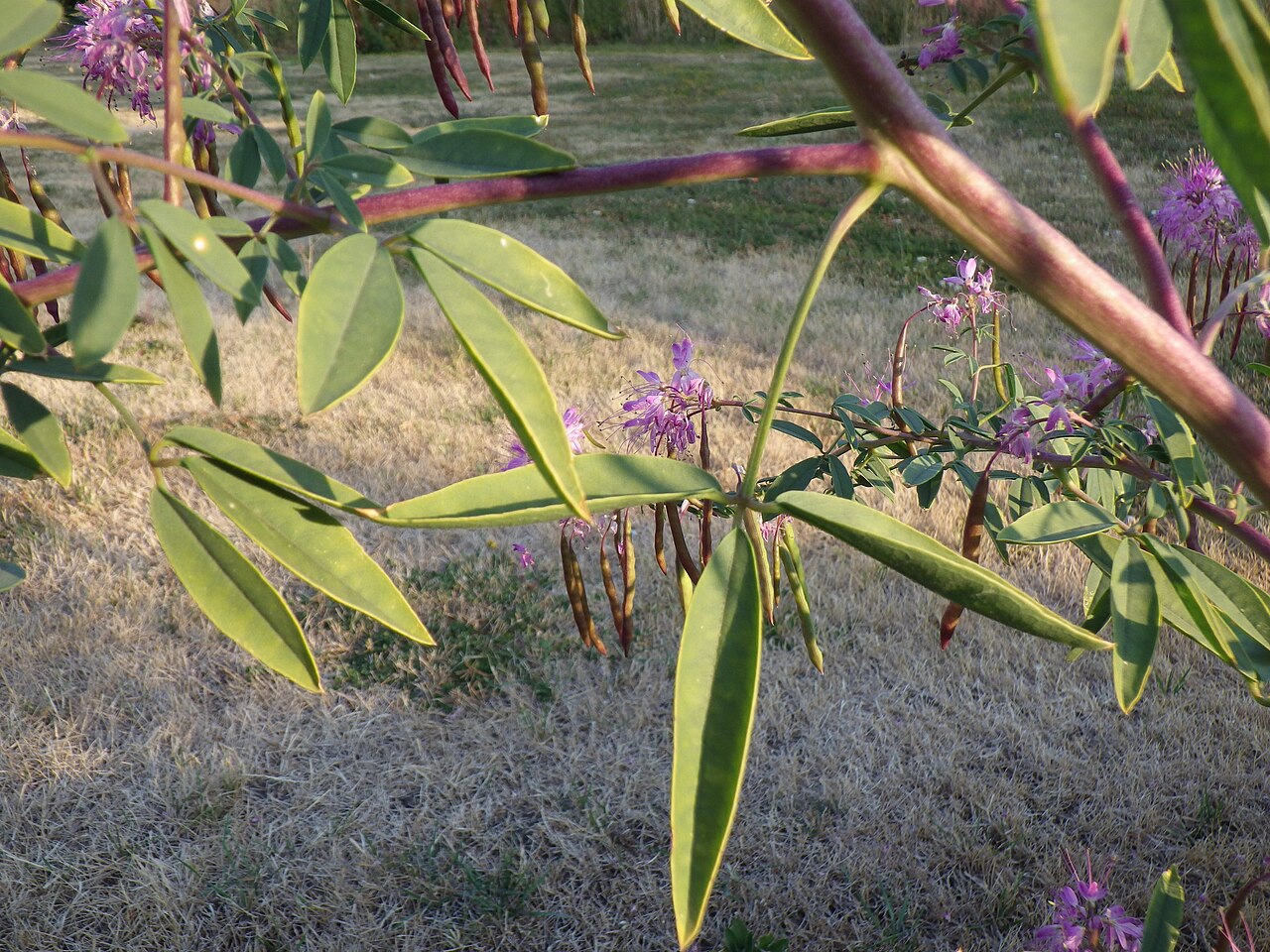
Leaves are divided into three slender leaflets attached at a shared point. Look for this trifoliate pattern on an intact stem rather than identifying detached leaves. The leaflets are lance-shaped to elliptic, and the foliage can have a noticeable odor when handled. Odor is a supporting character, not a reliable identification test by itself. Young seedlings deserve a label until you recognize the combination of leaves and developing flower clusters.
Flowers
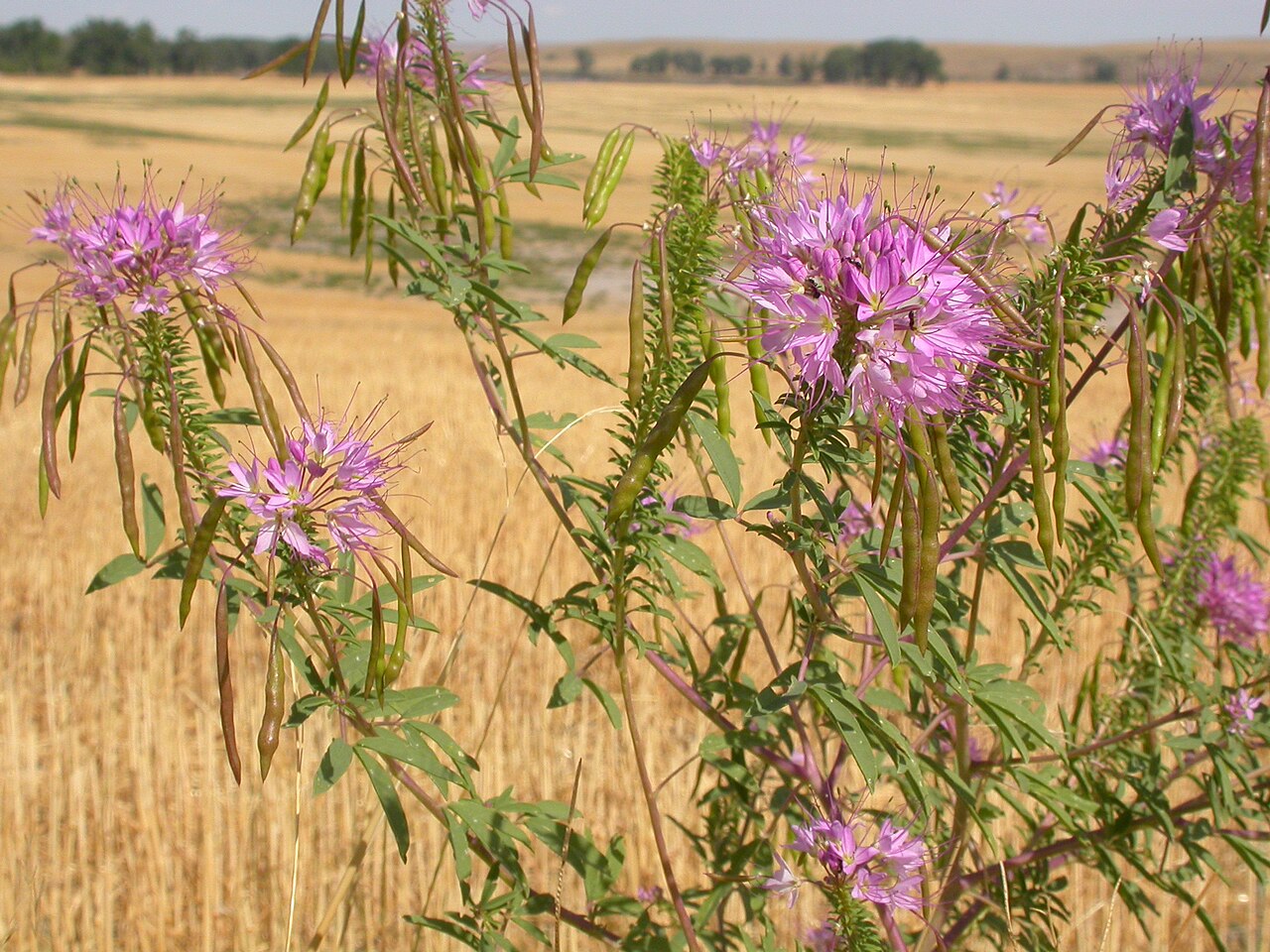
The pink-to-purple flowers have four petals and conspicuously projecting stamens. Flower clusters lengthen as growth continues, keeping fresh flowers toward their tips while older flowers develop into pods below. The airy effect comes partly from those long reproductive structures rather than from unusually large petals. White-flowered forms can occur, so color alone is not sufficient to separate related beeplants.
Fruit and seeds
The fruit is a slender, hanging capsule carried away from the stem on a small stalk. Several capsules may hang below an active flower cluster. Mature pods dry and release their seeds, making repeated light collections more practical than waiting for every pod on a plant to ripen together. Collect only from your own planting or where explicit permission allows it; roadside abundance does not establish permission to harvest.
Quick Facts
| Scientific Name | Cleomella serrulata; synonyms Cleome serrulata and Peritoma serrulata |
| Family | Cleomaceae |
| Plant Type | Native annual herb; not a perennial |
| Mature Height | Commonly 3–6 feet in favorable conditions; smaller on dry sites |
| Mature Spread | Variable branching annual; allow room around developing stems |
| Growth Rate | Rapid within one growing season |
| Sun Exposure | Full sun |
| Water Needs | Low to moderate after establishment; seedlings need moisture |
| Soil Type | Well-drained open mineral soil; avoid prolonged saturation |
| Soil pH | Match local seed-source conditions; no universal narrow target |
| Bloom Time | Summer to early fall in much of the interior West |
| Flower Color | Pink to purple; occasional pale forms |
| Fall Color | Not grown for fall foliage |
| Fruit | Slender hanging seed capsules |
| Deer Resistant | Not guaranteed; protect vulnerable seedlings if browsed |
| USDA Hardiness Zones | Annual; local growing-season length and seed provenance matter more than root winter-hardiness |
Native Range
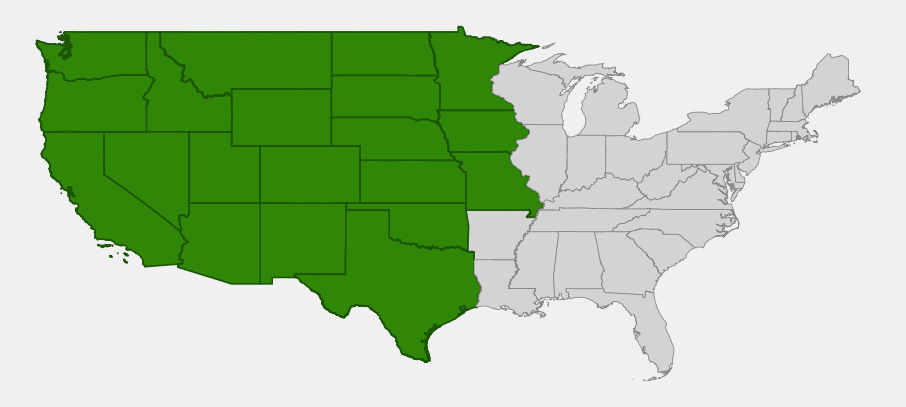
Kew places the native range in western and central Canada and the western and central United States. Utah and Colorado fall inside that range. The map below follows Kew's native-state treatment, not every state in which the species has been observed. Several eastern and Great Lakes populations are introductions, so an occurrence dot or a general North American distribution statement must not be read as proof of local nativity.
Across the interior West, beeplant often occupies open ground in grassland, shrubland, and foothill settings. Disturbance can create the light and seedbed conditions it needs. In drier landscapes it may benefit from shallow depressions where moisture collects without producing a permanently wet root zone. Its ability to occupy disturbed ground is useful in restoration but does not mean a compacted, salty road shoulder is the best model for a garden bed.
Choose seed grown from an appropriate regional source. A native species with a broad range still contains populations adapted to different growing seasons and rainfall patterns. The Utah and western Colorado list covers a large environmental gradient, from hot basins to cool uplands. A packet sourced for a nearby elevation and climate is a better starting point than assuming all beeplant seed will flower and mature at the same time.
📋 Regional plant list: Utah and Western Colorado
Growing & Care Guide
Light
Give beeplant a genuinely open position. A narrow strip shaded by a fence for most of the day is not equivalent to an open meadow even if it briefly receives afternoon sun. Place it where its eventual height will not shade smaller seedlings you want to retain. For a mixed planting, scatter it in gaps behind or between perennial groups instead of making a dense wall directly in front of low plants.
Soil and water
A prepared surface with good seed-to-soil contact is more useful than a rich planting pocket. Remove invasive competitors before sowing, but avoid repeatedly cultivating after native seedlings emerge. Water gently enough not to wash seed into clumps. Once roots develop, increase the interval between waterings according to actual soil moisture and weather. A tall annual can wilt temporarily in extreme heat; check the root zone before assuming every drooping leaf requires a soaking.
Planting tips
Direct sowing is usually the simplest approach. USDA guidance favors dormant fall sowing for many rangeland uses and shallow placement, at the surface to roughly one-eighth inch deep. In a garden, divide the planting area into small marked patches so you can distinguish germination failure from uneven seed distribution. Do not bury this seed under a thick bark layer. Keep an unsown path so you can reach weeds without trampling the emerging stand.
Pruning and maintenance
Beeplant does not need shrub-style pruning. Remove unwanted seedlings while small, and leave selected plants to flower and ripen seed. If volunteers are undesirable near paving, remove capsules before they dry rather than cutting all flowers early. Some flea-beetle feeding has been observed by NRCS; small leaf holes alone do not justify spraying a pollinator planting. Inspect growth and flowering before deciding whether damage is materially affecting the plant.
Propagation
Seeds may be dormant, and germination depends on source, age, and treatment. A cold-moist period of about a month is commonly suggested for spring sowing, while fall sowing lets outdoor conditions provide seasonal cues. Keep records and test a small portion before treating a valuable whole seed lot. Research involving growth regulators is not a reason to improvise chemical recipes at home. Dry, labeled seed stored from healthy garden plants offers a practical way to learn your population's timing.
Managing a changing annual display
Expect the stand to shift. When perennial neighbors fill the soil surface, beeplant may decline because suitable germination gaps disappear. That can represent normal establishment of a longer-lived community rather than failure. Maintain a few deliberate open pockets if you want annual color to persist. Conversely, if beeplant overwhelms a small bed, thin it before flowering and let fewer individuals seed. An annual's abundance can be managed without treating the whole planting as disposable.
Landscape Uses
- First-season flowers in a developing native meadow.
- Loose pink accents behind shorter drought-adapted perennials.
- Pollinator strips with room for annual regeneration.
- Demonstration beds showing flowers, green pods and ripe seed together.
- Locally designed restoration mixes where early-successional native annuals are appropriate.
Wildlife & Ecological Value
For pollinators
The long succession of flowers offers repeated feeding opportunities rather than one short flush. NRCS records visits by bees, butterflies, wasps and hummingbirds. Observe the actual visitors in your garden: different insects may use the same cluster at different times. Avoid insecticide applications on open flowers, and include other plants blooming earlier and later so this annual is one part of a continuous floral resource.
For birds
Doves are documented seed consumers. Leaving some ripe capsules can therefore support more than next year's planting. Keep a portion of the stand through seed maturation while tidying other parts for access. Seed use is seasonal, and a handful of beeplants cannot replace the shelter, water and varied vegetation required by a complete bird-friendly garden.
For mammals
An annual patch provides temporary cover near ground level, but it should not be advertised as guaranteed deer-proof forage or a mammal food crop. Browse pressure differs among gardens. Where rabbits clip seedlings, a simple temporary barrier may be more useful than repeatedly re-sowing into the same exposed position. Remove barriers once established plants can tolerate the site's actual conditions.
Ecosystem role
Beeplant helps occupy bare ground during the early stages of vegetation recovery. Its first-year flowers can be valuable while perennial species are still establishing. Restoration success still depends on controlling invasive plants and using an appropriate mix; sowing one showy annual is not a substitute for repairing the underlying site. A diverse planting also prevents the garden from becoming flowerless in a year when annual germination is poor.
Cultural & Historical Uses
The name Navajo spinach reflects documented Indigenous food traditions, not a suggestion to eat unidentified roadside plants. The USDA guide summarizes prepared-food uses among Navajo, Hopi, Cochiti and Apache peoples and records use in pottery paint and dyes. Those practices belong to particular cultures and preparation traditions; a general garden article should acknowledge them without turning them into an unsourced household recipe.
Changing botanical names can hide continuity in the literature. Older seed-production and restoration work commonly uses Cleome serrulata, while Kew currently accepts Cleomella serrulata. Retaining the synonyms in a garden record makes it easier to find legitimate research without confusing this species with an unrelated ornamental. The USDA plant-profile link also retains its established symbol, CLSE.
For a contemporary native garden, beeplant offers a useful lesson in succession. A plant can be native, valuable, and short-lived at the same time. Its role is not to remain permanently fixed in one spot. Photographing the same patch through flowering, pod development and the following spring can reveal how an annual population depends on both seed production and open space.
Frequently Asked Questions
Does Rocky Mountain beeplant return every year?
The individual plant is annual and dies after its growing season. A patch can return through seedlings if viable seed remains and conditions permit germination. That distinction matters when planning winter structure or expecting a permanent root crown.
Is Cleome serrulata the same plant?
Yes. Cleome serrulata and Peritoma serrulata are recognized synonyms of Cleomella serrulata. This does not make every ornamental sold as cleome equivalent; check the full species name.
Why did my seed fail to sprout?
Possible causes include dormancy, burial too deep, a dry seedbed, competition, or a seed lot poorly matched to the treatment used. Try a small labeled trial with seasonal cold-moist exposure and compare it with untreated seed rather than repeatedly sowing the entire supply.
Will it take over my perennial bed?
It can produce numerous volunteers in open soil, but its abundance is usually manageable by thinning and controlling how much seed matures. Dense established vegetation often reduces recruitment. Keep the annual where its changing character is welcome.
Is it native in every state where it grows?
No. Kew distinguishes a western and central native range from introduced occurrences farther east. The map shows native states under that treatment; local botanical records remain important for a specific project.
Sources & Further Reading
- USDA NRCS 2024 plant guide: Rocky Mountain beeplant
- Kew POWO: Cleomella serrulata accepted name and native distribution
- USDA PLANTS: CLSE
Find Native Plants
Ask growers about nursery propagation and regional provenance. Browse our Utah native plant nurseries, Colorado native plant nurseries directory for suppliers.