
Desert Broomrape (Orobanche cooperi)
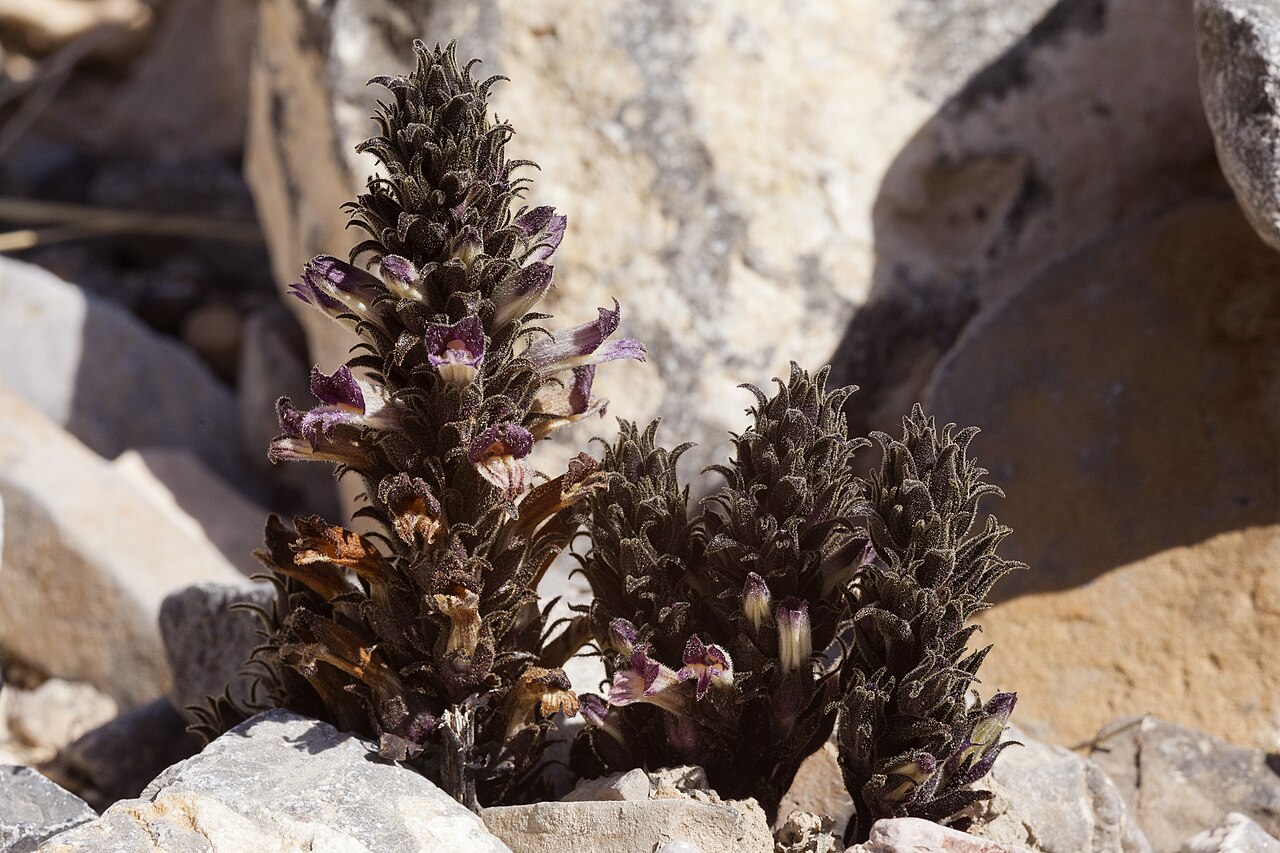
Orobanche cooperi, known as Desert Broomrape or Cooper’s broomrape, is a leafless, root-parasitic wildflower of the broomrape family (Orobanchaceae) native to the deserts of the southwestern United States and northwestern Mexico. Some botanists now place it in the genus Aphyllon as Aphyllon cooperi. It has no green leaves and no chlorophyll; instead it draws all its water and food from the roots of desert shrubs, especially bursages, cheesebush and brittlebush.
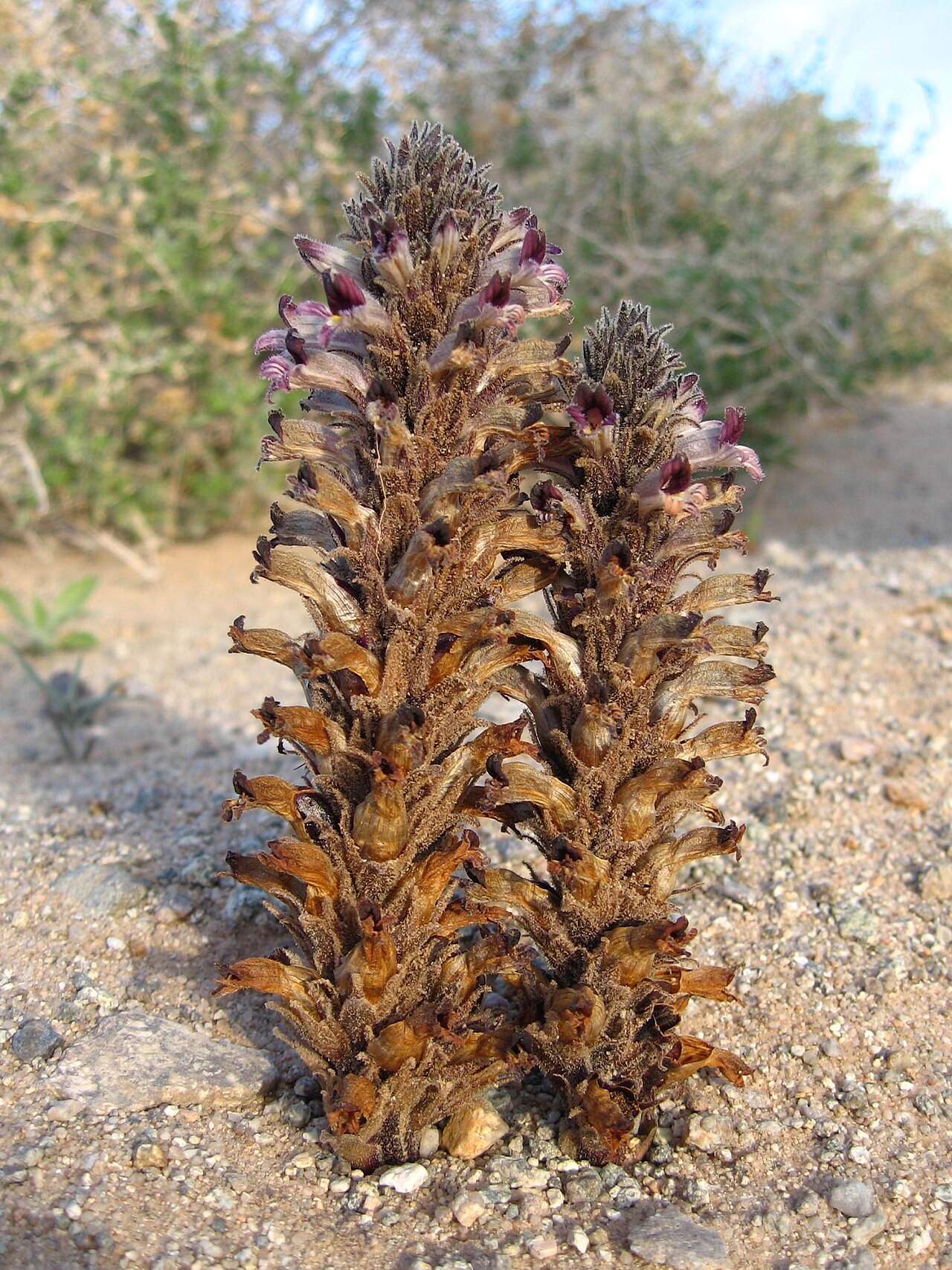
In late winter and spring, thick, fleshy spikes 4 to 12 inches tall push up through sand and gravel beside their host shrubs. They are purplish-brown and covered with sticky hairs, and they are crowded with dark purple to lavender, two-lipped tubular flowers. In good years dozens of spikes can appear around a single shrub.
Desert broomrape cannot be grown from nursery stock, cannot be transplanted, and dies if dug up, because it is attached to its host’s roots. It is a native plant, not a crop pest, and it is best appreciated where it grows. Please do not dig or pick it.
Identification
Look in spring for stout, leafless, purplish-brown spikes covered with sticky hairs and crowded with purple tubular flowers, rising from sand or gravel next to a desert shrub.
Growth Habit
It is a perennial or short-lived root parasite. Underground, a swollen base attaches to the roots of a host shrub. Above ground, one to several unbranched, fleshy stems rise 4 to 12 inches (occasionally to 18 inches), often in clusters. The whole plant is purplish, brown or tan, never green, and covered with glandular hairs.
Leaves
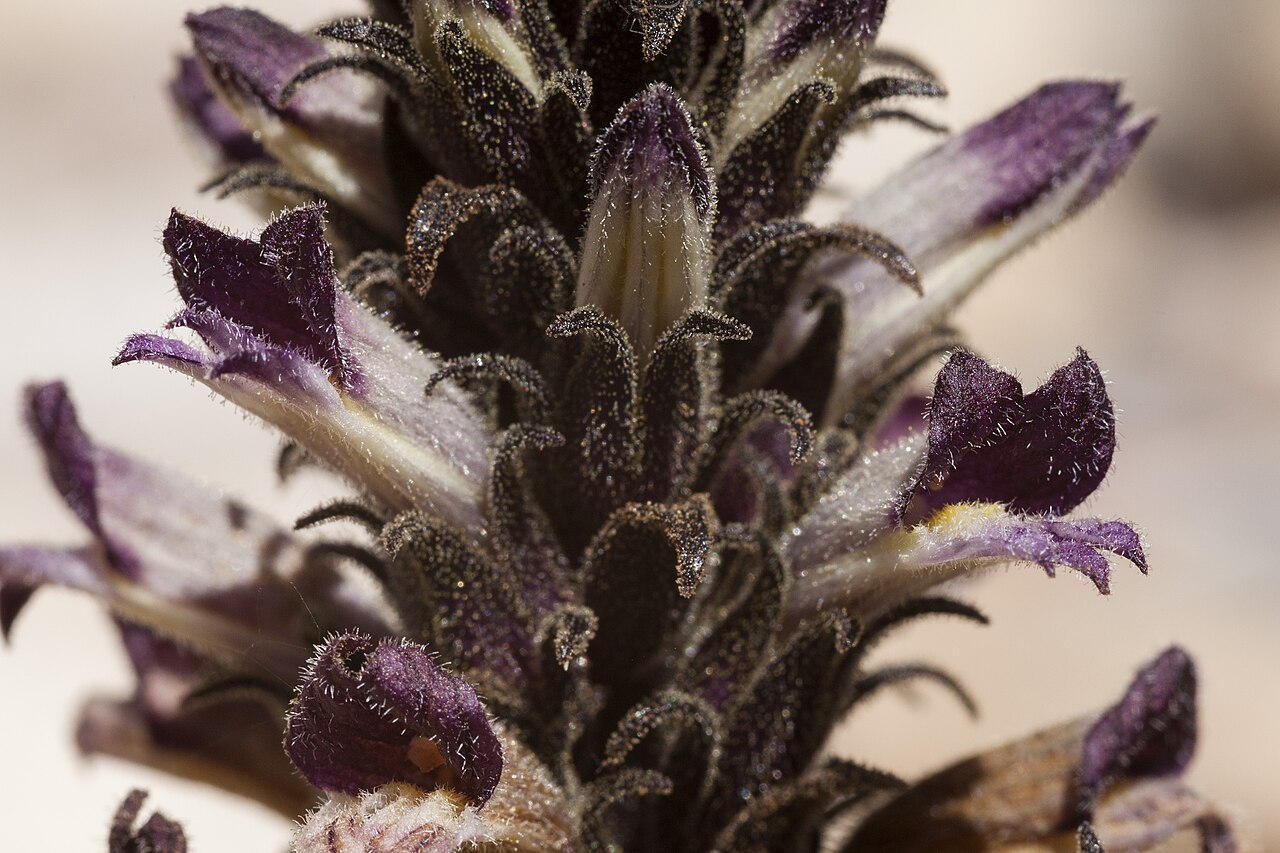
It has no true leaves. Small, scale-like bracts, brown to purple and pointed, overlap along the stem and under each flower.
Flowers
The flowers are crowded in a dense spike that makes up most of the stem. Each is a tubular, two-lipped flower about 3/4 to 1 1/4 inches long, dark purple to lavender, sometimes paler with darker veins, with a pale or yellowish throat. The upper lip has two lobes and the lower lip three. Bloom time is January to May, depending on rainfall and elevation.
Fruit
The fruit is an oval capsule that splits to release thousands of tiny, dust-like seeds. Seeds sprout only when they are close to the roots of a suitable host.
Look-alikes
Louisiana broomrape (Orobanche ludoviciana) is similar and also grows in the Southwest, but it is usually more slender, with smaller flowers and different hosts, and it is common in sandy grasslands and the Great Plains. One-flowered cancer-root has a single flower on each slender stalk. Sand food (Pholisma sonorae) of the Algodones Dunes is another desert root parasite, but its flowers form a flat, mushroom-like disk at ground level.
Quick Facts
| Scientific Name | Orobanche cooperi (syn. Aphyllon cooperi) |
| Family | Orobanchaceae (broomrape family) |
| Plant Type | Leafless root-parasitic perennial |
| Mature Height | 4–12 in (to 18 in) |
| Mature Spread | 2–6 in per stem; often clustered |
| Growth Rate | Appears quickly after winter rain |
| Sun Exposure | Full sun (where its host shrubs grow) |
| Water Needs | Very low; depends on its host |
| Soil Type | Sandy or gravelly desert soils |
| Soil pH | Neutral to alkaline (about 7.0–8.5) |
| Bloom Time | January–May |
| Flower Color | Dark purple to lavender |
| Fall Color | None (dies back after seeding) |
| Fruit | Oval capsule with dust-like seeds |
| Deer Resistant | Not applicable; not grown in gardens |
| USDA Hardiness Zones | Not grown in gardens; wild in about zones 7–10 |
Native Range
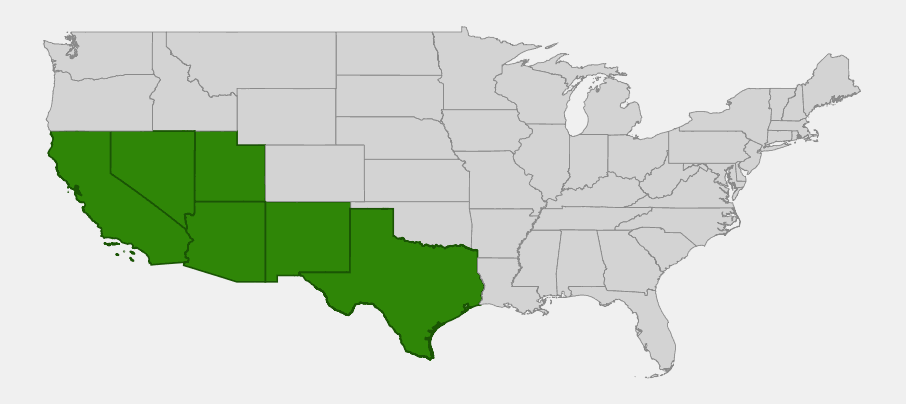
Desert broomrape is native to the warm deserts of North America. USDA PLANTS lists it as native in Arizona, California, Nevada, New Mexico, Texas and Utah. It also grows in Baja California, Sonora and other parts of northern Mexico.
It is most common in the Mojave and Sonoran Deserts of southeastern California, southern Nevada and Arizona, including Joshua Tree and Death Valley National Parks and Anza-Borrego Desert State Park. It reaches southwestern Utah, southern New Mexico and the Trans-Pecos region of far western Texas in the Chihuahuan Desert.
It grows on sandy flats, washes, dunes, gravelly bajadas and rocky slopes in creosote bush scrub and other desert shrublands, from below sea level in Death Valley to about 5,000 feet. Its location depends entirely on its host shrubs.
📋 Regional plant lists featuring Desert Broomrape: Arizona & New Mexico · Utah & Western Colorado · California & Nevada · South & West Texas
Can You Grow It?
No. Desert broomrape cannot be grown from nursery stock and is not sold. It has no chlorophyll and cannot make its own food; it lives attached to the roots of desert shrubs. A plant that is dug up is cut off from its host and dies, and its dust-like seeds sprout only next to the right host root. Please never dig, pick or transplant it. The best way to support it is to protect the native desert shrubs it depends on.
Light
Light does not matter to the broomrape itself, because it does not photosynthesize. It appears in full sun simply because its host shrubs grow in open desert.
Soil & Water
Leave desert soils undisturbed. Off-road driving, grading, trampling and clearing of shrubs destroy both the host plants and the hidden underground parts of the broomrape.
Planting Tips
There is nothing to plant. If it appears on your land, protect its host shrubs, especially bursages, cheesebush and brittlebush. Planting and keeping these native shrubs in a desert garden is the only realistic way to give broomrape a chance to appear.
Pruning & Maintenance
Leave the spikes alone after flowering so the capsules can ripen and release seed. Do not prune or remove the host shrub.
Propagation
It cannot be propagated in gardens or nurseries. Leave the seeds where they fall; over many years some may reach host roots and produce new plants.
Where to See It
- Joshua Tree National Park: look along sandy roads and washes in the Colorado Desert section in spring
- Death Valley National Park: in sandy and gravelly flats after wet winters
- Anza-Borrego Desert State Park: often beside bursage and brittlebush in February and March
- Southern Nevada and western Arizona: around bursage shrubs on bajadas and in washes
- Chihuahuan Desert of New Mexico and West Texas: in sandy shrublands in spring
Wildlife & Ecological Value
Although it is a parasite, desert broomrape is a natural part of desert shrub communities and has its own role in desert food webs.
For Pollinators
Native bees, including bumble bees and other large bees, visit the tubular flowers for nectar and pollen. Its early bloom provides food in late winter and spring.
For Birds
It is not a major bird food, though birds may forage for insects on the spikes.
For Mammals
Rodents and rabbits may eat the fleshy stems. Damage to host shrubs from the parasite is usually small.
Ecosystem Role
As a root parasite, it takes water and nutrients from shrubs such as bursage and can slightly reduce their growth, which may help keep any one shrub species from dominating. Its presence shows an intact desert shrub community.
Cultural & Historical Uses
The genus name Orobanche comes from Greek words meaning “vetch strangler,” because Old World broomrapes parasitize legumes and other crops. The name broomrape originally referred to a European species that grows on broom shrubs. The species name honors James Graham Cooper, a nineteenth-century naturalist and surgeon who collected in California.
Ethnobotanical records show that several desert peoples of the Southwest gathered broomrape stems in spring and ate them raw or roasted. It should not be collected today: populations are scattered, and every stem is part of a plant that may take years to appear again.
Recent DNA studies led some botanists to move the American broomrapes into the genus Aphyllon, which means “without leaves.” Both names are in use, and many field guides still list it as Orobanche cooperi.
Frequently Asked Questions
Is desert broomrape a fungus?
No. It is a flowering plant in the broomrape family. It has no chlorophyll and gets its food from the roots of host shrubs, which is why it looks brown or purple instead of green.
What does desert broomrape grow on?
Mostly shrubs of the sunflower family, such as white bursage, triangle-leaf bursage, cheesebush and brittlebush.
Can I grow desert broomrape?
No. It cannot be grown from nursery stock or transplanted, and it dies if dug up. Protect the native shrubs it depends on instead.
Does desert broomrape kill its host?
Usually not. It takes water and nutrients from the host’s roots, which can weaken it somewhat, but host shrubs usually survive.
When can I see desert broomrape?
From January to May, especially after wet winters, in the Mojave, Sonoran and Chihuahuan Deserts.

Looking for a nursery that carries Desert Broomrape?
Browse our native plant nursery directory: Arizona · California · Nevada & New Mexico · Texas & Utah

