
White Mariposa Lily (Calochortus eurycarpus)
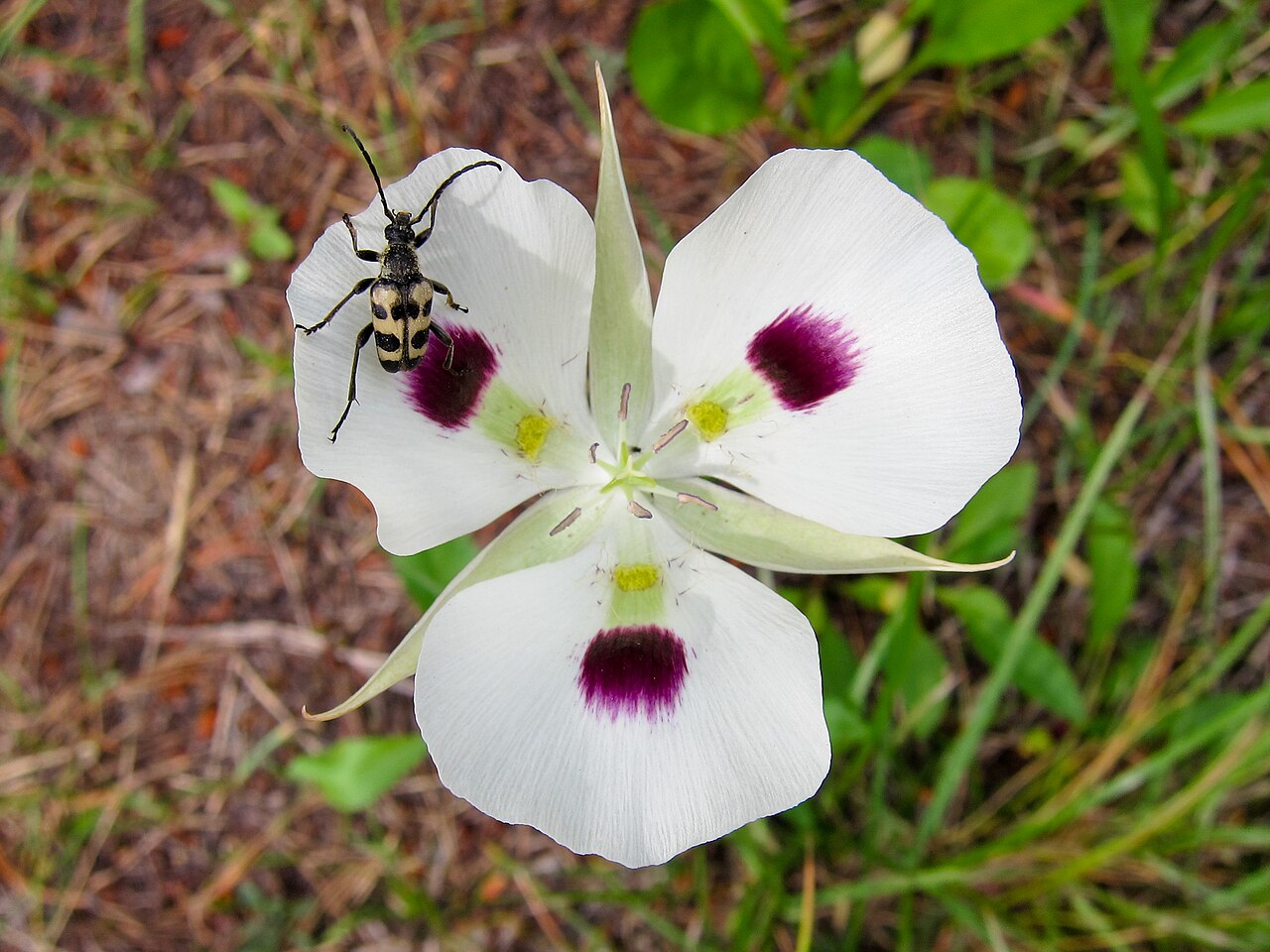
Calochortus eurycarpus, known as White Mariposa Lily or big-pod mariposa lily, is a native bulb of the meadows, grasslands and sagebrush slopes of the northern Rocky Mountains and the Intermountain West. In early summer it opens cup-shaped flowers, about 2 to 3 inches across, with three broad white to pale lavender petals, each marked in the center with a bold, red-purple blotch. A single plant has just one grass-like leaf and one to a few flowers, but in good years whole meadows can be dotted with them.
It belongs to the lily family (Liliaceae), together with the sego lily, the fairy lanterns and the cat’s ears of the genus Calochortus. The genus name comes from Greek words meaning “beautiful grass,” and the name mariposa is Spanish for butterfly, a reference to the wing-like petals with their eye-like spots. The species name eurycarpus means “broad-fruited,” referring to its wide seed capsules.
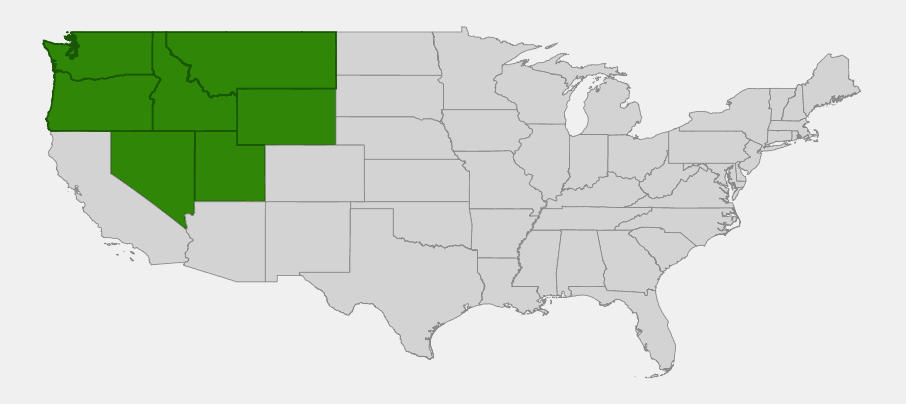
It ranges from Montana and western Wyoming west through Idaho to eastern Oregon and southeastern Washington, and south to northern Nevada and Utah. This guide covers how to identify white mariposa lily, where it grows, why it is so hard to grow in gardens, and its place in western wildflower meadows and culture.
Identification
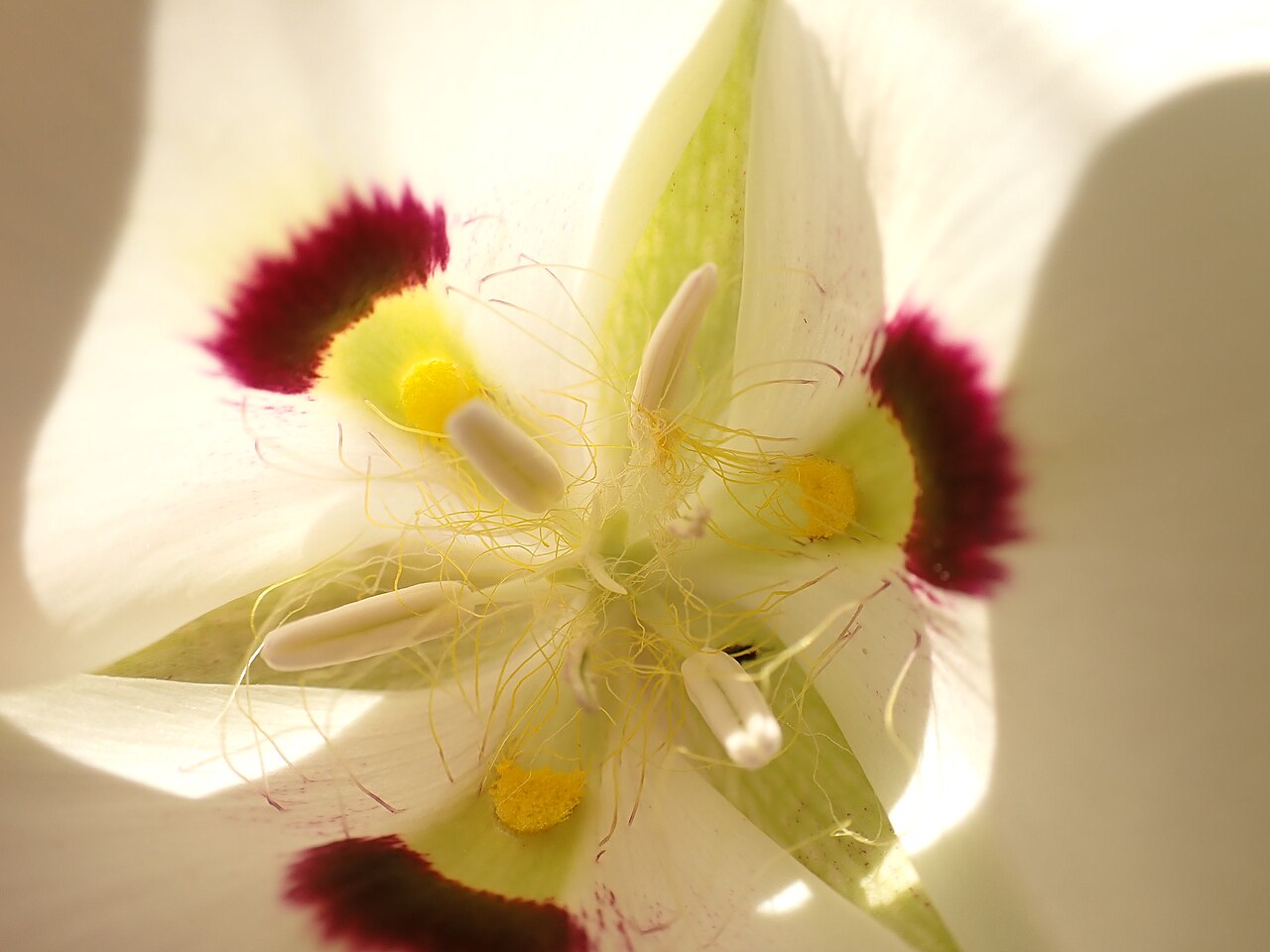
White mariposa lily is a slender, single-leaved bulb with large, cup-shaped white or lavender-tinged flowers. The best field mark is the large, red-purple blotch in the middle of each petal, with a yellow, hairy gland below it.
Growth Habit
It grows from a small, egg-shaped bulb a few inches below the surface. Each bulb sends up one straight, usually unbranched stem, about 4 to 20 inches tall. Plants grow singly but often in large, scattered colonies.
Leaves
There is a single narrow, grass-like basal leaf, flat and about 4 to 8 inches long, which often begins to wither by flowering time. One or two smaller leaves (bracts) occur on the stem below the flowers. Without flowers, the plant is very easy to overlook.
Flowers
The stem carries one to several upright, open, bowl-shaped flowers on separate stalks, often arranged in a loose umbel. Each flower has three broad, fan-shaped petals, white, cream or pale lavender, rarely pinkish, and three narrower, pointed, greenish sepals. Near the middle of each petal is a conspicuous red-purple to maroon blotch, and below it, near the base, a round, yellowish nectar gland fringed with short hairs. Bloom time is mainly June to August, depending on elevation.
Fruit & Seeds
The fruit is an upright, three-angled capsule, notably broad and winged, which is the origin of the names big-pod mariposa and eurycarpus. It splits at the top in late summer to release many flat, pale seeds.
Look-alikes
Sego lily (Calochortus nuttallii) is very similar but has a band or crescent of purple above a yellow base on each petal and grows in drier sagebrush and pinyon-juniper country. Gunnison’s mariposa lily has a band of purple and a hairy, oblong gland and grows mostly in the southern and central Rockies. Sagebrush mariposa lily has lavender to purple petals and long, pointed sepals that extend beyond the petals. The rare Palouse species Calochortus nitidus, once treated as including this plant, has a different gland shape and should be identified with a regional flora.
Quick Facts
| Scientific Name | Calochortus eurycarpus S. Watson |
| Family | Liliaceae (lily family) |
| Plant Type | Bulbous perennial wildflower |
| Mature Height | 4–20 in |
| Mature Spread | 2–4 in; single-stemmed |
| Growth Rate | Slow; several years from seed to flower |
| Sun Exposure | Full sun to light part shade |
| Water Needs | Moist in spring, dry in late summer |
| Soil Type | Well-drained loam, gravelly or rocky soils; meadow and grassland soils |
| Soil pH | About 6.0–7.5 |
| Bloom Time | June–August |
| Flower Color | White to pale lavender with a red-purple blotch on each petal |
| Fall Color | None; dormant by late summer |
| Fruit | Broad, winged, three-angled capsule |
| Deer Resistant | No; flowers and buds are eaten by deer, elk and livestock |
| USDA Hardiness Zones | 3–7 |
Native Range
White mariposa lily is native to the northern Rocky Mountains and the Intermountain West. USDA PLANTS lists it in Idaho, Montana, Nevada, Oregon, Utah, Washington and Wyoming.
It is most common in Idaho and western Montana, including the Sawtooth, Salmon River and Bitterroot regions, and extends into western Wyoming. In Oregon it grows in the Blue and Wallowa Mountains of the northeast, in Washington only in the far southeast corner (Asotin and Garfield Counties), and it reaches its southern limits in the mountains of northeastern Nevada and northern Utah.
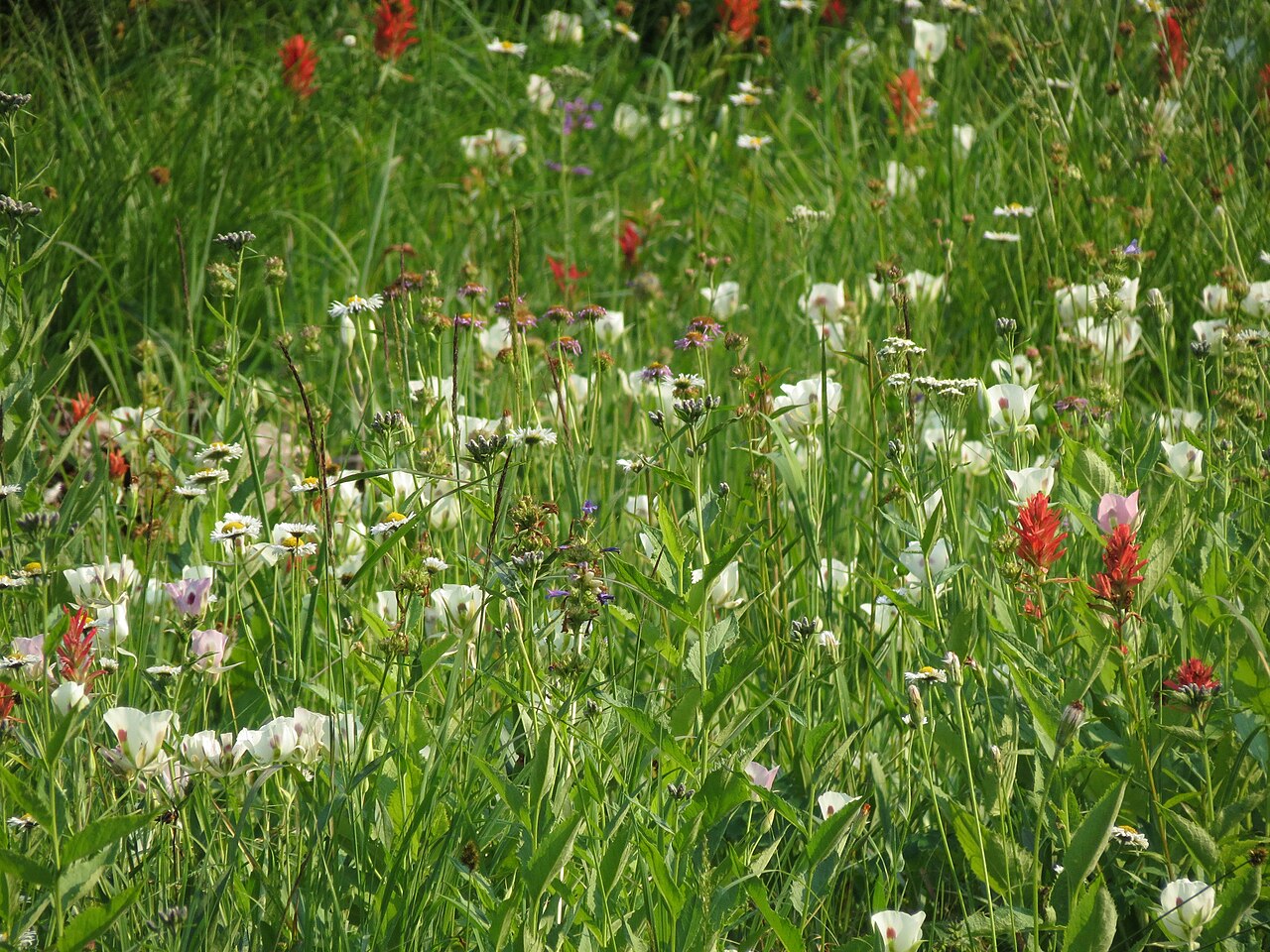
It grows in mountain meadows, grasslands, sagebrush steppe and open forests of ponderosa pine, Douglas fir and lodgepole pine, from the foothills into the subalpine zone. It favors sites that are moist in spring from snowmelt and dry by late summer, mostly between about 3,000 and 9,000 feet.
📋 Regional plant lists featuring White Mariposa Lily: Idaho, Eastern Oregon & Eastern Washington · Montana & Wyoming · Utah & Western Colorado · California & Nevada
Growing & Care Guide
White mariposa lily is beautiful but difficult in gardens, and it is best enjoyed in the wild. Bulbs are rarely offered by nurseries. Never dig bulbs from the wild: they almost never survive transplanting, and digging damages wild populations. Gardeners who want to try it should start from seed or from bulbs sold by specialist growers who propagate them.
Light
It needs full sun or the light shade of an open forest edge. In too much shade it does not flower.
Soil & Water
The bulbs need very well-drained soil that is moist in spring while the plant grows and then dry through late summer and fall while it is dormant. Summer irrigation or heavy, wet soil usually rots the bulbs. Gardeners outside the plant’s summer-dry native range often grow mariposa lilies in deep pots or raised beds that can be kept dry in summer.
Planting Tips
Plant dormant, nursery-grown bulbs in fall, about 3 to 4 inches deep, in gritty, fast-draining soil. Grow it in a dry meadow or rock garden among low bunchgrasses such as Idaho fescue, where neighbors will not shade it out or need summer water.
Pruning & Maintenance
No pruning is needed. Let the leaf and stem wither on their own so the bulb can store energy for next year. Protect plants from rodents and deer, which eat both bulbs and flowers.
Propagation
Grow it from seed, sown outdoors in fall in deep pots of gritty mix so it gets a long, cold, moist winter period. Seedlings form a single grassy leaf and take about three to five years to reach flowering size. Keep pots dry in summer when the young bulbs are dormant. Collect only a small amount of seed, and only where collecting is permitted.
Landscape Uses
- Rock gardens: for experienced growers with very well-drained, summer-dry soil
- Dry meadow plantings: within its native range, among native bunchgrasses
- Wildflower viewing: a highlight of early-summer meadows in Idaho and Montana
- Pollinator support: open flowers visited by bees and beetles
- Habitat restoration: seed in meadow and sagebrush restoration within its range
Wildlife & Ecological Value
White mariposa lily adds large, showy flowers to mountain meadows in early summer, and its bulbs and flowers feed a variety of wildlife.
For Pollinators
The open, bowl-shaped flowers are easy for insects to enter. They are visited by native bees, including bumble bees and solitary bees, and by beetles such as longhorn beetles, which feed on pollen and may help pollinate the flowers. The hairy nectar glands at the base of the petals offer nectar.
For Birds
Grouse and other ground-feeding birds eat the flowers, buds and seeds of many meadow wildflowers, including mariposa lilies.
For Mammals
The starchy bulbs are eaten by pocket gophers, ground squirrels and bears, and deer, elk and livestock browse the flowers and buds. Grazing at flowering time can greatly reduce seed production.
Ecosystem Role
As a summer-dormant bulb, white mariposa lily is adapted to snowy winters, moist springs and dry summers. Like other mariposas, it depends on seed for new plants, and populations can decline where meadows are heavily grazed, overrun by invasive annual grasses or converted to other uses.
Cultural & Historical Uses
The bulbs of many Calochortus species were an important food for Indigenous peoples of the West, who dug them in spring and early summer and ate them raw, roasted or boiled. The closely related sego lily is the state flower of Utah, honored in part because Mormon settlers ate its bulbs during food shortages in the 1840s and 1850s. Today, wild mariposa bulbs should be left in the ground; digging them is often illegal on public land and harms these slow-growing plants.
The species was described in 1879 by Sereno Watson, the Harvard botanist who described many plants of the American West. It has also been treated as a variety of Calochortus nitidus, a rare species of the Palouse region of Idaho and Washington, and it has been known by several other names.
For hikers in Idaho and Montana, white mariposa lilies are one of the signs of early summer in the mountains. Their fragile, butterfly-like flowers, with dark spots like eyes on the petals, make them one of the most admired wildflowers of the northern Rockies.
Frequently Asked Questions
Why is it called mariposa lily?
Mariposa is Spanish for butterfly. The broad petals with their dark central blotches suggest butterfly wings with eye spots.
What does eurycarpus mean?
It means “broad fruit,” for the wide, winged seed capsules. The plant is also called big-pod mariposa lily.
When does white mariposa lily bloom?
Mainly from June to August, depending on elevation, usually after the snow has melted and the meadows have begun to dry.
Can I dig up mariposa lily bulbs to grow at home?
No. Wild bulbs rarely survive transplanting, and digging harms wild populations and is often illegal on public land. Grow it from seed or buy propagated bulbs from specialist growers.
How is it different from the sego lily?
Sego lily usually has a purple band or crescent above a yellow base on each petal and grows in drier sagebrush country. White mariposa lily has a single bold blotch in the middle of each petal and grows in meadows and open forests of the northern Rockies.


