Eastern Narrowleaf Sedge (Carex amphibola)
Carex amphibola, commonly called eastern narrowleaf sedge (and sometimes simply “narrowleaf sedge”), is a clump-forming woodland sedge of the eastern and southeastern United States. It belongs to the vast genus Carex in the Cyperaceae, or sedge family, and like most of its relatives it is easy to walk past without a second glance — until you need a tough, reliable groundcover for the one part of the yard where grass refuses to grow. That part of the yard is usually dry shade under mature trees, and that is exactly where this sedge excels.
In the wild, eastern narrowleaf sedge grows scattered through mesic deciduous woodlands, often on the slightly elevated, loamy ground above a floodplain or along the base of a wooded slope. It forms neat, arching tufts of grass-like foliage that stay a soft medium green through the growing season, rising to a modest 8 to 20 inches, with flowering stems only slightly taller. The flowers themselves are unremarkable — small greenish spikes in spring — but the plant’s quiet good manners in the landscape are the whole point. It does not run, it does not flop, and it does not need mowing.
Gardeners restoring native woodland understories, or simply looking to replace struggling turf grass under oaks and hickories, have increasingly turned to eastern narrowleaf sedge and its close relatives as a low-maintenance, ecologically useful alternative. It is worth noting that this species is frequently confused with the very similar Carex grisea (inflated narrowleaf sedge) and the closely related Carex corrugata; even experienced botanists separate them by close examination of the perigynia (the small flask-shaped bodies surrounding each seed), so garden center labels and casual photographs should be taken with a grain of salt.
Identification
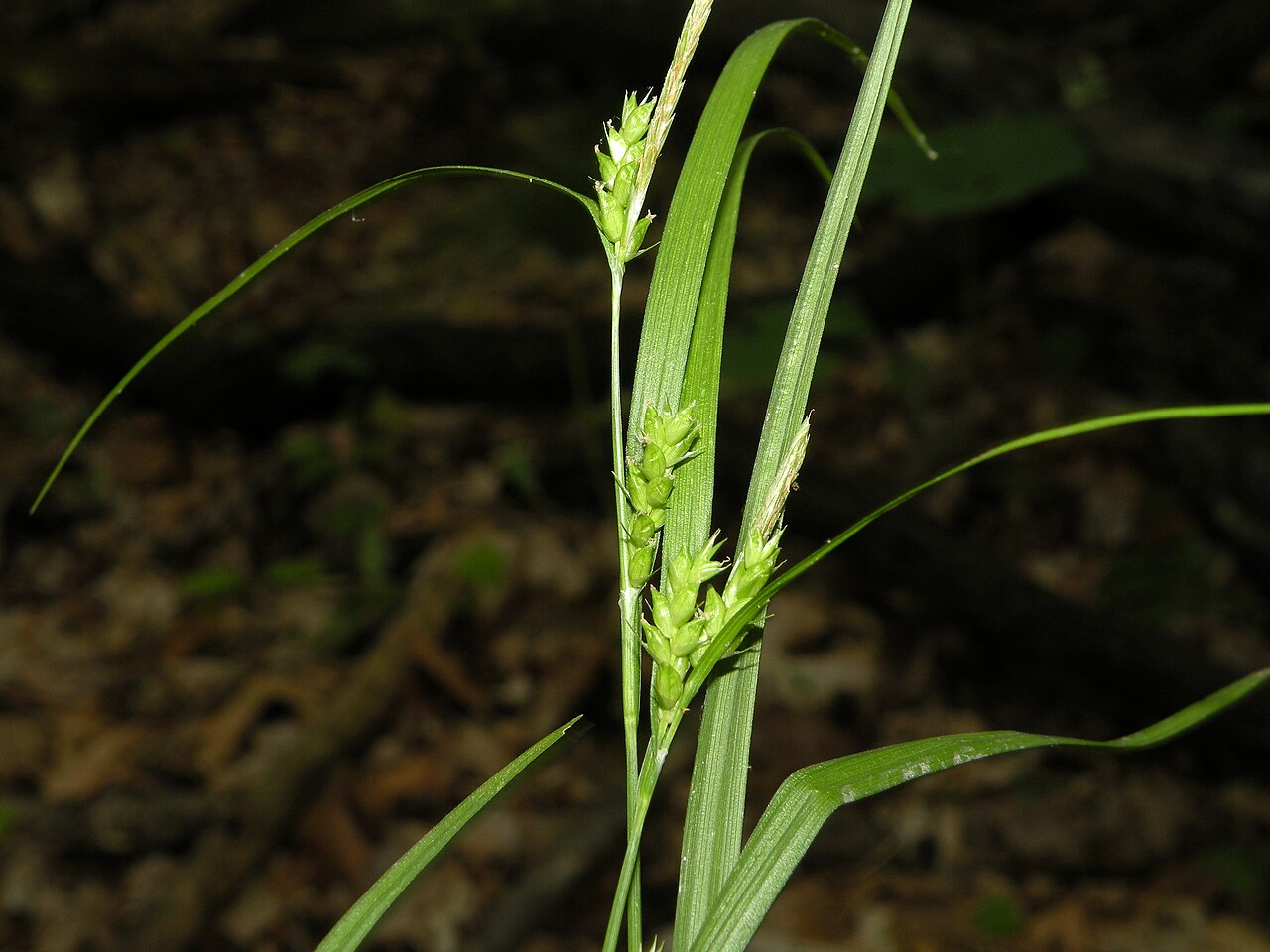
Eastern narrowleaf sedge is a tufted, rhizomatous perennial that forms loose to moderately dense clumps rather than running aggressively. Like other sedges, its stems are triangular in cross-section — “sedges have edges” is the old field mnemonic — distinguishing it at a glance from true grasses, which have round, hollow stems.
Leaves
The leaves are narrow, 2 to 6 mm wide, flat to slightly folded, and arch gracefully outward and downward from the base of the plant. They are a clean medium to yellow-green, somewhat glossy, and persist well into winter in milder parts of the range, giving the plant a semi-evergreen character. Leaf blades are noticeably longer than the flowering stems in many plants, adding to the fountain-like form of a mature clump.
Flowers
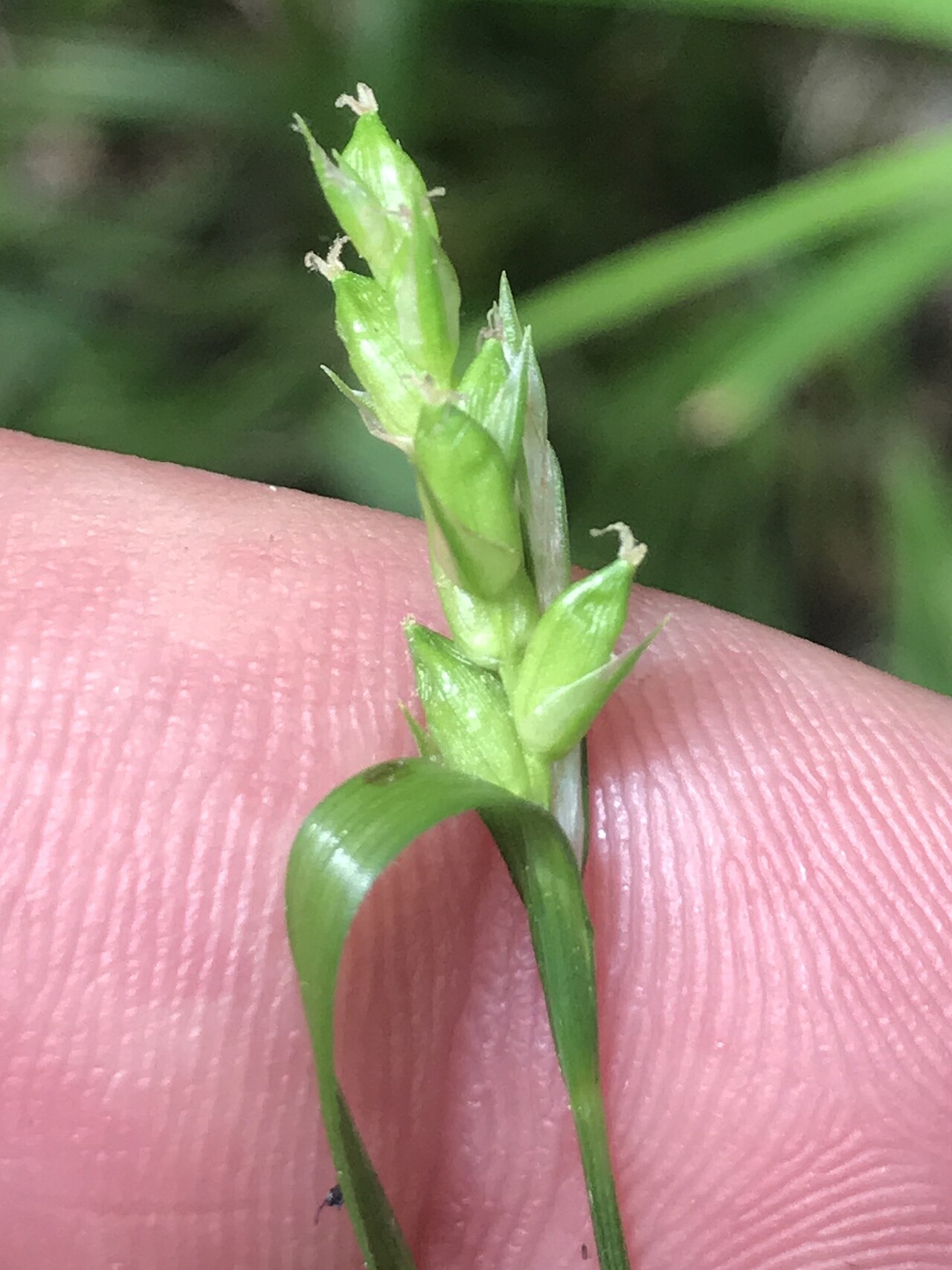
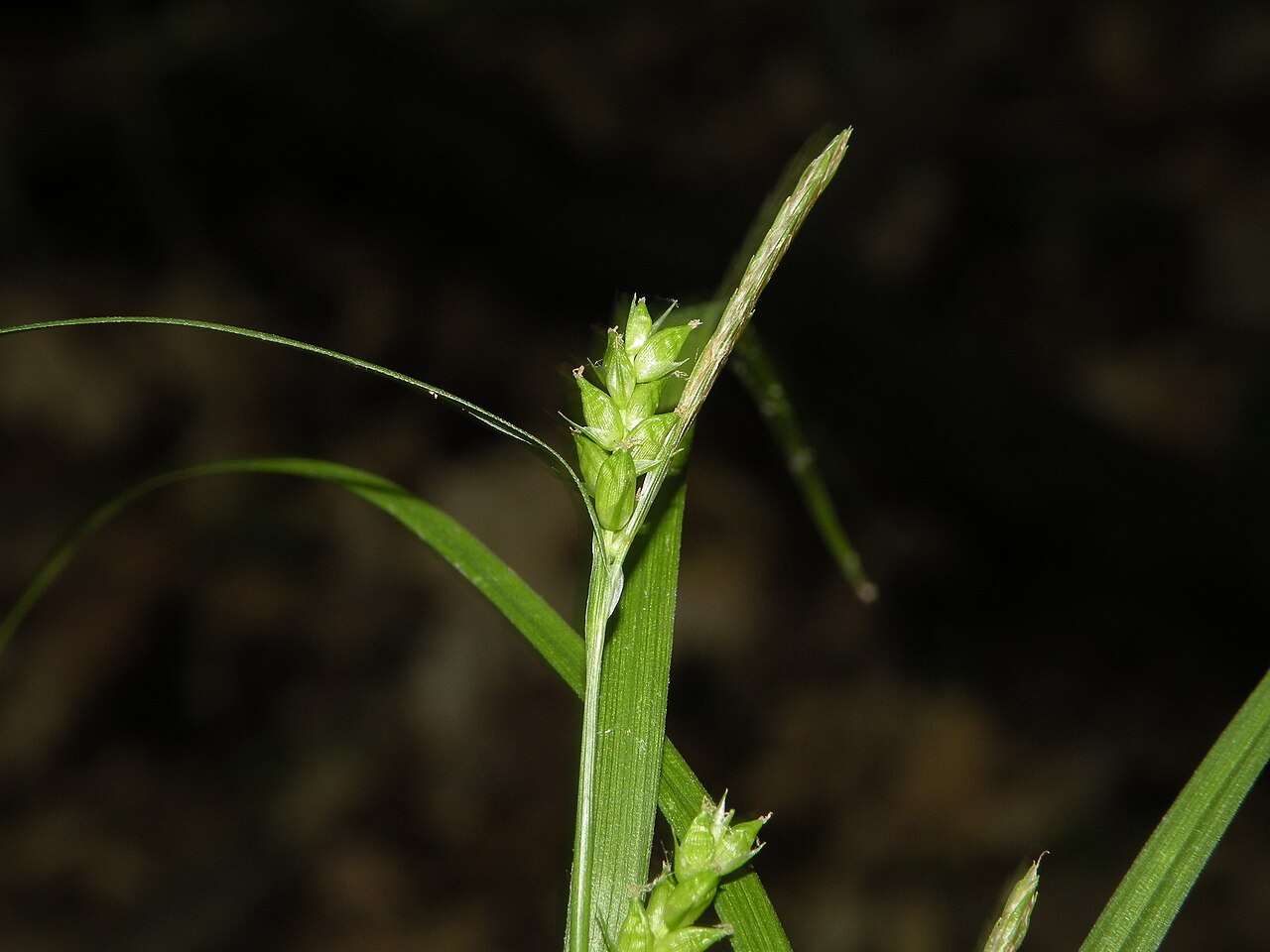
Flowering occurs in mid to late spring. Each flowering culm carries one slender male (staminate) spike at the top and two to four shorter, thicker female (pistillate) spikes below it, spaced along the stem. The spikes are green, ripening to a pale tan-brown, and are not showy in the way a wildflower is showy — their interest is textural rather than colorful, and close inspection rewards the curious with the sedge family’s odd, bristly charm.
Fruit & Seeds
The fruits are perigynia — small, inflated, beaked sacs that enclose the actual seed (achene) — arranged in those thick spikes. In Carex amphibola the perigynia are ascending to spreading and somewhat clustered at maturity, with an angular beak, which is one of the characters used to separate it from the very similar Carex grisea, whose perigynia are more strongly ascending with rounder tips. Seed set is reliable most years, and the ripe perigynia drop in early to midsummer.
Quick Facts
| Scientific Name | Carex amphibola |
| Family | Cyperaceae (Sedge) |
| Plant Type | Perennial Sedge (Graminoid) |
| Mature Height | 8–20 in (20–50 cm) |
| Mature Spread | 12–18 in clump |
| Growth Rate | Moderate |
| Sun Exposure | Part Shade to Full Shade |
| Water Needs | Medium; tolerates occasional dry spells once established |
| Soil Type | Loamy, humus-rich woodland soil; tolerates clay |
| Soil pH | 5.5–7.0 (slightly acidic to neutral) |
| Bloom Time | April – May |
| Flower Color | Green, ripening tan-brown |
| Fall Color | Semi-evergreen; foliage persists green into winter |
| Fruit | Small beaked perigynia in spiky clusters |
| Deer Resistant | Yes, generally unpalatable |
| USDA Hardiness Zones | 5–9 |
Native Range
Eastern narrowleaf sedge is native to the eastern and southeastern United States, with a core range running from eastern Texas and Oklahoma across the Ozarks and the Mississippi and Ohio valleys to the southern Great Lakes states, and east through the Appalachians to the mid-Atlantic coast. It becomes noticeably scarcer at the northern edge of its range, where it is a rare, local plant in southern New England, eastern New York, and extreme southern New Jersey rather than a common woodland component.
Across most of its southern and central range it is a familiar, if unassuming, presence in mesic hardwood forests — the kind of rich, well-drained but not droughty woods found on second-terrace floodplains, lower slopes, and ravine bottoms. It is rarely found in standing water or deep shade of conifer stands, preferring the dappled light and leaf-litter soils of oak-hickory and mixed mesophytic forest.
The species has not been documented as naturalized or spreading outside this native range, and it is not considered weedy or aggressive anywhere it grows; gardeners in its native range can plant it with confidence that it belongs on the land.
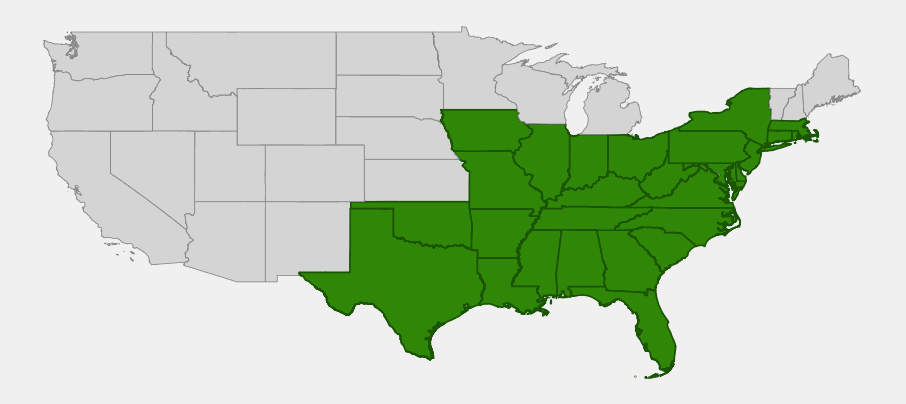
📋 Regional plant lists featuring Eastern Narrowleaf Sedge: Georgia, Alabama & Mississippi · Arkansas, Louisiana, Eastern Oklahoma & Eastern Texas · Delaware, Southern New Jersey & Long Island · Illinois, Iowa & Missouri · Ohio & Indiana · Kentucky & Tennessee · Maryland, Virginia & West Virginia · North Carolina & South Carolina · Connecticut, Massachusetts & Rhode Island · New York, Pennsylvania & Northern New Jersey
Growing & Care Guide
Eastern narrowleaf sedge is one of the easier native sedges to establish, as long as it is given the shaded, humus-rich conditions it expects from its woodland upbringing. Once settled in, it needs very little from the gardener.
Light
Part shade to full shade suits this sedge best, mimicking the dappled to deep shade of a hardwood forest floor. It will tolerate a few hours of morning sun, especially in cooler, northern parts of its range, but hot afternoon sun tends to scorch the foliage and should be avoided.
Soil & Water
A loamy, humus-rich soil with reliable but not soggy moisture is ideal, though established plants handle clay soils and brief dry spells without complaint. This is not a wetland sedge — it wants the same conditions a woodland wildflower would want, not a rain garden or pond edge. Working leaf mold or compost into the planting hole at installation helps it settle in quickly.
Planting Tips
Plant in spring or fall, spacing clumps 12 to 18 inches apart for a continuous groundcover effect, or further apart for an accent planting among other woodland perennials. Water regularly through the first growing season; once roots are established, supplemental watering is rarely needed except in prolonged drought.
Pruning & Maintenance
Little maintenance is required. In late winter, before new growth begins, old foliage can be cut back or raked out if it looks tattered, though many gardeners simply leave it for winter texture and early-season cover for overwintering insects. Division every few years rejuvenates older clumps and provides free plants for expanding the planting.
Propagation
The easiest method is division of established clumps in spring or early fall. Seed is also viable but slower and less predictable, requiring a period of cold-moist stratification to break dormancy before germinating the following spring.
Landscape Uses
- Shade groundcover under oaks and hickories where turf grass struggles
- Woodland garden edging along paths and beds
- Mass plantings for a natural, meadow-like woodland floor
- Companion planting with spring ephemerals and ferns
- Erosion control on shaded slopes
- Rain garden margins above the wettest zone
Wildlife & Ecological Value
Like most of its genus, eastern narrowleaf sedge contributes quietly but meaningfully to the woodland food web, feeding specialist insects and providing structural habitat that more ornamental plants do not.
For Pollinators
Sedges are wind-pollinated rather than insect-pollinated, so they offer no nectar reward, but the foliage hosts the larvae of several skipper butterflies, including Appalachian Brown and various satyrs, whose caterpillars feed specifically on sedge leaves.
For Birds
Ground-feeding birds such as native sparrows and towhees forage through sedge clumps for the seeds and for the insects sheltering within the dense foliage. The semi-evergreen leaves also provide cover through the leaner months when many other herbaceous plants have died back.
For Mammals
Small mammals use sedge tussocks for nesting cover, and the foliage is browsed lightly by rabbits, though the plant is generally considered deer resistant compared to more palatable woodland wildflowers.
Ecosystem Role
As a dominant understory graminoid in many eastern hardwood forests, this sedge helps stabilize leaf-litter soils on slopes, moderates moisture at the forest floor, and fills the ecological niche that non-native turf grass cannot occupy beneath a closed tree canopy.
Cultural & Historical Uses
Carex species in general have a long history of incidental human use — the fibrous leaves of various sedges were historically woven into mats, baskets, and cordage by Indigenous peoples across North America, though eastern narrowleaf sedge itself is not singled out in the ethnobotanical record as a species of particular significance, likely because its short, narrow leaves make it a less practical fiber source than larger wetland sedges and rushes.
Because sedges are notoriously difficult to tell apart, Carex amphibola and its relatives were largely overlooked by early botanists and herbalists in favor of more conspicuous woodland plants. Its modern significance is primarily ecological and horticultural rather than historical — valued today by restoration ecologists and native-plant gardeners for its role in rebuilding functioning woodland understories.
In recent decades, as awareness has grown of the problems caused by non-native turf grass and ornamental grasses under trees, nurseries specializing in native plants have begun propagating eastern narrowleaf sedge and its relatives for the home garden trade, giving this once-obscure woodland plant a modest second life as a practical landscaping solution.
Frequently Asked Questions
Is eastern narrowleaf sedge the same as Pennsylvania sedge?
No. Pennsylvania sedge (Carex pensylvanica) is a different, shorter, spreading sedge often used as a turf alternative. Eastern narrowleaf sedge is a clump-former rather than a runner, and the two are not interchangeable in the landscape, though both tolerate shade.
Will eastern narrowleaf sedge spread aggressively in my garden?
No. It is a clump-forming sedge that slowly expands its base over years rather than spreading by long rhizomes or self-seeding into a nuisance. It stays where you plant it.
Can it handle dry shade?
Once established, it tolerates brief dry spells in shade reasonably well, though it performs best with consistent moisture. For very dry, root-filled shade under mature trees, expect slower growth and water occasionally during drought.
Is this sedge evergreen?
It is semi-evergreen, holding green foliage well into winter across much of its range, especially in the milder southern portions, though it may die back more fully after hard freezes in the colder, northern edge of its range.
How do I tell it apart from similar sedges?
Eastern narrowleaf sedge is easily confused with Carex grisea and Carex corrugata. Positive identification relies on close examination of the perigynia shape and arrangement, so gardeners who want a guaranteed species should buy from a native plant nursery that propagates verified stock rather than relying on a casual field identification.

Looking for a nursery that carries Eastern Narrowleaf Sedge?
Browse our native plant nursery directory: AL, AR · CT, DE, FL, GA · IA, IL, IN · KY, LA, MA, MD, MS, MO · NJ, NY, NC, OH, OK · PA, RI, SC, TN, TX, VA · WV