
Firecrackerbush (Bouvardia ternifolia)
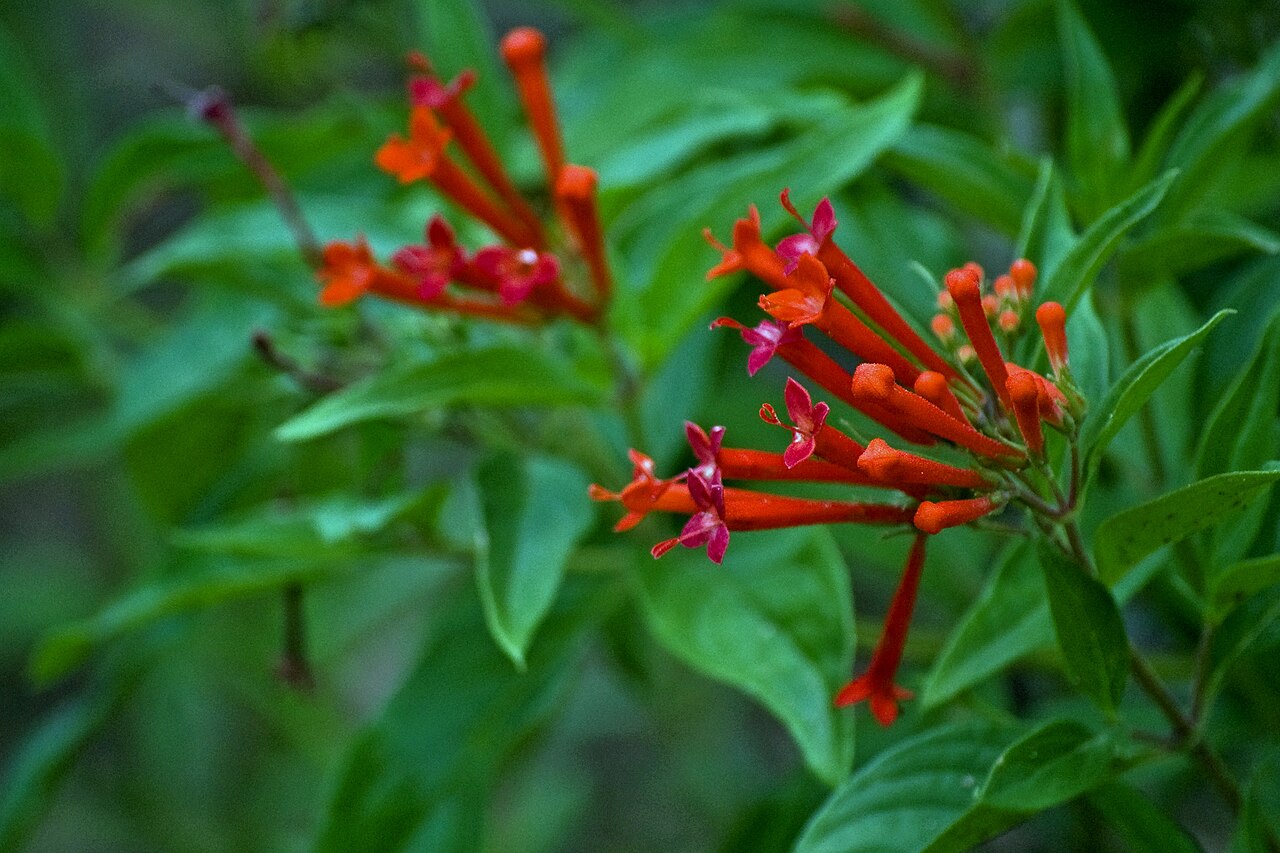
Bouvardia ternifolia, known as Firecrackerbush (the USDA PLANTS name), scarlet bouvardia, smooth bouvardia or, in Mexico, trompetilla, is a small shrub of the coffee family (Rubiaceae) native to the mountains of southern Arizona, southwestern New Mexico, West Texas and much of Mexico. From late spring to fall it bears clusters of slender, brilliant scarlet, tubular flowers at the tips of its many upright branches.
It is one of the classic hummingbird plants of the Southwest. The long, narrow red tubes are shaped for hummingbird bills, and in the canyons of the Arizona and New Mexico sky islands and the mountains of the Trans-Pecos, hummingbirds visit it through the summer and early fall. The species name ternifolia refers to its leaves, which are often arranged in whorls of three.
Firecrackerbush grows among boulders and on rocky slopes and canyon sides at middle elevations, usually in oak and pine-oak woodland. It is a tidy, long-blooming shrub for dry, partly shaded gardens in the Southwest. This guide covers how to identify it, where it grows, how to grow it, and its value to wildlife.
Identification
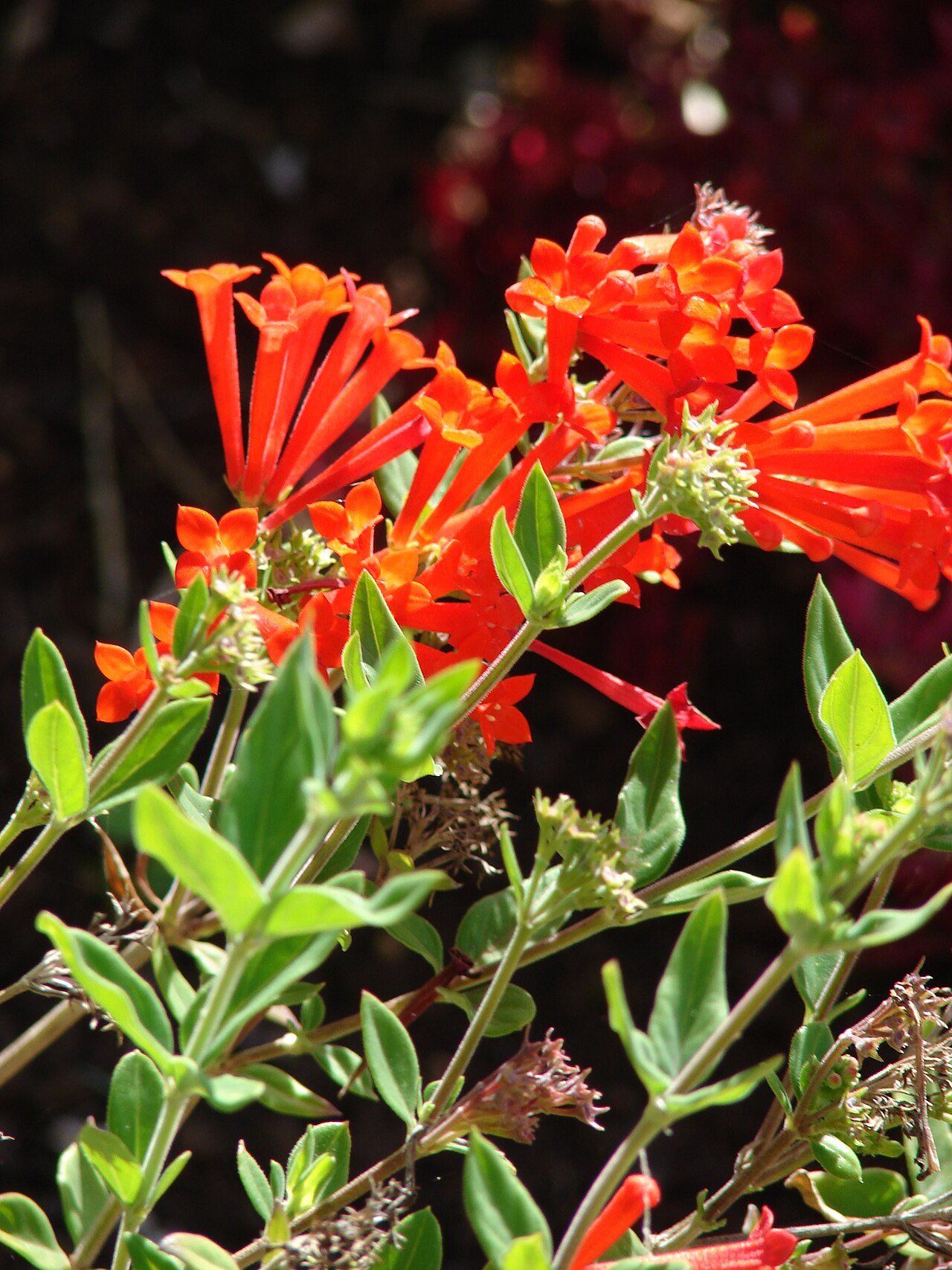
Firecrackerbush is easy to recognize in flower: a small, many-stemmed shrub with clusters of narrow, bright red tubes, each ending in four small, flared lobes. Look also at the leaves, which are often in threes around the stem.
Growth Habit
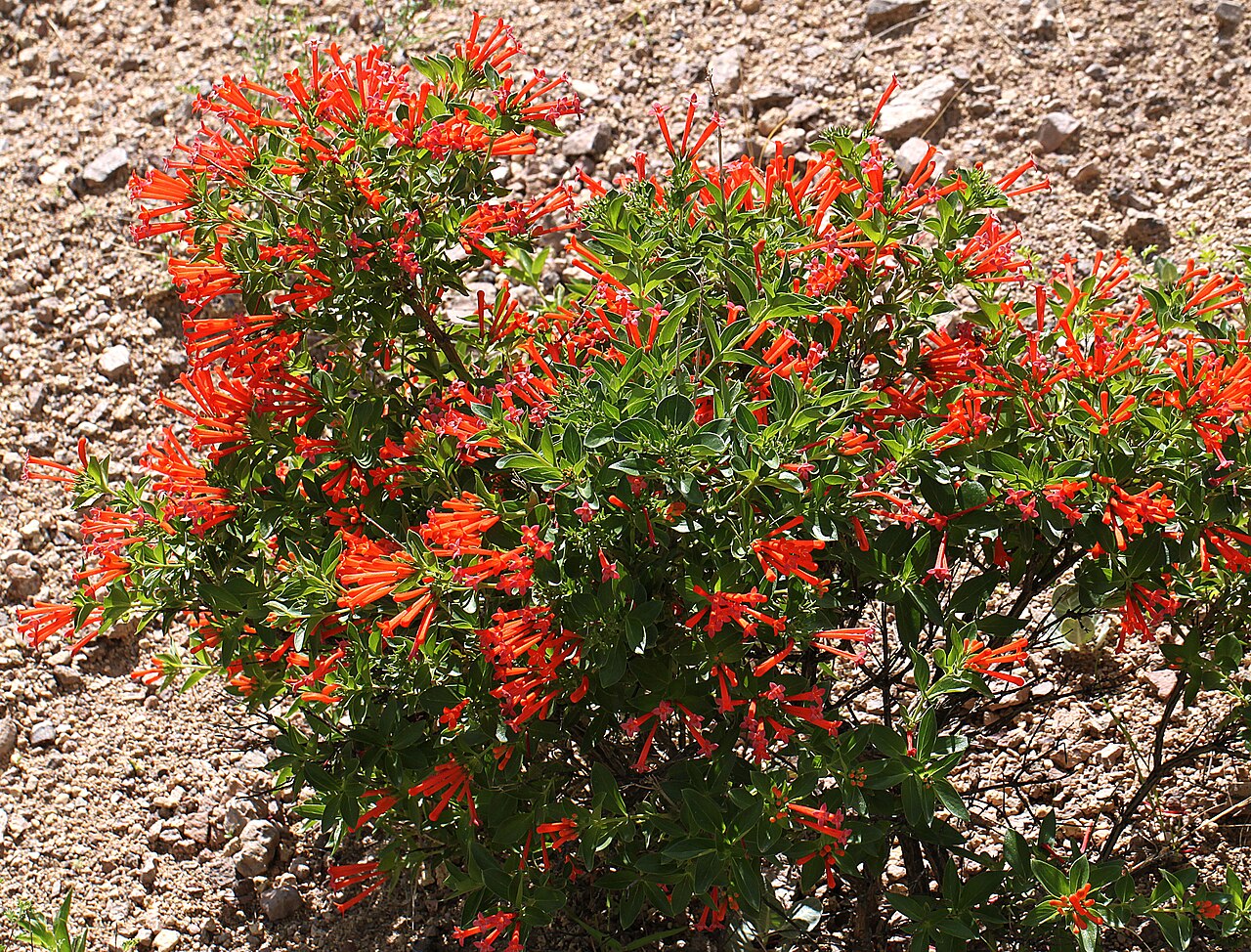
It is a small, upright to rounded shrub, usually 2 to 5 feet tall, with many slender stems rising from the base. In the wild it often grows among rocks, where it may be lower and more open. In very cold winters, the stems may die back and resprout from the base.
Leaves
The leaves are lance-shaped to narrowly oval, about 1 to 2 1/2 inches long, dark green and often shiny, with smooth edges. They are usually arranged in whorls of three around the stem, though some may be paired or in fours. In dry seasons or cold winters the plant may drop some of its leaves.
Flowers
The flowers are borne in loose to fairly dense clusters at the ends of the branches. Each is a long, narrow tube about 1 inch long or a little more, flaring at the mouth into four short, spreading lobes. The color is a brilliant scarlet to orange-red. Bloom begins in late spring and continues through summer and fall, often peaking after the summer monsoon rains; the Lady Bird Johnson Wildflower Center gives May to November.
Fruit & Seeds
After flowering, each flower develops a small, rounded, two-lobed capsule that turns brown as it ripens. The capsules split to release numerous small, flat, winged seeds that are carried by the wind.
Look-alikes
Several other red, tubular hummingbird flowers grow in the same mountains. Mountain sage (Salvia regla) and autumn sage (Salvia greggii) have two-lipped flowers and aromatic leaves. Flame acanthus (Anisacanthus quadrifidus) has flowers with four long, narrow, spreading lobes rather than a short, flared mouth. Scarlet creeper and other red morning glories are vines. Firecrackerbush is the only one with straight, narrow red tubes with four short lobes and leaves often in threes.
Quick Facts
| Scientific Name | Bouvardia ternifolia (Cav.) Schltdl. |
| Family | Rubiaceae (coffee or madder family) |
| Plant Type | Small deciduous to semi-evergreen shrub |
| Mature Height | 2–5 ft |
| Mature Spread | 2–4 ft |
| Growth Rate | Moderate |
| Sun Exposure | Part shade to full sun |
| Water Needs | Low to moderate |
| Soil Type | Well-drained rocky, gravelly, sandy or loamy soils |
| Soil pH | About 6.0–8.0 |
| Bloom Time | May–November |
| Flower Color | Scarlet to orange-red |
| Fall Color | None notable; may drop leaves in cold or drought |
| Fruit | Small two-lobed capsules with winged seeds |
| Deer Resistant | No; browsed by deer |
| USDA Hardiness Zones | 8–11 |
Native Range
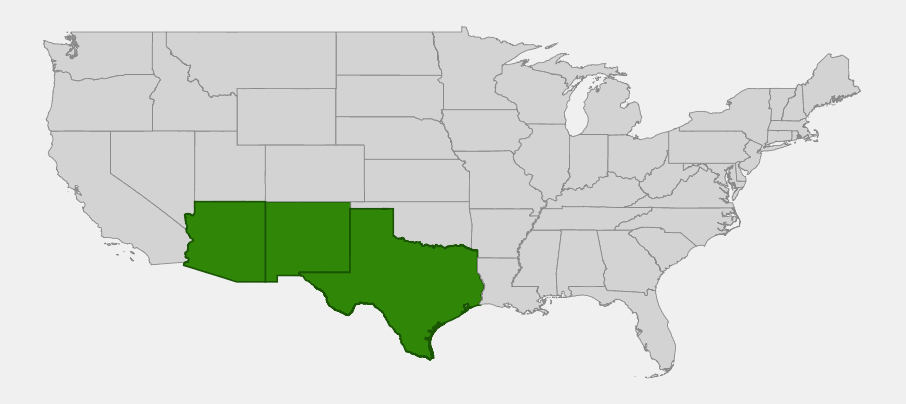
Firecrackerbush is widespread in the highlands of Mexico and reaches its northern limit in the southwestern United States. USDA PLANTS lists it as native to Arizona, New Mexico and Texas. The Lady Bird Johnson Wildflower Center describes its range as throughout the Mexican highlands, north to the Trans-Pecos and New Mexico.
In Arizona it grows in the sky island mountains of the southeastern part of the state, such as the Santa Rita, Huachuca, Chiricahua and Santa Catalina Mountains and the canyons along the Mexican border. In New Mexico it occurs in the southwestern mountains, and in Texas it grows in the mountains of the Trans-Pecos, including the Davis and Chisos Mountains. In Mexico it ranges widely through the Sierra Madre and central highlands.
Its habitat is dry mountain sites: among boulders and rimrock, on rocky slopes, ledges and canyon sides, usually in oak, pine-oak and juniper woodlands at middle elevations, often in partial shade from rocks or trees. It is most often found where rocks shelter its roots and trap a little extra moisture.
📋 Regional plant lists featuring Firecrackerbush: Arizona & New Mexico · South & West Texas
Growing & Care Guide
Firecrackerbush is a long-blooming hummingbird shrub for gardens in the Southwest and other mild, dry climates. It is sold by some native plant nurseries in Arizona, New Mexico and Texas, and it is grown as an ornamental in warm regions elsewhere. It does best with some shade and well-drained soil.
Light
In the low desert, give it part shade, especially afternoon shade, or plant it on the north or east side of a wall or large rock. At higher elevations and in milder climates it tolerates full sun. In deep shade it blooms less.
Soil & Water
Plant it in well-drained soil; rocky, gravelly or sandy soils are ideal, and it tolerates loam and some clay if drainage is good. Once established it is drought tolerant, but in hot, dry areas it looks and blooms best with a deep watering every week or two in summer. Avoid soggy soil.
Planting Tips
Plant in spring or fall. Place it near boulders, in a rock garden, at the edge of a patio or under the light shade of oaks or mesquites, where hummingbirds can be watched. Combine it with other hummingbird plants such as autumn sage, flame acanthus and penstemons to provide flowers through the season.
Pruning & Maintenance
Trim off spent flower clusters to keep the plant neat and encourage more bloom. In late winter, cut back stems that were damaged by frost and shorten leggy branches to keep the shrub compact. Plants killed back by a hard freeze usually resprout from the base.
Propagation
Grow it from seed sown in spring or from softwood cuttings taken in spring or early summer. Cuttings root readily with rooting hormone and bottom heat. Seedlings grow fairly quickly and may bloom in their first or second year.
Landscape Uses
- Hummingbird gardens: long-season scarlet tubular flowers
- Shaded desert gardens: blooms well in part shade near walls, rocks and trees
- Rock gardens: a natural companion for boulders and gravel
- Patio and courtyard plantings: compact size and long bloom for close viewing
- Sky island and canyon restoration: a native shrub of oak and pine-oak woodland
Wildlife & Ecological Value
Firecrackerbush is a key nectar plant for hummingbirds in the mountains of the borderlands.
For Pollinators
The long, narrow, red tubes are classic hummingbird flowers, and they are visited by many hummingbird species that breed in or migrate through southeastern Arizona, southwestern New Mexico and West Texas. Butterflies, especially long-tongued species, also visit the flowers.
For Birds
Beyond hummingbirds, the dense shrubs provide cover for small birds among the rocks. The small winged seeds are dispersed by wind rather than eaten by birds.
For Mammals
Deer and other browsers eat the leaves and stems; the Lady Bird Johnson Wildflower Center lists it as a browse plant. Small mammals shelter among the rocks and shrubs where it grows.
Ecosystem Role
Because it blooms from late spring into fall, firecrackerbush provides nectar for hummingbirds through the summer breeding season and into fall migration, when other red flowers are scarce. It is part of the rich shrub layer of the Madrean oak woodlands that make the sky islands one of the most biologically diverse regions in the United States.
Cultural & Historical Uses
The genus name Bouvardia honors Charles Bouvard, a seventeenth-century physician to King Louis XIII of France and superintendent of the royal garden in Paris. The species name ternifolia means “with leaves in threes.” The plant was first described by the Spanish botanist Antonio José Cavanilles and later moved to Bouvardia by Diederich von Schlechtendal. Some older references call the plants of Arizona and New Mexico Bouvardia glaberrima.
Bouvardias, mostly Mexican species and their hybrids, became popular greenhouse and cut-flower plants in Europe in the nineteenth century. Firecrackerbush itself is still grown as an ornamental in warm climates around the world.
In Mexico, where it has many local names such as trompetilla (“little trumpet”), the plant has a long history of use in traditional medicine. Do not use it medicinally yourself; its safety has not been established.
Frequently Asked Questions
Why is it called firecrackerbush?
Its bright scarlet, narrow tubular flowers, held in clusters at the branch tips, look like small firecrackers. It is also called scarlet bouvardia and, in Mexico, trompetilla.
Where does firecrackerbush grow?
It is native to the mountains of southeastern Arizona, southwestern New Mexico and the Trans-Pecos of West Texas, and widely in the highlands of Mexico, on rocky slopes and among boulders in oak and pine-oak woodland.
Does firecrackerbush attract hummingbirds?
Yes. It is one of the best native hummingbird shrubs of the Southwest, blooming from late spring into fall.
Can firecrackerbush grow in full sun?
In mild or higher-elevation gardens, yes. In the hot low desert it does better with afternoon shade and occasional deep summer watering.
Is firecrackerbush cold hardy?
It tolerates light frosts. A hard freeze may kill the stems back, but established plants usually resprout from the base in spring.

Looking for a nursery that carries Firecrackerbush?
Browse our native plant nursery directory: Arizona · New Mexico · Texas

