
Smooth Cliffbrake (Pellaea glabella)
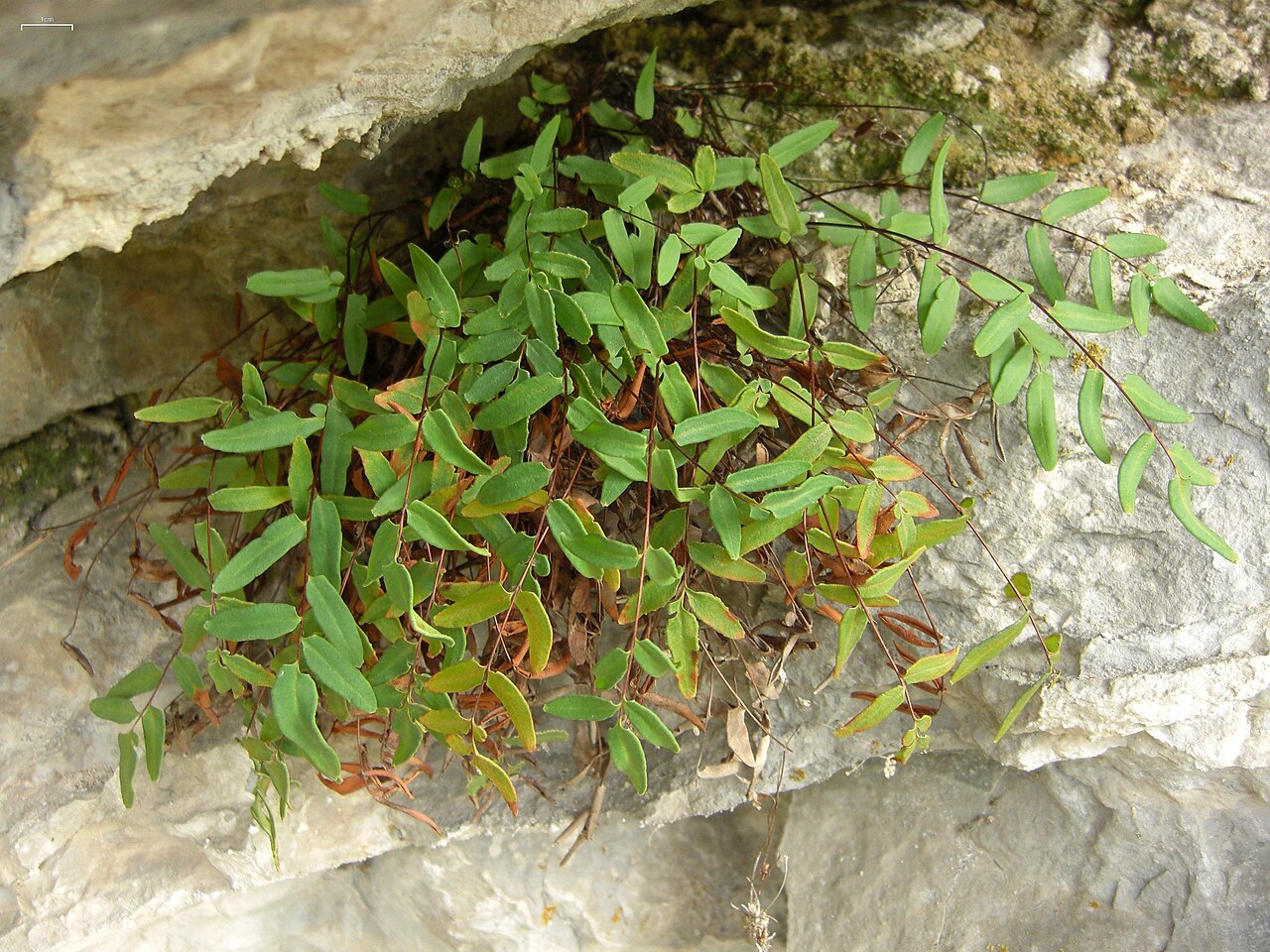
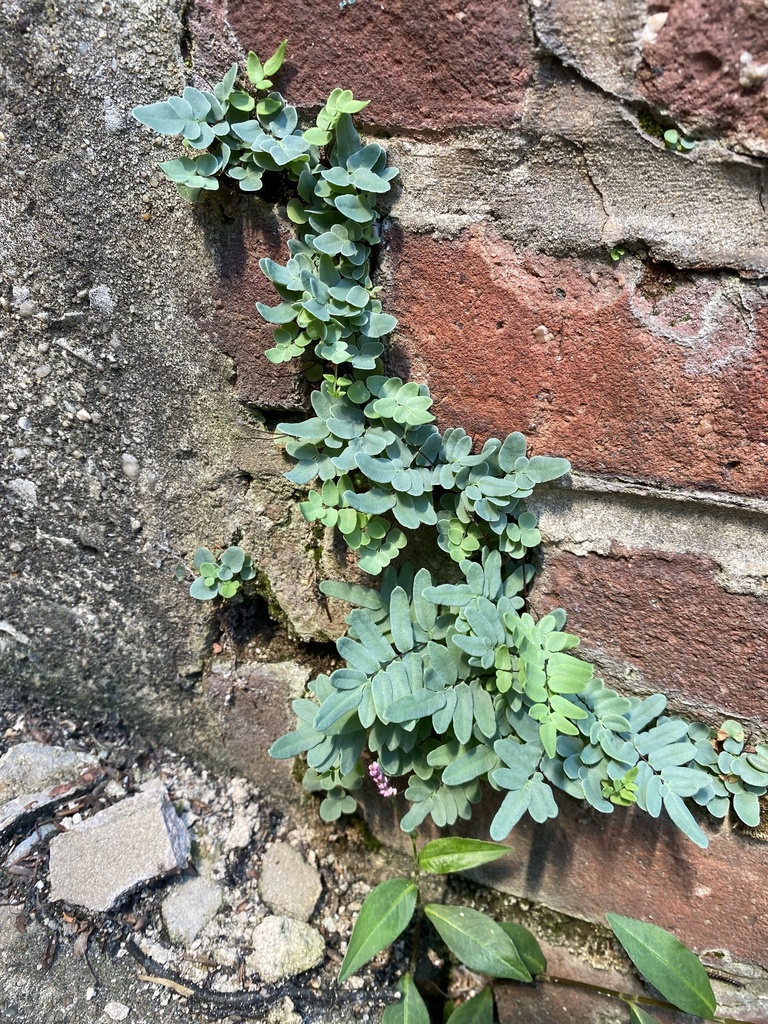
Pellaea glabella, known as Smooth Cliffbrake, is a small, tough, evergreen fern in the brake family (Pteridaceae). It forms tufts of stiff, leathery, blue-green fronds 3 to 12 inches long, with narrow leaflets on smooth, shiny brown stalks. It grows almost exclusively on limestone and dolomite: in crevices of cliffs, ledges and boulders, and on old walls with lime mortar.
Smooth cliffbrake has a wide but patchy range across North America, from Vermont and the Great Lakes west through the Ozarks and northern Great Plains to the Rocky Mountains, the Great Basin and eastern Washington, and north into Canada. It is divided into four subspecies: subspecies glabella in the East and Midwest, subspecies missouriensis in Missouri, subspecies occidentalis in the northern Great Plains and subspecies simplex in the Rocky Mountains and the West. It was once treated as a variety of purple cliffbrake, as Pellaea atropurpurea var. glabella.
For rock gardeners with limestone or a lime-mortared wall, smooth cliffbrake is a charming, drought-tolerant fern. It needs very sharp drainage and alkaline grit, and it grows slowly. Buy nursery-propagated plants from a fern or rock garden nursery, and never pry plants from wild cliffs, where many populations are small and rare.
Identification
Look for a small tuft of stiff, blue-green, once- to twice-divided fronds on smooth, shiny brown stalks, growing from a crack in limestone or a mortared wall.
Growth Habit
Smooth cliffbrake grows in compact tufts from a short, scaly rhizome wedged in a rock crevice. Clumps are usually 3 to 12 inches tall (rarely to 14 inches) and a few inches to a foot across. The fronds are evergreen, and old stalks persist at the base of the clump.
Fronds
The fronds are once-pinnate to twice-pinnate at the base, with 5 to 11 pairs of leaflets. The leaflets are narrowly oblong to lance-shaped, leathery, smooth and blue-green to gray-green, often turning reddish or purplish in exposed sites. The stalk and central axis are reddish-brown to dark brown, shiny and smooth or nearly so, a key difference from purple cliffbrake.
Sori & Spores
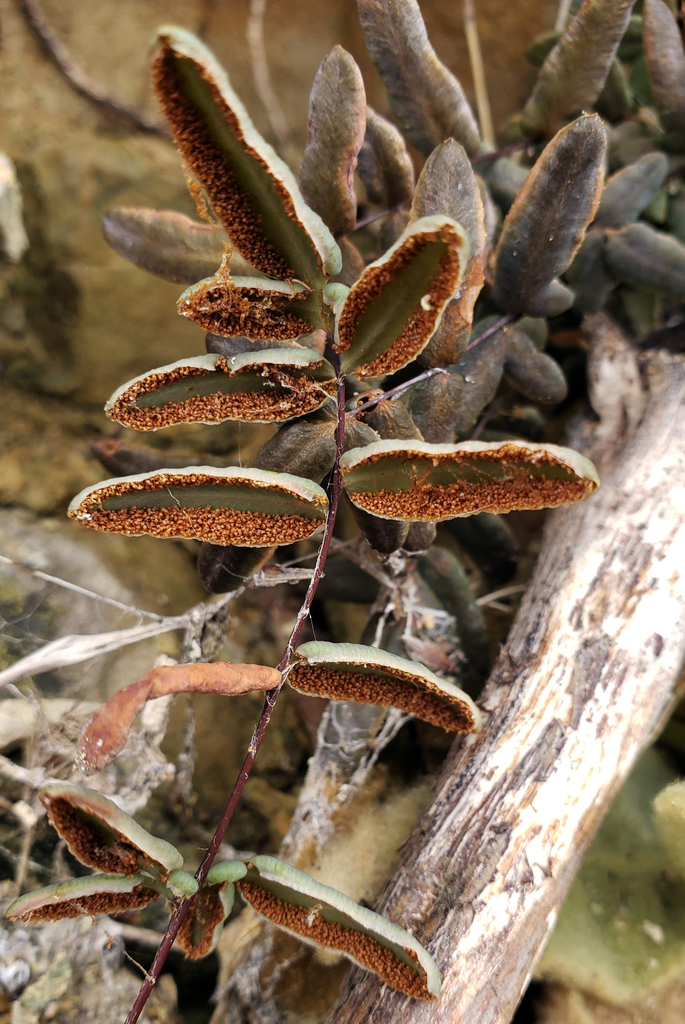
On fertile leaflets, the edges roll under to form a false indusium that covers a continuous band of brown spore cases (sporangia) along the margin. Fertile and sterile fronds look similar. Spores ripen from midsummer to fall.
Subspecies
Subspecies glabella of the East and Midwest and subspecies occidentalis of the northern Plains are tetraploids that reproduce without fertilization (apogamy), while the rare subspecies missouriensis of Missouri is a sexual diploid. Western subspecies simplex has smaller, more often once-divided fronds. They are told apart mainly by small details of the leaflets, scales and spores.
Look-alikes
Purple cliffbrake (Pellaea atropurpurea) is larger, with dark purple stalks and axes that are covered with short, curly hairs. Smooth cliffbrake has smooth or nearly smooth, brown stalks. Walking fern and maidenhair spleenwort share its limestone habitat but have very different, undivided or tiny-leafleted fronds. Wall-rue (Asplenium ruta-muraria) has small, fan-shaped leaflets.
Quick Facts
| Scientific Name | Pellaea glabella |
| Family | Pteridaceae (brake family) |
| Plant Type | Small evergreen fern |
| Mature Height | 3–12 in |
| Mature Spread | 4–12 in |
| Growth Rate | Slow |
| Sun Exposure | Full sun to part shade |
| Water Needs | Low; sharply drained |
| Soil Type | Limestone and dolomite crevices, lime mortar, alkaline grit |
| Soil pH | Alkaline (about 7.0–8.5) |
| Bloom Time | None; spores ripen summer–fall |
| Flower Color | None (fern) |
| Fall Color | Evergreen; leaflets may turn reddish |
| Fruit | None; spores under rolled leaflet margins |
| Deer Resistant | Yes; rarely browsed |
| USDA Hardiness Zones | 3–8 |
Native Range
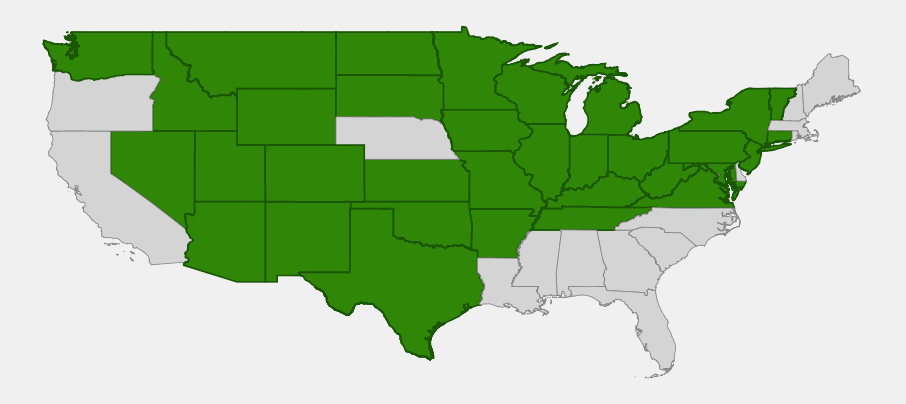
Smooth cliffbrake is native to much of the United States and southern Canada. USDA PLANTS lists it from 33 states, from Vermont, New York, Connecticut and New Jersey west through the Great Lakes, Ohio Valley and Ozarks to the Great Plains, and on to the Rocky Mountains, the Great Basin, Arizona and eastern Washington. In Canada it grows in British Columbia, Alberta, Saskatchewan, Manitoba, Ontario and Quebec.
In the East and Midwest (subspecies glabella) it is most common on the limestone and dolomite bluffs of the Ozarks, the upper Mississippi and Ohio valleys, the Driftless Area of Wisconsin, Minnesota and Iowa, and the Niagara Escarpment. It is rare at the edges of this range and is ranked critically imperiled in Connecticut, Maryland, Texas and West Virginia. Subspecies occidentalis grows on rock outcrops and badland bluffs of the Dakotas, Montana and Wyoming, and subspecies simplex grows in the Rocky Mountains, Great Basin ranges and the dry country east of the Cascades in Washington and Idaho, including the Columbia Basin and northeastern Washington.
Its habitat is almost always calcareous rock: crevices and ledges of limestone and dolomite cliffs, river bluffs, rock outcrops and boulders, and old walls, bridges and buildings with lime mortar. It tolerates full sun and drought far better than most ferns.
📋 Regional plant lists featuring Smooth Cliffbrake: New York, Pennsylvania & Northern New Jersey · Idaho, Eastern Oregon & Eastern Washington · Ohio & Indiana · Montana & Wyoming · Michigan, Wisconsin & Eastern Minnesota · Kentucky & Tennessee · Nebraska, Kansas & Eastern Colorado · Utah & Western Colorado · Connecticut, Massachusetts & Rhode Island · New Hampshire, Maine & Vermont · Maryland, Virginia & West Virginia · Delaware, Southern New Jersey & Long Island · Arizona & New Mexico · Illinois, Iowa & Missouri · Arkansas, Louisiana, Eastern Oklahoma & Eastern Texas · North Dakota, South Dakota & Western Minnesota · California & Nevada
Growing & Care Guide
Smooth cliffbrake is a fern for specialists and rock gardeners. It needs what it has on a limestone cliff: alkaline grit, excellent drainage and a crevice that keeps its roots cool. Buy nursery-propagated plants from a fern or alpine nursery.
Light
Full sun to part shade. Unlike most ferns, it tolerates direct sun on a north- or east-facing rock face, and it often grows in sunny cliff crevices. In hot climates, give it afternoon shade.
Soil & Water
Plant it in a gritty mix of limestone chips or coarse sand, a little loam and crushed mortar or limestone. Drainage must be excellent; wet soil around the crown is fatal. Water during establishment and long droughts, but let it dry between waterings. Established plants tolerate drought by curling their fronds.
Planting Tips
Plant it in spring, wedged into a vertical crevice in a limestone rock garden, a trough or a dry-laid wall, with the crown just above the surface. Choose a spot where water drains away from the crown. It combines well with other small limestone ferns, columbines and alpine plants.
Pruning & Maintenance
Remove dead or damaged fronds in spring. Avoid fertilizer and do not let larger plants crowd or shade it heavily.
Propagation
It grows from spores, which develop into new plants without fertilization in most subspecies, so spore-grown plants are often easy to raise. Sow spores on sterilized, limey compost under cover and keep humid. Older clumps can be divided carefully in spring.
Landscape Uses
- Limestone rock gardens: a small evergreen fern for alkaline crevices
- Walls and troughs: grows in lime mortar and trough gardens
- Dry, sunny rock faces: one of the few ferns that tolerates sun and drought
- Winter interest: blue-green fronds through the year
- Conservation plantings: for gardeners interested in rare cliff plants
Wildlife & Ecological Value
Smooth cliffbrake is part of the specialized plant community of limestone cliffs, one of the harshest plant habitats in North America.
For Pollinators
As a fern, it has no flowers and offers no nectar or pollen.
For Birds
It provides little direct food for birds, but limestone cliffs with ferns are used by phoebes, swallows and other cliff-nesting birds.
For Mammals
Deer rarely browse it, and its cliff habitat keeps it out of reach of most grazing animals.
Ecosystem Role
It helps trap dust and organic matter in rock crevices, building the small pockets of soil that other cliff plants depend on. It is an indicator of calcareous rock, and botanists use it to recognize limestone and dolomite cliff communities.
Cultural & Historical Uses
The genus name Pellaea comes from the Greek word pellos, meaning “dark,” referring to the dark stalks of many species. The species name glabella means “smoothish,” referring to the hairless stalks that separate it from the hairy purple cliffbrake.
Smooth cliffbrake has played a role in fern research because most of its populations reproduce without sexual fertilization, producing new plants that are genetically almost identical to the parent. The rare, sexually reproducing subspecies missouriensis of Missouri is of special interest to botanists studying how these forms are related.
Like other cliff ferns, it is affected by rock climbing, quarrying and the clearing of cliffs. In several states it is tracked as a rare plant, and climbers and land managers in some areas take care to protect cliff vegetation.
Frequently Asked Questions
Does smooth cliffbrake need limestone?
Almost always. It grows on limestone, dolomite and other calcareous rock, and on walls with lime mortar. In gardens, add limestone chips or crushed mortar to the planting mix.
How is smooth cliffbrake different from purple cliffbrake?
Purple cliffbrake is larger and has dark purple stalks covered with short, curly hairs. Smooth cliffbrake has smooth, brown stalks and usually smaller fronds.
Can smooth cliffbrake grow in sun?
Yes. It tolerates more sun and drought than most ferns, as long as its roots are cool in a rock crevice.
Is smooth cliffbrake evergreen?
Yes. Its leathery fronds stay through winter, sometimes turning reddish in exposed sites.
Is smooth cliffbrake rare?
It is common in parts of its range, such as the Ozarks and the upper Mississippi Valley, but rare at the edges. It is ranked critically imperiled in Connecticut, Maryland, Texas and West Virginia.

Looking for a nursery that carries Smooth Cliffbrake?
Browse our native plant nursery directory: Arizona & Arkansas · Colorado & Connecticut · Idaho, Illinois, Indiana, Iowa & Kansas · Kentucky, Maryland, Michigan, Minnesota, Missouri & Montana · Nevada, New Jersey, New Mexico, New York, North Dakota, Ohio & Oklahoma · Pennsylvania, South Dakota, Tennessee, Texas, Utah, Vermont & Virginia · Washington · West Virginia, Wisconsin & Wyoming

