
Maidenhair Spleenwort (Asplenium trichomanes)
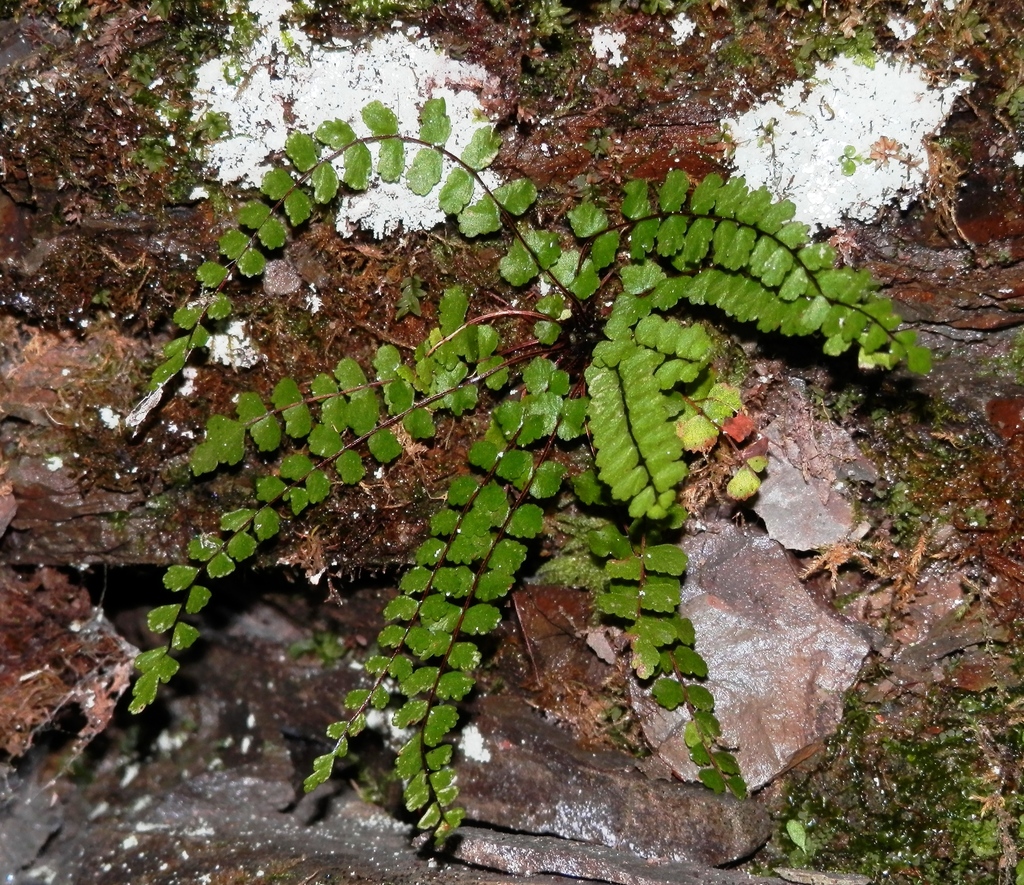
Asplenium trichomanes, known as Maidenhair Spleenwort, is a small, evergreen fern that grows in tufts in rock crevices, on cliffs and on old stone walls. It is one of the most widespread ferns in the world, found across North America, Europe, Asia, Africa, Australia and many islands, including Hawaii. It belongs to the spleenwort family (Aspleniaceae). Its narrow fronds, usually 2 to 8 inches long, carry 15 to 35 pairs of small, rounded leaflets along a wiry, shiny, dark reddish-brown to black stalk.
The neat rosettes, fine texture and dark “maidenhair” stalks make it one of the most attractive small ferns. It grows on a wide range of rocks and has two common subspecies in North America with different rock preferences: subspecies trichomanes grows on acidic rocks such as sandstone, granite and schist, while subspecies quadrivalens grows on limestone, dolomite and other calcareous rock, including mortar in walls.
Maidenhair spleenwort is a lovely plant for rock gardens, troughs and stone walls in partial shade. It needs very sharp drainage and grows slowly. Buy nursery-propagated plants from a fern or rock garden nursery and never pry plants from wild cliffs or walls.
Identification
Look for small, tidy rosettes of narrow fronds with dark, shiny stalks and rows of tiny round leaflets, growing directly out of rock crevices.
Growth Habit
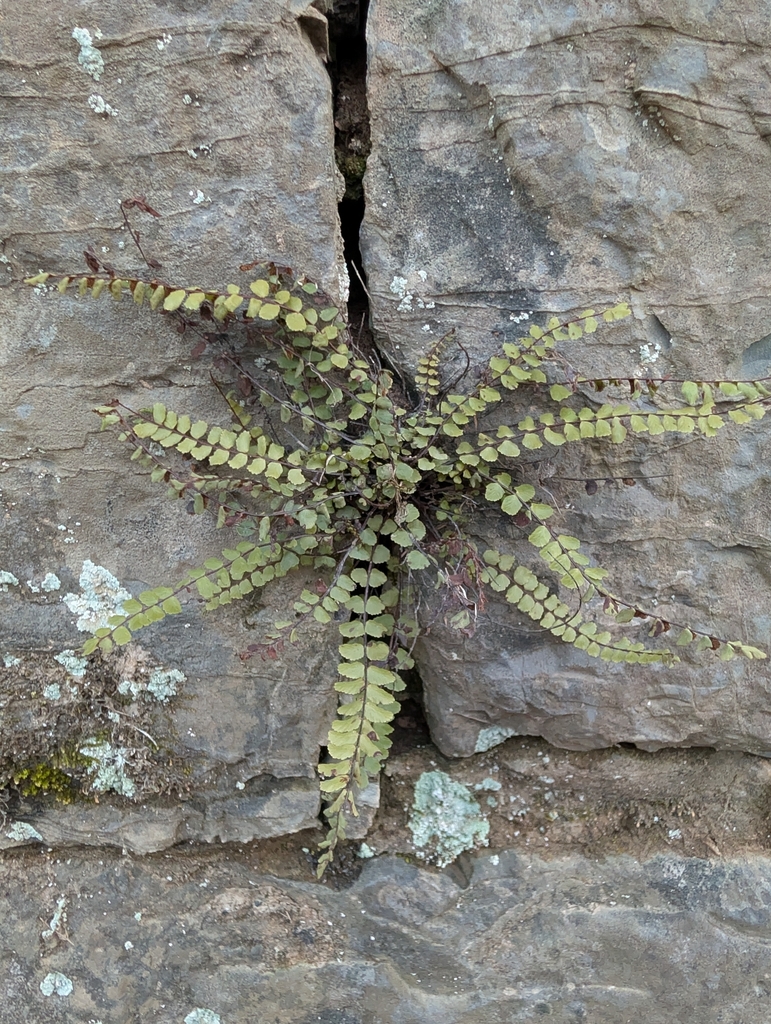
Plants form dense, spreading or erect tufts from a short, scaly rhizome. A mature clump can have dozens of fronds radiating out in a rosette, usually 3 to 8 inches across. The bare, dark stalks of old fronds persist after the leaflets have fallen, forming a wiry tangle at the base.
Fronds
The fronds are evergreen, 2 to 8 inches long (occasionally to about 10 inches) and 1/4 to 1/2 inch wide, linear, and once-pinnate. The stalk and central axis (rachis) are shiny and dark reddish-brown to purplish-black all the way to the tip. The 15 to 35 pairs of leaflets are oblong to nearly round, about 1/8 to 1/4 inch long, with finely scalloped edges, and are attached to the rachis by a very short stalk or directly. The leaflets often fall off older fronds, leaving bare, black axes.
Sori & Spores
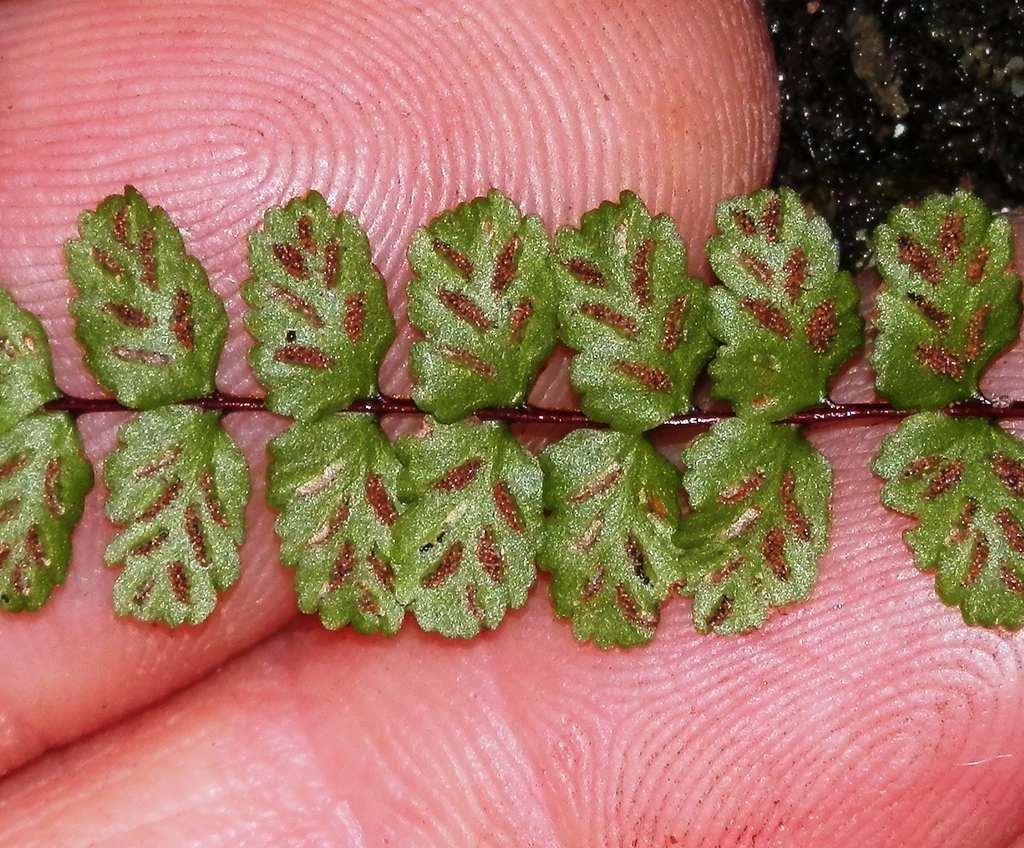
On the underside of fertile fronds, each leaflet has two to five pairs of short, linear sori angled along the veins, each covered at first by a narrow, flap-like indusium. They turn brown as the spores ripen from summer into fall.
Subspecies
Subspecies trichomanes is diploid and grows on acidic, non-calcareous rock; its leaflets are often a little more separated and attached by a tiny stalk. Subspecies quadrivalens is tetraploid and grows on limestone and other calcareous rock and on mortar; its leaflets are often more crowded and attached directly. They are hard to tell apart reliably without microscopic examination of spores. Hawaiian plants are often treated as a separate subspecies, densum.
Look-alikes
Ebony spleenwort (Asplenium platyneuron) is larger, with longer, eared leaflets and separate, taller fertile fronds. Green spleenwort (A. viride, also called A. trichomanes-ramosum) has a green rachis in its upper part. Maidenhair ferns (Adiantum), such as northern maidenhair fern, also have dark, shiny stalks but much larger, fan-shaped or branched fronds.
Quick Facts
| Scientific Name | Asplenium trichomanes |
| Family | Aspleniaceae (spleenwort family) |
| Plant Type | Small evergreen fern |
| Mature Height | 2–8 in |
| Mature Spread | 3–8 in |
| Growth Rate | Slow |
| Sun Exposure | Part shade to shade |
| Water Needs | Low to medium; sharply drained |
| Soil Type | Rock crevices, cliffs, stone walls, gritty soil |
| Soil pH | Acidic to alkaline, depending on subspecies (about 5.0–8.0) |
| Bloom Time | None; spores ripen summer–fall |
| Flower Color | None (fern) |
| Fall Color | None; evergreen |
| Fruit | None; linear sori on frond undersides |
| Deer Resistant | Yes; rarely browsed |
| USDA Hardiness Zones | 3–9 |
Native Range
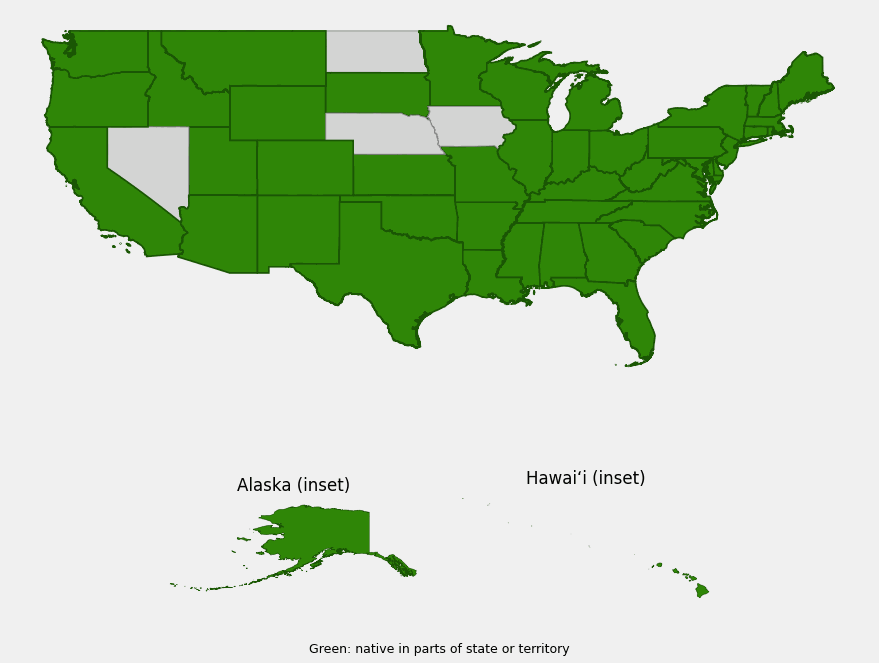
Maidenhair spleenwort is nearly cosmopolitan, growing on every continent except Antarctica. USDA PLANTS lists it as native in the lower 48 states, Alaska, Hawaii and Canada, and records it from 46 states and the District of Columbia. In Canada it grows from British Columbia and Yukon east to Newfoundland and Labrador.
In the East it is common in rocky areas of New England, the Appalachians, the Great Lakes region, the Ohio Valley and the Ozarks, and becomes scarce on the Coastal Plain, where suitable rock is rare. In the West it grows in the Rocky Mountains, the Black Hills of South Dakota, the mountains of the Southwest, the Sierra Nevada and the Pacific Northwest, including rock outcrops west of the Cascades in Oregon and Washington, and in southeast Alaska. In Hawaii it grows on rocky sites in the uplands of several islands.
Habitats include shaded or partly sunny cliffs, ledges, boulders and talus, rocky ravines and stream banks, and old masonry such as walls, bridges and canal locks. Subspecies trichomanes grows on acidic rocks, and subspecies quadrivalens on limestone, dolomite and mortar. It is absent from most of the open Great Plains, where rock outcrops are scarce.
📋 Regional plant lists featuring Maidenhair Spleenwort: New York, Pennsylvania & Northern New Jersey · Idaho, Eastern Oregon & Eastern Washington · Hawaii · Ohio & Indiana · Montana & Wyoming · Michigan, Wisconsin & Eastern Minnesota · Kentucky & Tennessee · Nebraska, Kansas & Eastern Colorado · Utah & Western Colorado · Connecticut, Massachusetts & Rhode Island · New Hampshire, Maine & Vermont · Maryland, Virginia & West Virginia · Delaware, Southern New Jersey & Long Island · Arizona & New Mexico · Illinois, Iowa & Missouri · Alabama, Georgia & Mississippi · Alaska · North & South Florida · North & South Carolina · Arkansas, Louisiana, Eastern Oklahoma & Eastern Texas · South & West Texas · North Dakota, South Dakota & Western Minnesota · Western Oregon & Western Washington · California & Nevada
Growing & Care Guide
Maidenhair spleenwort is a small treasure for rock gardeners. It needs the conditions of a shaded rock crevice: excellent drainage, cool roots and protection from hot sun. Buy nursery-propagated plants from a fern or alpine nursery.
Light
Part shade to shade, or morning sun with afternoon shade. In cool, humid climates it tolerates more sun. Hot afternoon sun scorches the fronds.
Soil & Water
Plant in a gritty, fast-draining mix of coarse sand or fine gravel and leaf mold. For plants from limestone (subspecies quadrivalens), add limestone chips or mortar rubble; for acid-rock plants, use non-calcareous grit. Water during establishment and dry spells, but never let the crown sit in wet soil.
Planting Tips
Plant in spring or early fall, wedging the crown into a vertical crevice between rocks, a pocket in a dry stone wall or a trough garden, with the crown slightly above the surface. Vertical planting keeps water from collecting in the crown. Combine it with other small rock ferns, mosses and alpine plants.
Pruning & Maintenance
Very little care is needed. Remove old, bare stalks and fallen leaves in spring if they look untidy. Keep larger plants from shading or crowding it.
Propagation
It grows readily from spores, which often produce volunteer plants in nearby wall crevices. Larger clumps can be carefully divided in spring.
Landscape Uses
- Rock gardens: a tiny evergreen fern for shaded crevices
- Stone walls: grows in mortar joints and gaps in dry-laid walls
- Troughs and containers: a small-scale accent in alpine troughs
- Shade gardens: fine texture next to mosses and small woodland plants
- Winter interest: green fronds through the year
Wildlife & Ecological Value
Maidenhair spleenwort is part of the specialized community of plants that live on bare rock, where few other plants can grow.
For Pollinators
Ferns reproduce by spores and have no flowers, so maidenhair spleenwort offers no nectar or pollen.
For Birds
It provides little direct food for birds, but cliff and ledge habitats with ferns are used by nesting birds such as phoebes.
For Mammals
Deer rarely browse it. Its tufts give small cover to invertebrates and salamanders in rock crevices.
Ecosystem Role
As a pioneer on rock faces and masonry, it helps trap dust and organic matter in crevices, starting the slow process of soil formation. Its presence on walls and cliffs adds to the biodiversity of these specialized habitats.
Cultural & Historical Uses
The name Asplenium comes from the Greek for “spleen,” reflecting an old belief that spleenworts could treat ailments of the spleen. The species name trichomanes is an ancient Greek name for a fern, usually linked to the Greek word for hair, a fitting reference to its hair-like stalks.
In Europe, maidenhair spleenwort was used in traditional herbal medicine, especially for coughs; it should not be used as a home remedy. It also grows on old walls and buildings in many European towns, and gardeners have long valued it for planting in stone walls.
The species is a classic example of how ferns form new species through chromosome doubling. Its subspecies differ in chromosome number and rock preference, and botanists have studied them for decades to understand fern evolution.
Frequently Asked Questions
Is maidenhair spleenwort evergreen?
Yes. Its fronds stay green all year, although older leaflets drop off and leave bare, dark stalks.
Does maidenhair spleenwort need limestone?
It depends on the subspecies. Subspecies quadrivalens grows on limestone and mortar, while subspecies trichomanes grows on acidic rocks. Garden plants usually adapt if drainage is excellent.
Can I grow maidenhair spleenwort in a stone wall?
Yes. It is ideal for walls, either planted into crevices or allowed to colonize from spores.
How is it different from maidenhair fern?
Maidenhair ferns (Adiantum) have much larger, branched or fan-shaped fronds. Maidenhair spleenwort has small, narrow, unbranched fronds with tiny round leaflets.
Is maidenhair spleenwort native to Hawaii and Alaska?
Yes. USDA PLANTS lists it as native in both. It grows in southeast Alaska and on rocky slopes in the Hawaiian Islands.

Looking for a nursery that carries Maidenhair Spleenwort?
Browse our native plant nursery directory: Alabama, Alaska, Arizona & Arkansas · California · Colorado, Connecticut, Delaware, Florida, Georgia & Hawaii · Idaho, Illinois, Indiana & Kansas · Kentucky, Louisiana, Maine, Maryland, Massachusetts, Michigan, Minnesota, Mississippi, Missouri & Montana · New Hampshire, New Jersey, New Mexico, New York, North Carolina, Ohio & Oklahoma · Oregon · Pennsylvania, Rhode Island, South Carolina, South Dakota, Tennessee, Texas, Utah, Vermont & Virginia · Washington · West Virginia, Wisconsin & Wyoming