Purple Cliffbrake (Pellaea atropurpurea)
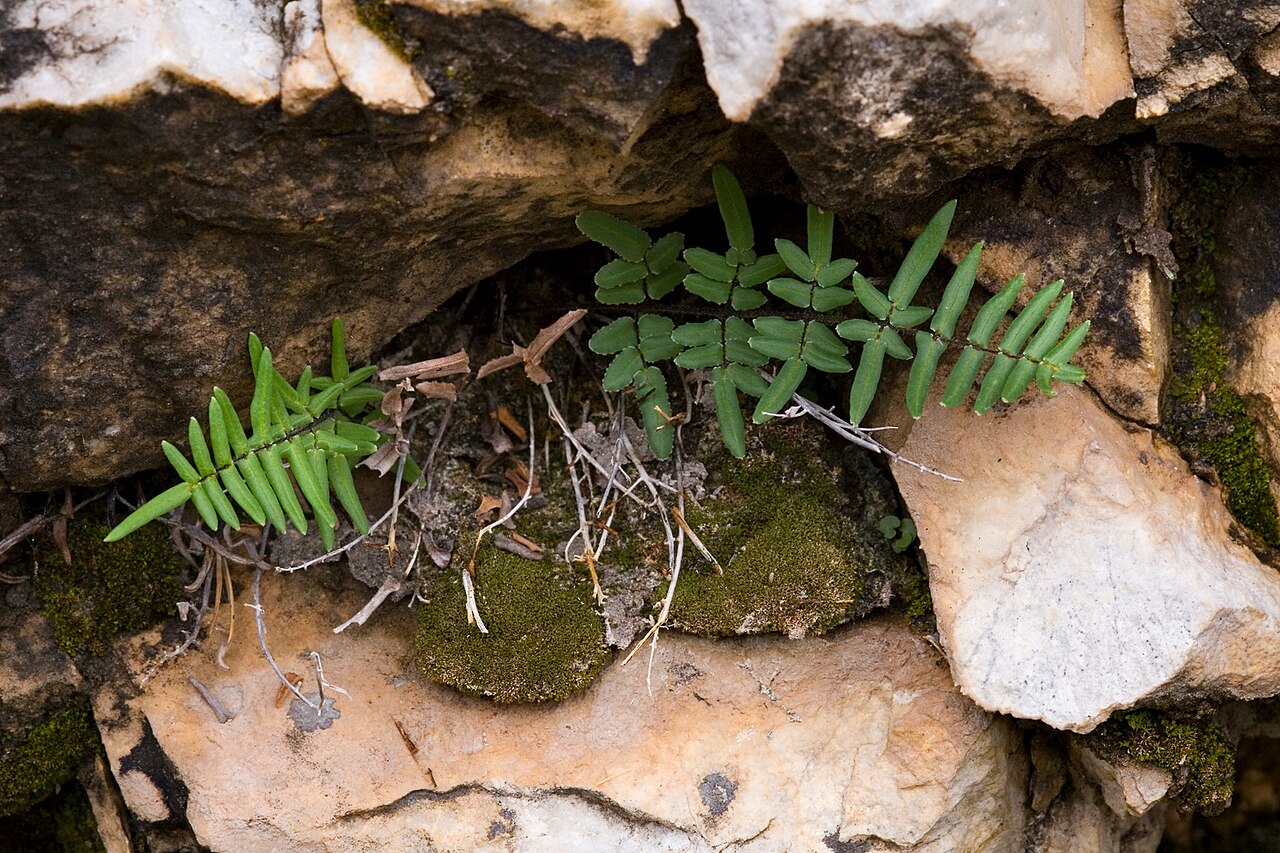
Pellaea atropurpurea, commonly called purple cliffbrake or purple-stemmed cliffbrake, is a small, wiry evergreen fern that makes its home in the cracks of limestone and other calcium-rich rock across most of the eastern two-thirds of the United States, with outlying populations in the desert mountains of Arizona and New Mexico. It belongs to the Pteridaceae, the maidenhair fern family, and is immediately recognizable by its dark purple-black stalks and stiff, blue-green leaflets — a combination that sets it apart from almost every other fern it grows alongside.
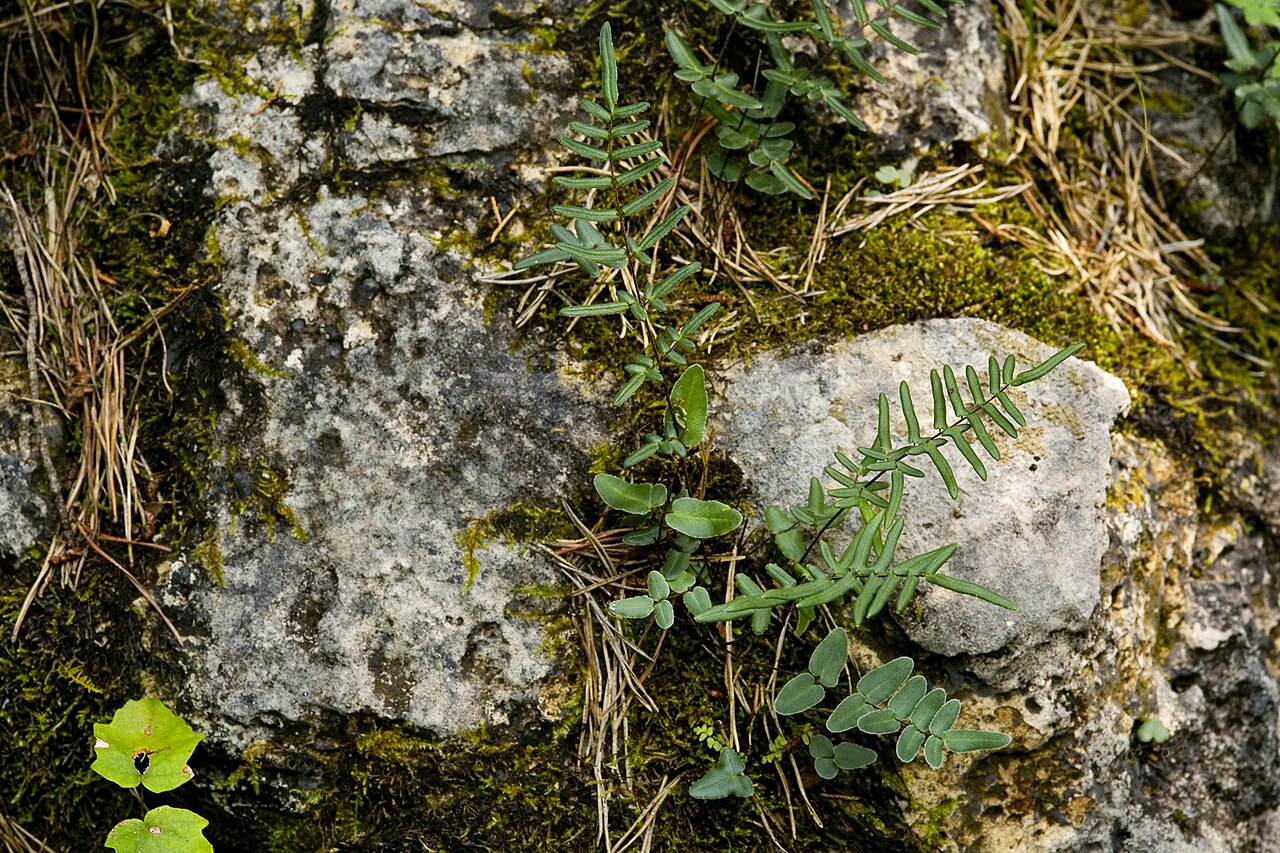
Unlike the moisture-loving ferns most gardeners picture, purple cliffbrake is a true rock fern. It grows directly out of narrow limestone cracks, old stone walls and alkaline ledges, often in full sun, and shrugs off the kind of heat and drought that would wilt a wood fern in a single afternoon. Clumps are small and tidy, rarely more than a foot across, with leathery fronds that stay green through winter in much of its range and simply take on a duller, more bronzed cast in the cold.
Because it needs so little — just a crack, a bit of lime, and good drainage — purple cliffbrake is an excellent choice for rock gardens, dry stone walls, and the tops of retaining walls where few other natives will take hold. It is rarely offered by mainstream nurseries, but fern specialists and native-plant societies in its range increasingly propagate it from spores, and it is well worth seeking out for a site that nothing else wants.
Identification
Purple cliffbrake forms a low, dense tuft of fronds from a short, scaly rhizome wedged into rock. Mature clumps are typically 4 to 12 inches tall and not much wider, with individual fronds reaching 4 to 16 inches in length, though plants in deep, sheltered cracks can grow larger than those on exposed, baking ledges. The whole plant has a stiff, almost succulent toughness that reflects its rock-crevice life.
Stems
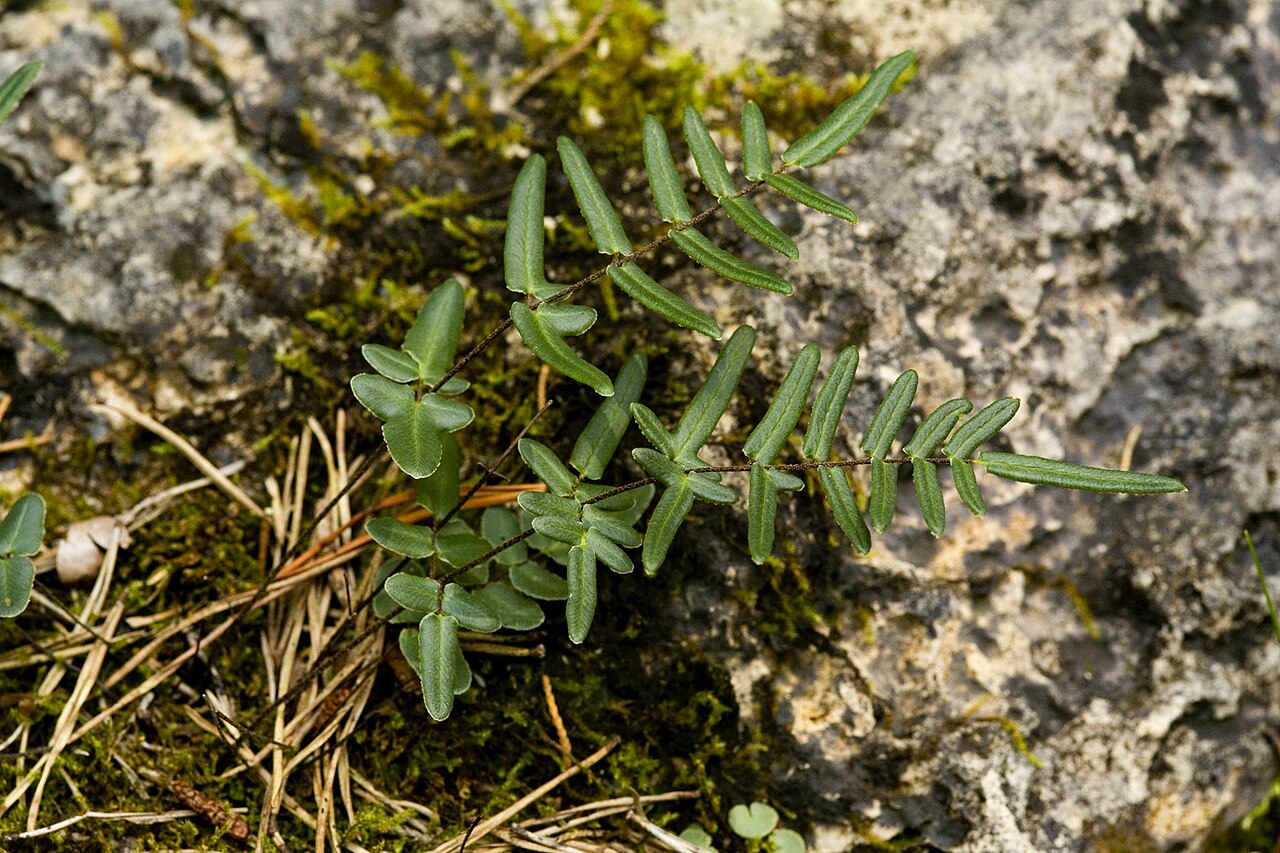
The most diagnostic feature is the stipe (leaf stalk) and rachis (central axis of the frond): both are glossy, wiry, and dark purple-black to nearly black, giving the species its common name. The stalks are noticeably hairy, which distinguishes purple cliffbrake from the similar, smooth-stalked smooth cliffbrake (Pellaea glabella) that sometimes shares its rocky habitat.
Leaves
Fronds are once- or twice-divided (pinnate to bipinnate), leathery, and blue-green to gray-green above with a paler, often hairy underside. The lower pairs of leaflets (pinnae) are typically divided into three to seven smaller pinnules, while the upper pinnae are simple, narrow, and undivided, tapering to a point — giving each frond a tiered, feathery outline that narrows toward the tip. Two kinds of fronds are produced: shorter sterile fronds with broader leaflets, and taller, more finely divided fertile fronds that carry the spores.
Spores
Purple cliffbrake does not flower, fruit, or produce seed. Instead it reproduces by spores, which ripen in continuous brown lines along the curled-under margins of the fertile pinnules in summer. Most populations are apogamous triploids, meaning they can produce new plants without the usual fern life cycle of fertilization — a trait that lets isolated rock-crevice colonies persist and spread locally even where spores rarely find a mate.
Quick Facts
| Scientific Name | Pellaea atropurpurea |
| Family | Pteridaceae (Maidenhair Fern) |
| Plant Type | Evergreen rock fern |
| Mature Height | 4–12 in (occasionally to 16 in in sheltered cracks) |
| Mature Spread | 6–12 in, slowly widening clump |
| Growth Rate | Slow |
| Sun Exposure | Full Sun to Part Shade |
| Water Needs | Low once established; drought tolerant |
| Soil Type | Thin, rocky, fast-draining; limestone or other calcareous rock |
| Soil pH | Alkaline (about 7.0–8.0) |
| Bloom Time | None — ferns do not flower |
| Flower Color | None (reproduces by spores, ripening in summer) |
| Fall Color | Evergreen; fronds dull to a bronze-green in cold weather |
| Fruit | None (spore-bearing fern) |
| Deer Resistant | Yes |
| USDA Hardiness Zones | 4–9 |
Native Range
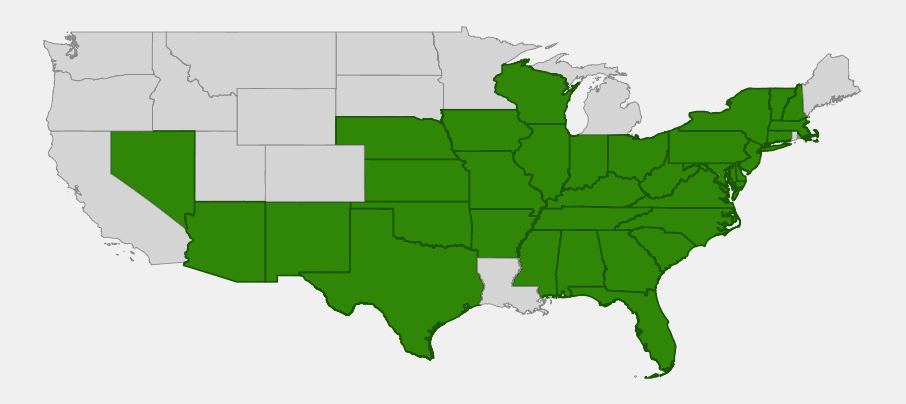
Purple cliffbrake has one of the broadest ranges of any North American fern, stretching from New England and the upper Midwest south to Florida and west through the southern Great Plains to Arizona and New Mexico, with an outlying foothold in southern Nevada. Despite this huge footprint on the map, the species is never common in the usual sense: it only grows where exposed limestone, dolomite or other calcium-rich rock breaks the surface, so its real distribution is a scatter of rock outcrops, bluffs, glades and old stone walls rather than a continuous sweep of territory.
The fern is most abundant in limestone country — the Ozark Plateau of Missouri and Arkansas, the limestone glades and cedar barrens of Kentucky and Tennessee, and the dolomite bluffs of the upper Midwest — where it carpets ledges and crevices alongside other calciphile plants. Farther west, in the mountains of Arizona and New Mexico, it grows on dry limestone and volcanic rock in canyons and foothill woodlands, often at considerably higher elevation than its eastern populations. In several states at the edges of its range, including Florida, Iowa and Rhode Island, it is uncommon enough to be tracked as a state-rare species, and it is believed to have disappeared from Louisiana entirely.
Because it depends on exposed calcareous rock rather than a particular climate zone, purple cliffbrake turns up in a wide range of ecoregions — Appalachian cove forests, Ozark oak-hickory woodlands, Great Plains limestone glades, and Southwestern desert canyons alike — as long as the right rock is present. It is absent from the acidic granite and sandstone country of New England’s coast, the Pacific states, and most of the Rocky Mountain interior, where suitable calcareous outcrops are scarce.
📋 Regional plant lists featuring Purple Cliffbrake: South and West Texas · Arkansas, Louisiana, Eastern Oklahoma & Eastern Texas · Nebraska, Kansas & Eastern Colorado · Illinois, Iowa & Missouri · Ohio & Indiana · Kentucky & Tennessee · Maryland, Virginia & West Virginia · North Carolina & South Carolina · Georgia, Alabama & Mississippi · New York, Pennsylvania & Northern New Jersey · Delaware, Southern New Jersey & Long Island · Connecticut, Massachusetts & Rhode Island · New Hampshire, Maine & Vermont · Michigan, Wisconsin & Eastern Minnesota · Arizona & New Mexico · California & Nevada
Growing & Care Guide
Purple cliffbrake is not a woodland fern, and treating it like one — rich soil, constant moisture, shade — tends to rot it out within a season or two. Give it instead the conditions of its native cliffs: lean, mineral soil, sharp drainage, and a crack or pocket that lets its roots run back into cool rock rather than sitting in a wet garden bed.
Light
In the wild this fern grows in everything from full, baking sun on open ledges to the dappled light of a wooded bluff, and garden plants are nearly as flexible. Full sun suits it well as long as its roots are tucked into a crevice where they stay cool, while part shade is a safer bet in hot gardens or in fast-draining containers where the root zone heats up quickly.
Soil & Water
The single most important requirement is alkaline, rocky, fast-draining soil — ordinary garden loam, especially anything acidic or moisture-retentive, is the fastest way to lose this plant. Tuck it into a crack between limestone pavers, a dry-stacked limestone wall, or a rock garden built with crushed limestone or dolomite gravel as the growing medium. Water regularly the first season to help roots establish, then back off; mature plants handle extended dry spells well and are more often killed by overwatering than drought. If your soil is naturally acidic, a handful of crushed limestone or dolomitic lime worked into the planting pocket will help it settle in.
Planting Tips
Plant purple cliffbrake in spring or fall, setting the crown at the same depth it grew in its container and firming rocky soil or gravel around the roots so no large air pockets remain. Vertical or angled cracks that shed excess water work better than flat, low spots that can stay soggy. Because it is slow-growing and rarely available at general nurseries, plan on sourcing it from a fern specialist or regional native-plant sale and give it a permanent spot rather than moving it later — the wiry rhizome resents disturbance once it has gripped the rock.
Pruning & Maintenance
Maintenance is minimal. Trim off old, browned fronds in early spring before new growth starts, and otherwise leave the clump alone. It has no significant pest or disease problems and does not need fertilizer; feeding it rich soil amendments works against its rock-fern nature rather than for it.
Propagation
Purple cliffbrake is propagated from spores collected from the undersides of mature fertile fronds in summer, sown on a sterile, alkaline medium such as crushed limestone grit mixed with peat-free compost. Because most populations are apogamous, plants can sometimes be raised from spores without the usual need for a separate fertilization step, though germination is still slow and best left to fern specialists. Division of established clumps is difficult and usually not worth attempting given the fern’s firm grip on rock crevices.
Landscape Uses
This is a specialist’s fern for a specific kind of site:
- Limestone rock gardens and crevice gardens built around alkaline stone
- Dry-stacked stone walls and the tops of retaining walls
- Xeriscaping in regions with naturally alkaline soil
- Trough gardens and raised beds filled with gritty, limestone-based mix
- Restoration plantings on exposed limestone outcrops and glades
Wildlife & Ecological Value
As a small, spore-bearing rock fern, purple cliffbrake does not offer the nectar, fruit or seed that drive most wildlife-garden recommendations — it produces no flowers and no edible fruit. Its ecological value lies instead in the specialized, often fragile plant communities it helps anchor.
Ecosystem Role
Purple cliffbrake is a characteristic member of limestone glade and cliff-face plant communities, habitats that are naturally rare and easily damaged by quarrying, trampling or overcollection. Alongside other calciphile plants, it helps stabilize thin soil pockets on exposed rock and contributes to the structure of these specialized microhabitats, which in turn support glade-adapted insects and reptiles that rely on open, rocky ground.
For Insects and Small Wildlife
The dense, wiry clumps provide shelter for small invertebrates and cover for lizards and other rock-dwelling animals that favor the sun-warmed crevices this fern also prefers. It is not a larval host plant for any well-documented butterfly or moth, and its chief wildlife contribution is this structural, habitat role rather than a food source.
Cultural & Historical Uses
Purple cliffbrake has no well-documented history of food, medicinal or craft use among Indigenous peoples or early settlers, and none should be assumed or attempted — like many ferns, it is better left admired than eaten or used as a home remedy. Its real cultural history belongs to botany and horticulture rather than folk use.
The species was swept up in the Victorian “pteridomania,” or fern craze, of the nineteenth century, when collectors across Europe and North America prized small, hardy rock ferns for Wardian cases and rockeries. Purple cliffbrake’s combination of toughness, tidy size and striking dark stems made it a natural candidate for these collections, and botanical illustrators of the era documented it in detail for fern floras of the period.
Today its cultural role has shifted toward conservation and native-plant horticulture. Because it is tied so closely to limestone outcrops — habitats that are often small, scattered and vulnerable to quarrying or development — botanists and native-plant societies in several states monitor its populations, and specialty growers propagate it from spores rather than collecting from the wild. Gardeners who grow it today are usually rock-garden and fern enthusiasts drawn to its unusual, almost succulent toughness rather than any practical use.
Frequently Asked Questions
Does purple cliffbrake need limestone to survive?
It needs alkaline conditions, which in practice usually means limestone, dolomite or another calcium-rich rock. In acidic garden soil it struggles and often dies out within a year or two, so gardeners outside limestone country typically grow it in a dedicated alkaline rock garden or crevice bed amended with crushed limestone.
Is purple cliffbrake evergreen?
Yes, in most of its range the leathery fronds persist through winter, though they often take on a duller, more bronze-green tone in cold weather. In the coldest parts of its range, fronds can be damaged by severe winters and are best trimmed off in spring once new growth begins.
Why doesn’t my purple cliffbrake ever flower?
Ferns never flower or set seed — they reproduce by spores instead of flowers, a much older strategy in plant evolution. Look on the undersides of the narrower, more finely divided fronds in summer for the brown spore-bearing lines along the leaflet margins; that is the fern’s equivalent of blooming.
Can purple cliffbrake handle drought?
Very well, once its roots are established in a rock crevice. Like many rock ferns, it is adapted to short bursts of growth after rain followed by long dry spells, and it is far more likely to be killed by soggy, poorly drained soil than by underwatering.
Where is the best place to plant it in a home garden?
A crevice or pocket in a limestone rock garden, the top of a dry-stacked stone wall, or a trough planted with a gritty, alkaline mix are all good choices. Avoid ordinary flower beds, rich mulched soil, or any spot that stays consistently moist, since none of these recreate the rocky, free-draining conditions this fern depends on.

Looking for a nursery that carries Purple Cliffbrake?
Browse our native plant nursery directory: Alabama, Arizona & Arkansas · Connecticut, Delaware, Florida & Georgia · Illinois, Indiana, Iowa & Kansas · Kentucky, Maryland, Massachusetts, Mississippi & Missouri · Nebraska, Nevada, New Hampshire, New Jersey, New Mexico, New York, North Carolina, Ohio & Oklahoma · Pennsylvania, South Carolina, Tennessee, Texas & Vermont · West Virginia & Wisconsin