
Flatcrown Buckwheat (Eriogonum deflexum)
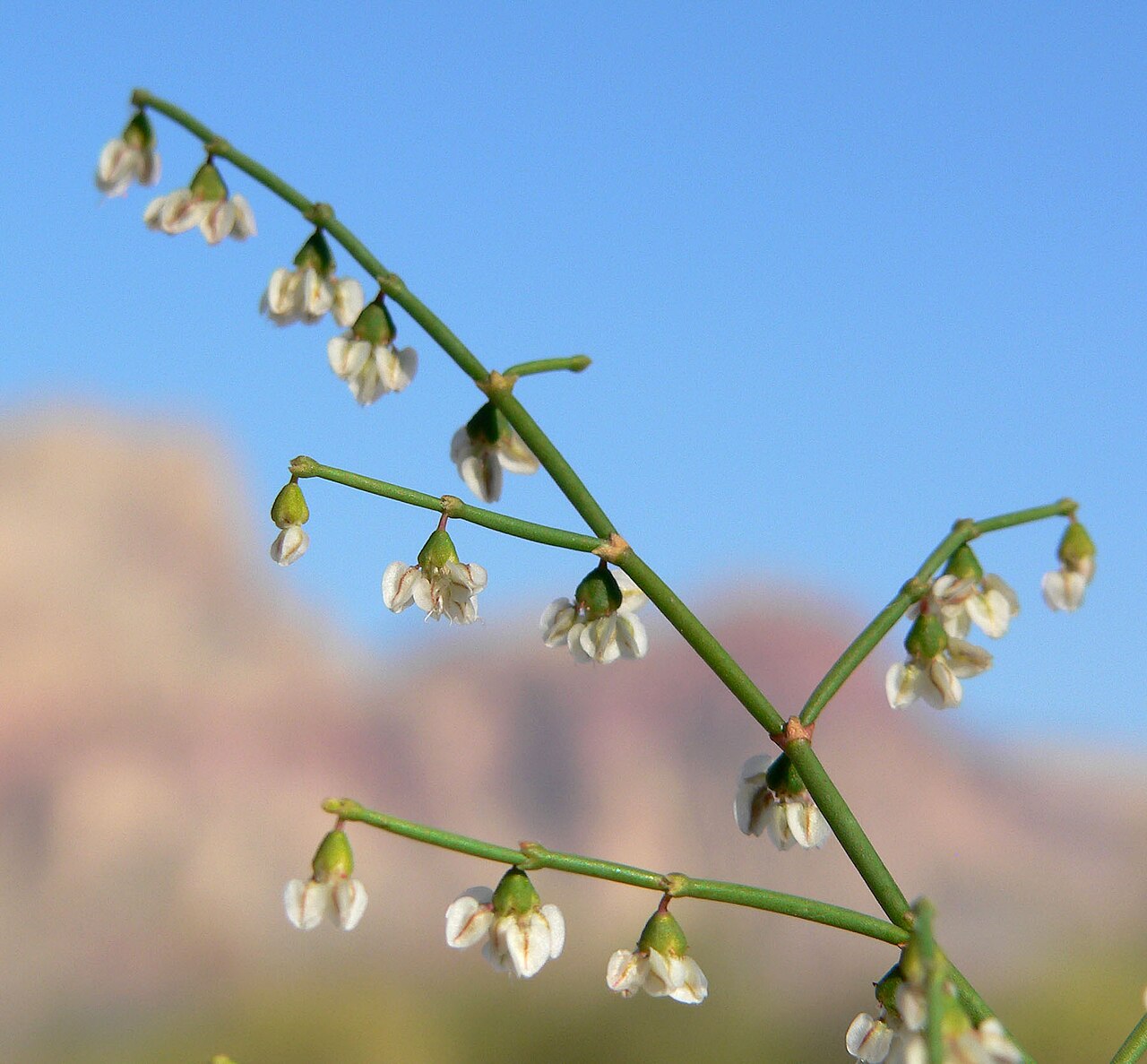
Eriogonum deflexum, known as Flatcrown Buckwheat (also flat-top buckwheat or skeleton weed), is one of the most common annual wild buckwheats of the Mojave, Sonoran and Great Basin deserts. From a small rosette of rounded, woolly leaves it sends up a stiff, repeatedly forked framework of green to reddish stems that spreads into a flat-topped or rounded crown, usually 4 inches to 2 feet tall and sometimes far larger in wet years. Along the branches hang tiny cups of white to pink flowers, each turned downward on a short stalk.
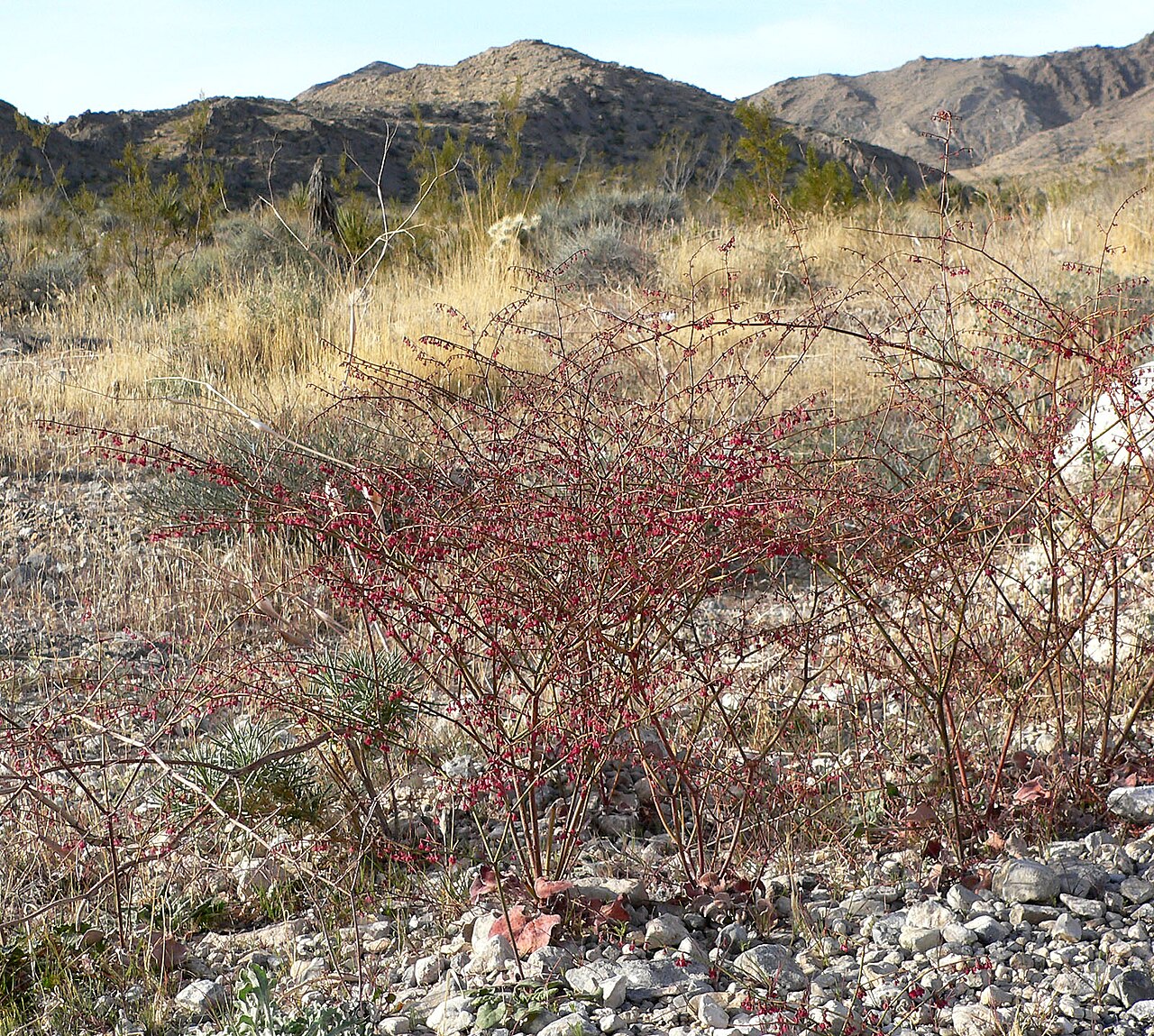
The species name deflexum, “bent downward,” describes those nodding flower cups (involucres), the easiest way to tell it from similar desert buckwheats. As the season goes on, the leaves wither and the stems often turn red or rusty brown, so a mature plant looks like a delicate, leafless skeleton sprinkled with flowers, which explains the name skeleton weed. Dried plants remain standing for months and are a familiar sight along desert roads and washes.
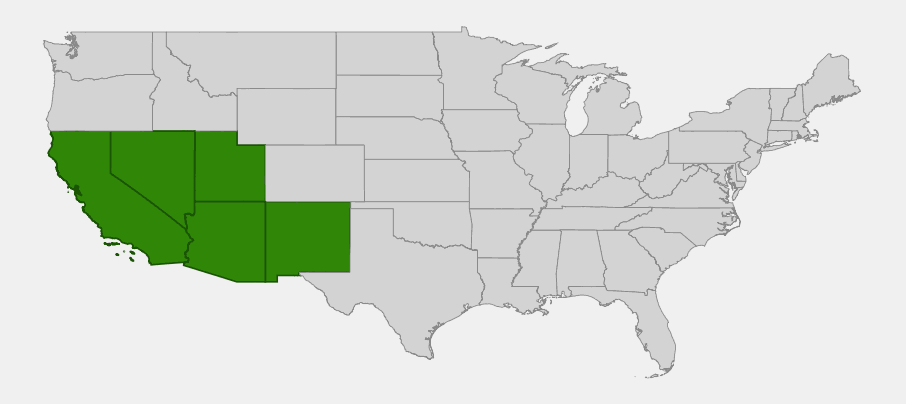
Flatcrown buckwheat grows in Arizona, California, Nevada, Utah and New Mexico and south into northwestern Mexico, in creosote bush scrub, desert washes, sandy and gravelly flats, rocky slopes and disturbed ground. It is a valuable late-season nectar source for desert insects and a host plant for several small butterflies. This guide covers how to identify it, where it grows, how to grow it from seed in a desert garden, and its role in desert ecosystems.
Identification
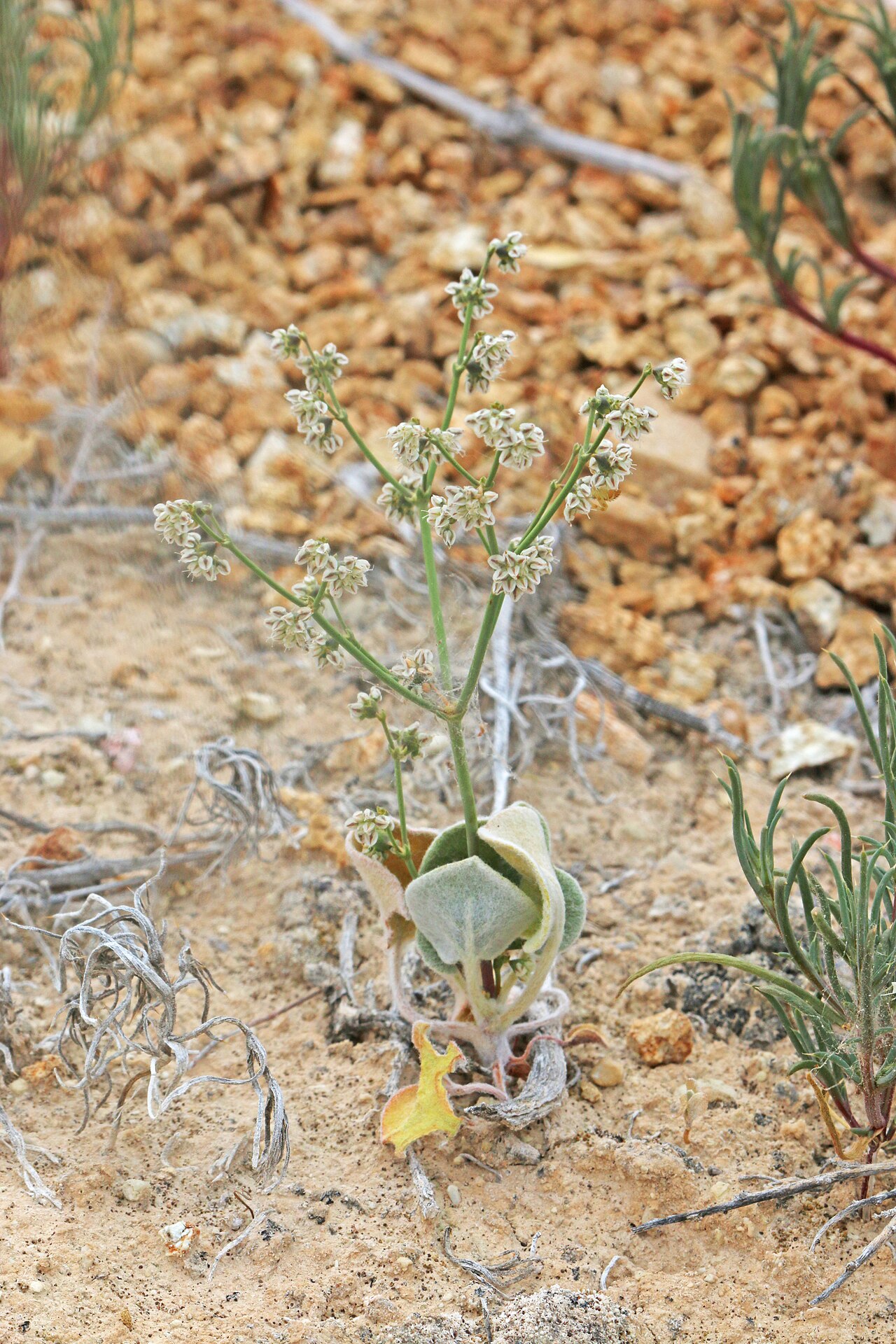
Many annual buckwheats grow in the desert Southwest, and they can be difficult to tell apart. Flatcrown buckwheat is recognized by its rounded, woolly basal leaves, its smooth, hollow-looking stems that fork repeatedly into a flat-topped crown, and its small flower cups that hang downward on short stalks along the branches.
Stems & Growth Habit
Flatcrown buckwheat is an annual that usually germinates with winter rains and flowers from spring through fall. It grows a single main stem that forks again and again into a broad, flat-topped to rounded crown. Typical plants are 4 inches to 2 feet tall and about as wide, but in good years, especially in washes, they can become large, tangled bushes 3 feet or more tall. The stems are smooth, often with a whitish bloom, and green turning red or brown with age.
Leaves
All the leaves are at the base of the plant. They are round to heart-shaped, about ½ to 1½ inches across, on long stalks, and densely woolly, especially beneath, giving them a grey-green to whitish look. They often lie flat on the soil, and they wither and fall by the time the plant is in full bloom, leaving the stems bare.
Flowers
The flowers are tiny, about 1/16 to ⅛ inch long, white to pinkish with darker reddish midribs, and are grouped in small, bell-shaped cups (involucres) that are scattered along the branches. Each involucre hangs or bends downward on a short stalk, especially on the upper branches. Plants can bloom from about April to November, depending on rainfall, and in the low deserts they may flower in almost any month.
Fruit & Seeds
Each flower produces a small, brown, three-angled achene. The seeds fall close to the dried plant or are scattered by wind, water and animals as the brittle skeleton breaks apart, and they germinate after the next good rains.
Quick Facts
| Scientific Name | Eriogonum deflexum |
| Family | Polygonaceae (buckwheat family) |
| Plant Type | Annual herb |
| Mature Height | 4 in–2 ft (occasionally 3 ft or more in wet years) |
| Mature Spread | 6 in–2 ft |
| Growth Rate | Fast |
| Sun Exposure | Full sun |
| Water Needs | Very low |
| Soil Type | Sandy, gravelly or rocky soils; also clay and gypsum soils |
| Soil pH | About 7.0–8.5 (neutral to alkaline) |
| Bloom Time | April–November (nearly year-round in the low deserts) |
| Flower Color | White to pinkish, with reddish midribs |
| Fall Color | Stems turn red to rusty brown |
| Fruit | Small brown three-angled achene |
| Deer Resistant | Yes; little browsed |
| USDA Hardiness Zones | 7–11 (grown as an annual) |
Native Range
Flatcrown buckwheat is a plant of the desert Southwest. USDA PLANTS and the Lady Bird Johnson Wildflower Center record it as native in Arizona, California, Nevada, New Mexico and Utah, and it extends south into Sonora and Baja California, Mexico. It is most abundant in the Mojave Desert of southern Nevada, southeastern California and northwestern Arizona, and in the Sonoran Desert of southern Arizona and southeastern California.
From there it reaches north into the southern Great Basin of Nevada and California, including the Owens Valley and the lower slopes of the White Mountains, and onto the southwestern edge of the Colorado Plateau in southern Utah. In New Mexico it is found mostly in the west and southwest. It grows from below sea level in the low deserts to about 6,500 feet.
Within this range it occupies a wide variety of open, dry habitats: creosote bush and white bursage scrub, blackbrush and saltbush communities, sandy and gravelly washes, alluvial fans, desert pavement, rocky hillsides, gypsum and clay badlands, and roadsides and other disturbed ground. Botanists recognize several varieties, including the widespread var. deflexum, the tall var. baratum and var. nevadense of the Great Basin.
📋 Regional plant lists featuring Flatcrown Buckwheat: Arizona & New Mexico · California & Nevada · Utah & Western Colorado
Growing & Care Guide
Flatcrown buckwheat is a true desert annual, and it is easiest to grow by sowing seed where it is to bloom. It is suited to dry, unirrigated gardens and naturalistic desert plantings in the Southwest, where its airy branches and long season of tiny flowers add texture and feed pollinators.
Light
Plant it in full sun. In shade it grows thin and floppy and flowers poorly.
Soil & Water
It needs very well-drained sandy, gravelly or rocky soil and does well in poor, alkaline desert soils. Rain is usually enough. In a dry winter, water the seeded area lightly every week or two until seedlings are established, then stop; too much water produces lanky plants and invites rot. Do not fertilize.
Planting Tips
Sow seed in fall or early winter on bare, open ground and rake it in very lightly. Combine it with desert marigold, desert wildflowers and low shrubs such as bursage. Because the plants are airy and see-through, they look best in loose drifts or scattered through a gravel garden.
Pruning & Maintenance
No pruning is needed. Leave the dried skeletons standing through winter for their texture and so that the seeds can fall; clear them in late winter if you prefer. Dry plants are flammable, so remove them from areas next to buildings.
Propagation
Propagate only by seed. Collect seed from dried plants in fall, store it dry, and sow it in fall or winter. Plants reseed readily on open, sunny ground in suitable climates.
Landscape Uses
- Desert and gravel gardens: adds an airy, sculptural texture and a long season of small flowers
- Pollinator gardens: a long-blooming nectar source for small bees, wasps and butterflies
- Desert restoration: a fast-establishing native annual for disturbed desert soils within its range
- Dried arrangements: the red, branching skeletons are attractive in dried floral displays
- Naturalized roadsides and open ground: covers bare desert soil without irrigation
Wildlife & Ecological Value
Wild buckwheats are among the most important plants for desert insects, and flatcrown buckwheat, with its long flowering season, is a key late-season food source.
For Pollinators
The tiny flowers are visited by many small native bees, wasps, flies and butterflies, especially in late summer and fall when few other desert plants are blooming. Annual and perennial Eriogonum species are larval hosts for several blues, hairstreaks and metalmarks, and desert buckwheats like this one help support these specialist butterflies.
For Birds
Sparrows, finches, quail and doves eat the small seeds, and the dried plants give small birds and lizards a bit of cover on open desert flats.
For Mammals
Desert rodents such as kangaroo rats and pocket mice gather the seeds. The stems and leaves are of low value as forage, and the plant is rarely browsed.
Ecosystem Role
As an abundant annual that responds quickly to rain, flatcrown buckwheat stabilizes loose desert soils, recolonizes disturbed ground and adds to the desert seed bank that feeds rodents, ants and birds. Its long bloom keeps pollinator populations going between the spring wildflower season and the summer monsoon.
Cultural & Historical Uses
The botanist John Torrey described Eriogonum deflexum in the 1850s from specimens collected during the U.S. government surveys of the West. The genus name Eriogonum comes from Greek words meaning “woolly knees,” a reference to the hairy stem joints of some species, and with more than 250 species it is one of the largest plant genera in North America.
Annual buckwheats were used as food and medicine by several Southwestern Native peoples, who gathered the seeds of some species and used others in teas and washes. Records of specific uses for flatcrown buckwheat are limited, so it is best appreciated today for its role in desert ecology.
Flatcrown buckwheat is common and not of conservation concern, and in some places it is abundant enough on roadsides and disturbed ground to be considered slightly weedy. For desert travelers, its red skeletons and faint pink haze of flowers along washes and roadsides are a familiar part of the late-season landscape.
Frequently Asked Questions
Why is it called flatcrown buckwheat?
The repeatedly forked stems spread into a broad, flat-topped crown, especially in younger plants. The name deflexum refers to its small flower cups, which bend downward on their stalks.
Why is it also called skeleton weed?
By the time it flowers, its basal leaves have withered, leaving a bare, branching framework of stems that often turns red or brown. The dried plants stand for months and look like delicate skeletons.
Is flatcrown buckwheat related to food buckwheat?
Yes, both belong to the buckwheat family (Polygonaceae), but flatcrown buckwheat is a wild desert annual in the genus Eriogonum, while food buckwheat is the Old World crop Fagopyrum esculentum.
Can I grow flatcrown buckwheat in my garden?
Yes, in hot, dry gardens in the Southwest, by sowing seed in fall or winter in sunny, well-drained soil. It needs little or no irrigation and reseeds on its own.
How is it different from other wild buckwheats?
Many perennial desert buckwheats, such as Flat-topped Buckwheat, are woody shrubs with leafy stems. Flatcrown buckwheat is an annual with leaves only at the base and nodding flower cups scattered along bare, forked stems.

Looking for a nursery that carries Flatcrown Buckwheat?
Browse our native plant nursery directory: Arizona · California · Nevada & New Mexico · Utah

