Goodding’s Verbena (Glandularia gooddingii)
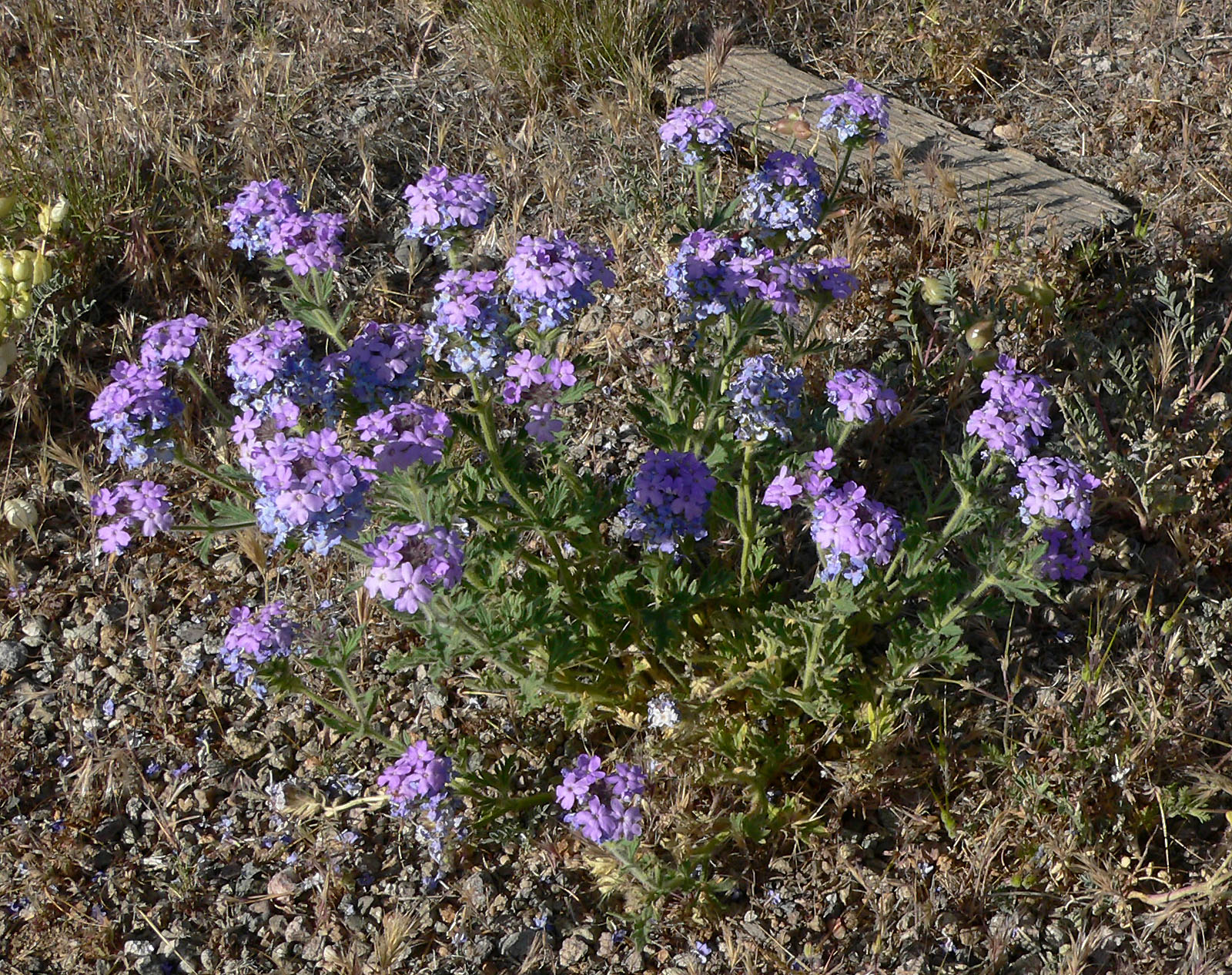
Glandularia gooddingii, commonly called Goodding’s Verbena or southwestern mock vervain, is a low, spreading perennial wildflower of the hot desert Southwest. Named for American botanist Leslie Newton Goodding, who collected extensively in Arizona and the Southwest in the early 1900s, this little plant is one of the most dependable sources of color in a desert garden — a sprawling mound of ferny, gray-green leaves topped for months at a time with rounded clusters of lavender-purple flowers.
Goodding’s verbena grows wild on dry slopes, washes, mesas and roadsides throughout the Sonoran and Mojave deserts, usually below 5,000 feet in elevation, though it climbs higher into pinyon-juniper woodland in parts of its range. It asks for almost nothing once established: full sun, sharp drainage and the kind of neglect that kills thirstier plants. For that reason it has become a staple of low-water landscaping across the desert Southwest, equally at home softening the edge of a gravel path or tumbling over a retaining wall.
Unlike the many garden verbena hybrids sold at nurseries — crosses bred for continuous color that are not native anywhere in North America — Goodding’s verbena is the real, wild desert species, and it supports the bees, butterflies and hummingbirds that evolved alongside it.
Identification
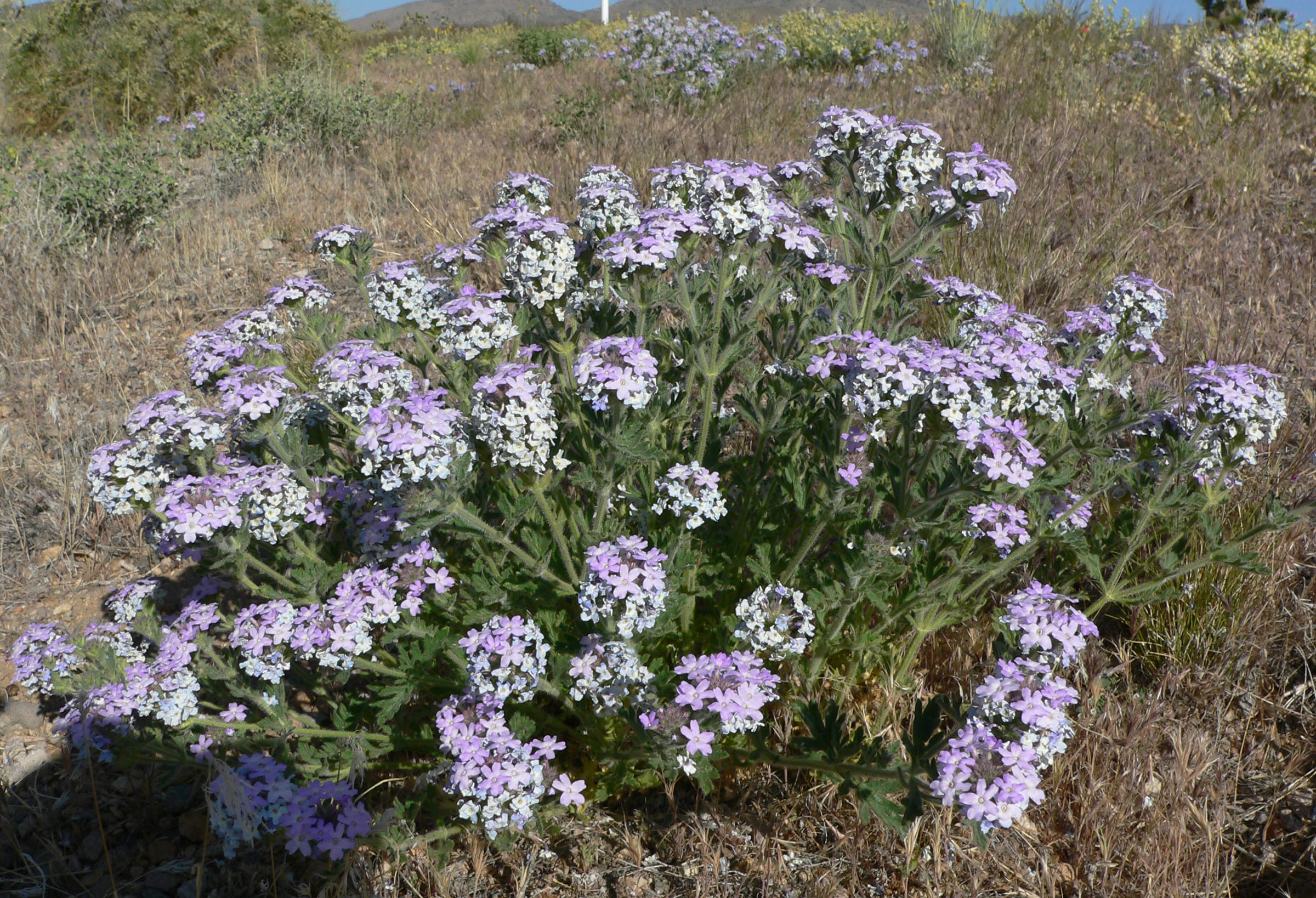
Goodding’s verbena is a herbaceous perennial that forms a loose, spreading mound rather than an upright stem. Established plants typically reach 6 to 12 inches tall and spread 1 to 2 feet across, with stems that sprawl along the ground and root where they touch moist soil, slowly widening the clump.
Leaves & Stems
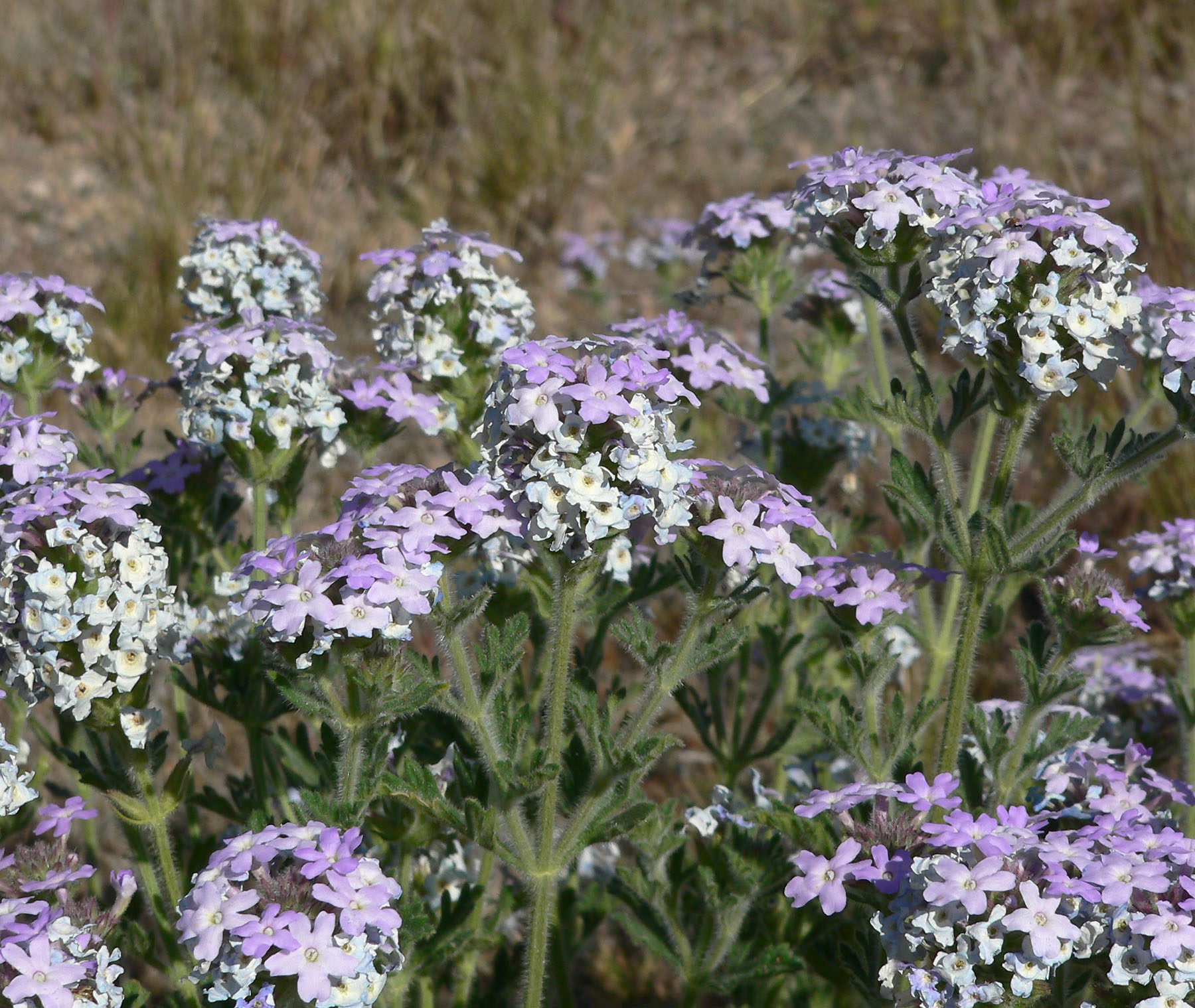
The leaves are opposite, 1 to 2 inches long, and deeply cut into narrow, toothed lobes, giving the foliage a soft, fern-like or parsley-like texture. Leaf color ranges from gray-green to a duller olive, and the whole plant is covered in fine, soft hairs that help it conserve moisture in the desert heat. Stems are slender, sprawling, and often tinged reddish at the base.
Flowers
Flowers are small — about ½ inch across — but are packed into dense, rounded to flat-topped clusters (umbel-like cymes) held just above the foliage on short stalks. Each tubular flower flares into five notched lobes, usually a soft lavender to purple-blue, occasionally pale pink, with a small pale throat. A single plant can carry dozens of these clusters at once, and under good conditions it blooms on and off nearly year-round, with peaks in spring and again after summer rains.
Fruit
After flowering, each flower produces a small dry fruit (schizocarp) that splits into four single-seeded segments called nutlets. The fruit is inconspicuous and not ornamentally significant; most gardeners never notice it among the foliage.
Quick Facts
| Scientific Name | Glandularia gooddingii |
| Family | Verbenaceae (Verbena) |
| Plant Type | Herbaceous perennial wildflower / ground cover |
| Mature Height | 6–12 in |
| Mature Spread | 1–2 ft |
| Growth Rate | Fast |
| Sun Exposure | Full Sun |
| Water Needs | Low once established |
| Soil Type | Dry, well-drained; sandy, rocky or gravelly |
| Soil pH | Neutral to alkaline |
| Bloom Time | Spring through fall, heaviest after rain |
| Flower Color | Lavender-purple, occasionally pale pink |
| Fall Color | None notable |
| Fruit | Dry nutlets, inconspicuous |
| Deer Resistant | Yes, generally |
| USDA Hardiness Zones | 8–11 |
Native Range
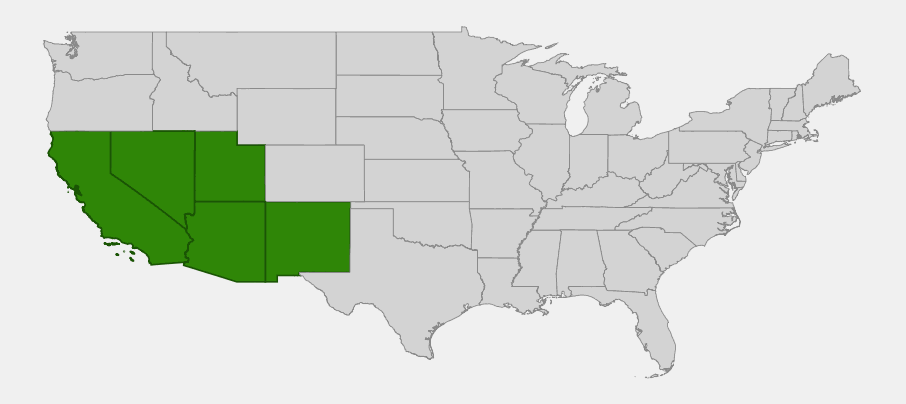
Goodding’s verbena is native to the hot deserts of the American Southwest, with county-verified populations in Arizona, California, New Mexico, Nevada and Utah. It is most common and widespread in Arizona, especially in the Sonoran Desert around Phoenix and Tucson, and ranges into the Mojave Desert of southern Nevada and southeastern California, the canyon country of southern Utah, and the deserts and grasslands of New Mexico. Its range continues south into northern Mexico. It is not native farther east in Texas, Oklahoma or Colorado, where it is sometimes planted but does not occur as a wild population.
Typical habitat includes dry rocky or gravelly slopes, washes, mesas, roadsides and disturbed ground in desert scrub, creosote bush flats and pinyon-juniper woodland, generally below 5,000 feet (and up to about 6,400 feet in parts of California). It thrives in open, sun-baked sites with minimal competition and tolerates the thin, mineral soils typical of the desert Southwest.
📋 Regional plant lists featuring Goodding’s Verbena: Arizona & New Mexico · Utah & Western Colorado
Growing & Care Guide
Goodding’s verbena is one of the easiest native wildflowers to grow in a hot, dry garden. It wants exactly what the desert gives it: intense sun, sharp drainage and a light hand with water.
Light
Give it full sun. This is a desert plant through and through, and it flowers most heavily and stays most compact where it gets direct sun for most of the day. In partial shade it grows leggier, flowers less, and is more prone to rot in damp soil.
Soil & Water
Plant it in fast-draining soil — sandy, gravelly or rocky ground mimics its native washes and slopes. Heavy clay or any soil that stays wet is its main enemy; soggy roots quickly lead to crown rot. Water regularly to establish a young plant through its first spring and summer, then back off sharply. Established plants are quite drought tolerant and often need no supplemental water beyond occasional deep soaking during the hottest, driest stretches of summer. Overwatering shortens the life of the plant far more often than underwatering does.
Planting Tips
Set out nursery plants in fall or early spring so roots can establish before the heat of summer. Space plants 12 to 18 inches apart to let the spreading mounds knit together as a ground cover, or use single plants as filler among rocks, along a dry streambed, or spilling over a wall. Good drainage at planting time matters more than soil fertility — amend heavy soil with coarse sand or decomposed granite rather than rich compost.
Pruning & Maintenance
Goodding’s verbena is short-lived as perennials go, often fading after 3 to 5 years, but it reseeds readily where conditions suit it, so a planting tends to renew itself. Shear plants back by about a third after the main spring flush to tidy the mound and encourage a fresh round of bloom. Established plants need little fertilizer; a light topdressing of compost in fall is usually enough.
Landscape Uses
- Low-water ground cover for rock gardens, gravel beds and xeriscapes
- Pollinator gardens, paired with other low desert wildflowers
- Edging along paths, driveways and retaining walls, where it can spill over
- Erosion control on dry, sunny slopes
- Container plantings on sunny patios, if drainage holes are generous
- Desert restoration plantings alongside creosote bush and brittlebush
Wildlife & Ecological Value
Despite its small size, Goodding’s verbena is a reliable nectar source in a landscape where blooms can be scarce for months at a stretch.
For Pollinators
The flower clusters attract a wide range of native bees, honeybees, and butterflies, including swallowtails and skippers, which visit for nectar throughout the long bloom season. The tubular flower shape and bright color also draw hummingbirds, especially during spring and late-summer bloom flushes after rain.
For Birds & Small Wildlife
Seed-eating birds take some of the small nutlets, and the dense, sprawling foliage gives small lizards and insects a bit of cover and shade close to the ground, which matters in open desert terrain with little other low vegetation.
Ecosystem Role
As a fast-establishing, early-blooming perennial, Goodding’s verbena helps stabilize disturbed desert soils and fills gaps between larger shrubs with living ground cover. Because it flowers nearly year-round whenever moisture allows, it functions as a dependable nectar bridge between the larger pulses of bloom from shrubs like brittlebush and penstemons.
Cultural & Historical Uses
Goodding’s verbena carries the name of Leslie Newton Goodding (1880–1967), a botanist who collected extensively across Arizona and the Southwest in the early twentieth century and who has several other desert plants named in his honor, including Goodding’s willow (Salix gooddingii). There is no significant documented history of food, medicinal or ceremonial use of this species by Indigenous peoples of the region; its historical value has been mainly as a conspicuous, easily recognized wildflower of the desert floor rather than a utilitarian plant.
In more recent decades, Goodding’s verbena has become a mainstay of low-water, native landscaping in Arizona and the surrounding desert states, prized by xeriscape and pollinator-garden designers for its long bloom season and minimal care requirements.
Frequently Asked Questions
Is Goodding’s verbena the same as the verbena sold as a bedding plant?
No. Most verbena sold in garden centers as colorful bedding plants are hybrid cultivars (often listed simply as Verbena or Glandularia hybrids) bred for continuous bloom and not native to North America. Goodding’s verbena is a true wild desert species, better adapted to low water and heat, though it has a shorter individual lifespan.
How long does Goodding’s verbena live?
Individual plants are relatively short-lived, often 3 to 5 years, but the species reseeds readily in suitable conditions, so an established planting tends to persist and refresh itself over time.
Does Goodding’s verbena need a lot of water?
No. Once established, it is quite drought tolerant and is better harmed by overwatering than underwatering. Regular water is only needed during the first year while roots establish.
Will Goodding’s verbena spread aggressively?
It spreads by reseeding and by stems rooting where they touch soil, but it is not considered invasive or aggressive outside of its native range; it simply fills in open, sunny ground within its desert habitat.
Can Goodding’s verbena grow outside the desert Southwest?
It can be grown as an annual or short-lived perennial in other warm, dry climates, but it is not native outside Arizona, California, Nevada, New Mexico and Utah, and it performs best where summers are hot and dry and winters stay mild.

Looking for a nursery that carries Goodding’s Verbena?
Browse our native plant nursery directory: Arizona · California · Nevada & New Mexico · Utah