
Greater Fringed Gentian (Gentianopsis crinita)
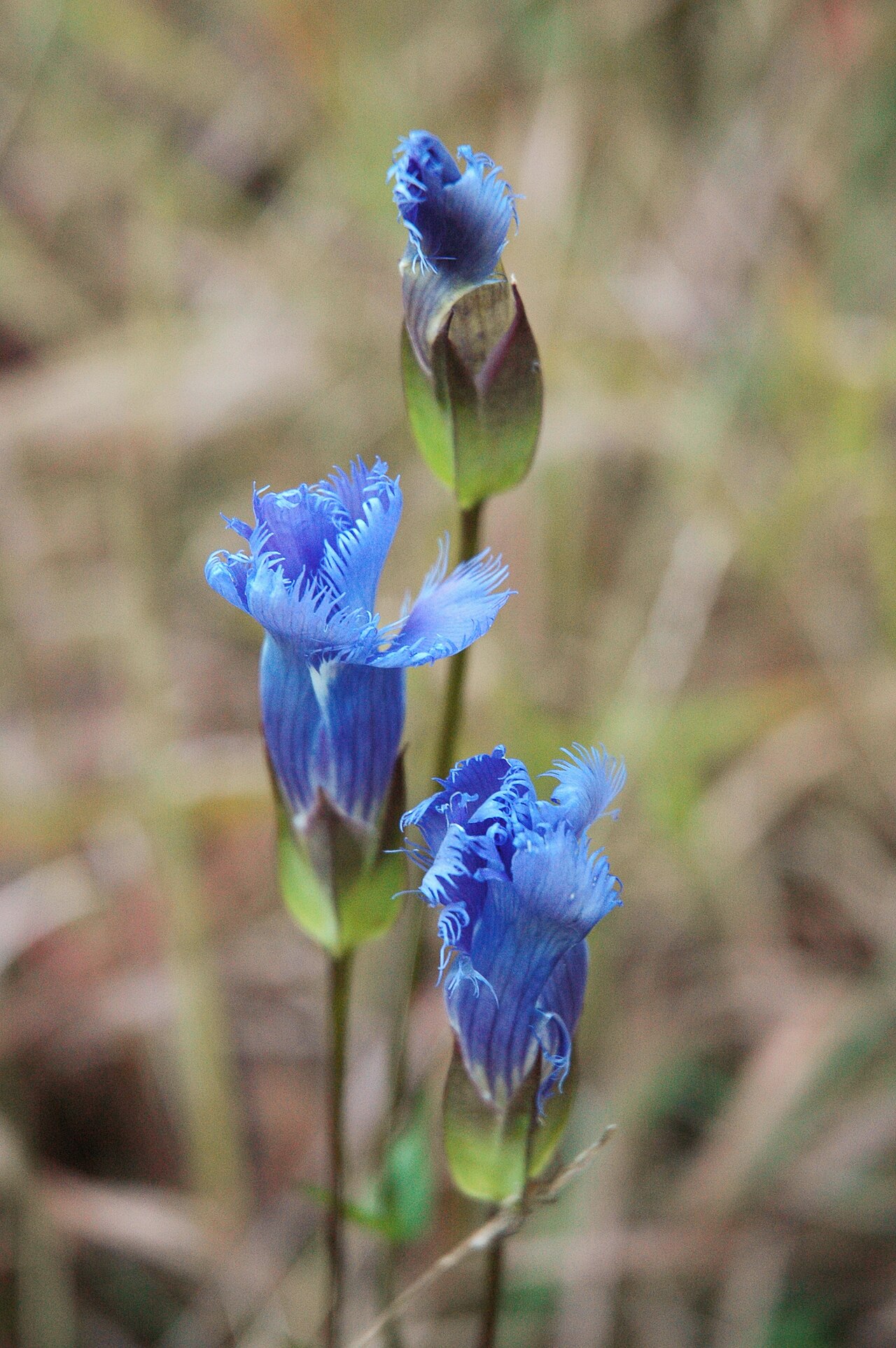
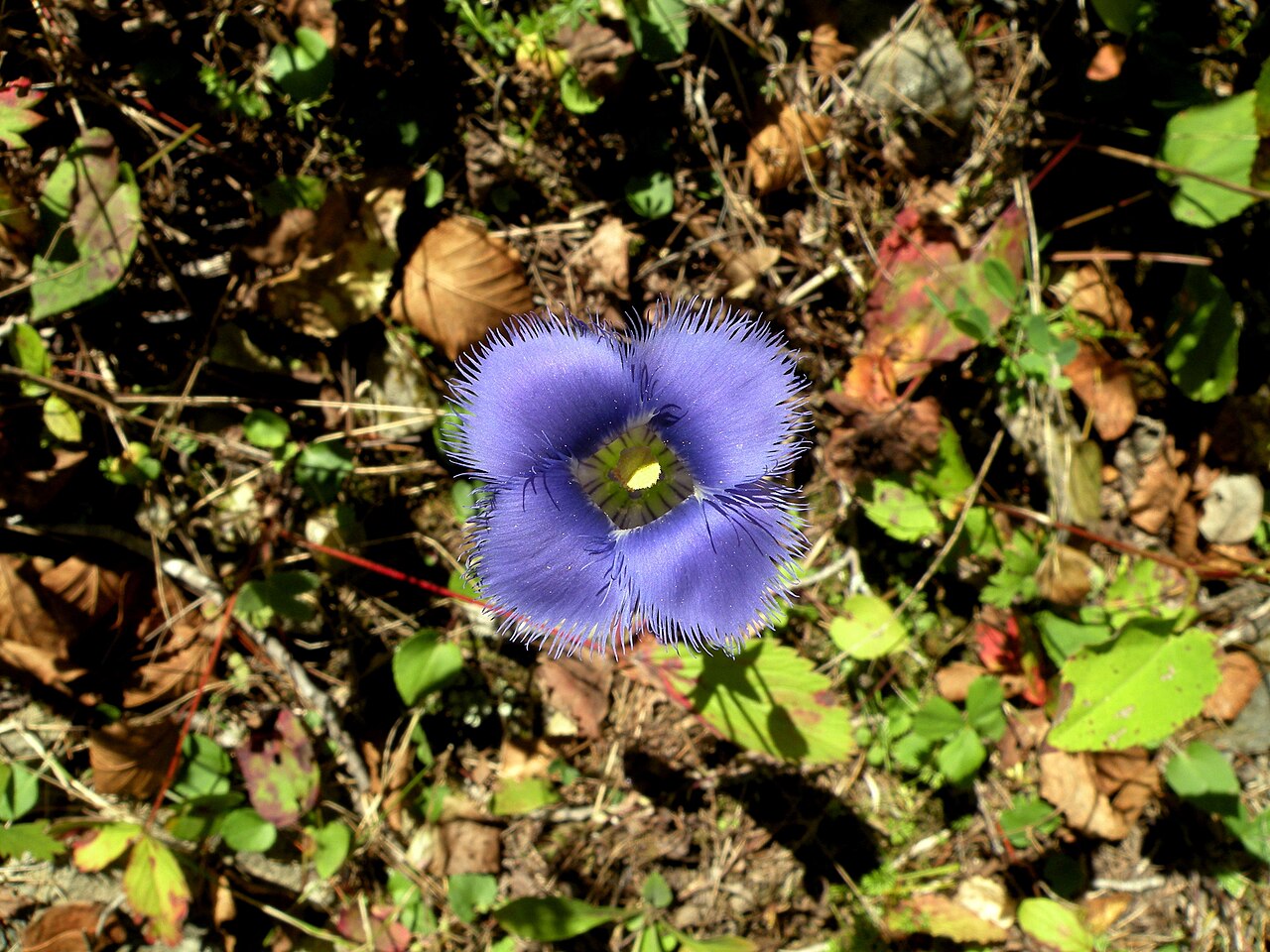
Gentianopsis crinita, known as Greater Fringed Gentian, is a native annual or biennial wildflower of moist meadows, fens and seepy openings in the northeastern and north-central United States and adjacent Canada. It belongs to the gentian family (Gentianaceae) and was long known as Gentiana crinita. In late summer and fall it bears some of the most striking blue flowers in North America: vase-shaped blossoms 1 1/2 to 2 1/2 inches long, each with four broad petals finely fringed along their edges.
The flowers open only in sunshine, spreading their petals into a fringed, four-pointed cross, and twist shut at night and on cloudy days. Plants usually grow 1 to 3 feet tall on slender, branched stems, each branch tipped by a single flower. Because the plant lives only one or two years and depends on seed every year, its numbers can rise and fall sharply from one season to the next.
Greater fringed gentian is uncommon or rare in parts of its range, and its moist, open habitats are easily lost to drainage, development and shrub growth. It is hard to establish in gardens. The best approach is to protect the meadows and fens where it grows, and to grow it only from responsibly collected or purchased seed, never by digging wild plants.
Identification
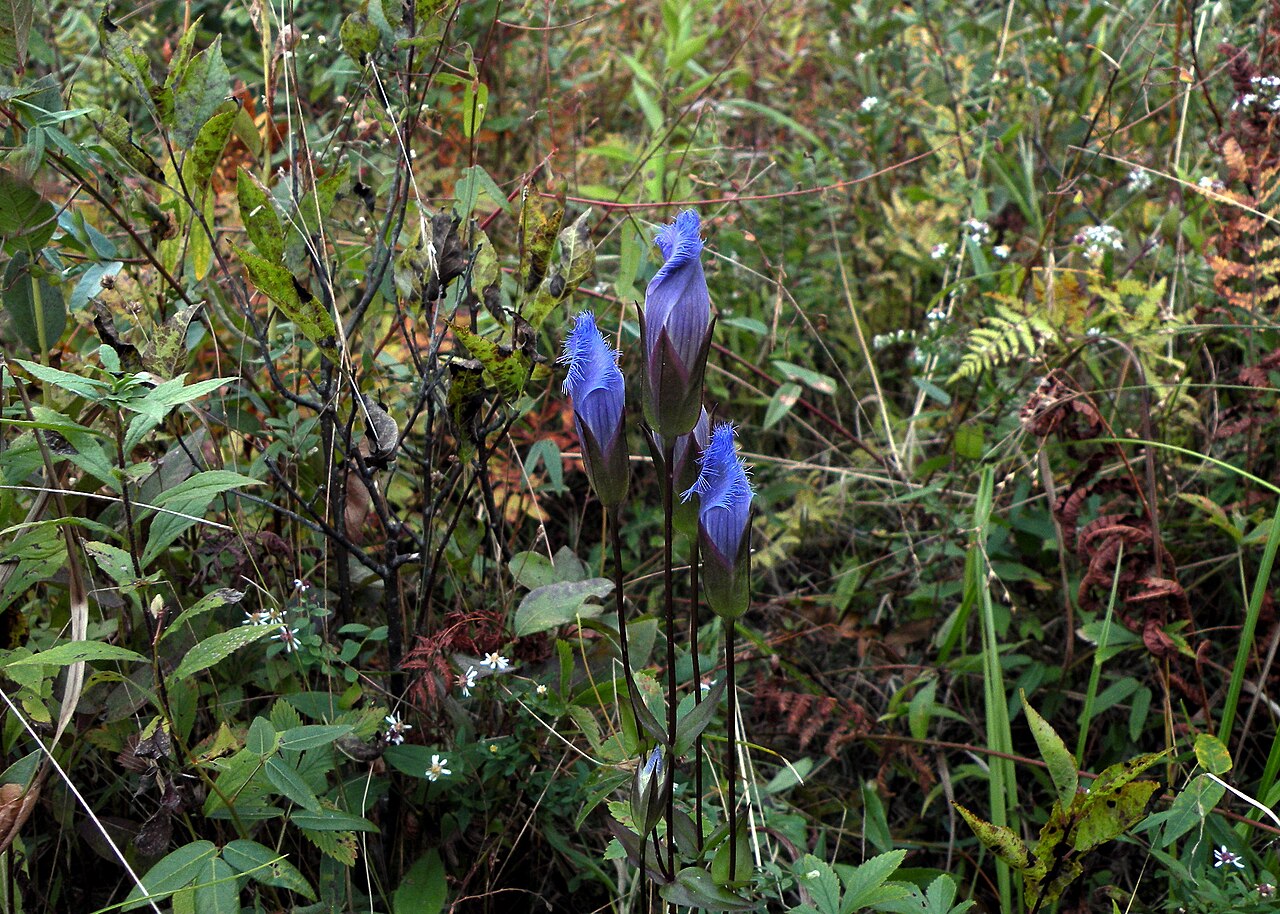
In fall, look for slender plants topped with single, upright, deep blue to violet-blue flowers whose four petals are fringed at the edges. No other plant in its range has such large, fringed blue flowers.
Growth Habit
An annual or biennial. In the first year many plants form only a small rosette of leaves; in the second year they send up an erect, often freely branched stem 1 to 3 feet tall (sometimes shorter in poor sites). Vigorous plants can carry a dozen or more flowers at once.
Leaves
The leaves are opposite, stalkless and often clasp the stem. They are lance-shaped to egg-shaped, about 1 to 2 inches long, with pointed tips and smooth edges, and are usually rounded or slightly heart-shaped at the base.
Flowers
Flowers are borne singly at the ends of long stalks from late August into October. The corolla is a tube 1 1/2 to 2 1/2 inches long that opens into four rounded, spreading lobes, each edged with a fine fringe along the sides and the rounded tip. The color is a vivid sky blue to violet-blue; white-flowered plants are rare. A green, four-lobed calyx with two longer and two shorter lobes surrounds the base of the tube. The flowers open in bright sun and close in dim light.
Fruit & Seeds
After flowering, a narrow capsule develops inside the withered corolla. It splits open to release very large numbers of tiny, dust-like seeds that are scattered by wind and water.
Look-alikes
Lesser fringed gentian (Gentianopsis virgata, also called G. procera) is a smaller plant with narrow, linear leaves and less fringed petals, found mostly in calcareous fens and wet prairies. Bottle gentian (Gentiana andrewsii) is a perennial with clusters of closed, bottle-shaped flowers that never open. Neither has the long, open, fringed petals of greater fringed gentian.
Quick Facts
| Scientific Name | Gentianopsis crinita |
| Family | Gentianaceae (gentian family) |
| Plant Type | Annual or biennial wildflower |
| Mature Height | 1–3 ft |
| Mature Spread | 6–12 in |
| Growth Rate | Fast (one to two years to flower) |
| Sun Exposure | Full sun to light shade |
| Water Needs | Medium to high; moist soil |
| Soil Type | Moist loam, sand or peat; often calcareous |
| Soil pH | Slightly acidic to alkaline (about 6.0–8.0) |
| Bloom Time | Late August–October |
| Flower Color | Bright blue to violet-blue; rarely white |
| Fall Color | None notable |
| Fruit | Narrow capsule with many tiny seeds |
| Deer Resistant | Moderate; occasionally browsed |
| USDA Hardiness Zones | 3–7 |
Native Range
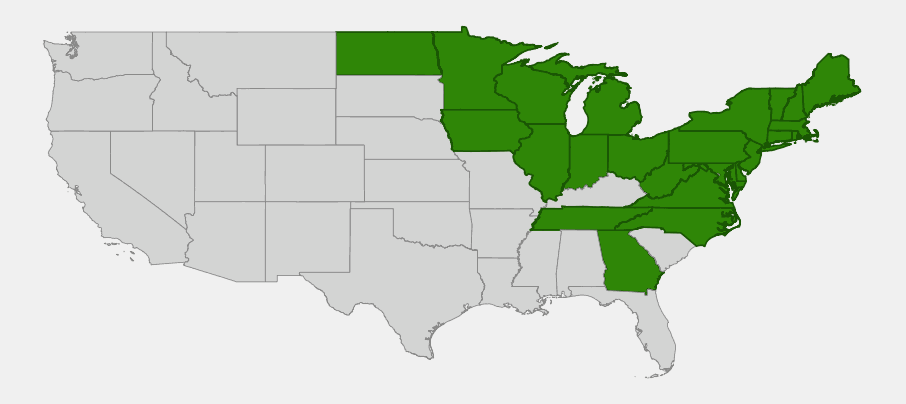
Greater fringed gentian is native to eastern North America. USDA PLANTS records it as native in 24 states, from Maine south to Maryland and Delaware, west through the Great Lakes states to Minnesota, Iowa and North Dakota, and south along the Appalachian Mountains to Virginia, West Virginia, North Carolina, Tennessee and northern Georgia. In Canada it grows in southern Manitoba, Ontario and Quebec.
It is most frequent in New England, New York, Pennsylvania and the Great Lakes region. In the southern Appalachians it is scattered and uncommon, growing in mountain meadows, seeps and bogs, and in Georgia it reaches its southern limit in the mountains of the north. At the western edge of its range in Minnesota, Iowa and eastern North Dakota it grows in wet prairies and fens.
Typical habitats are moist meadows, wet prairies, fens, seepage slopes, stream banks, lakeshores, open wet woods and damp, sunny roadsides and ditches. It favors places with little competition from tall plants and is often found on calcareous (limy) soils, though not always. Because it needs open ground, it often appears on moist sites recently disturbed by mowing, grazing or fire.
📋 Regional plant lists featuring Greater Fringed Gentian: New York, Pennsylvania & Northern New Jersey · Ohio & Indiana · Michigan, Wisconsin & Eastern Minnesota · Kentucky & Tennessee · Connecticut, Massachusetts & Rhode Island · New Hampshire, Maine & Vermont · Maryland, Virginia & West Virginia · Delaware, Southern New Jersey & Long Island · Illinois, Iowa & Missouri · Alabama, Georgia & Mississippi · North & South Carolina · North Dakota, South Dakota & Western Minnesota
Growing & Care Guide
Greater fringed gentian is famously difficult to keep in a garden. As an annual or biennial it must reseed every year, and its tiny seedlings need moist, open, sunny soil without competition. Gardeners who succeed usually have a naturally damp meadow or the edge of a pond or fen, and they sow seed year after year. Use purchased or responsibly collected seed only, and never dig plants from the wild; they rarely survive transplanting.
Light
Full sun to light shade. The flowers open only in bright light, so a sunny spot gives the best display. Too much shade from taller plants weakens the plants and prevents seedlings from establishing.
Soil & Water
Grow it in consistently moist to wet, but not flooded, soil: sandy or peaty loam is ideal, and many populations grow on neutral to limy soils. It will not tolerate drought, especially as a seedling, so keep the soil damp through the first summer.
Planting Tips
Sow the dust-like seed in fall or early winter directly on the surface of moist, bare soil or short vegetation and press it in lightly; do not cover it, because the seed needs light to germinate. Winter cold helps break dormancy. Seedlings are tiny and easily lost, so mark the area and keep it weeded. Expect flowers in the second fall.
Pruning & Maintenance
Do not cut the plants until the capsules have opened and released their seed in late fall. Keep the area open by mowing or hand-cutting surrounding vegetation in late fall or early spring, after seed has fallen. Light disturbance that exposes a little bare soil helps new seedlings.
Propagation
Only by seed. Collect ripe capsules in late fall when they begin to split and scatter the seed at once on suitable moist ground. Because each plant dies after flowering, a colony survives only if seed is produced and finds open soil every year.
Landscape Uses
- Wet meadows: fall color in damp, sunny meadows and prairie plantings
- Pond and fen edges: naturalizes on moist, open shores with low competition
- Rain gardens: for the moist, sunny margins of larger rain gardens
- Pollinator gardens: late-season flowers for bumblebees
- Habitat restoration: a showy target species for fen and wet prairie restorations
Wildlife & Ecological Value
Greater fringed gentian flowers when little else is blooming in wet meadows, and it is a valued late-season resource for bees.
For Pollinators
Bumblebees are the main pollinators. They are strong enough to push into the deep corolla tube to reach the nectar, and they often crawl right inside the flower. Because the flowers close in poor weather, visiting bees sometimes shelter inside them.
For Birds
The tiny seeds are of little food value to birds, but the moist, open meadows where it grows are used by sparrows, wrens and other birds for nesting and feeding.
For Mammals
Deer and rabbits sometimes eat the stems and flower buds. The plant is not known as an important food for other mammals.
Ecosystem Role
As a short-lived plant that needs open, moist ground, it is an indicator of healthy, open wetland meadows and fens. Its presence often signals a site with other uncommon wetland plants. It declines where meadows grow up into shrubs or are drained.
Cultural & Historical Uses
The fringed gentian is one of the most celebrated wildflowers in American poetry. William Cullen Bryant’s poem “To the Fringed Gentian” (1829) praises its “sweet and quiet eye” of heaven’s blue that waits until “woods are bare and birds are flown,” and Emily Dickinson also wrote of the gentian weaving her fringes as summer ends.
The genus name Gentianopsis means “resembling Gentiana,” the genus where this plant was placed for many years; the species name crinita is Latin for “long-haired,” referring to the fringed petals. The name Gentiana honors Gentius, an ancient king of Illyria who was said to have discovered the medicinal value of gentians.
Because it is beautiful, uncommon and difficult to transplant, greater fringed gentian has long been a symbol of wildflower conservation. It disappears where people pick or dig it or where wet meadows are drained, and several states now track it as a rare plant.
Frequently Asked Questions
Is greater fringed gentian a perennial?
No. It is an annual or biennial. Plants flower once, set seed and die, so colonies persist only through seed each year.
Why are the flowers closed?
The flowers open only in sunshine and close at night and on cloudy or rainy days. Visit on a bright, sunny fall afternoon to see them fully open.
Can I transplant fringed gentian from the wild?
No. It does not survive transplanting well, it is uncommon in many areas, and digging it harms wild populations. Grow it from purchased or responsibly collected seed instead.
When does greater fringed gentian bloom?
From late August into October, often after the first light frosts, making it one of the last wildflowers of the season.
How is it different from bottle gentian?
Bottle gentian is a perennial with clusters of closed, bottle-shaped flowers. Greater fringed gentian has single, open flowers with four fringed petals on long stalks.

Looking for a nursery that carries Greater Fringed Gentian?
Browse our native plant nursery directory: Connecticut, Delaware & Georgia · Illinois, Indiana & Iowa · Maine, Maryland, Massachusetts, Michigan & Minnesota · New Hampshire, New Jersey, New York, North Carolina, North Dakota & Ohio · Pennsylvania, Rhode Island, Tennessee, Vermont & Virginia · West Virginia & Wisconsin

